

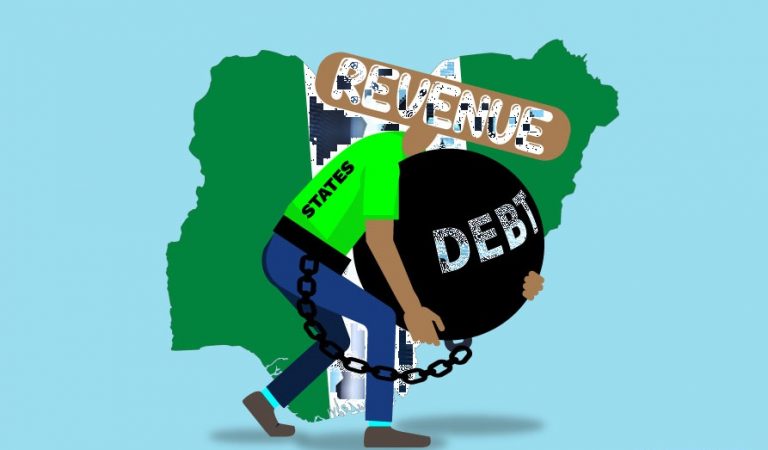
Nigeria’s federal government spent N7.7 trillion on debt interest payments in the first half of 2026, exceeding the N6.2 trillion it generated in revenue during the period and highlighting how rising borrowing costs continue to constrain public spending despite stronger government receipts.
The figures, reported by the World Bank in its 2026 Nigeria Development Update (NDU), titled Beyond the Federal Purse: How Higher Revenues Reshaped State Priorities, expose a persistent imbalance in the country’s public finances: revenue is improving, but debt-servicing obligations are absorbing more than the government collects, leaving limited room to finance infrastructure and other public services without additional borrowing.
Interest payments climbed from N5.6 trillion in the first half of 2025 to N7.7 trillion in the corresponding period of 2026. As a share of gross domestic product (GDP), they increased from 2.5% to 3.1%, reflecting the burden of high domestic borrowing costs.
Register for the next Tekedia Mini-MBA.
Register for Tekedia AI in Business Masterclass.
Join Tekedia Capital Syndicate and co-invest in great global startups.
Federal government revenue, meanwhile, rose to N6.2 trillion, equivalent to 2.5% of GDP, from N3.6 trillion, or 1.6% of GDP, a year earlier. Although the increase represents a substantial improvement in revenue mobilization, it was insufficient to cover interest obligations, leaving a N1.5 trillion gap between revenue and debt-interest payments alone.
The figures underscore the limits of measuring fiscal progress solely by revenue growth. Nigeria is collecting more money, but the cost of servicing its debt is rising faster than the government’s capacity to finance its obligations from internally generated receipts.
According to the World Bank, the revenue improvement was supported by a recovery in oil receipts, stronger corporate tax collections and higher independent revenues. Customs revenue remained stable, while value-added tax (VAT) collections were comparatively flat.

“Federal revenues rose to about 2.5 percent of GDP (N6.2 trillion), from 1.6 percent of GDP (N3.6 trillion) a year earlier, supported by a recovery in oil receipts, stronger corporate tax collections, and higher independent revenues, while customs revenues held stable and VAT collections stayed comparatively flat,” the bank said.
The composition of revenue growth matters because some of the improvement came from oil receipts, which remain exposed to fluctuations in production, prices and other sector-specific conditions. Stronger corporate tax collections and independent revenues also helped, but the figures do not establish whether the gains are sufficient to support a durable expansion of the government’s revenue base.
The immediate fiscal problem is clearer: higher collections have not translated into enough additional spending capacity to reduce the government’s dependence on borrowing.

Debt Servicing Crowds Out Capital Expenditure
The pressure is evident in the government’s spending pattern. Total federal expenditure reached N16.1 trillion in the first half of 2026, up from N14.6 trillion a year earlier. However, expenditure declined slightly as a share of GDP, from 6.6% to 6.5%, according to the World Bank.
More consequentially, the composition of spending shifted towards debt servicing and away from capital investment.
Reported capital expenditure fell to N700 billion, equivalent to 0.3% of GDP, from ?1 trillion, or 1% of GDP, in the first half of 2025. The decline raises questions about the government’s capacity to sustain infrastructure investment while meeting rising financial obligations.
Capital spending finances projects such as roads, transport infrastructure, public facilities and other assets that can support productivity over time. When investment is compressed to accommodate debt servicing, the government may struggle to address infrastructure deficits that raise operating costs for businesses and households.
Personnel expenditure, by contrast, increased to N4.2 trillion from N3.7 trillion following wage adjustments. However, personnel costs remained unchanged at 1.7% of GDP, suggesting that the increase broadly tracked the expansion in the nominal size of the economy rather than rising as a share of GDP.
The World Bank reported that other expenditure remained at 1.3% of GDP. Taken together, the figures show how debt interest is consuming a growing portion of the federal budget while capital expenditure has contracted sharply.
The fiscal arithmetic is particularly challenging. Of the N16.1 trillion spent during the period, N7.7 trillion went to interest payments, leaving N8.4 trillion for all other expenditure. Capital spending accounted for just N700 billion of that remainder, with the balance covering personnel costs and other recurrent obligations.
Financial analyst Abdulrauf Aremu Bello argued that the figures illustrate why stronger revenue has not removed the government’s need to borrow.
“If I wanted to be ‘mischievous’, I’d have said N7.7trn was borrowed to pay salaries (which is not false, by the way). But I won’t do that. That’s not my objective,” Bello said.
His broader argument centers on the difficulty of escaping a cycle in which the government raises additional revenue but must devote much of its fiscal capacity to existing debt obligations and recurrent expenditure. As a result, new borrowing can remain necessary even when collections improve.
However, the available figures do not establish that every naira borrowed during the period was used to pay salaries or recurrent expenditure. They show that interest payments exceeded federal revenue and that capital spending declined, illustrating the overall budget constraint rather than tracing individual borrowed funds to specific uses.
Bello described the situation as the government fetching water into a “basket”, arguing that efforts to improve public finances continue to be undermined by the legacy of previous borrowing.
“And from the looks of things, this may be the best the FG can do. But the jury is out,” he added.
Overall, Nigeria’s fiscal challenge is not simply that revenue remains low. It is that the government’s existing obligations consume a substantial share of the resources it raises, limiting the amount available for new investment and essential public services.