

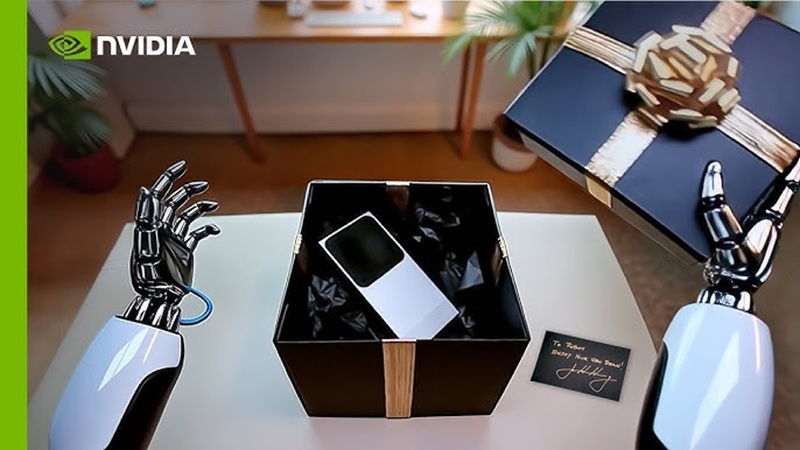
Nvidia has officially put a price tag on its latest gamble in robotics: $3,499 for the new Jetson AGX Thor developer kit. Dubbed by the company as a “robot brain,” the module is now available for pre-order, with shipments slated for next month.
But beyond the sleek branding and early partnerships, the launch underscores Nvidia’s wider strategy to dominate the computing layer of next-generation robotics — positioning itself as the infrastructure backbone, not the maker of machines.
For companies that move from prototyping to commercial deployment, Nvidia will sell Thor T5000 modules at $2,999 apiece, with discounts kicking in for bulk orders above 1,000 units. That pricing reflects Nvidia’s calculated move to make the upfront cost attractive enough to lure startups and research labs while ensuring scalability for industrial production.
Register for Tekedia Mini-MBA edition 20 (June 8 – Sept 5, 2026).
Register for Tekedia AI in Business Masterclass.
Join Tekedia Capital Syndicate and co-invest in great global startups.
Register for Tekedia AI Lab.
Jensen Huang, Nvidia’s CEO, has repeatedly flagged robotics as the company’s most promising growth engine outside artificial intelligence. In the past two years alone, AI demand has tripled Nvidia’s overall sales, cementing its position as the world’s most valuable chipmaker. Robotics, though still small — just 1% of Nvidia’s revenue — is now seen as the next logical frontier.
Deepu Talla, Nvidia’s vice president of robotics and edge AI, framed it bluntly: “We do not build robots, we do not build cars, but we enable the whole industry with our infrastructure computers and the associated software.”
In other words, Nvidia isn’t chasing Tesla’s humanoid robot dream or Boston Dynamics’ acrobatics. It’s selling the “brains” to anyone willing to build the bodies.

Technically, the Jetson Thor is a leap. Built on Nvidia’s Blackwell GPU architecture — the same backbone behind its data-center AI chips and gaming processors — the module is 7.5 times faster than its predecessor. With 128GB of memory, it’s capable of running generative AI, large language models, and advanced vision systems, all critical for humanoid robots and autonomous systems that must interpret and react to the world in real time.
That matters for customers like Amazon, Meta, Agility Robotics, and Boston Dynamics, all of whom Nvidia says are testing or deploying Jetson-based solutions. Nvidia has even invested directly in robotics startups such as Field AI, signaling that it wants a financial stake in the ecosystem its chips are powering.
The company’s restructuring also highlights the bet. By merging its automotive and robotics units into a single reporting line, Nvidia is effectively grouping all edge AI and real-world machine intelligence under one growth banner. That unit booked $567 million in revenue in May, up 72% year-on-year, proof that momentum is building even from a small base.

However, Nvidia faces a paradox. Robotics is a long-tail market — fragmented, capital-intensive, and prone to hype cycles. The sector has produced more spectacular demos than sustainable revenue streams, and while Nvidia’s Jetson chips are powering impressive prototypes, few have reached meaningful commercial scale. Investors will be watching whether Jetson Thor can push robotics beyond pilot programs and into mass deployment, the same way Nvidia’s H100 GPUs turned generative AI from research labs into a trillion-dollar business.
There’s also a geopolitical angle. Nvidia said the Jetson Thor can be used for self-driving cars, particularly from Chinese automakers. That matters because U.S. export restrictions have already squeezed Nvidia’s AI chip sales to China. Positioning robotics and automotive AI as less politically sensitive export categories may offer Nvidia an escape valve — even if Washington later revisits the rules.
The Thor launch ultimately distills Nvidia’s broader playbook: dominate the computational core of every emerging machine intelligence industry, whether it’s data centers, cars, or humanoid robots. The chips themselves may only account for 1% of revenue today, but as history with gaming GPUs and AI accelerators shows, Nvidia has a knack for turning small bets into category-defining monopolies.
The question is whether robotics will follow the same trajectory.