

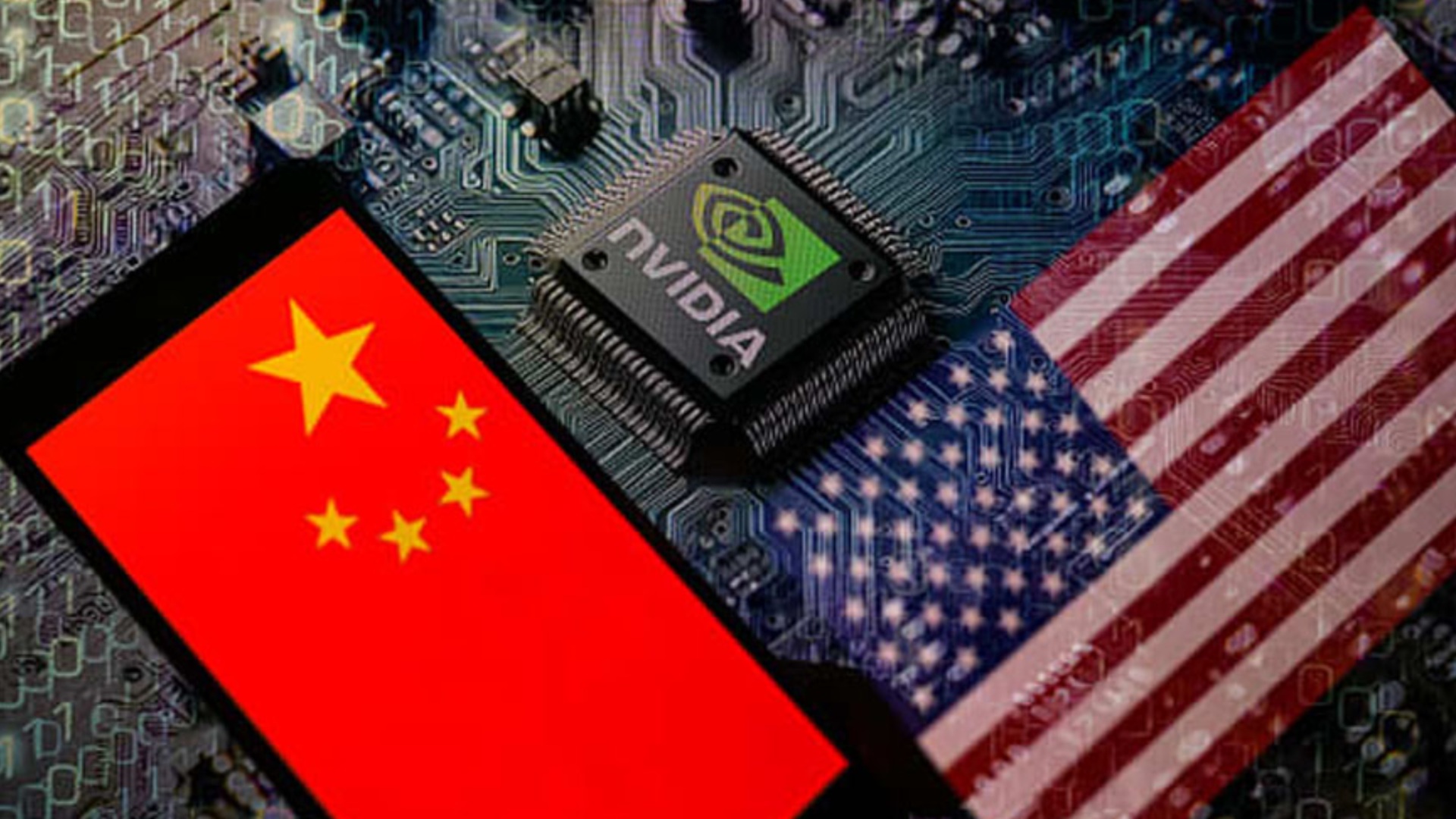
Nvidia Chief Executive Jensen Huang has ruled out any immediate possibility of selling the company’s flagship Blackwell AI chips to China, saying there are “no active discussions” to ease U.S. export restrictions.
His remarks highlight how Washington’s tightening curbs on advanced chip sales have upended one of Nvidia’s most lucrative markets, deepening the fracture between the world’s two largest economies over control of artificial intelligence and semiconductor technology.
Speaking on Friday in Tainan, Taiwan, where he was attending chipmaking partner TSMC’s sports day, Huang said there was no change in Nvidia’s position despite speculation that a diplomatic breakthrough between President Donald Trump and President Xi Jinping could result in a limited deal allowing toned-down versions of the Blackwell chips to enter China.
Register for Tekedia Mini-MBA edition 20 (June 8 – Sept 5, 2026).
Register for Tekedia AI in Business Masterclass.
Join Tekedia Capital Syndicate and co-invest in great global startups.
Register for Tekedia AI Lab.
“Currently, we are not planning to ship anything to China,” Huang said. “It’s up to China when they would like Nvidia products to go back to serve the Chinese market. I look forward to them changing their policy.”
The Blackwell series, Nvidia’s latest and most advanced line of AI chips, powers large-scale machine learning models and data centers that drive everything from generative AI to robotics and cloud computing. But the technology has been at the center of Washington’s campaign to curb China’s access to cutting-edge semiconductors that could be repurposed for military or surveillance use.
Under a string of export control measures first introduced in 2022 and expanded in 2023, the U.S. Commerce Department banned Nvidia and other chipmakers from selling their highest-end GPUs — including the A100, H100, and now Blackwell — to Chinese firms. The restrictions have forced Nvidia to develop lower-spec alternatives like the H20 chip, which comply with export limits but fall short of the performance Chinese companies seek for large-scale AI training.

Huang acknowledged the consequences of the faceoff, saying, “Our market share in China for advanced AI chips is zero.” He said the U.S. government’s limited exemptions have done little to change the reality on the ground, as Chinese firms are now pouring resources into domestic chip development to reduce dependence on American suppliers.
The policy shift has cost Nvidia billions in potential revenue. Before the export bans, China accounted for roughly one-fifth of Nvidia’s total sales, with its GPUs powering data centers for Chinese tech giants like Alibaba, Tencent, and Baidu. But those firms are now turning to local alternatives such as Huawei’s Ascend series, which Beijing has heavily subsidized as part of its broader “self-reliance” drive in semiconductor technology.
Analysts say the outcome reflects a broader tech and trade standoff between Beijing and Washington that has transformed from a tariff dispute into a race for technological dominance. While tariffs and supply chain realignments defined the early stages of the trade war, the current conflict centers on who controls the infrastructure of the AI age — chips, data, and algorithms.

The Trump administration has positioned chip export bans as a national security imperative, arguing that cutting off access to advanced semiconductors will slow China’s military modernization and surveillance capacity. In response, Beijing has retaliated by restricting exports of critical minerals like gallium and germanium, both essential for chipmaking, and by investing heavily in its domestic semiconductor ecosystem.
Huang, who has visited Taiwan several times this year, reaffirmed Nvidia’s commitment to its manufacturing partnerships despite these tensions.
“Business is very strong,” he said. “So I came back to encourage my TSMC friends.” Nvidia relies on TSMC to produce its most advanced chips, including the Blackwell architecture, using the foundry’s cutting-edge 4-nanometer process technology.
When asked about Tesla CEO Elon Musk’s recent plan to build a semiconductor fabrication plant to support AI growth, Huang noted the formidable barriers to entry.
“Building advanced semiconductor manufacturing capabilities like TSMC does is extremely hard,” he said. “But it’s a very important technology and the demand is extremely high.”
Huang also sought to clarify earlier remarks reported by the Financial Times suggesting he had said China would win the AI race.
“That’s not what I said,” he explained. “What I said was that China has very good AI technology. They have many AI researchers.”
He added that half of the world’s AI researchers are based in China and that some of the most popular open-source AI models originate there.
“They’re moving very, very fast,” he said. “The United States has to continue to move incredibly fast; otherwise, the world is very competitive, so we have to run fast.”