

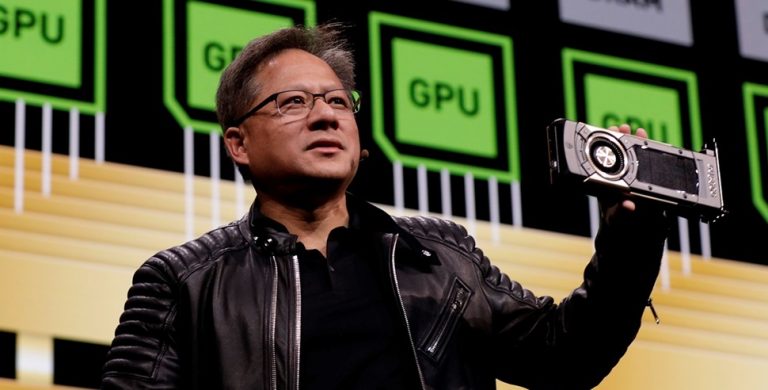
Business and tech leaders have continued to share diverse views about the future of work as AI adoption accelerates. Elon Musk has painted a future where robots do all the work and humans collect free money for doing nothing. Nvidia CEO Jensen Huang, however, thinks that won’t be the case.
Speaking on Fox Business on Thursday, Huang pushed back on the utopian notion that artificial intelligence and robotics will usher in mass leisure. Instead, he argued that humans will likely be busier than ever as AI accelerates productivity and unlocks a flood of new opportunities.
The remarks came during a wide-ranging interview in which Huang discussed U.S. tensions over chip sales to China, Nvidia’s success as a $4 trillion company, and warnings from OpenAI’s Sam Altman about a potential AI bubble. Huang dismissed the bubble fears, insisting that demand for AI infrastructure is only in its early stages.
Register for Tekedia Mini-MBA edition 20 (June 8 – Sept 5, 2026).
Register for Tekedia AI in Business Masterclass.
Join Tekedia Capital Syndicate and co-invest in great global startups.
Register for Tekedia AI Lab.
When asked about Nvidia’s Jetson Thor “robot brain” and the future of robotics, Huang predicted a sweeping transformation.
“Everything that moves will be robotic,” he said. “There will be robotic humanoid robots that are very general-purpose. They’re going to be in hospitals doing robotic surgery. They’re going to be in factories building things. They’re going to be in farms doing agriculture. I mean, it’s just incredible the number of robotic systems.”
According to Huang, every industrial company will eventually rely on robots and AI in its operations, with Nvidia supplying much of the technology to power them. He called it a “really exciting future.”

But pressed on whether such productivity gains could mean shorter workweeks or more free time—ideas long tied to visions of technological utopia and more recently promoted by Musk—Huang suggested the opposite may be true.
“I have to admit that I’m afraid to say that we are going to be busier in the future than now,” Huang said. “And the reason for that is because a lot of different things that take a long time to do are now faster to do. And I’m always waiting for work to get done because I’ve got more ideas. Most countries, most companies have more ideas than we know what to pursue.”
While not ruling out a shift to a four-day workweek, he said the real story will be expanding opportunities.

“The more productive we are, the more opportunity we get to go pursue new ideas,” he explained. “I fully expect GDP to grow. I expect productivity to increase. I actually expect us to have more things to do.”
Still, Huang added, “I’m hopeful for that day too—so that we have four-day work weeks, and so that we could spend more time on the weekends with family and get some reading done, and do some traveling. And nothing is better than that.”
Unlike Musk, whose narrative about “universal basic income” requires political change, Huang focused squarely on the technological and economic implications.
“Life quality will get better, of course, over time,” he said, but added that AI is more likely to transform work than abolish it.
Automation Scares Through History
History offers plenty of echoes. In the 19th century, the mechanization of textile factories triggered widespread unrest across Europe, with the Luddites smashing machines they believed threatened their jobs. In the 20th century, the spread of mainframe computers and later PCs sparked similar fears of mass unemployment. But each wave of automation not only eliminated certain tasks but also created new sectors of work that were unimaginable before.
AI, Huang believes, is following that same arc. While some roles will inevitably shrink, others are already emerging around AI model training, ethics oversight, prompt engineering, and integration into existing industries.
“We came from a world of seven-day work weeks. And now we’re in five-day work weeks. Every industrial revolution leads to some change in social behavior,” Huang said. “Some jobs will go away. Many jobs will be new and invented. But one thing for sure, every job will be changed as a result of AI.”
However, with the growing concern of disruption, analysts warn that, unlike past waves, AI’s ability to scale across white-collar jobs may make the transition more jarring. Generative AI is not just reshaping factories, but also the professions once thought safest—law, medicine, finance, and media—making the stakes higher than in previous technology revolutions.
For Nvidia, which dominates the global market for the chips powering AI systems, Huang’s message is also a reminder of the company’s central role in this transformation. Its hardware has become the backbone of generative AI models like ChatGPT, and its outlook on the workforce debate carries weight not just in Silicon Valley but among policymakers grappling with how to balance innovation with social stability.