

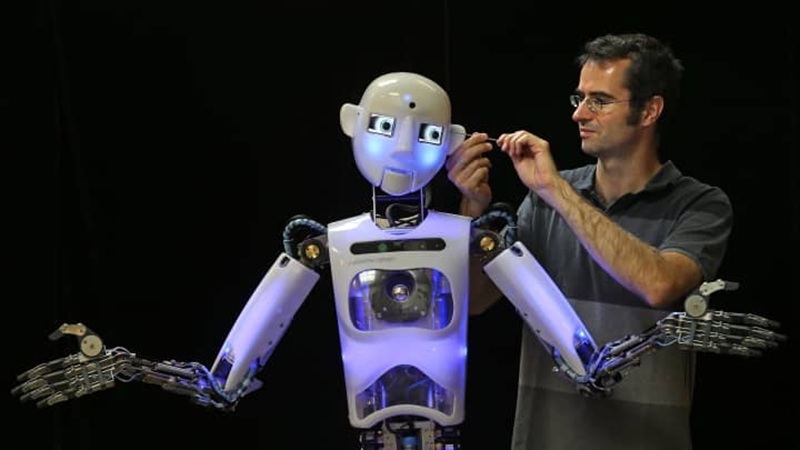
Only about 7,000 humanoid robots were sold worldwide in 2025 for industrial and professional service applications, highlighting the wide gap between the technology’s current commercial footprint and the explosive growth projected for the sector.
The figure, compiled by the International Federation of Robotics (IFR) and reviewed by Reuters ahead of its publication, provides one of the first industry-wide estimates of humanoid robot sales. It comes as manufacturers, technology companies and investors pour billions of dollars into a technology increasingly viewed as a potential extension of the artificial intelligence boom.
China is emerging as a major center of that push. The world’s largest market for industrial robots showcased humanoid machines running and boxing at its robot games last month, underscoring the country’s effort to build a domestic robotics industry around sophisticated AI systems.
Register for the next Tekedia Mini-MBA.
Register for Tekedia AI in Business Masterclass.
Join Tekedia Capital Syndicate and co-invest in great global startups.
Yet the IFR data show that humanoid robots remain a niche market.
The roughly 7,000 units sold last year compare with about 542,000 conventional industrial robots installed globally in 2024. An additional 199,000 service robots were estimated to have been sold that year for applications including transport, hospitality and cleaning.
The IFR’s broader 2025 data for industrial and service robots are due to be published on September 24.

“Humanoids are a fraction of the overall robot population globally,” Susanne Bieller, secretary general of the Frankfurt-based IFR, told Reuters.
The definition itself is relatively demanding. Under the IFR’s criteria, a humanoid robot must have a human-like appearance and be capable of operating autonomously in an environment designed for people. Legs are not required.
That requirement matters because the current humanoid market contains a significant research and development component. Bieller said many of the humanoids sold in 2025 were not being used for productive commercial work. Instead, research institutions and companies bought the machines to collect data and improve AI models.

That means headline sales numbers may overstate the extent to which humanoid robots have already become commercially useful. The industry is still moving from demonstrations and pilot programs toward repeatable deployments that can generate measurable productivity gains.
Automakers are among the earliest industrial adopters, but even their deployments remain small. Carmakers are testing single-digit or, in some cases, double-digit numbers of humanoids inside factories, Bieller said.
The contrast between those limited deployments and the industry’s ambitious forecasts illustrates the scale of the bet being made on physical AI.
Bank of America Global Research estimates that 90,000 humanoid robots will be shipped this year and that annual shipments could reach 1.2 million by 2030. Those projections imply a dramatic acceleration from today’s installed base and would require humanoids to move beyond research facilities and carefully controlled pilots into large-scale industrial operations.
The IFR’s numbers provide a useful baseline for judging those forecasts. Its humanoid data are based on information from suppliers and national industry associations and exclude consumer and military humanoid robots. Medical robots are also classified separately.
The most important question for the industry is therefore not simply how many robots manufacturers can produce, but how quickly businesses can find economically viable uses for them.
Humanoid machines have an obvious potential advantage: they are designed to operate in environments already built around human workers. A robot capable of manipulating tools, navigating factories and performing repetitive tasks could potentially be introduced without requiring companies to redesign entire production lines.
But that proposition has yet to translate into mass deployment. The current reliance on pilots and research purchases suggests companies are still testing whether humanoids can operate reliably enough, cheaply enough, and for long enough to justify replacing or supplementing existing automation.
The economics could also become more complicated as manufacturers scale production. Falling hardware costs could accelerate adoption, but businesses will still have to account for maintenance, software, training, safety systems and the computing infrastructure required to run sophisticated robotic models.
This is where the connection with the broader AI investment cycle becomes important. Much of the excitement around humanoids rests not only on improvements in mechanical engineering but also on advances in computer vision, reasoning and autonomous decision-making. Companies are effectively betting that improvements in AI will make robots capable of handling the variability that has historically limited conventional industrial automation.
However, the data currently indicate that the humanoid revolution remains largely prospective. Around 7,000 professional and industrial units sold in a year is a small market compared with the hundreds of thousands of conventional robots already deployed globally.
The industry’s challenge over the next several years will be converting impressive demonstrations into machines that can perform useful work reliably at commercial scale. If that transition occurs, the 7,000-unit market could prove to have been an early foothold for a much larger physical-AI industry. If it does not, the gap between projected shipments and actual productive deployment could remain substantial.