

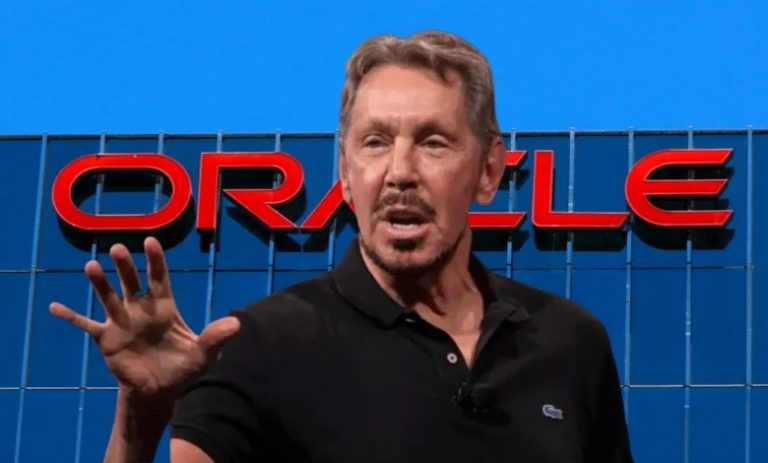
Oracle shares rose in early trading on Wednesday after the software and cloud giant began cutting thousands of jobs in a sweeping restructuring designed to release cash for its increasingly expensive artificial intelligence infrastructure expansion.
The layoffs, which have affected employees across the United States, India, and other key markets, come at a pivotal moment for the Larry Ellison-led company as it attempts to transform itself from a legacy database powerhouse into a front-rank AI cloud infrastructure player.
Multiple reports indicate that the latest round of cuts could run into the tens of thousands, with estimates ranging from about 10,000 to as many as 30,000 positions, potentially affecting nearly a fifth of Oracle’s global workforce of 162,000.
Register for Tekedia Mini-MBA edition 20 (June 8 – Sept 5, 2026).
Register for Tekedia AI in Business Masterclass.
Join Tekedia Capital Syndicate and co-invest in great global startups.
Register for Tekedia AI Lab.
Rather than punishing the stock, investors pushed shares higher, reflecting a view that the restructuring may help restore confidence in Oracle’s balance sheet at a time when its AI ambitions have become a major source of concern.
This is fundamentally a story about capital intensity.
Oracle is pouring unprecedented sums into data centers, GPU clusters, networking hardware, and power infrastructure to support large AI workloads for clients that include Nvidia Corporation, Meta Platforms, Inc., OpenAI, Advanced Micro Devices, Inc., and xAI.

The company has already raised roughly $45 billion to $50 billion in debt and equity to finance this expansion, a figure that has sharply increased scrutiny over leverage, free cash flow, and the pace at which these investments can begin generating returns.
Oracle’s enormous commitment to AI-related cloud contracts, particularly its multibillion-dollar infrastructure arrangements linked to OpenAI and the broader Stargate ecosystem, has become a large source of investors’ anxiety.
Those deals promise significant long-term revenue, but they also require massive upfront spending. That mismatch between immediate cash outflows and deferred revenue inflows is now driving the company’s restructuring decisions.

In effect, Oracle is trying to rebalance its cost structure by shrinking recurring labor expenses while preserving the financial flexibility needed to continue building AI capacity.
Analysts have increasingly framed the layoffs as less about cyclical weakness and more about cash-flow engineering. Payroll remains one of the largest controllable operating costs for a technology company of Oracle’s scale. Cutting headcount allows management to redirect billions of dollars toward capex without relying solely on further borrowing.
This matters because Wall Street has become increasingly sensitive to debt-fueled AI bets. Earlier concerns over Oracle’s capital spending intensified after the company’s free cash flow turned sharply negative amid escalating infrastructure outlays.
The company’s stock has already lost substantial value this year, underlining skepticism about whether its aggressive AI expansion can be monetized quickly enough. The latest restructuring is therefore as much about reassuring investors as it is about funding physical infrastructure.
Across the technology sector, major hyperscalers including Alphabet Inc., Microsoft Corporation, Amazon.com, Inc., and Meta have committed hundreds of billions of dollars to AI infrastructure, from advanced chips to dedicated data-center campuses.
What distinguishes Oracle is that it is making this push from a relatively smaller cloud base compared with its larger rivals. That raises the stakes considerably.
AI capex is an extension of already dominant cloud businesses for Microsoft and Amazon, while Oracle sees it as a strategic repositioning that could redefine the company’s long-term growth trajectory. The job cuts, therefore, signal more than cost discipline. They represent a decisive shift in corporate priorities.
Human capital is being subordinated to infrastructure capital, and it is becoming a defining feature of the AI era: companies are no longer only cutting jobs because demand is weak; increasingly, they are cutting jobs to fund technology bets whose returns remain uncertain.
There is also a productivity narrative at play. Some analysts have pointed to Oracle’s lower profit per employee relative to peers, arguing that the restructuring may help improve operational efficiency ratios and support margin expansion over time.
However, Oracle’s AI strategy depends on sustained enterprise demand for high-performance cloud capacity and the ability of major clients to keep expanding their own AI spending. Against that backdrop, any slowdown in enterprise AI adoption, any delay in customer deployments, or any weakening in the broader tech investment cycle is expected to expose Oracle to elevated debt and a leaner workforce without the expected revenue uplift.
For now, the company is making a clear calculation: in the current technology cycle, the priority is not preserving headcount but securing the compute infrastructure required to compete in the next phase of enterprise AI.
While the market may be rewarding that discipline today, the longer-term outcome is not certain, as the future of the AI industry is still a debate.