

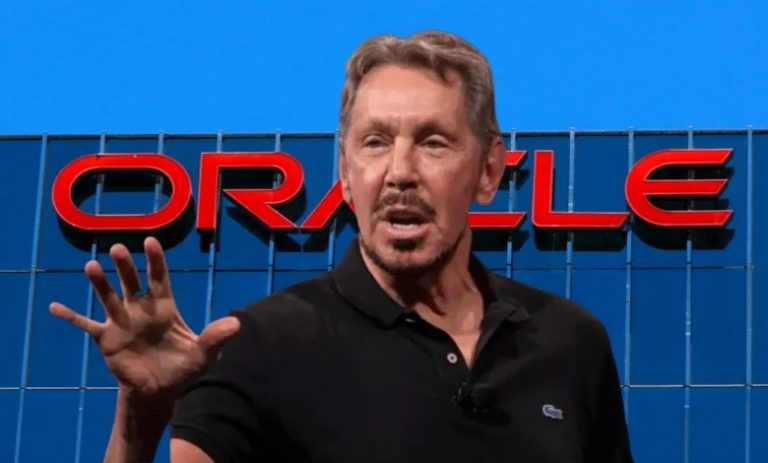
Oracle shares suffered a dramatic decline, plummeting by 13% on Thursday following the issuance of a significantly weaker-than-expected earnings forecast.
This sharp drop, which threatened to erase over $90 billion from Oracle’s market capitalization, triggered a broader selloff across the technology sector. The plunge points to a growing skepticism among investors regarding the immense capital cost and delayed profitability associated with the company’s aggressive, debt-fueled expansion into Artificial Intelligence (AI) infrastructure.
The disappointing financial predictions from the crucial OpenAI cloud-computing partner revealed the uneven and often protracted returns from the nascent technology. While many corporate leaders believe AI is the future, Oracle’s results suggest that the massive upfront investments have so far yielded only limited, visible productivity gains or corresponding revenue spikes.
Register for Tekedia Mini-MBA edition 20 (June 8 – Sept 5, 2026).
Register for Tekedia AI in Business Masterclass.
Join Tekedia Capital Syndicate and co-invest in great global startups.
Register for Tekedia AI Lab.
The Financial Strain of the AI Build-Out
Oracle’s financial health is currently being defined by its commitment to the AI race. The company, long a smaller cloud player, dramatically escalated its profile by securing a massive $300 billion cloud computing deal with OpenAI, beginning in 2027. This high-stakes partnership has tightly linked Oracle’s fortunes to the AI startup, leading to increased stock volatility fueled by concerns that rivals like Google may be pulling ahead of OpenAI.
The core financial concerns center on an astonishing acceleration in capital expenditure (CapEx) that is currently straining the balance sheet:
Oracle shocked the market by announcing that its expected CapEx for fiscal year 2026 is now projected to be $15 billion higher than its estimates just last September. This increase pushes the company’s total planned spending to an unprecedented level over the planning horizon, primarily to fund the construction of colossal data centers necessary to meet the demanding requirements of its AI contracts. The OpenAI agreement alone is expected to utilize 4.5 gigawatts of power capacity over the five-year term of the deal.

The immediate cost of this expansion is visible in the company’s cash flow. Oracle reported burning approximately $10 billion in cash during the first half of its fiscal year due to these AI investments, resulting in a negative free cash flow of around -$13.18 billion in the most recent quarter. To finance this build-out, the company has increasingly relied on debt, holding approximately $100 billion in total debt.
Further dampening sentiment, Oracle missed Wall Street consensus estimates for its total revenue, which came in at $16.06 billion versus expectations of around $16.21 billion. It also issued a third-quarter revenue growth forecast that fell below Wall Street estimates, signaling margin pressure as the investment cycle ramps up.
Credit Markets Signal Caution
The sheer scale and speed of Oracle’s debt-fueled CapEx have injected anxiety into the credit markets. This behavior—relying on significant bond issuance rather than strong operating cash flows—marks a departure for Big Tech companies, though rivals like Meta and Amazon.com have also recently issued over $30 billion and $15 billion in bonds, respectively, to finance their AI infrastructure arms race.

Concerns about Oracle’s debt were immediately reflected in derivatives markets. The cost to insure against Oracle’s default, measured by credit-default swaps (CDS), surged by nearly 12 basis points on Thursday, reaching a minimum of five-year highs. Investors are actively dumping Oracle bonds while piling into these CDS contracts to hedge against potential default risk.
The market value hit to Oracle directly impacted its leadership. Larry Ellison, whose net worth of $276 billion (according to Forbes) is largely derived from his roughly 40% stake in the company, saw his net worth potentially decline by more than $30 billion in the wake of the stock plunge.
Broader Tech Sector Selloff
Oracle’s struggles triggered a sympathetic selloff across the entire AI-focused segment, heightening fears that the ongoing AI market frenzy has become an investment bubble reminiscent of the 1990s dot-com boom. This fear is exacerbated by the circular deals and massive, undetailed future spending commitments, such as those from OpenAI (valued at $500 billion but still unprofitable), which is expected to spend over $1 trillion on AI infrastructure by 2030.
The tech-heavy Nasdaq fell to a one-week low as other AI-related stocks and chipmakers followed Oracle’s trajectory. Key components of the AI supply chain—including Nvidia, Advanced Micro Devices, Micron, Broadcom, and Arm Holdings—all recorded declines ranging from 3.1% to 4.2%.
Despite the immediate negative market reaction, at least 13 brokerages cut their price targets, but some analysts defended the company’s strategy. BofA Global Research analysts argued that the decline represents an investment cycle payment, stating, “The current weakness is more capex investment cycles needed to support demand, with the company paying the price for the abnormal speed in which investment is required to meet current AI demand trends.”
However, the market is demanding greater clarity. Oracle now trades at a forward price-to-earnings (P/E) ratio of 29.56, still slightly above that of rivals like Microsoft at 27.24 and Amazon at 29.06, leaving its current valuation under intense scrutiny until its massive CapEx translates into sustained, high-margin cloud revenue.