

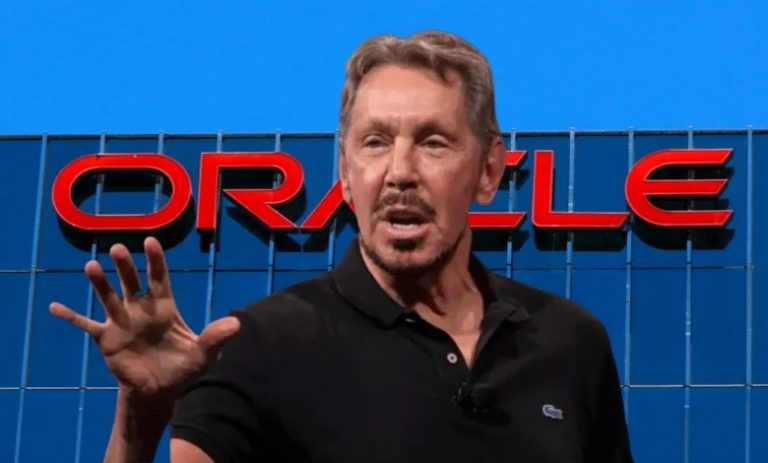
Oracle’s newly appointed co-CEOs, Clay Magouyrk and Mike Sicilia, are grappling with a rocky beginning to their leadership, as shares have tumbled approximately 30% this quarter—on track for the steepest decline since the 2001 dot-com bust—with only four trading days left, according to a CNBC report.
Closing Wednesday at $197.49, the stock has erased 43% of its value from an intraday record high of $345.72 reached in September, despite a brief lift last Friday from reports of Oracle’s involvement in a potential TikTok U.S. asset sale alongside other investors. The downturn reflects mounting investor skepticism over Oracle’s ability to deliver on massive AI infrastructure commitments, particularly its September agreement with OpenAI to host over $300 billion in cloud spending for training and running advanced models.
Doubts intensified after Oracle’s December earnings report revealed weaker-than-expected quarterly revenue of $13.8 billion, missing estimates by $200 million, and free cash flow of negative $1.2 billion, down from positive $800 million the prior quarter. Newly named finance leader Doug Kehring forecasted $50 billion in fiscal 2026 capital expenditures—a 43% increase from September guidance and double the prior year’s total.
Register for Tekedia Mini-MBA edition 20 (June 8 – Sept 5, 2026).
Register for Tekedia AI in Business Masterclass.
Join Tekedia Capital Syndicate and co-invest in great global startups.
Register for Tekedia AI Lab.
Additionally, Oracle plans $248 billion in leases to expand cloud capacity, fueling concerns about financial strain. Such aggressive scaling raises alarms about debt sustainability. In September, Oracle issued $18 billion in bonds—one of the tech industry’s largest-ever debt sales—to fund growth, with maturities ranging from 3 to 40 years at yields averaging 4.5%.
Kehring reiterated commitment to maintaining an investment-grade rating (currently BBB+ from S&P, Baa2 from Moody’s), but rising prices for Oracle’s credit default swaps—up 25% since earnings—signal bets on potential downgrades. Analysts at DA Davidson, holding the equivalent of a neutral rating and $210 price target, warned in a December 12 note, saying: “Considering Oracle is already barely hanging on to an investment-grade rating, we would be concerned about Oracle’s ability to live up to these obligations without restructuring its OpenAI contract.”
Magouyrk and Sicilia assumed co-CEO roles in September, succeeding Safra Catz amid historic optimism fueled by the OpenAI deal, which drove a 36% stock surge—the third-largest since Oracle’s 1986 IPO—and a 359% revenue backlog tied heavily to AI commitments. The partnership positioned Oracle as a key enabler for OpenAI’s ambitions, including the $500 billion Stargate data center project with SoftBank, aimed at constructing hyperscale facilities across the U.S. to power next-generation AI training.

However, execution risks loom large. Oracle trails Amazon Web Services (34% market share), Microsoft Azure (22%), and Google Cloud (11%) in infrastructure-as-a-service, absent from Gartner’s 2024 top-five providers despite clients like Meta, Uber, and Elon Musk’s xAI. Competitors like Databricks, valued at $134 billion post-funding, and Snowflake have yet to port services to Oracle Cloud, with Databricks CEO Ali Ghodsi stating it will happen “when customers start banging on my door.”
Snowflake CEO Frank Slootman echoed similar sentiments in a recent earnings call, citing integration complexities. Long-term bulls remain steadfast. Zachary Lountzis of Lountzis Asset Management, holding $25 million in Oracle shares as of September 30, views the drop from $340 as a “healthy correction.” His firm first bought in 2020 below $60 and added positions earlier this year.
“Our philosophy is that we’re OK with short-term over-valuation if the economics of the business have not changed, and that was the case with Oracle,” Lountzis said.

Much of his trust stems from founder Larry Ellison, Oracle’s chairman and CTO, the world’s second-richest person with a net worth exceeding $200 billion per Bloomberg.
“You would have gone bankrupt 40 times betting against Larry over the last 50 years. He sees the future,” he added.
In October, the new leadership trio outlined “hypergrowth” to $225 billion in fiscal 2030 revenue from $57 billion in 2025, largely via AI infrastructure powered by Nvidia GPUs, including custom clusters for OpenAI’s o4 model. Yet, this shift sacrifices margins: Gross margins are projected to fall from 77% in fiscal 2021 to ~49% by 2030, with $34 billion in cumulative negative free cash flow through 2029 before turning positive, per FactSet consensus.
Eric Lynch of Suncoast Equity Management expressed discomfort with the five-year horizon, saying, “Four or five years is a long time. That’s just not within our investment discipline.”
He also questioned heavy reliance on cash-burning OpenAI, committed to over $1.4 trillion in AI investments, including data centers and compute acquisitions.
Conversely, Wells Fargo’s Michael Turrin, initiating coverage this month with a buy-equivalent rating and $280 target, sees potential: Successful OpenAI delivery—potentially one-third of revenue by 2029—could validate Oracle’s pivot from value to growth stock, attracting broader enterprise adoption.
“They’re kind of shifting away from more of a value-oriented business to a more growth-oriented business,” Turrin said.
A big challenge for Oracle remains picking up market share in cloud infrastructure, where the company badly trails Amazon, Microsoft, and Google, even though its customer roster includes names like Meta, Uber, and Elon Musk’s xAI. Databricks, which was just valued at $134 billion in a funding round, doesn’t make its popular data processing software available on Oracle’s cloud.
Against this backdrop, Oracle’s new leadership faces a high-stakes transition, where the market’s verdict hinges on execution amid soaring capex, debt loads, and competition.