DD
MM
YYYY

PAGES

DD
MM
YYYY

spot_img

PAGES

Home Blog Page 11

Porsche Faces Tough Road Ahead with 5,000 Additional Job Cuts in Stuttgart, as Audi Cuts Annual Outlook

0

German luxury sports car manufacturer Porsche has announced another significant round of job cuts, revealing plans to eliminate an additional 5,000 positions in the Stuttgart region as the company grapples with mounting economic and industry pressures.

The latest reduction comes as Europe’s automotive sector faces slowing demand, rising production costs, and the rapid transition toward electric vehicles, forcing even premium brands to rethink their long-term strategies.

Porsche has long been regarded as one of Germany’s most successful automakers, renowned for producing high-performance sports cars and luxury SUVs that command strong global demand.

However, the company has not been immune to the challenges reshaping the global automotive industry.

Weak consumer spending in key markets, increased competition from Chinese electric vehicle manufacturers, and uncertainty surrounding international trade have all placed pressure on profitability.

The additional 5,000 job cuts are expected to affect employees primarily in the Stuttgart region, where Porsche’s headquarters and major production facilities are located.

While the company has emphasized that it remains committed to Germany as its manufacturing base, executives argue that restructuring has become necessary to ensure long-term competitiveness. The workforce reduction follows earlier cost-cutting measures and reflects a broader effort to streamline operations while investing heavily in future technologies.

One of the key drivers behind Porsche’s restructuring is the costly transition to electrification. Governments across Europe continue to tighten emissions regulations, requiring automakers to accelerate investments in battery-powered vehicles.

Developing new electric platforms, battery technology, and advanced software requires billions of dollars in research and development. Sales of electric vehicles have softened in several markets, creating a difficult balance between investment and profitability.

China, once Porsche’s fastest-growing market, has also become a major source of concern.

Sales have weakened as domestic Chinese brands introduce increasingly competitive premium electric vehicles at lower prices. Companies such as BYD, NIO, and Xiaomi have rapidly gained market share by offering advanced technology, attractive pricing, and strong local brand recognition.

This shift has reduced demand for imported luxury vehicles, including Porsche models The job reductions also reflect wider challenges facing Germany’s industrial sector.

Rising energy prices, inflation, and persistent supply chain disruptions have increased manufacturing costs across the country. Many German manufacturers have responded by reducing production, delaying investment, or cutting jobs to preserve financial stability.

Industry analysts warn that the country’s automotive sector is undergoing one of its most significant transformations in decades.

Despite the layoffs, Porsche continues to invest in innovation.

The company remains committed to expanding its electric vehicle lineup while improving battery efficiency, digital services, and autonomous driving capabilities.

It also plans to maintain its reputation for premium engineering by balancing traditional combustion-engine models with next-generation electric performance vehicles. Executives believe these investments will strengthen Porsche’s competitive position over the long term despite the short-term financial strain.

For employees and the Stuttgart community, however, the announcement represents another difficult chapter. Thousands of families will be directly affected, while suppliers and local businesses could also experience reduced economic activity.

Labor unions are expected to push for negotiations aimed at minimizing compulsory redundancies through voluntary retirement programs, retraining opportunities, and internal transfers where possible.

Porsche’s decision underscores the profound transformation taking place across the global automotive industry. As manufacturers race toward electrification while navigating economic uncertainty and intensifying competition, even iconic luxury brands are being forced to make difficult choices.

The latest job cuts highlight that maintaining long-term competitiveness increasingly requires painful restructuring, significant technological investment, and a willingness to adapt to an industry undergoing historic change.

Audi Cuts Annual Outlook as Global Headwinds Pressure Performance

Audi has lowered its financial outlook for the year, citing weakening demand in China and rising geopolitical uncertainty in the Middle East.

The announcement underscores the growing challenges facing global car manufacturers as they navigate economic slowdowns, changing consumer preferences, supply chain risks, and intensifying international tensions.

Audi now expects lower annual revenue and reduced profit margins than previously forecast.

The company attributed the downgrade primarily to a more difficult business environment in China, the world’s largest automotive market, where demand for premium vehicles has weakened considerably.

Chinese consumers have become more cautious with spending due to a slowing economy, ongoing concerns in the property sector, and increased competition from domestic electric vehicle manufacturers that are rapidly gaining market share.

For Audi, China has long been one of its most important markets, contributing significantly to global sales and profitability. However, local brands such as BYD, NIO, XPeng, and Li Auto have transformed the competitive landscape by offering technologically advanced electric vehicles at competitive prices.

These companies have captured growing consumer interest through innovation, software integration, and aggressive pricing strategies, making it increasingly difficult for traditional European manufacturers to maintain their dominance.

Beyond China, Audi also highlighted escalating tensions in the Middle East as another source of uncertainty. Geopolitical conflicts often have widespread economic consequences, particularly through their impact on global energy markets.

Rising oil prices can increase manufacturing and transportation costs while also weakening consumer confidence.

For an industry that relies on complex international supply chains, regional instability introduces additional risks, including shipping delays, higher logistics expenses, and uncertainty in sourcing critical components.

The revised outlook reflects broader pressures affecting the global automotive industry. Automakers are simultaneously investing billions of dollars in the transition to electric mobility while managing slower-than-expected adoption rates in several markets.

Although demand for electric vehicles continues to grow over the long term, the pace has become uneven as consumers weigh affordability, charging infrastructure, and economic uncertainty before making purchasing decisions.

Audi is also competing in an environment where technological innovation has become just as important as traditional engineering excellence. Consumers increasingly evaluate vehicles based on software capabilities, connectivity features, autonomous driving technologies, and digital ecosystems.

This shift requires continuous investment in research and development, placing additional pressure on profitability during periods of slowing sales. Despite these challenges, Audi remains committed to its long-term transformation strategy.

The company continues to expand its electric vehicle portfolio and strengthen its digital capabilities while seeking operational efficiencies to improve competitiveness. Executives believe that sustained investment in innovation will position the brand for future growth once market conditions stabilize.

Industry analysts note that Audi’s revised forecast is not an isolated case. Several global automakers have recently adjusted expectations amid weakening economic growth, persistent inflationary pressures, and changing consumer demand patterns.

Premium manufacturers are particularly exposed because luxury purchases are often among the first expenditures consumers postpone during uncertain economic periods.

Audi’s performance will depend largely on developments in China, the evolution of geopolitical risks, and the recovery of consumer confidence across key markets.

While short-term headwinds remain significant, the company’s strong global brand, engineering heritage, and commitment to electrification provide a foundation for long-term resilience.

The revised outlook serves as a reminder that even established automotive leaders must continually adapt to an increasingly volatile and competitive global marketplace.


Michael Burry Warns AI-Linked Private Credit Could Become Source of Broader Financial Contagion

0

Investor Michael Burry, best known for predicting the 2008 U.S. housing market collapse, has renewed his warnings about the artificial intelligence boom, noting this time that mounting exposure to AI-related debt within the private credit market could become a significant source of financial instability.

In a post on his Substack, the Scion Asset Management founder said he is increasingly concerned about private equity firms that have acquired insurance companies and filled their balance sheets with illiquid, asset-backed securities, many of which are tied to financing the rapid expansion of AI infrastructure.

Burry’s latest comments extend a series of warnings he has made this year about what he considers excessive speculation in artificial intelligence, particularly the surge in financing for data centers, semiconductor manufacturing and AI computing infrastructure.

“The Big Short” investor highlighted a research paper examining how private equity firms have increasingly used insurance companies to hold complex credit instruments, arguing that a growing share of those investments are now linked to AI-related assets.

“Those asset-backed assets and structured securities are increasingly coming off data center and chip leases,” Burry wrote.

“This is where the possible contagion takes down the economy – by withdrawing funding for the data center buildout, which is also an increasing part of United States economic growth.”

His warning emerges amid concerns that the AI investment boom is no longer being financed primarily through equity capital but increasingly through private credit markets, where lenders provide financing outside the traditional banking system.

Private credit has expanded rapidly over the past decade as investment firms stepped in to provide loans that banks have become less willing to originate following tighter post-financial crisis regulations. As technology companies race to build massive AI data centers equipped with advanced semiconductors, the sector has become one of the fastest-growing borrowers in private credit markets.

Much of the financing supports expensive infrastructure, including data centers, servers, networking equipment and long-term semiconductor leasing arrangements, creating a new class of asset-backed securities linked to AI development.

Burry argues that this growing concentration could amplify risks if AI investment slows or financing conditions tighten.

His concerns also center on the role of insurance companies. Private equity firms have increasingly acquired insurers because their steady stream of premium income provides a large pool of capital that can be invested in higher-yielding private assets.

Critics have believed that some insurers are assuming greater exposure to illiquid investments than traditional insurance portfolios historically carried, potentially increasing financial risks during periods of market stress.

According to the paper cited by Burry, insurers occupy a unique position within the financial system because policyholders are protected by state guaranty associations if an insurer fails. That means losses from risky investment strategies could ultimately be absorbed through mechanisms supported by the broader insurance industry and, indirectly, taxpayers.

The paper argues that such a structure could “socialize losses more sharply than banking’s federal deposit insurance” if widespread failures were to occur.

Burry said persistently elevated interest rates could become the catalyst that exposes those vulnerabilities.

“Higher rates for longer could prove a catalyst,” he wrote.

“The 10-year Treasury closed today yielding 4.68%. That is not acceptable to the PE boys, who have been holding their collective breath for a long while now.”

Higher bond yields generally increase borrowing costs while reducing the value of existing fixed-income assets. For highly leveraged private equity firms and private credit investors, sustained high interest rates can make refinancing more expensive and reduce returns on debt-funded investments.

Burry noted that the sharp rise in Treasury yields over the past five years has made many debt-driven financing models increasingly difficult to sustain.

He argued that private equity firms have continued postponing the consequences of those higher financing costs.

“Nothing virtuous about this process,” Burry wrote.

“This is Private Equity kicking its final can down to the end of that very long road. Taxpayers wait there.”

The assertion is consistent with Burry’s increasingly skeptical view of both artificial intelligence and private markets.

Earlier this year, he described AI as a speculative bubble and disclosed bearish positions against several companies viewed as major beneficiaries of the AI boom, including Nvidia and Palantir Technologies. He has also argued that both the private equity and private credit industries are approaching what he called the “end of the road” after years of rapid expansion fueled by inexpensive financing.

Burry’s concerns come as spending on AI infrastructure reaches unprecedented levels.

Major technology companies, including Microsoft, Amazon, Alphabet and Meta Platforms, have collectively committed hundreds of billions of dollars to expanding AI data centers and computing capacity. At the same time, chipmakers such as Nvidia, AMD and Intel have benefited from surging demand for processors that power generative AI models.

Much of that investment has been supported not only by public equity markets but also by private financing, infrastructure funds and structured credit products. Supporters of the AI investment cycle believe that demand for computing power remains strong enough to justify continued spending, pointing to accelerating enterprise adoption of generative AI and cloud-based services.

Burry, however, suggests the growing reliance on leveraged financing creates a potential vulnerability. If higher interest rates, weaker economic conditions or slowing AI demand reduce investment in data centers, financing for new projects could dry up, affecting lenders, insurers and other institutions exposed to AI-linked debt.

While his warnings represent one investor’s assessment rather than a consensus market view, they highlight growing scrutiny of the financial structures supporting the AI boom.

CME Launches Nearly 24-Hour Single-Stock Futures, Expanding Access to High-Profile AI and Tech Stocks

0

Investors seeking around-the-clock exposure to some of the world’s most closely watched companies now have a new way to trade, as CME Group has launched a suite of single-stock futures covering 55 U.S. equities.

The Chicago-based exchange on Monday introduced cash-settled single-stock futures, alongside micro-sized contracts on 22 companies, allowing investors to take leveraged bullish or bearish positions on individual stocks for nearly 24 hours a day. The contracts trade on CME’s Globex platform from Sunday evening through Friday afternoon, pausing only for a one-hour daily maintenance window.

The launch represents one of CME’s most significant retail-focused product expansions in recent years and comes as demand grows for markets that operate beyond traditional U.S. trading hours, particularly as earnings announcements, geopolitical developments and macroeconomic events increasingly occur when equity markets are closed.

Among the companies included are SpaceX, whose highly anticipated public listing has attracted enormous investor interest, as well as AI and semiconductor leaders including Nvidia and Micron Technology, alongside Tesla and Apple. Standard contracts represent 100 shares of the underlying stock, while micro contracts cover 10 shares, offering lower-capital access for smaller investors.

Morgan Stanley analyst Michael Cyprys described the rollout as a major catalyst for retail participation.

“Retail brokers have characterized the launch as the year’s largest retail growth catalyst, with more than 35 retail partners targeting day one/week one readiness,” Cyprys wrote in a research note.

The introduction comes as investors increasingly seek ways to hedge risk or react instantly to market-moving developments outside regular trading hours. Quarterly earnings from major technology companies, Federal Reserve decisions, geopolitical conflicts and overnight developments in Asia and Europe frequently trigger sharp price moves before U.S. exchanges open.

Unlike traditional stock ownership, the new contracts are cash settled, meaning investors receive or pay the difference in price at expiration rather than taking delivery of shares. CME said settlement will be based on each stock’s official closing price.

The exchange also argues the products provide a simpler alternative to listed options. Options pricing is influenced by factors such as implied volatility and time decay, which can complicate trading strategies. Single-stock futures eliminate those variables while still providing leveraged exposure through margin requirements, allowing traders to control larger positions with a smaller upfront capital commitment.

The launch is believed to have been inspired by broader structural changes in financial markets, where investors increasingly expect continuous access to trading. Cryptocurrency markets operate around the clock, while futures markets have long offered extended trading sessions. Bringing nearly continuous trading to individual equities narrows the gap between traditional financial markets and digital asset platforms.

The move also strengthens CME’s competitive position at a time when exchanges face mounting pressure from overseas venues offering perpetual futures, or “perps,” which have become increasingly popular among retail traders. Perpetual futures differ from traditional futures because they have no expiration date, allowing investors to maintain leveraged positions indefinitely as long as margin requirements are met.

Although equity perpetual futures remain largely unavailable within the United States, international platforms have aggressively expanded the products. Interest intensified ahead of SpaceX’s public listing, with offshore exchanges such as Hyperliquid already offering perpetual futures tied to the aerospace company before its official stock market debut.

Regulatory momentum has also shifted in favor of broader derivatives offerings. Earlier this year, the U.S. Commodity Futures Trading Commission cleared Kalshi and Coinbase to offer cryptocurrency perpetual futures, a move widely viewed by market participants as laying the groundwork for broader innovation across other asset classes.

Against that backdrop, CME’s new contracts are seen as an effort to capture growing investor demand while defending its position in an increasingly competitive derivatives landscape.

The products are also expected to benefit from enduring enthusiasm surrounding artificial intelligence and semiconductor companies. Nvidia and Micron remain among the biggest beneficiaries of the global AI infrastructure buildout, while Tesla continues to attract heavy speculative trading tied to autonomous driving, robotics and artificial intelligence initiatives.

CME said it intends to expand beyond the initial list of 55 stocks if customer demand supports additional listings and the securities meet the exchange’s eligibility standards.

For institutional investors, hedge funds and sophisticated retail traders, the new futures provide another instrument for hedging concentrated equity exposure, expressing directional views and responding immediately to overnight developments without waiting for U.S. stock exchanges to open.

The launch also signals that traditional exchanges are adapting to a market where continuous trading, greater leverage and faster access to high-profile growth companies are becoming increasingly important competitive differentiators.

Amazon Seeks Approval For 5,105 Satellites To Expand Direct-To-Device Service, Intensifying Race With SpaceX

0

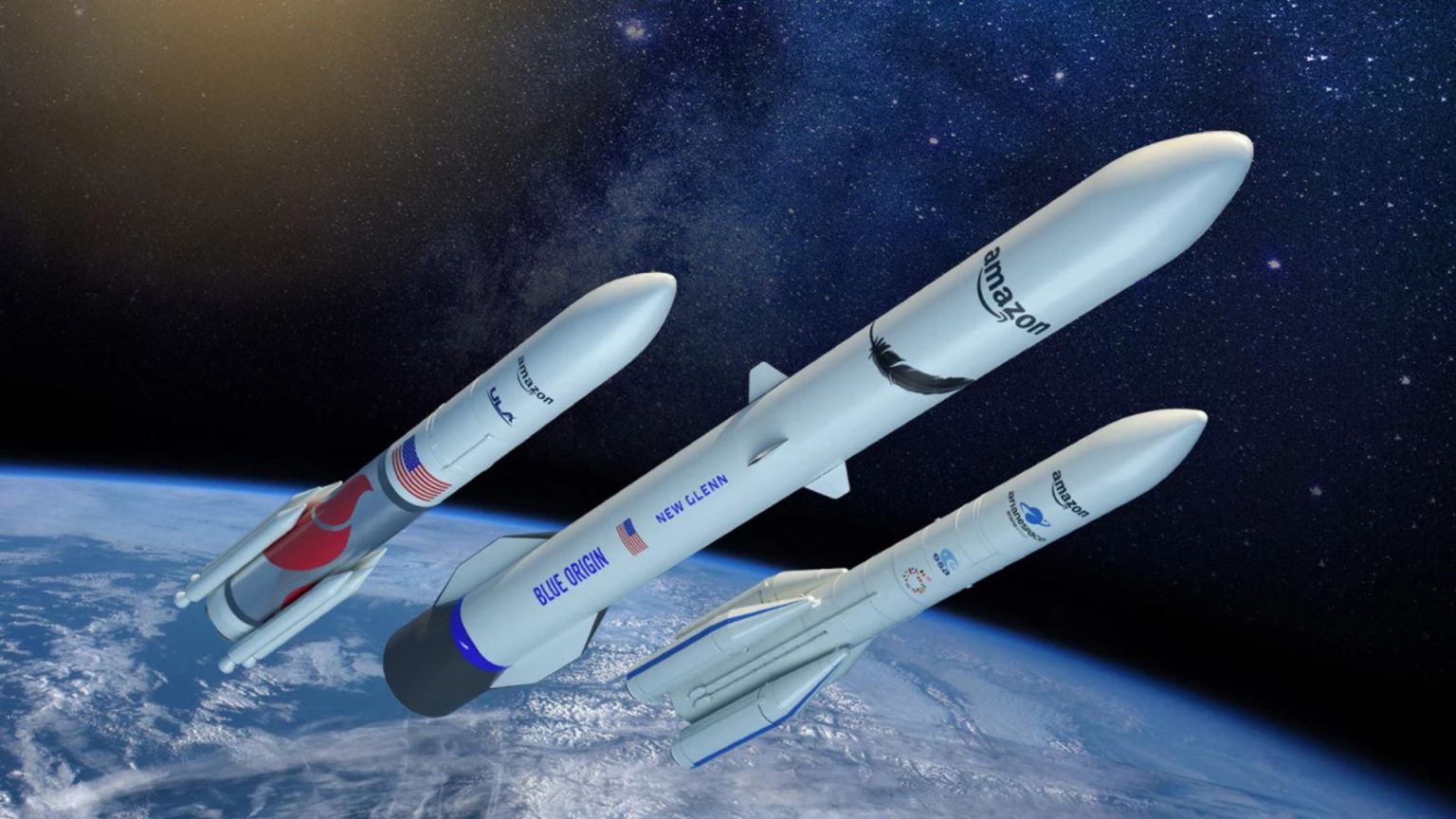
Amazon has asked U.S. regulators for permission to deploy up to 5,105 internet satellites to power a direct-to-device (D2D) communications network, marking a major expansion of its ambitions in the fast-growing satellite connectivity market and setting up a more direct challenge to SpaceX’s Starlink.

In a filing submitted Saturday to the Federal Communications Commission (FCC), Amazon said the proposed satellite constellation would combine its existing Project Kuiper infrastructure with the satellites and wireless spectrum of Globalstar, the satellite operator it agreed to acquire in a deal valued at approximately $11.6 billion.

The filing, which comes more than a year after SpaceX’s, represents Amazon’s first formal regulatory step toward building a satellite network capable of connecting directly to smartphones and other mobile devices without relying on traditional cellular towers.

If approved, the project would significantly broaden Amazon’s role in the space communications industry, moving beyond broadband internet services into the emerging direct-to-device market, where technology companies and satellite operators see strong demand for expanding mobile coverage to remote regions and improving emergency communications.

Direct-to-device technology enables ordinary smartphones and connected devices to communicate with satellites using licensed cellular spectrum, allowing users to send messages, make calls, or access data in areas where terrestrial mobile networks are unavailable.

Amazon said the network is intended to serve consumers and businesses that remain beyond the reach of conventional wireless infrastructure.

“Amazon looks forward to delivering on the promise of D2D connectivity, including to the millions of people living, traveling and working in places beyond the reach of existing networks today,” the company said in its FCC application.

According to the filing, the service will target users who are “unserved or underserved” by existing wireless providers while also supporting emergency response operations, including search-and-rescue missions, disaster recovery efforts and communications for remote industrial sites, transportation fleets and supply chains.

The proposal builds on Amazon’s announcement in April that it would acquire Globalstar, a move widely viewed as an effort to secure the spectrum rights necessary to compete in satellite-enabled mobile communications. The company expects the acquisition to close in 2027, with deployment of the direct-to-device network scheduled to begin in 2028.

The initiative also complements Amazon’s broader Project Kuiper program, its low-Earth orbit satellite broadband network designed to compete with SpaceX’s Starlink. Project Kuiper has accelerated deployment over the past year. Amazon now has more than 390 satellites in orbit, a milestone the company recently said is sufficient to begin offering initial broadband service later this year.

Although that figure represents meaningful progress, Amazon still trails Starlink by a wide margin. SpaceX operates more than 10,000 satellites, giving it by far the world’s largest low-Earth orbit satellite constellation and a substantial first-mover advantage in satellite broadband and direct-to-cell services.

Amazon also continues to face an aggressive deployment schedule imposed by regulators.

Last month, the FCC granted the company a waiver from a deadline requiring it to deploy 1,600 first-generation Kuiper satellites by July 30, acknowledging delays related to satellite manufacturing and launch availability. However, Amazon remains obligated to deploy its full first-generation constellation of 3,232 satellites by July 2029, a requirement intended to ensure efficient use of licensed spectrum.

The proposed direct-to-device constellation would operate alongside, rather than replace, Amazon’s existing Kuiper network, substantially increasing the company’s overall satellite footprint.

Competition in the direct-to-device market has intensified as satellite operators seek new revenue streams beyond traditional broadband internet access.

SpaceX has already begun rolling out Starlink Mobile, its direct-to-cell service developed in partnership with T-Mobile in the United States. The company strengthened its position by acquiring wireless spectrum licenses from EchoStar, allowing compatible smartphones to connect directly to Starlink satellites without requiring specialized satellite hardware.

The broader industry is moving rapidly toward satellite-enabled mobile connectivity as advances in satellite technology, antenna design and spectrum sharing make it increasingly feasible for conventional smartphones to communicate directly with orbiting satellites.

Analysts view direct-to-device services as one of the most promising growth segments in the satellite communications industry because they address coverage gaps in rural areas, maritime routes, aviation corridors and disaster zones where conventional mobile infrastructure is either unavailable or vulnerable to outages.

For Amazon, integrating Globalstar’s spectrum assets with Project Kuiper could provide an advantage by enabling the company to offer a broader suite of connectivity services spanning broadband internet, enterprise communications and direct smartphone connectivity.

Peak UHT Milk: When Consumers Rewrite Recipes

0

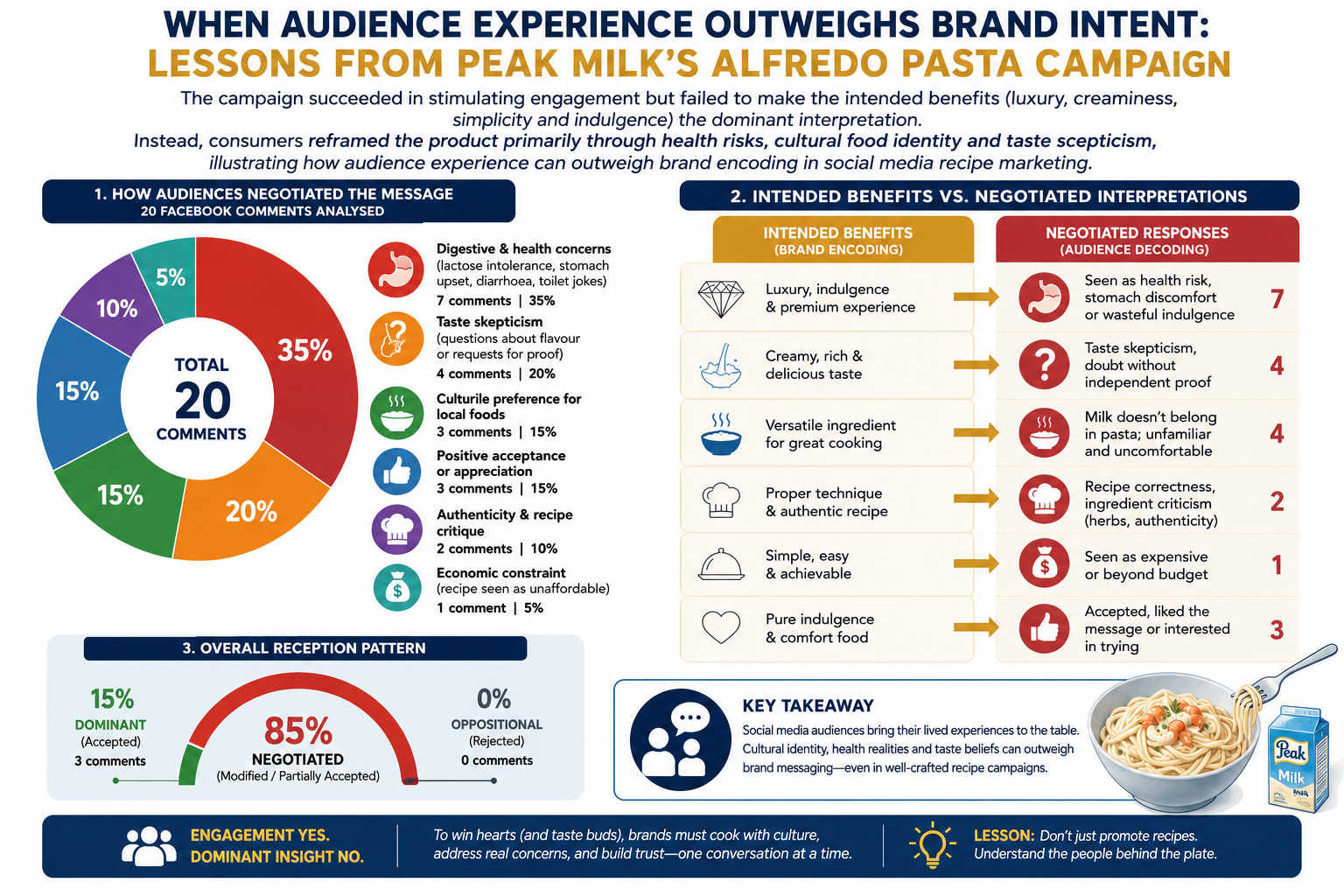
Brands often assume that a good recipe sells itself. Show consumers an attractive meal, explain why it tastes great, and position the featured product as the secret ingredient. Yet digital conversations show that recipes are not simply followed. They are interpreted, questioned, modified, and sometimes rejected. A recent Facebook campaign by Peak Milk promoting Alfredo pasta made with Peak UHT Full Cream Milk illustrates this reality.

The campaign presented Alfredo as “real luxury” achieved through simplicity. Butter, garlic, herbs, parmesan, shrimp, and Peak UHT Full Cream Milk were positioned as the right combination for creating a smooth, creamy, and indulgent sauce. The message was carefully constructed to communicate versatility, premium quality, and culinary sophistication. However, the audience’s responses reveal that consumers evaluate recipe marketing through cultural identity, health experiences, affordability, and trust rather than through the product benefits alone.

The discussion demonstrates an important lesson for food marketers. Consumers do not simply decode advertising messages as brands intend. They negotiate them.

One of the strongest themes in the public responses was cultural negotiation. Many commenters compared Alfredo pasta with familiar Nigerian dishes, asking why anyone would replace stew-based pasta or traditional meals such as fufu and vegetable soup with a milk-based recipe. Others questioned why foreign recipes should receive attention when indigenous foods remain popular and meaningful. These reactions were not merely about taste. They reflected how food represents identity, tradition, and everyday culture.

This result suggests that introducing international recipes into local markets requires more than showcasing attractive food photography. Consumers need help understanding where the recipe fits within their existing culinary practices. Without this bridge, the product risks being perceived as culturally distant rather than exciting.

Health concerns formed another dominant interpretation. Peak Milk promoted creaminess as the defining characteristic of the recipe. Yet many Facebook users associated that same creaminess with digestive discomfort. Comments about lactose intolerance, stomach upset, diarrhoea, and repeated visits to the toilet appeared throughout the discussion. Some users even joked that the recipe would guarantee digestive problems before anyone could enjoy the meal.

These responses illustrate how consumers often evaluate food products through personal health experiences instead of advertised taste benefits. What the brand framed as indulgence was reinterpreted by some audiences as potential physical discomfort. This gap highlights the importance of recognising dietary diversity when promoting dairy-based recipes. Addressing common concerns or providing alternatives for lactose-sensitive consumers may reduce resistance and improve message credibility.

Authenticity also became a point of negotiation. While the campaign emphasised proper technique and the right ingredients, some commenters challenged the recipe itself, arguing that traditional Alfredo sauce contains only cheese, butter, and pasta water. Others questioned ingredient preparation, including the use of herbs with their stems.

These responses demonstrate that digital audiences increasingly possess culinary knowledge and are willing to challenge brand authority. Consumers no longer accept branded recipes as unquestionable expertise. Instead, they compare marketing claims with their own knowledge, online information, and lived experiences.

Economic realities further shaped audience interpretations. Although the campaign suggested that luxury comes from using quality ingredients rather than complicated cooking, one commenter admitted that financial constraints prevented them from experimenting with such recipes despite wanting to do so. The recipe therefore became symbolic of aspiration rather than accessibility.

This highlights an important consideration for premium food marketing in emerging markets. Consumers may admire a product while simultaneously recognising that it falls outside their current spending priorities. Aspirational marketing remains valuable, but it should acknowledge economic realities instead of assuming universal purchasing power.

Perhaps the most striking feature of the conversation was the role of humour. Rather than expressing outright hostility, many users relied on jokes, sarcasm, and playful exaggeration to communicate scepticism. Humour became a socially acceptable way to question unfamiliar ingredients, anticipated digestive effects, and the overall appeal of the recipe.

For marketers, humorous resistance should not be dismissed as meaningless entertainment. It offers valuable insight into the emotional and cultural barriers preventing message acceptance. In many cases, jokes reveal genuine concerns that consumers may hesitate to express directly.

The broader lesson extends beyond one advertising campaign. Social media has transformed consumers from passive recipients of marketing into active interpreters of brand messages. Every campaign enters a public conversation where audiences negotiate meaning according to their cultural values, health beliefs, financial circumstances, and everyday experiences. The intended message is only one version of reality. The audience ultimately decides whether to accept, modify, or reject it.

For brands operating in culturally diverse markets such as Nigeria, successful recipe marketing requires more than presenting visually appealing meals. It demands cultural sensitivity, nutritional awareness, authentic storytelling, and an understanding that consumers actively reshape promotional messages through their own lived realities.

Peak Milk’s Alfredo campaign demonstrates that the real challenge is not convincing people that a recipe tastes good. It is convincing them that the recipe belongs in their kitchens, aligns with their lifestyles, respects their cultural preferences, and addresses their practical concerns. In today’s digital environment, consumers do not merely consume recipes. They rewrite them, and in doing so, they also rewrite the meaning of the brand itself.