DD
MM
YYYY

PAGES

DD
MM
YYYY

spot_img

PAGES

Home Blog Page 115

Amazon Opens Enterprise Tests of Leo Satellite Network as It Goes After Starlink, Commits $50B To AI Infra

0

Amazon is moving its satellite internet project into a more advanced phase, giving select companies early access to its newly renamed Amazon Leo network — a quiet but notable escalation in its long-planned bid to compete with SpaceX’s Starlink, the world’s largest satellite internet provider.

In a blog post on Monday, the company said that an “enterprise preview” has begun, allowing businesses to test Amazon Leo production hardware and software ahead of a broader rollout. Amazon said the test program will help it collect feedback from users in different sectors, refine its engineering decisions, and “tailor solutions for specific industries” before the service becomes widely available.

The expanded testing comes shortly after Amazon officially rebranded its satellite initiative from “Project Kuiper” to “Amazon Leo,” accompanied by a redesigned website and a more direct commercial pitch. The name points to low Earth orbit — the region up to about 1,200 miles above the planet where the entire satellite network will operate.

Amazon first revealed its satellite ambitions six years ago with a plan to deploy a constellation of 3,236 low Earth orbit satellites to deliver high-speed, low-latency internet to consumers, companies, and government clients — especially those in areas underserved by traditional broadband. The system is designed around flat, square terminals that connect to satellites overhead.

So far, the company has launched more than 150 satellites since April, using rockets from partners including United Launch Alliance and SpaceX. The latter is a notable choice, given that Amazon’s main competitor in the space now has nearly 9,000 satellites in orbit and has a commanding lead in global market share.

Still, Amazon is pressing on with its own roadmap. It has already secured commercial agreements with JetBlue, L3Harris, and Australia’s NBN network, and the company says units of its “Pro” terminals and “Ultra” antennas are now being shipped to participants in the enterprise preview program.

On Monday, Amazon also revealed the final production design of its Ultra model — the highest-end terminal in its lineup. According to the company, the Ultra antenna will offer download speeds up to 1 gigabit per second and upload speeds up to 400 megabits per second. Amazon says the terminal is powered by a custom in-house silicon chip, which it describes as the fastest commercial phased-array antenna currently in production.

The enterprise preview is expected to expand steadily over the coming months as the company adds more satellites and increases network capacity. Amazon has not yet announced pricing or a timeline for consumer availability.

The broader context behind Amazon’s push is the escalating race to build global satellite broadband infrastructure — a contest that involves enormous capital, unprecedented scale, and long-term bets on connectivity trends. For Amazon, Leo is both a strategic project and a competitive hedge: the company’s cloud business, AWS, sees satellite broadband as a critical layer for global enterprise customers, while Amazon’s retail and logistics divisions rely increasingly on connectivity in remote areas.

However, Starlink’s head start means any challenger faces steep odds, but Amazon’s scale, partnerships, and hardware development suggest it is preparing for a long contest. With more satellites set for launch and enterprise testing now underway, Amazon’s low Earth orbit network is gradually taking shape — even as pricing, rollout timelines, and final performance remain open questions for the consumer market.

Amazon Commits $50bn to AI and Supercomputing for U.S. Government Cloud Services

Meanwhile, Amazon.com also announced Monday a landmark investment of up to $50 billion to expand artificial intelligence and high-performance computing capabilities for its Amazon Web Services (AWS) customers within the U.S. government.

The initiative, expected to commence in 2026, will establish one of the largest public-sector cloud infrastructure commitments in U.S. history, reflecting the strategic role of AI and cloud computing in national security and technological leadership.

The expansion will add nearly 1.3 gigawatts of AI and supercomputing capacity across AWS’s Top Secret, Secret, and GovCloud regions. These specialized cloud environments handle sensitive and classified government data, and the planned infrastructure will feature cutting-edge computing hardware, high-bandwidth networking, and energy-efficient design to meet federal security and operational standards. One gigawatt of computing power is roughly equivalent to the electricity used by 750,000 U.S. households, highlighting the scale of the initiative.

AWS currently serves over 11,000 U.S. government agencies, ranging from defense and intelligence organizations to federal civilian departments. The company’s cloud services include foundational AI tools like Amazon SageMaker for model training and fine-tuning, Amazon Bedrock for rapid deployment of AI models, and proprietary foundation models, including Amazon Nova and Anthropic Claude. These platforms allow agencies to develop tailored AI solutions for mission-critical tasks, from intelligence analysis to cybersecurity, predictive maintenance, and administrative automation.

“This investment removes the technology barriers that have held government back,” AWS CEO Matt Garman said, emphasizing the importance of dedicated infrastructure to meet the increasing computational demands of AI-driven initiatives.

Garman noted that while Amazon continues to lead the broader cloud market, competitors such as Google Cloud and Oracle are accelerating AI-specific growth, making large-scale investments essential for maintaining leadership in the federal sector.

Analysts say the move underscores the intensifying AI infrastructure race, both in the commercial and public sectors. Tech companies, including Microsoft, Alphabet, and OpenAI, have committed billions of dollars to scale AI compute resources, sparking a surge in demand for GPUs, networking hardware, and specialized AI chips.

“Large-scale infrastructure is no longer optional,” said Emarketer analyst Jacob Bourne. “Organizations and governments that fail to secure sufficient AI compute capacity risk falling behind competitors in innovation and operational efficiency.”

The U.S. government has increasingly prioritized AI adoption to maintain strategic advantages over international rivals, particularly China, which has rapidly scaled its AI capabilities. According to D.A. Davidson analyst Gil Luria, the federal government’s reliance on AWS for expanded compute capacity is part of a broader effort to bolster AI readiness in national security, energy, healthcare, and economic forecasting.

Amazon did not provide a detailed timeline for the full $50 billion expenditure but emphasized that investments would be phased to ensure uninterrupted service to current AWS government clients while supporting new AI workloads. In addition to compute and networking upgrades, the expansion will also enhance power resilience, cooling infrastructure, and cybersecurity protections, ensuring that government data remains secure even as AI workloads scale dramatically.

The investment is expected to generate thousands of high-skilled jobs across engineering, operations, and security functions. It may also stimulate demand for U.S.-manufactured semiconductors and data center components, supporting broader supply chain and industrial policy objectives.

Beyond government applications, the project boosts AWS’ chance to maintain dominance in the AI ecosystem, providing tools for private sector innovation in sectors such as autonomous systems, healthcare, financial modeling, and logistics optimization. The initiative reflects a growing trend of public-private collaboration in AI infrastructure, bridging technological innovation with national priorities.

However, analysts note that while investments of this magnitude can drive breakthroughs, they also risk creating overcapacity and infrastructure bubbles if growth expectations do not materialize.

Monad Officially Launches on Mainnet and its Presale is Oversubscribed on Coinbase

0

Monad, the high-performance EVM-compatible Layer 1 blockchain promising 10,000 TPS, 0.4s block times, and near-zero gas fees, officially launched its mainnet today.

This marks a major milestone for the project, which raised $225M in a Paradigm-led round earlier this year at a $3B valuation. The native token, $MON total supply: 100B, is now live, with immediate trading and ecosystem activity kicking off.

Token Sale Recap 1.43x Oversubscribed on Coinbase

Monad’s public sale on Coinbase—its first major token auction on the platform—closed yesterday with strong late momentum, raising $269M from 85,820 participants across 70+ countries.

This exceeded the $187.5M target by 1.43x, ensuring 99% of requesters got their full allocation no major cuts for most. 7.5B $MON 7.5% of supply sold at $0.025 each; min $100, max $100K per user higher for Coinbase One. Tokens unlocked 100% at TGE.

Early days were slow only 45% filled on day 1, but the “commit-and-lock” mechanism led to a final-hour rush. It prioritized broad distribution via a “fill from the bottom” algorithm, favoring smaller buyers to reduce whale dominance.

$MON is trading ~20% above sale price on early venues pre-market hit $0.03 on Hyperliquid, implying ~$3B FDV. Circulating supply at launch is ~10.9% after ecosystem reserves, which should help stabilize volatility.

This success signals robust retail demand for EVM L1s, especially amid Ethereum’s scaling challenges. Future Coinbase sales may reward long-term holders with bigger allocations—dumping early could limit access.

Day-One Listing on Solana via Sunrise DeFi

In a cross-chain power move, $MON is natively listed on Solana today through Wormhole Labs’ new Sunrise platform—a “day-one liquidity gateway” for seamless token imports.

This lets Monad users bridge $MON to Solana in one click, unlocking instant trading against USDC, SOL, and more on DEXs like Jupiter. No wrapped tokens or fragmented bridges needed.

Positions Solana as the “internet capital markets” hub, pulling in non-native assets like $MON for its mature DeFi ecosystem $11.5B TVL, $4B daily DEX volume. Early liquidity pools were pre-seeded, minimizing slippage.

$MON holders get broader access without leaving Monad; Solana users snag it instantly. This is Sunrise’s debut test—expect more L2 tokens, RWAs, and institutional assets soon.

Solana even swapped its X avatar to Monad’s purple logo in hype, tweeting “MON mode activated. Mainnet is live—dive in now for gas-covered testnet vibes, but with real stakes. Focus on low-risk entry: bridge small, explore incentives, and hunt alpha.

Transfer ETH/USDC from Ethereum/Solana to Monad for liquidity. Bridge $100-500 max first. <$0.01. Avoid unverified bridges. Monad Momentum Wave 1 live—$MON rewards for referrals/competitions.

Meme launches on gmonad.meme. Stake for yields via Momentum campaigns like trading comps. Exit fast on pumps. Join Monad Momentum for $MON airdrops—focus on user-acquisition quests not just TVL farms.

High FDV ~$2.5B at sale + 49% unlocked could mean volatility. Size positions <5% portfolio. Monad’s parallel execution + EVM compatibility makes it a dev magnet—migrate ETH apps seamlessly. With Solana integration and Momentum incentives, day-one activity could explode.

Ape responsibly; this is the “performant EVM” era. Despite raising $269M in a 1.43x oversubscribed Coinbase sale and distributing ~$80M in airdrops to 225,000+ users, $MON opened trading at ~$0.024 below the $0.025 sale price with modest $50M volume, signaling weaker-than-expected demand.

This sets the stage for broader ripple effects across ecosystems, markets, and strategies. The launch highlights classic L1 pitfalls: hype-fueled expectations clashing with immediate sell pressure.

With 10.8% of the 100B $MON supply unlocked at TGE 7.5% from public sale + 3.3% airdrop, early dumping from airdrop recipients and presale holders is inevitable, especially in a bearish environment where fear indices hit yearly lows.

Community sentiment is mixed but leaning frustrated, with presale buyers locked into positions and non-US users facing withdrawal delays on Coinbase.

Michael Burry Has Launched a Paid Substack Newsletter for Investors

0

Michael Burry, the legendary investor from The Big Short who famously bet against the housing market before the 2008 crash, has indeed launched a paid Substack newsletter.

It went live on November 23, 2025—just a day ahead of the November 25 reveal he teased on X. The newsletter is titled Cassandra Unchained, a nod to the Greek myth of the prophetess who foretells disasters but is never believed, Warren Buffett once called Burry a “Cassandra” for his early warnings.

This move comes right after Burry deregistered his hedge fund, Scion Asset Management, from the SEC, shifting his focus to personal trading and direct commentary without regulatory constraints.

$379 per year roughly $31.58/month, a discount over monthly billing. Monthly: $39 per month. Currently, it has over 21,000 paid subscribers, generating an estimated $737,000 in net monthly revenue for Burry after Substack’s 10% cut. Substack handles payments and distribution, with creators keeping 90%.

Burry explained in his launch post that professional money management “muzzled” his voice due to SEC rules, leading to misinterpretations of his 13F filings. Now, he says, the Substack has his “full attention”—he’s “not retired,” just unchained.

Burry’s posts draw on his value-investing roots and history of spotting bubbles. His first two entries:” My 1999 and part of 2000″: A memoir-style piece from his days as a Stanford neurology resident, where he blogged about shorting Amazon amid the dot-com hype.

He contrasts it with today’s AI frenzy, quoting Fed Chair Alan Greenspan’s 2005 dismissal of the housing bubble and Jerome Powell’s 2025 comments on AI profitability “it’s a different thing”.

The Cardinal Sign of a Bubble

A deep dive into AI infrastructure overbuilds, likening Nvidia to Cisco during the 2000 dot-com peak which later crashed 78%. Burry warns of “catastrophically overbuilt supply” from hyperscalers like Microsoft, Google, Meta, Amazon, and Oracle outpacing real demand—echoing the subprime excess he shorted in 2008.

He promises ongoing analysis of stocks, markets, economic trends, and “potential economic bubbles,” with historical parallels to help subscribers spot risks. Some X users see it as a contrarian buy signal  like “Burry launching a Substack is bullish—markets love ignoring Cassandras”, while others joke it’s his pivot to “funding his trading” amid a tough economy.

Korean media highlighted the $379 price as premium access to his bubble-busting insights. A few Reddit threads gripe about the cost “Buffett gives advice for free”, but defenders argue $39/month for unfiltered Burry intel beats decoding his cryptic tweets or incomplete 13Fs.

Burry’s Nvidia skepticism has fueled buzz, especially after he exited Palantir puts in October and clashed publicly with its CEO Alex Karp. Burry’s track record—nailing the 2008 crash and early pandemic calls—makes it intriguing for contrarians, but remember, his views are bearish by nature.

Past performance isn’t a guarantee, and this is his first foray into paid newsletters. Michael Burry’s pivot to a $379/year Substack— just days after deregistering Scion Asset Management—marks a seismic shift for the “Big Short” icon.

No longer constrained by SEC regulations or client mandates, Burry is unleashing unfiltered bearish insights on markets, stocks, and bubbles, with early posts zeroing in on AI’s “supply-side gluttony” akin to the dot-com era. With over 21,000 subscribers already up from 7,700 in the first hours, it’s not just a newsletter—it’s a potential market disruptor.

Burry’s timing screams caution. Launching amid record-highs in tech S&P 500 up ~25% YTD, his debut critiques Nvidia (NVDA) and hyperscalers like Microsoft and Amazon for overbuilding AI infrastructure, mirroring Cisco’s 78% post-dot-com crash.

He flags “aggressive accounting” inflating profits and warns of “catastrophic oversupply” outpacing demand—echoing his 2008 subprime calls.

Burry’s cryptic X posts once sparked mini-panics. NVDA’s flat performance today (-0.2%), with traders joking it’s a “contrarian buy” markets ignore Cassandras until they don’t. If his thesis gains traction—especially with thin holiday liquidity—expect amplified swings in QQQ or NVDA, potentially 5-10% corrections if sentiment sours.

At $39/month, 21k subs yield ~$819k gross monthly revenue, netting ~$737k after Substack’s 10% cut—over $8.8M annually. This dwarfs many hedge fund returns in down years and funds his personal trading without AUM pressures. It’s a savvy monetization of his brand, but risks dilution if predictions falter.

Contrarians may pile into value plays, Burry’s old favorites like Alibaba or water utilities, while bulls double down on AI’s “infinite demand curve” as one analyst countered, noting intelligence scales unlike finite networks.

Substack’s finance category like Citrini at $999/year shows appetite for premium alpha, but at $379, it’s a litmus for how many value Burry’s edge over free Buffett wisdom.

Wall Street Rallies as Rate-Cut Hopes Surge, Tech Megacaps Lead Broad Market Rebound

0

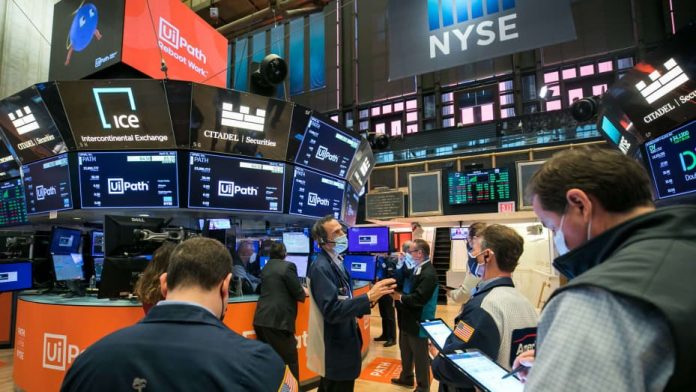
Wall Street kicked off the week on a strong note on Monday, reversing part of a bruising November stretch as investors piled back into tech names and other mega-cap favorites.

Alphabet, Tesla, and Broadcom powered the rebound, helped by growing expectations that the Federal Reserve could finally deliver its first rate cut in December.

The renewed risk appetite followed a wave of dovish signals from influential Fed officials, including Governor Christopher Waller and New York Fed President John Williams. Their comments helped ease pressure after a month-long selloff that had left U.S. equities struggling for direction.

The tone inside the central bank is far from unified, with other policymakers still warning against premature policy easing ahead of December’s FOMC meeting. But traders appear far more convinced the Fed is heading toward a pivot: market pricing now reflects a 76.9% probability of a 25-basis-point cut next month, up sharply from 42% just a week earlier, according to CME’s FedWatch Tool.

That shift alone was enough to ignite buying across the board.

Alphabet jumped 4.6%, Tesla surged 6.7%, and Broadcom notched a standout 10% gain. Communication Services led all S&P 500 sectors with a 3% rise, while chipmakers roared back as the semiconductor index climbed 4.3%.

“It’s a combination of rate-cut enthusiasm, which has completely turned around since Williams made his comments on Friday morning, and the usual fear of missing out,” said Steve Sosnick, chief market analyst at Interactive Brokers.

By late morning — around 11:40 a.m. ET — the indexes were all firmly higher:
• Dow Jones Industrial Average: +249.13 points, or 0.54%, at 46,494.54
• S&P 500: +87.81 points, or 1.33%, at 6,690.80
• Nasdaq Composite: +503.65 points, or 2.26%, at 22,776.74

A Tech Bounce Amid Bubble Concerns

The turnaround offered relief after weeks of turbulence. Markets had been grappling with fears that the artificial-intelligence boom — the engine behind this year’s enormous tech-sector gains — might be tipping toward bubble territory. The volatility was amplified by the prolonged U.S. government shutdown, which cut off key economic data releases that investors typically rely on to gauge demand, hiring, and inflation trends.

Both the S&P 500 and the Nasdaq remain on track for monthly losses in November, with the slide shaping up to be the steepest since the March selloff triggered by tariff-hike worries. Analysts warn that the market’s choppiness may not be over, even if Monday’s rally suggests investors are still willing to buy dips.

Deutsche Bank maintains its bullish long-term view, projecting the S&P 500 will reach 8,000 by the end of 2026, supported by resilient earnings and sustained AI-related productivity gains that bolster corporate margins.

Holiday Season to Test Consumer Strength

Investors will turn their focus later this week to September retail sales and producer price data — key indicators ahead of the crucial holiday shopping season. With Thanksgiving approaching, followed by Black Friday and Cyber Monday, retailers are hoping to capitalize on what could be a record-breaking period.

The National Retail Federation expects holiday sales to surpass $1 trillion for the first time, even as signs of household strain continue to emerge.

A string of layoff announcements, rising unemployment numbers, and new rounds of U.S. tariffs have clouded consumer sentiment. But spending has held up better than expected.

“The consumer sentiment numbers are still lousy. But it’s telling us the consumer is nervous but still somewhat resilient,” Sosnick said.

Sector Movers: Health Stocks, Pharma, and Insurers

In healthcare, Bristol-Myers rose 4.9% after Bayer reported strong late-stage trial data for a cardiovascular drug — news that lifted sentiment across the large-cap pharma space.

Health insurers and hospital operators registered broader gains following a report that President Trump’s health plan could extend certain subsidy provisions for two years. Centene climbed 7.5%, while Oscar Health surged 20% as investors bet on a more favourable short-term regulatory environment.

Advancers comfortably outpaced decliners, with a 1.96-to-1 ratio on the NYSE and 2.18-to-1 on the Nasdaq — evidence that the rally extended beyond the tech giants. The S&P 500 tallied 17 new 52-week highs against two new lows, while the Nasdaq recorded 87 new highs and 88 new lows, a sign the market remains bifurcated even amid Monday’s optimism.

The Bigger Picture

Monday’s upswing was powered by rate-cut optimism, but the market is still navigating a thorny backdrop. Inflation remains above the Fed’s comfort zone, the labor market is cooling unevenly, and trade tensions and lingering shutdown effects continue to distort forecasts.

For now, traders are betting that December marks the beginning of monetary easing — a shift that would relieve pressure on the tech sector’s stretched valuations and give consumers and corporates breathing room heading into 2026.

But with internal divisions at the Fed, a fragile consumer mood, and geopolitical crosswinds still swirling, the path ahead remains uncertain. While investors have embraced Monday’s rally, many remain cautious about calling it a turning point.

Anthropic Claims Coding Crown with “Superhuman” Opus 4.5 Launch – Its Latest Model

0

The relentless velocity of the artificial intelligence arms race accelerated once again on Monday as Anthropic announced the immediate release of Claude Opus 4.5, a flagship model that the startup claims has eclipsed both human experts and rival systems from Google and OpenAI in complex software engineering tasks.

The launch marks the San Francisco-based lab’s third major model release in just two months, underscoring a frenetic pace of development that has propelled the company’s valuation to a staggering $350 billion.

The debut of Opus 4.5 serves as a direct counterstrike to recent moves by Anthropic’s primary competitors. According to the company, the new model is now state-of-the-art for “agentic coding”—the ability of an AI to autonomously plan and execute programming tasks. On SWE-bench Verified, the industry standard test set for measuring software coding abilities, Opus 4.5 reportedly outperformed Google’s Gemini 3 Pro, which was announced just last week, as well as OpenAI’s GPT-5.1.

Perhaps the most striking metric of the model’s capability comes from Anthropic’s internal hiring data. The company revealed that when it tested Claude Opus 4.5 on the rigorous take-home exam given to prospective performance engineers, the AI scored higher than any human candidate in the company’s history. This level of proficiency marks the model as a highly specialized tool for professional software developers, financial analysts, consultants, and accountants—knowledge workers who require high-level reasoning rather than simple chatbot interactions.

Scott White, Anthropic’s product leader for Claude.ai, described the release as a milestone for users eager to expand their professional purview.

“The amount that we’re releasing to the market and the feedback loops that we’re generating from it just make me so unbelievably excited,” White said.

He noted that the ideal user for the new system is someone looking to push their creativity and build new things, as the model is “meaningfully better” at everyday enterprise workflows, such as conducting deep research and manipulating complex data in spreadsheets and slide decks.

The release creates a crowded timeline for the company, known for its “Claude” family of models. The startup unveiled its mid-sized Claude Sonnet 4.5 in late September, followed swiftly by the compact Claude Haiku 4.5 in October. The previous iteration of its flagship, Claude Opus 4.1, was released only in August. This rapid obsolescence cycle is fueled by massive capital injections; just last week, Microsoft and Nvidia announced multi-billion-dollar investments in the firm, cementing Anthropic’s status as a central pillar of the generative AI economy alongside OpenAI and Google.

Beyond the raw intelligence of the model, Monday’s announcement included a suite of integration updates designed to weave Claude deeper into corporate workflows. The company is expanding “Claude for Chrome,” a browser extension that allows the AI to take action across tabs, to all Max users. Additionally, “Claude for Excel,” which enables the AI to understand, edit, and analyze spreadsheets, is now generally available to all Max, Team, and Enterprise users. The startup is also bringing its specialized “Claude Code” environment to its desktop application, further lowering the barrier for non-engineers to generate software.

Claude Opus 4.5 is available immediately and will serve as the default intelligence engine for Anthropic’s Pro, Max, and Enterprise subscription tiers, signaling the company’s intent to capture the high-end enterprise market while the window of technological superiority remains open.