DD
MM
YYYY

PAGES

DD
MM
YYYY

spot_img

PAGES

Home Blog Page 1221

Ndubuisi Ekekwe, MBA (UNICAL) – “50 Most Distinguished Alumni With Impactful Contributions To National Development”

0

Good People, the University of Calabar and The Guardian have selected an Ovim village boy on the 50th anniversary of UNICAL as one of the “50 Most Distinguished Alumni With Impactful Contributions To National Development”.

You see – things happen. If not, how do you include the name of a village guy when there are “His Excellencies”, “Her Excellencies”, “Honourables”, etc, that can easily make up the list? To my fellow Malabites and Malabresses, and to our great university, Thank You.

I have a tough LOVE for UNICAL because they taught me Business Strategy and Market Competition by the best in the game. Those days they hired former executives of companies and banks to teach students, and the MBA classes were academic-boardrooms, with practical, actionable, intellectual raw materials for professional ascension. My focus was on global markets and international currencies, and I wrote briefs for the World Bank, AU, etc. You can read this seminal one on the single African Currency (I remain against it until there is a prior convergence of regional economies under a supranational banking institution, so as to avoid welfare losses) which I presented before the African Union Congress on invitation.

Prof CK Ayo, ex-Vice chancellor of Covenant University, supervised my thesis and it was all about mathematics and statistics. When a professor of mathematics with focus on numerical computation guides you on analysis of currency and competition, you will see things from a different angle. He introduced me to SPSS and actually taught me how to use it. Prof whom I visited many times when he was in Covenant has since gone to heaven.

Of course, on a day like this, I will dedicate this to venerable banker, Chairman Paschal Dozie, who recently exited the solid bounds of the earth for the ecclesiastical heaven, with cherubim, seraphim and angels welcoming him, for the uncommon grace and favour I found before him when I was in Diamond Bank.

UNICAL – the best university for an impactful MBA in Nigeria. Get a print copy of the Guardian and read my short interview.

File

Nigel Farage’s Crypto Asset Bill Could Position The UK As A Crypto Pioneer

0

Nigel Farage, leader of Reform UK, announced at the Bitcoin 2025 conference in Las Vegas on May 29, 2025, that his party has drafted a Crypto Assets and Digital Finance Bill, which includes a proposal for a Strategic Bitcoin Reserve to be held by the Bank of England. The bill aims to position the UK as a global crypto hub and includes measures such as:

Reducing capital gains tax on crypto assets from 24% to 10%. Prohibiting banks from “debanking” customers for engaging in legal cryptocurrency transactions. Establishing a Bitcoin digital reserve within the Bank of England. Opposing the introduction of a central bank digital currency (CBDC). Farage emphasized that the bill would be a key campaign priority for Reform UK in the next general election, expected by August 2029. He stated that the party’s goal is to “launch a crypto revolution” in the UK and make London a major global trading center for digital assets.

Reform UK has also become the first UK political party to accept donations in Bitcoin and other cryptocurrencies, facilitated through the crypto payments provider Radom. However, the UK Treasury has explicitly stated it has no plans to adopt a strategic Bitcoin reserve, focusing instead on a phased approach to crypto regulation prioritizing consumer protection and financial stability. The UK already holds 61,245 BTC ($6.4 billion), making it the third-largest sovereign holder of Bitcoin globally, behind the U.S. and China, according to Bitcoin Treasuries data.

Farage’s proposal has drawn mixed reactions. Supporters, particularly in the crypto community, praise the move as a step toward mainstream adoption, while critics, including Prime Minister and Labour leader Keir Starmer, have likened it to economically risky policies, comparing it to former PM Liz Truss’s approach. Reform UK currently holds only five seats in the House of Commons, compared to Labour’s 403 and the Conservatives’ 120, making the bill’s passage uncertain without significant political shifts.

The announcement aligns with Farage’s broader narrative of promoting individual sovereignty and resisting centralized financial control, drawing parallels to his Brexit advocacy and citing his 2023 debanking experience as a motivation. The proposed Crypto Assets and Digital Finance Bill by Nigel Farage and Reform UK, including a Strategic Bitcoin Reserve, could have significant implications for the UK’s economy, financial system, and global standing in the crypto space.

Holding Bitcoin as a strategic reserve could hedge against fiat currency inflation and diversify the UK’s financial assets, especially if Bitcoin’s value continues to rise (currently ~$105,664 per BTC). The UK’s existing 61,245 BTC ($6.4 billion) could appreciate, strengthening national reserves. Bitcoin’s volatility poses risks to fiscal stability. A price crash could devalue the reserve, drawing criticism for speculative investment with public funds. The Treasury’s opposition suggests concerns about financial prudence.

Tax Reduction on Crypto Gains

Reducing capital gains tax from 24% to 10% could incentivize crypto investment, attract high-net-worth individuals, and stimulate economic activity in the digital asset sector. However, it may reduce tax revenue in the short term, potentially straining public finances unless offset by increased economic activity. Positioning London as a global crypto trading center could attract blockchain startups, talent, and investment, boosting the UK’s fintech sector. This aligns with post-Brexit goals to enhance financial competitiveness.

Risks include regulatory challenges, as loose oversight could invite fraud or money laundering, while strict rules might deter innovation. Prohibiting banks from debanking crypto users could encourage adoption but might expose financial institutions to risks from unregulated or illicit crypto activities, potentially clashing with anti-money laundering (AML) regulations.

The bill is a bold move to differentiate Reform UK from Labour and the Conservatives, appealing to younger, tech-savvy voters and the growing crypto community. Accepting Bitcoin donations reinforces this branding. With only five MPs, Reform UK’s ability to pass the bill is limited unless they gain significant seats by 2029 or form alliances. The proposal could galvanize their base but risks alienating traditional voters wary of economic experimentation.

The Treasury’s rejection and Starmer’s criticism indicate resistance from major parties, framing the bill as fiscally irresponsible. This could polarize debate, with Labour and Conservatives likely to prioritize regulatory caution over bold crypto adoption. Farage’s comparison to Brexit suggests he aims to rally populist sentiment, but mainstream political opposition may limit the bill’s traction. If passed, the bill would signal a pro-crypto stance, potentially aligning the UK with nations like El Salvador, which adopted Bitcoin as legal tender. This could enhance diplomatic ties with crypto-friendly jurisdictions but strain relations with anti-crypto regulators like the EU.

A Strategic Bitcoin Reserve could normalize cryptocurrency in the UK, encouraging retail and institutional adoption. This aligns with Farage’s narrative of financial sovereignty, resonating with those skeptical of centralized banking. However, public skepticism, fueled by crypto scams or volatility, could lead to backlash if the reserve underperforms or if debanking protections enable illicit activity.

Resistance to CBDCs

Opposing a central bank digital currency (CBDC) taps into concerns about government surveillance and control, appealing to privacy advocates. However, it may conflict with global trends, as many countries (e.g., China, EU) explore CBDCs, potentially isolating the UK in digital finance innovation. The proposal could deepen divides between tech-forward, libertarian-leaning groups and traditionalists or risk-averse voters. A UK Bitcoin reserve could boost global Bitcoin demand, potentially driving up prices and reinforcing its status as a “digital gold.” This might prompt other nations to consider similar reserves, accelerating institutional adoption.

Conversely, failure or backlash could dampen global confidence in sovereign crypto holdings. The UK could leapfrog competitors in the crypto space, challenging hubs like Singapore or Dubai. However, regulatory misalignment with the EU or U.S. could complicate cross-border crypto trade and compliance. If the UK moves too aggressively without robust regulation, it risks criticism from international bodies like the Financial Action Task Force (FATF), potentially affecting its standing in global finance.

Managing a Bitcoin reserve would require secure storage (e.g., cold wallets) and clear governance to avoid mismanagement or theft, as seen in past crypto hacks. Reform UK’s limited parliamentary power makes passage unlikely without a major electoral shift or coalition support. Convincing a skeptical public and financial institutions to embrace Bitcoin as a reserve asset will be challenging, especially given the Treasury’s stance and Starmer’s critique.

Farage’s bill could position the UK as a crypto pioneer, boosting economic innovation and appealing to a niche but growing voter base. However, it faces significant hurdles due to political opposition, economic risks, and regulatory complexities. The debate could shape the UK’s financial future, but its success hinges on Reform UK’s electoral gains and broader public acceptance of cryptocurrency.

DeFi Development Corp Invests On Solana-Based Liquidity Staking Tokens

0

DeFi Development Corp. (Nasdaq: DFDV) has become the first publicly traded company to invest in Solana-based liquid staking tokens (LSTs), specifically dfdvSOL, using technology developed by Sanctum. This move, announced on May 28, 2025, allows the company to stake its Solana (SOL) holdings while maintaining liquidity, enhancing its validator operations and treasury management.

Users stake SOL to DeFi Development’s validators and receive dfdvSOL, which represents the staked SOL plus accumulated rewards and can be used in DeFi or CeFi applications or redeemed for SOL. This aligns with the company’s goal to maximize its SOL Per Share (SPS) metric, strengthening its position as a crypto-native treasury model. The firm holds over 609,190 SOL, valued at approximately $107 million, making it the largest publicly traded SOL holder.

A publicly traded company investing in DeFi assets like dfdvSOL signals increasing institutional acceptance of blockchain-based financial instruments. This could encourage other public companies to explore DeFi, potentially driving mainstream adoption of crypto-native strategies. By staking Solana (SOL) to earn dfdvSOL, DeFi Development Corp. maintains liquidity while generating staking rewards. This hybrid approach demonstrates how firms can integrate DeFi’s yield-generating mechanisms into traditional treasury management, potentially setting a precedent for others.

The move may boost confidence in Solana’s ecosystem, increasing demand for SOL and LSTs. With DeFi Development holding $107 million in SOL, its actions could influence market dynamics, especially if other firms follow suit. DeFi Development’s focus on maximizing SOL Per Share (SPS) through LSTs positions it as a leader in crypto-native treasury models. This could attract investors seeking exposure to DeFi without direct crypto investment.

By operating validators and issuing dfdvSOL, the company strengthens its role in Solana’s network, potentially increasing its influence over governance and ecosystem development. As a public company, DeFi Development’s move invites regulatory attention. How regulators respond could shape the legal framework for other public firms engaging with DeFi, potentially clarifying rules around staking and tokenized assets.

The investment may appeal to crypto-savvy investors but could alienate traditional ones wary of DeFi’s volatility and complexity, impacting the company’s stock valuation. Many traditional investors and firms lack familiarity with DeFi concepts like liquid staking or yield farming, creating a barrier to widespread adoption. DeFi Development’s move may highlight this gap, as investors struggle to evaluate the risks and rewards of dfdvSOL.

DeFi’s technical nature (e.g., staking, validator operations, and token redemption) contrasts with TradFi’s simpler financial instruments, potentially deterring risk-averse institutions. DeFi operates in a decentralized, often unregulated space, while public companies face strict compliance requirements. This creates tension, as regulators may view LSTs as securities or derivatives, complicating DeFi Development’s strategy and deterring others from following.

DeFi’s high-yield potential comes with risks like smart contract vulnerabilities, market volatility, and liquidity issues. TradFi firms typically prioritize stability, creating a cultural and operational divide that DeFi Development’s move challenges but doesn’t fully resolve. The company’s $107 million SOL holding exposes it to crypto market fluctuations, which may concern traditional shareholders accustomed to more predictable assets.

While DeFi Development’s investment narrows the gap, the broader divide persists. Many DeFi protocols remain inaccessible to traditional firms due to technical barriers, wallet management issues, or lack of custodial solutions that satisfy compliance needs. Conversely, DeFi advocates may view public companies’ involvement as diluting the decentralized ethos, creating ideological friction.

DeFi Development Corp.’s investment in Solana LSTs is a landmark step toward integrating DeFi into traditional corporate finance, potentially paving the way for greater institutional participation and market growth. However, the divide between TradFi’s structured, regulated world and DeFi’s decentralized, experimental nature remains. Regulatory clarity, education, and risk management will be critical to narrowing this gap, with DeFi Development’s success or challenges serving as a key case study.

How Political Messaging Is Shaping the 2027 Oyo Governorship Race

0
Nigerian Newspapers, 2024-2025; Infoprations Analysis, 2025

As Nigeria prepares for the 2027 general elections, one state to watch closely is Oyo. The race for governor is already gaining momentum, and what’s emerging is more than just political posturing. It’s a contest shaped by messages, alliances, and shared goals that are forming long before any ballots are cast.

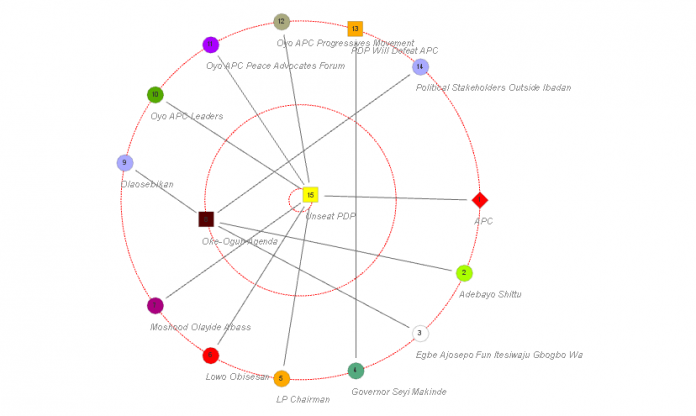
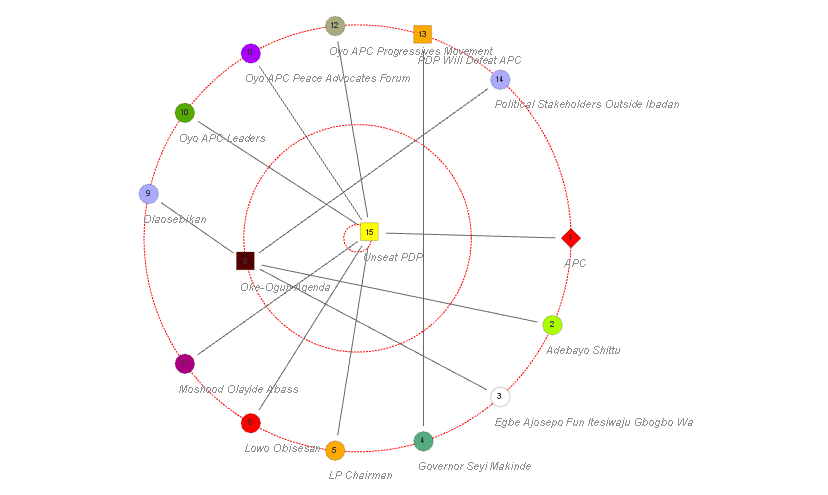
Our analysis of recent activities of stakeholders, examining how often political actors and groups are mentioned together in public discussions gives us a new perspective. It tells us who is at the center of these conversations, who is working together, and what themes are driving the momentum.

At the center of this picture is a message, not a person or party. “Unseat PDP” has become the most talked-about theme among various groups and individuals. It reflects a growing effort by different stakeholders to focus public attention on removing the ruling People’s Democratic Party from office in Oyo State.

This is more than just a slogan. It appears to be the common thread connecting different opposition groups, campaigners, and political voices. When a message like this appears so frequently and in connection with so many different players, it becomes a powerful organizing tool. It provides clarity, focus, and a sense of shared direction.

This kind of clarity matters. In politics, as in business, success often depends on how well a message resonates and how many people rally behind it. Right now, “Unseat PDP” is serving as the main point of agreement for a diverse set of actors. That gives it real power.

Another important message gaining ground is the “Oke-Ogun Agenda.” While it is not as widely connected as “Unseat PDP,” it represents something significant. Oke-Ogun is a region in Oyo State that has historically played a quieter role in state politics. The emergence of this message suggests that people in that region are becoming more politically organized and assertive.

Exhibit 1: Activities and actors’ connectivity

Source: Nigerian Newspapers, 2024-2025; Infoprations Analysis, 2025

The growing attention to Oke-Ogun may point to a desire for greater political inclusion or even a push to support a candidate from that area. Either way, it shows that regional voices are starting to matter more in the bigger picture.

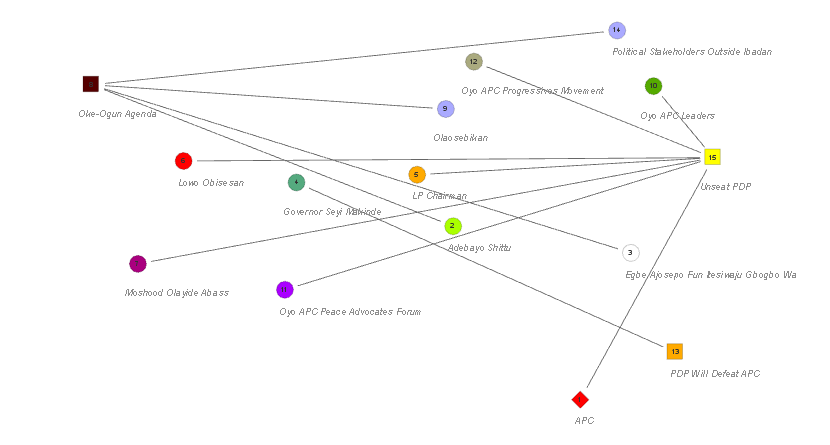
What’s also worth noting is who is not yet at the center of these conversations. Most of the political figures, party leaders, and advocacy groups included in the data appear only on the margins. Each is linked to only a small number of others and does not seem to be playing a key role in shaping the central narrative of the race.

This includes Governor Seyi Makinde, the current officeholder. While his position gives him visibility, he does not appear to be a major part of the ongoing discussion around the future of the state’s leadership, at least not yet. That could be a sign of caution on his part, or it could reflect a deliberate strategy to stay above the early noise of campaign season.

The same goes for many members of the All Progressives Congress (APC), the main opposition party. There are several groups aligned with the APC, but none of them is currently taking the lead in framing the conversation or building alliances around a clear message. This may be a missed opportunity. When groups remain fragmented and disconnected from one another, it becomes harder to drive momentum or persuade undecided voters.

Exhibit 2: Activities and actors’ prestige position

Nigerian Newspapers, 2024-2025; Infoprations Analysis, 2025

So what does this all mean for political leaders, campaigners, and citizens watching the 2027 race unfold?

First, it shows the importance of having a strong and simple message. The message to remove the PDP from power is clear and easy to understand. That kind of clarity makes it easier to bring people together.

Second, it highlights the value of unity. A single, widely shared goal is more powerful than several small efforts moving in different directions. For the opposition to succeed, it will need to stay focused and work together around a common vision. Third, it suggests that regional voices are becoming more influential. Political campaigns that want to win will need to listen carefully to these voices and find ways to include them in broader state-wide plans.

Lastly, for those currently on the sidelines of the discussion, there is still time to get involved. But doing so will require more than just statements or press releases. It will require joining the conversation that is already shaping the race and contributing something meaningful to it.

The 2027 election in Oyo will not be decided on election day alone. It is already being shaped by the way people talk about the future, the messages they choose to rally around, and the alliances they are building today. For those who want to lead, now is the time to step into that conversation with purpose and clarity.

How Nigerians Are Responding to President Tinubu’s Two-Year Anniversary Speech

0

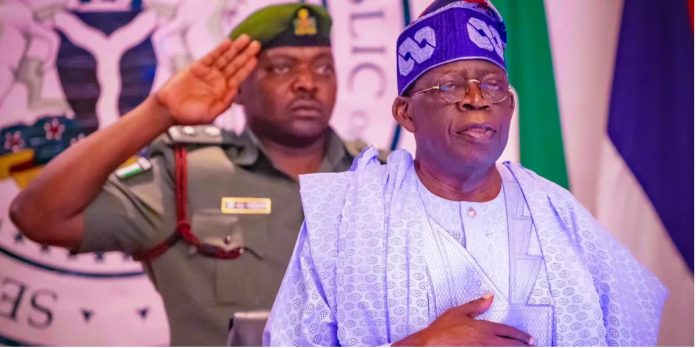
President Bola Ahmed Tinubu recently marked two years in office with a national statement that sought to instill optimism and present evidence of steady progress. He spoke of tough economic reforms, including the removal of fuel subsidies and changes to the foreign exchange system, and claimed these were necessary measures to avoid fiscal disaster. The president emphasized improved revenue, a stronger oil and gas sector, and increased investor confidence. In his words, “the worst is behind us,” and he called on citizens to “bet on Nigeria.”

However, the response from Nigerians has been anything but uniform. Social media, particularly Twitter, became a vibrant arena of contestation. For many, the president’s tone and claims felt out of touch with the everyday reality on the ground.

Some voices welcomed the speech (see below) and praised the administration’s resolve. One user wrote, “Congratulations on IMF debt settlement. Looking forward to more action, Mr. President.” Another added, “You are taking the bullets others were scared of. You could have continued with the norm, but you chose a different path. Patriots are behind you.”

These citizens view Tinubu’s policies as bold and necessary. They argue that while the impact might not yet be widespread, the groundwork is being laid for long-term improvement. Supporters credited him for increasing the tax-to-GDP ratio, settling international debt, and restoring investor confidence in the oil and gas sector.

Yet others responded with cautious skepticism. They acknowledged parts of the government’s progress, but questioned the extent to which these improvements translated into better lives. As one user said, “We are listening, yes, we’re also watching. We want actions that match the speeches — fuel in our tanks, food on our tables, and peace in our communities.” For this group, there’s a growing desire to see numbers reflect reality, not just in reports, but in households and streets across the country.

A significant number of Nigerians expressed deep dissatisfaction. They felt the speech glossed over the suffering many are experiencing. One critic put it starkly: “Your message sounds like a corporate PR memo, not a sincere address to a people in deep anguish.” This sentiment echoed widely, as many argued that removing subsidies and unifying exchange rates without strong safety nets plunged more people into poverty.

Another user painted a harsher picture: “Today, millions cannot afford basic food items, transportation, rent, or healthcare. Families are choosing between feeding their children and paying school fees.” While the government claims inflation is easing, the cost of a 50kg bag of rice still hovers near ?95,000. Critics argue that the president’s reforms, though potentially sound in theory, lacked the compassion and support mechanisms needed in practice.

Insecurity remains another key area of concern. Despite Tinubu’s assertion that security forces are stepping up, Nigerians continue to report kidnappings, communal violence, and unsafe roads. “You say the worst is behind us, yet insecurity still haunts us,” one tweet read. “Every Nigerian deserves to live without fear. That’s not our reality today.”

Some responses also reflected deep political resentment. A number of users outright rejected the legitimacy of Tinubu’s administration, claiming he “forced his way into power” during a controversial election. As one person bluntly posted, “Nobody entrusted anything to you. You stole it.” While these sentiments may be politically charged, they highlight a trust gap that cannot be ignored.

Others went further, accusing the government of enriching a few while the majority suffer. “You entrusted yourself with the sacred responsibility of enriching your future generations with Nigeria’s plundered wealth,” another user wrote. These comments show how public trust is not just fragile, but in many quarters, completely broken.

Still, not all responses were hostile. A few expressed hope and wished the president well. “Happy 2 years anniversary sir. May your remaining years be smoother,” one tweet read. Another prayed: “God will continue to silence all your enemies and the enemies of our great country.”

The mixed reactions show that Nigerians are not simply passive recipients of political messaging. They are actively engaging, questioning, supporting, and challenging. They are not merely reacting emotionally; they are responding based on how they experience government policies in their daily lives.

This moment presents a crucial lesson in leadership. National progress is not just measured by GDP or oil rig counts. It is measured by how people feel, what they can afford, and how safe they are. A successful administration must not only make good policies, it must ensure those policies touch the lives of citizens in real and visible ways.

—the speech

Two years ago, you entrusted me with the sacred responsibility to lead our nation at a time of historic challenges. Together, we faced those headwinds with courage and determination.

The economic and general situation I inherited required that we redirect the country’s affairs with a bold and new vision. I immediately implemented two necessary policies—to stop our country from drifting into the precipice. We removed decades-long fuel subsidies and dismantled the corruption-ridden multiple exchange rate windows. These were no longer sustainable and had become a chokehold on our nation’s neck, strangling our future.

Let me be clear: the only alternative to the reforms we initiated was a fiscal crisis—runaway inflation, external debt default, crippling fuel shortages, a plunging Naira, and an economy in free-fall.

Despite the bump in the cost of living, we have made undeniable progress. Inflation has begun to ease. Rice prices and other staples are declining. Our oil and gas sector is recovering—rig counts are up by over 400%, and over $8 billion in new investments have been committed.

We have stabilised our economy. We’re better positioned for growth and prepared to withstand global shocks. Gross proceeds per barrel are aligned with forecasts. Fiscal deficit narrowed from 5.4% of GDP in 2023 to 3.0% in 2024. We recorded over N6 trillion in revenue in Q1 of this year.

We have discontinued Ways & Means financing. The NNPC, no longer burdened by unsustainable fuel subsidies, is now a net contributor to the Federation Account. We are achieving fuel supply security through local refining.

Our debt service-to-revenue ratio dropped from nearly 100% in 2022 to under 40% by 2024. We paid off IMF obligations. Our net external reserves grew from $4 billion in 2023 to over $23 billion by the end of 2024.

Under our bold tax reform agenda, our tax-to-GDP ratio rose from 10% to over 13.5% in just one year. Food, education, and healthcare now attract 0% VAT. Rent, public transport, and renewables are fully exempted. We’re eliminating multiple taxation and protecting disposable incomes—especially for low-income households and small businesses.

This is not just about revenue. It is about inclusive economic growth. This is about economic justice.

This is the movement we promised—a government of action powered by the energy and innovation of young Nigerians. From Innovate Naija and NASENI’s digital reboot, to electric vehicle assembly and drone engineering, we are restoring dignity to work and opening a future of possibilities.

I told security chiefs: up your game and collaborate to end this plague of evil men. Every Nigerian deserves to live without fear. We shall remain vigilant.

We are preparing to welcome the world to Nigeria for the Motherland Festival—a landmark gathering that will spotlight our rich heritage, vibrant creative industries, and the beauty of our people. It will showcase Nigeria’s promise—inviting the world to rediscover our nation.

Our journey is not over, but our direction is clear. So is our resolve. By the Grace of God, the worst is behind us. The real impact of our governance is beginning to take hold. The future is bright—and together, we will build a stronger, more inclusive Nigeria.

Bet on Nigeria.

~ PBAT