DD
MM
YYYY

PAGES

DD
MM
YYYY

spot_img

PAGES

Home Blog Page 1232

AfDB Unveils $6bn for Health Investment Across Africa, Reports Major Gains in Agriculture and Energy

0

The African Development Bank (AfDB) Group is rolling out a bold $6 billion investment strategy to transform Africa’s fragile healthcare systems and reduce the continent’s reliance on imported drugs.

The initiative, unveiled at the 2025 AfDB Annual Meetings in Abidjan, marks one of the most ambitious continent-wide health interventions in recent memory—divided into two $3 billion programmes targeting infrastructure and local pharmaceutical manufacturing.

AfDB President Dr. Akinwumi Adesina, while presenting his 10-year scorecard, emphasized that the investment was already underway, describing it as a critical step toward ensuring Africa can both deliver and produce healthcare solutions at scale.

“Today, the African Development Bank Group is implementing a $3 billion programme for quality health infrastructure and a $3 billion programme for the development of local pharmaceutical manufacturing capacity in Africa,” Adesina announced.

Central to this vision is the newly established African Pharmaceutical Technology Foundation, an institution designed to break Africa’s historical exclusion from proprietary pharmaceutical technologies. The foundation will help African countries gain access to intellectual property rights and safeguard essential manufacturing know-how for medicines and vaccines.

Adesina’s remarks came as the Bank marked what he called “a decade of delivery,” particularly in agriculture, food security, and energy access—three areas where the AfDB says it has either mitigated or outright reversed looming crises.

The Bank’s Feed Africa strategy, launched in response to growing food insecurity and exacerbated by the war in Ukraine, reportedly helped 104 million Africans achieve food security. The Bank said its interventions also gave 13 million farmers access to improved agricultural technologies across the continent.

When the war in Ukraine triggered fears of a food crisis due to blocked exports of wheat, maize, and oilseeds, the AfDB moved swiftly with a $1.5 billion emergency food production facility. According to Adesina, the facility exceeded expectations.

He said in just two years, our support allowed 14 million farmers across 30 countries to have access to improved seeds and fertilizers. This led to the production of 44 million tons of food—116% above the target—worth $17.3 billion.

Ethiopia’s Wheat Revolution and a $72 Billion Food Pledge

One standout example is Ethiopia, which expanded its heat-tolerant wheat-producing areas from just 5,000 hectares in 2018 to more than 650,000 hectares by 2023. The result: self-sufficiency in wheat within four years—a feat that was once seen as far-fetched in a region traditionally reliant on imports.

The momentum gained from such successes was evident at the Feed Africa Summit in Dakar, where over 30 African leaders signed the Food and Agriculture Delivery Compacts. The summit mobilized a staggering $72 billion in global pledges to back national food security agendas, which were later endorsed by the African Union.

Energy Access Push Gains Steam

Buoyed by gains in agriculture, the AfDB is now turning its attention to another foundational issue—energy. In partnership with the World Bank, the Bank launched Mission 300, an ambitious drive to connect 300 million people to electricity by 2030.

This culminated in the Africa Energy Summit in Dar es Salaam, co-chaired by Tanzanian President Samia Suluhu Hassan, where more than 48 African countries endorsed the Dar es Salaam Declaration on Energy Access.

“Leaders at the summit unanimously endorsed the Dar es Salaam Declaration on Energy Access, with the full support of the African Union,’’ Adesina said.

The Declaration reflects a rare continent-wide consensus to accelerate energy delivery through a combination of national policy shifts, regional electricity grid interconnections, and increased investment in renewables and transmission infrastructure. The Bank reported that $55 billion has already been mobilized to support these efforts.

A Coordinated Future

Adesina’s report card paints a picture of an institution not merely reacting to crises but proactively reshaping the African development narrative—from health and food to energy. The Bank is banking on high-level coordination and massive financial commitments to drive systemic changes across sectors.

With the launch of the African Pharmaceutical Technology Foundation, a major step has been taken to change how the continent responds to health emergencies—ending dependence on imported vaccines and treatments that became painfully evident during the COVID-19 pandemic.

The broader investment push underlines a coordinated, long-haul approach by the AfDB to ensure that Africa’s economic growth is not only resilient but also anchored in self-reliance and innovation.
Meta AI Hits 1 Billion Users as AI Race Intensifies Among Tech Giants

0

Meta’s artificial intelligence assistant has surpassed one billion monthly active users, CEO Mark Zuckerberg announced during the company’s annual shareholder meeting.

The milestone, first reported by CNBC, represents a doubling of Meta AI’s user base since September 2024, when the company last disclosed it had 500 million active users.

The growth cements Meta AI as one of the most widely adopted consumer-facing AI platforms in the world and underlines Meta’s unique advantage: the unmatched reach of its social media empire.

Social Media Synergy Accelerates Meta AI Growth

Meta’s success in rapidly onboarding users to its AI assistant is closely tied to its control of some of the most widely used social platforms globally—Facebook, Instagram, WhatsApp, and Messenger. The company has capitalized on its massive user base by providing seamless access to AI tools across platforms that users already depend on daily, embedding the assistant directly into these services and recently launching a standalone Meta AI app.

“The focus for this year is deepening the experience and making Meta AI the leading personal AI with an emphasis on personalization, voice conversations, and entertainment,” Zuckerberg told shareholders.

Meta has made it clear that it’s not just competing to be first—it wants to dominate the AI space by making its assistant a routine part of how people interact online. This strategic integration gives Meta an advantage many of its rivals can’t match.

Monetization on the Horizon

Zuckerberg also hinted at future monetization models for Meta AI, which has so far remained free to users. The company is exploring inserting paid recommendations and offering a subscription service for those who want access to more powerful AI capabilities—particularly those requiring more computational resources.

“If we’re delivering value to people, there will be opportunities to either insert paid recommendations or offer subscriptions so that people can pay to use more compute,” he said.

Such a move would position Meta AI to go head-to-head with other leading AI platforms like OpenAI’s ChatGPT, which already offers a paid tier to access GPT-4 and other advanced tools.

The Broader AI Battle: Leverage is King

Meta isn’t the only player using platform leverage to drive AI adoption. Elon Musk’s xAI, still in its early stages, is following a similar path by integrating its chatbot, Grok, directly into X (formerly Twitter), which Musk owns. The tactic gives xAI instant distribution and feedback loops across millions of users, a powerful boost in an increasingly competitive field.

This is a key edge that OpenAI currently lacks. Despite its leading technical position and widespread name recognition, OpenAI does not have a proprietary social media platform to deploy its assistant at scale. As competition heats up, OpenAI appears to be aware of the gap.

In recent months, there have been signals that OpenAI is exploring ways to build or acquire a social network of its own. The company understands that while superior AI models are essential, they aren’t enough to win the race without mass user engagement and data streams that platforms like Meta and X can readily supply.

As the AI assistant space moves from novelty to necessity, distribution power may prove as decisive as technical prowess. With Meta’s user base now surpassing the billion mark, the company is positioned not only as a front-runner in AI—but potentially the first to truly embed it into daily digital life at scale.

The inevitability of AI monetization also means that Meta’s control of both infrastructure and distribution puts it in a rare position to turn scale into sustained revenue.

Salesforce’s aggressive artificial intelligence push isn’t just limited to its products. Speaking at a quarterly earnings call this week, Chief Operating and Financial Officer Robin Washington said the company has “reduced some of (its) hiring needs” as it outsources more work to AI. Engineering and customer service are seeing the most movement, and Washington says 500 customer service employees will be reassigned to other roles. Hiring hasn’t slowed down in all departments, however: Salesforce plans to beef up its sales ranks by 22%.

Boeing to Resume Jet Deliveries to China as Trump’s 90-Day Truce Softens Trade Standoff

0

Boeing will resume aircraft deliveries to China next month, marking a breakthrough in the icy trade relationship between Washington and Beijing.

The move comes after months of stalled transactions that left the American aerospace giant shut out of its second-largest market. The restart also follows President Donald Trump’s announcement of a 90-day truce in the U.S.-China trade conflict earlier this month — a key development that appears to have paved the way for the return of Boeing jets to Chinese tarmacs.

CEO Kelly Ortberg confirmed the update on Thursday during a presentation at the Bernstein investor conference, saying China had now given the green light to resume deliveries after previously halting them amid heightened trade tensions.

“China has now indicated … they’re going to take deliveries,” Ortberg said. “The first deliveries will be next month.”

The renewed flow of Boeing jets into China highlights what could be a significant shift in U.S.-China commercial relations — one catalyzed by President Trump’s unexpected trade truce announcement on May 5. The 90-day pause in new tariffs and trade hostilities was framed by Trump as a window to “allow our teams to work on a more comprehensive agreement.”

The truce marked a rare cooling of rhetoric in a trade war that has spanned tariffs on billions of dollars worth of goods, export restrictions, and a near halt in cross-border industrial cooperation. For Boeing, which is often seen as a proxy for broader U.S. manufacturing and export health, the resumption is an early sign that the truce is already having commercial consequences.

Boeing has long depended on China’s booming aviation sector, fueled by a growing middle class and rapid domestic airport expansion, to drive long-term sales growth. But the company’s deliveries to Chinese airlines have slowed to a trickle in recent years, weighed down by regulatory uncertainty, pandemic disruptions, and a wider geopolitical chill.

Ortberg declined to comment on whether the resumed deliveries came with additional conditions or concessions but acknowledged that the development was “encouraging for everyone watching the U.S.-China dynamic.”

Boeing’s Strategic Stakes in China

China is not just a major buyer of Boeing aircraft — it is a critical linchpin in the company’s global business. The country is expected to account for nearly 20% of all global aircraft demand over the next two decades, according to Boeing’s own forecasts. Missing out on Chinese contracts leaves Boeing exposed to European rival Airbus, which has capitalized on the opening to deepen its footprint in the country.

Thursday’s announcement provides a shot in the arm to Boeing’s embattled commercial division, which has been trying to recover from a series of crises — including the two fatal 737 Max crashes and the more recent midair blowout of a door panel on an Alaska Airlines Max 9 jet. Those incidents invited waves of regulatory scrutiny and production restrictions, including a Federal Aviation Administration (FAA) cap limiting output to 38 Max jets per month.

However, Ortberg said Boeing is aiming to ramp up production to 42 planes per month by midyear and will assess increasing that number to 47 by the end of 2025. The company is also targeting certification for its Max 7 and Max 10 models by year-end, which would restore its full narrow-body lineup for the first time in years.

Even with the resumed deliveries, Boeing continues to face tariff pressures. Ortberg noted that the company is still paying duties on some imported aircraft components, particularly from Japan and Italy, used in the production of wide-body Dreamliner jets. Those jets are primarily assembled in South Carolina.

He, however, pointed out that most of those duties can be recouped once the aircraft are exported.

“The only duties that we would have to cover would be the duties for a delivery, say, to a U.S. airline,” he said, downplaying any lasting financial impact for international orders.

He added that the current trade environment, while volatile, is unlikely to be permanent.

“I personally don’t think these [tariffs] will be permanent in the long term,” Ortberg said, expressing cautious optimism about a thaw in U.S. trade relations with its key partners.

Ortberg’s leadership, which began last August, has won cautious praise from major airline CEOs, who had grown increasingly frustrated with Boeing’s delayed deliveries during a period of surging post-pandemic travel demand. United Airlines CEO Scott Kirby, speaking on CNBC Thursday, said he believed Boeing “has turned the corner.”

“We over-ordered aircraft believing the supply chain would be challenged,” Kirby said, noting that global production remains under strain even as demand returns.

Airlines have welcomed the prospect of more predictable Boeing deliveries, especially as summer travel season approaches and capacity constraints loom.

Turning a Corner or Temporary Relief?

While the resumed deliveries to China are a clear win for Boeing, questions remain about whether this shift is a permanent reordering of the U.S.-China trade balance — or just a temporary reprieve under Trump’s 90-day truce.

China’s willingness to re-engage in commercial aviation may indicate a strategic pivot to secure essential industrial partnerships while avoiding further economic fallout. For Trump, allowing Boeing to restart deliveries gives his administration leverage to claim a trade win — even as structural issues in U.S.-China relations remain unresolved.

In the meantime, Boeing is capitalizing on the opportunity, using the breakthrough to reset its narrative. The company still faces a long road to recovery, burdened by regulatory hurdles, production constraints, and the lingering reputational scars of its past missteps.

Trump Media’s $2.5B Bitcoin Treasury Deal Is A High-Stakes Bet

0

Trump Media & Technology Group, the parent company of Truth Social, announced on May 27, 2025, a $2.5 billion deal to create a Bitcoin treasury, one of the largest by a public company. The funds will be raised through a private placement with approximately 50 institutional investors, involving $1.5 billion in common stock and $1 billion in 0% convertible senior secured notes, priced at a 35% premium.

The deal, expected to close around May 29, 2025, will boost the company’s liquid assets to over $3 billion, alongside existing cash and investments of $759 million from Q1 2025.  CEO Devin Nunes described Bitcoin as an “apex instrument of financial freedom,” stating the investment aims to protect against financial institution discrimination and create synergies for subscription payments and utility tokens across Truth Social, Truth+, and Truth.Fi platforms.

Crypto.com and Anchorage Digital will provide custody for the Bitcoin holdings. The move aligns with a broader trend of companies like MicroStrategy adopting Bitcoin as a treasury asset and reflects Trump’s pro-crypto stance, including his push for a U.S. strategic Bitcoin reserve. However, Trump Media’s stock fell 10-12% following the announcement, despite Bitcoin trading near its all-time high of around $112,000.

The $2.5 billion Bitcoin treasury deal by Trump Media & Technology Group carries significant implications, both for the company and the broader financial and political landscape. The deal significantly boosts Trump Media’s liquid assets to over $3 billion, providing substantial financial flexibility. This could fund expansion of Truth Social, Truth+, and Truth.Fi, potentially enhancing their competitiveness in social media, streaming, and financial services.

By allocating a large portion of its treasury to Bitcoin, Trump Media is betting on the cryptocurrency’s long-term value as a hedge against inflation and fiat currency devaluation. This aligns with strategies adopted by companies like MicroStrategy, which has seen its stock soar due to its Bitcoin holdings. Bitcoin’s volatility (trading near $112,000 but with historical swings) introduces risk. A price crash could impair the company’s financial position, while a continued rally could amplify returns. The 10-12% stock drop post-announcement suggests investor skepticism about the move’s immediate benefits.

Using Crypto.com and Anchorage Digital for custody and planning synergies with subscription payments and utility tokens positions Trump Media as a crypto-friendly entity, potentially attracting a younger, tech-savvy user base. The deal reflects Donald Trump’s recent pro-crypto stance, including his advocacy for a U.S. strategic Bitcoin reserve and policies to make the U.S. a “Bitcoin mining powerhouse.” This could appeal to his political base and crypto enthusiasts, reinforcing Truth Social’s role as a platform for his supporters.

CEO Devin Nunes’ framing of Bitcoin as an “apex instrument of financial freedom” ties into broader themes of resisting centralized financial control and “debanking” risks, resonating with populist and libertarian sentiments. As one of the largest Bitcoin treasury deals by a public company, this move could inspire other firms to follow suit, further legitimizing cryptocurrency as a corporate asset class.

Integrating Bitcoin into Truth Social’s ecosystem (e.g., via Truth.Fi) could pioneer new models for decentralized finance (DeFi) within social platforms, though execution risks remain high given the company’s limited track record in fintech. Supporters of Bitcoin and decentralized finance see this as a bold move to embrace a future where cryptocurrencies challenge traditional banking systems. Critics, including traditional investors, view it as reckless due to Bitcoin’s volatility and regulatory uncertainties. The stock’s 10-12% drop reflects this skepticism among some shareholders. Retail investors, particularly those aligned with Trump’s base or crypto communities, may view this as a visionary step.

Institutional investors, wary of Bitcoin’s risks and Trump Media’s governance issues (given its association with a polarizing figure), may remain cautious, contributing to the stock’s decline. The deal reinforces Trump Media’s alignment with Trump’s political brand, appealing to his base who see Bitcoin as a tool for economic sovereignty. Opponents may view it as a publicity stunt or a risky financial maneuver tied to Trump’s polarizing persona, deepening partisan divides in perceptions of the company.

Libertarians and crypto advocates may praise the move as a stand against centralized financial control, while proponents of regulation may argue it invites scrutiny from agencies like the SEC, especially given Trump’s history of regulatory battles. The crypto community, active on platforms like X may celebrate this as a mainstream endorsement of Bitcoin, boosting sentiment. Skeptics, including those who see crypto as speculative or environmentally harmful (due to mining’s energy use), may criticize the move as irresponsible.

The deal may solidify Truth Social’s niche as a platform for Trump-aligned, crypto-friendly users, but it risks alienating mainstream users who prefer platforms like X or Meta’s offerings, which have not yet embraced crypto at this scale. Trump Media’s Bitcoin treasury deal is a high-stakes bet that could reshape its financial and strategic trajectory while amplifying its ideological alignment with Trump’s pro-crypto stance.

It strengthens the company’s position in the crypto ecosystem but introduces significant risks due to Bitcoin’s volatility and the company’s polarizing brand. The move deepens divides between crypto advocates and skeptics, Trump supporters and detractors, and decentralized finance proponents and traditional financial institutions. Its success will hinge on Bitcoin’s performance, regulatory developments, and Trump Media’s ability to execute its crypto-integrated vision for Truth Social and beyond.

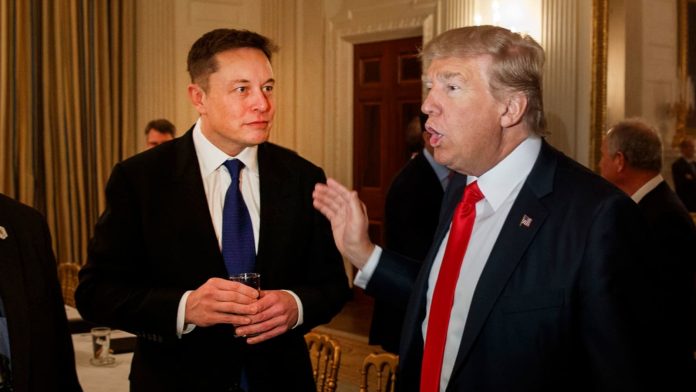
Musk Criticizes Trump’s “Big, Beautiful Bill” in Rare Break with the President, Says It Undermines DOGE’s Work

0

In a rare and pointed criticism of President Donald Trump, Elon Musk has slammed the recently passed Republican spending bill, calling it a setback for efforts to reduce wasteful government expenditure.

The criticism, which aired in a preview of an upcoming interview on CBS Sunday Morning, marks one of Musk’s most direct and public rebukes of the man he has long backed—both ideologically and politically—even when Trump’s policies ran contrary to Musk’s business interests.

“I was, like, disappointed to see the massive spending bill, frankly, which increases the budget deficit, not just decrease it, and undermines the work that the DOGE team is doing,” Musk said, referring to the Department of Government Efficiency (DOGE), the federal cost-cutting agency he headed until recently.

The bill in question—the “One Big Beautiful Bill Act”—is projected by the Congressional Budget Office (CBO) to raise the federal budget deficit by $3.8 trillion over the next ten years. That’s a sharp reversal from DOGE’s stated aim of fiscal prudence.

Since its creation in January 2025, DOGE has claimed to have saved $170 billion in taxpayer money by slashing bureaucratic redundancies and eliminating overlapping federal programs, including a controversial gutting of the U.S. Agency for International Development and job cuts affecting some 275,000 federal employees, according to data from consulting firm Challenger, Gray & Christmas.

Trump had boasted of the bill as a landmark legislative win, calling it “big and beautiful.” But Musk, in a dig at that framing, retorted, “I think a bill can be big or it can be beautiful, but I don’t know if it can be both.”

This stark divergence in rhetoric has sparked speculation of a growing schism between the billionaire industrialist and the Republican leader, especially as Musk announces the end of his role at the White House.

For years, Musk has been seen as a cheerleader for Trump, praising his deregulatory stance and frequently appearing at White House events. He continued to offer public support even when the Trump administration pursued policies that threatened Musk’s core businesses—particularly the electric vehicle sector, which faced headwinds from Trump’s fossil fuel-heavy energy agenda and the rollback of federal EV subsidies.

Trump’s support for oil drilling and traditional automakers has consistently undermined the clean energy transition championed by Tesla and other Musk ventures. Yet Musk, always calculating, maintained cordial relations with Trump, securing influence in key policy discussions and later accepting a high-profile advisory role as DOGE chief—a position that allowed him to shape federal spending but also put him directly in the political spotlight.

Now, Musk’s comments suggest a shift, with the SpaceX and Tesla CEO signaling that he is stepping back from his Washington role.

“It was clear that DOGE became the whipping boy for everything,” Musk told The Washington Post in a separate interview published Tuesday. “The federal bureaucracy is much worse than I realized.”

His withdrawal comes just as Trump’s bill heads to the Senate, where it faces stiff opposition—not only from Democrats but also from Republican fiscal conservatives. Florida Governor Ron DeSantis, a former presidential hopeful and one-time Trump rival, has blasted House Republicans for failing to codify DOGE’s proposed spending cuts, calling it “a betrayal of the voters.”

The timing of Musk’s criticism is significant. Trump is known for his zero-tolerance approach to dissent, particularly from allies. His history of falling out with former aides, executives, and party loyalists is well-documented. From former Secretary of State Rex Tillerson to Attorney General Jeff Sessions and one-time strategist Steve Bannon, Trump has often publicly castigated former allies after a perceived betrayal.

That history raises questions about whether Musk’s comments could escalate into a full-blown feud. Already, reports suggest tensions have been simmering behind the scenes.

Meanwhile, markets appeared to respond positively to Musk’s pivot. Tesla stock edged higher following the release of the CBS interview clip, buoyed by investor optimism that Musk would now be refocusing on the company after months of distraction from political affairs. His companies—including Tesla, X (formerly Twitter), and SpaceX—have faced mounting challenges amid regulatory pressure and competition, making his return to the helm a welcome development for shareholders.

However, the “One Big Beautiful Bill Act” continues to divide Congress—and possibly one of its most high-profile corporate allies. If Musk’s past loyalty can no longer buffer him from Trump’s retaliation, the political fallout could reshape the calculus for other business leaders who’ve walked the tightrope of MAGA politics.