
DD
MM
YYYY

PAGES

DD
MM
YYYY

spot_img

PAGES

Home Blog Page 1253

BONK Coin Bounces Back! Experts Say Ditch PEPE for Lightchain AI’s 100x Growth Potential

0

The meme coin market is undergoing a notable shift as BONK stages a strong rebound, renewing interest in high-risk, high-reward tokens. While traders continue to chase short-term profits with meme coins like PEPE, experts are encouraging a pivot toward projects with greater long-term potential.

One standout in this space is Lightchain AI, a groundbreaking blockchain platform that leverages artificial intelligence to enhance decentralization, scalability, and governance. With its presale currently priced at $0.007 and over $18.4 million already raised, Lightchain AI is positioning itself as a promising high-growth opportunity. Analysts are even forecasting a potential 100x surge, making it a compelling option for forward-thinking investors.

Uncertain Future of BONK and PEPE

?Bonk (BONK) and Pepe (PEPE) are the meme coins that have experienced a lot of roller coasters, though. Bonk has achieved a peak price level of $0.0000579 during the latest bull market yet followed it by a major 70% drop. Market experts anticipate that Bonk’s price may rise to $0.00004468 by April 2025, registering the growth of 232.08% in percentage terms.

Moreover, Pepe’s fluctuation has been in the price zone of $0.000013 to $0.00004468 by April 2025, a figure which experts were grappling with for a long time though. But analysts who deal with money are the most skeptical about these forecasts, saying that they are based on assumptions, and the future of these meme coins is also unclear because of their inherent volatility.?

Why Experts Choose Lightchain AI Over PEPE

Experts favor Lightchain AI over PEPE due to its Cross-Chain Integration, which allows seamless communication between different blockchain networks. In comparison, PEPE remains confined to its own ecosystem, limiting both its adaptability and scalability.

Additionally, Lightchain AI promotes adoption through its Ecosystem Growth Initiatives, offering grants and incentives to developers who build on its platform. This strategy encourages continuous innovation and supports long-term growth, positioning Lightchain AI as a major player in the ever-evolving blockchain landscape.

Could Lightchain AI Be Next 100x Crypto Superstar?

Lightchain AI is the talk of the crypto world—and for good reason. Its presale is gaining serious momentum, and unlike the fleeting hype of meme coins like PEPE, this project is built on real-world utility and game-changing innovation. If you’re on the hunt for the next big thing in crypto, Lightchain AI might just be your golden ticket.

Why is everyone buzzing about Lightchain AI? Because it’s more than just another coin—it’s a revolution. By fusing AI-driven blockchain technology with solid fundamentals, Lightchain AI isn’t just playing the game; it’s rewriting the rules. This project is shaping up to become a major driver of change in the crypto investment landscape.

The presale is already drawing big attention, with savvy investors eyeing it as the next breakout star. Forget speculative assets that fizzle out—Lightchain AI has the potential for explosive, long-term growth. For those looking for a project with real staying power, this could be the one to watch.

Meme coins come and go, but Lightchain AI is here to leave its mark. If you’re ready to invest in a project that combines innovation, utility, and vision, don’t let this opportunity pass you by. The future of crypto is evolving—make sure you’re part of it!

https://lightchain.ai

https://lightchain.ai/lightchain-whitepaper.pdf

https://x.com/LightchainAI

https://t.me/LightchainProtocol

Convert your BTC, ETH and DOGE into daily income with winnermining

0

Top cryptocurrency analyst Ali Martinez reports that miners have recently taken advantage of Bitcoin’s impressive price gains, realizing nearly $18.6 million in profits as the price surged above $94,000.

Data shows that Bitcoin is decoupling from the U.S. stock market and starting to trade more like gold, once again demonstrating Bitcoin’s growing role as a safe-haven asset against global economic turmoil. With the rapid development of the digital economy, cloud mining has become an important trend in the blockchain industry. As a leader in cloud mining investment, WinnerMining is committed to revolutionizing the way people mine cloud.

The charm of Winnermining

WinnerMining makes earning money easy and even fun with its simple and transparent approach to trading and investing. Users can easily mine cryptocurrencies with just a smartphone or internet-connected device, without having to invest in expensive hardware or deal with complex technical challenges. From guaranteed returns to a transparent, fee-free environment, Winner Mining is paving the way for profitable cloud mining, making it easier than ever to earn passive income in the cloud mining space.

Winnermining: Combining environmental protection and profits

WinnerMining was founded in 2021. The company uses recyclable wind and solar energy as the core to provide users with efficient and green energy so that users can easily and conveniently earn wealth in their spare time. Winnermining has more than 100 mines and more than 3 million mining equipment around the world. All equipment is powered by renewable energy cycles, and has won the recognition and support of more than 13 million users with stable income and safety.

Incredible profit opportunities

Winnermining is world-famous for its unique daily passive income, which can reach $70,370 or more, helping users become millionaires is no longer a dream. Imagine earning a considerable income without continuous efforts or complicated settings – this is the charm of Winnermining.

Safety and sustainability

Trust and security are of paramount importance in the cloud mining sector. WinnerMining operates in compliance with all corporate governance, legal and regulatory requirements. We have chosen to follow the principles of the 2018 UK Corporate Governance Code in our corporate governance framework, ensuring that your investment is protected and allowing you to focus on profitability. All mines use renewable energy, making cloud mining carbon neutral. Protect the environment from pollution and bring huge returns, so that every investor can enjoy opportunities and benefits.

Platform advantages: 

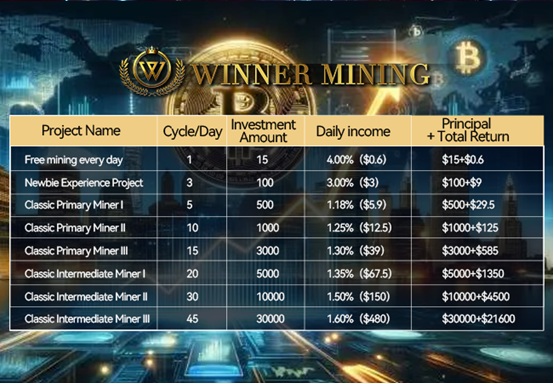
  1. Register to get an instant bonus of $15 ($0.6 for daily sign-in)?
  2. Purchase a cloud mining contract:
  3. Waiting for earnings:

For example: you purchase 100 USD, and the net profit earned from mining every day is 3 USD; you purchase 30,000 USD, and the net profit earned every day is 480 USD. The more you invest, the more you earn. You can get the profit the next day after purchasing the contract. When the profit reaches 100 USD, you can choose to withdraw it to your wallet or continue to purchase other contracts.

Affiliate Program

WinnerMining now has an affiliate program where you can earn 3%-1.5% commission by inviting new users. You can make money even if you don’t invest. Unlimited referrals, unlimited profit potential!

In short

Winner Mining subverts the world of cloud mining investment. The passive income it generates is the goal of every investor and trader. Our mission is to allow anyone, anywhere to conduct any transaction. To reduce people’s dependence on financial institutions, free themselves from the trouble of money, and embark on the road to wealth freedom.


For more information, please visit winnermining official website?https://winnermining.com

Or contact the company:  info@winnermining.com

Understanding The Startup Incentive Construct by Ndubuisi Ekekwe

0

The Startup Incentive Construct explains why startups often outperform established companies despite having fewer resources. The central idea is that older companies, while having advantages like money and experience, often misalign their incentives when addressing problems. They tend to adapt problems to fit their existing incentives, causing them to focus on the wrong issues and lose out to startups. Startups possess different incentives, giving them inherent advantages. Established companies often experience an “Innovation Hangover,” making it difficult for them to sacrifice current revenue for new opportunities.

In this piece, I explain why startups win, despite the efforts of older companies who challenge them in new areas they are pioneering. The older companies can come with money, experience and technology, but most times, they are solving problems, with the wrong incentives.

Consequently, they adjust the problems to accommodate their incentives and in the process, solve an entirely different problem, resulting to a loss. You read it from me: African and specifically Nigerian startups, you can win over the big players. Your incentives are different, and those are inherent advantages for you.

The established companies have what I have called Innovation Hangover which is an inertia to cannibalize existing revenue sources for new opportunities. See it this way: If you run a treasury operation in a bank which will yield $5,000 profit but your fintech unit (a subsidiary) can do the same for $200, would you dismantle that treasury unit, and allow the fintech unit to serve the public because one fintech startup has started offering the service for $200?

That is not what we do most times because of the revenue/profit hangover. So, what happens is this: to fix that problem, the bank has to create a new market friction, and try to solve it. Possibly, that new problem can yield for the bank $1,000 profit, and it can feel that it has innovated, and has challenged the startup on pricing. Indeed, it could offer more features and services than what the fintech startup is offering for $200.

Yet, that is not the original friction which the standalone startup went for. Typically, over time, the startup can still win because the incumbent is hanging onto the established profits, and solving entirely new problems. I have called this Startup Incentive Construct.

Summary

  • In a video, Ndubuisi Ekekwe discusses why startups often outperform older companies in new areas they pioneer, despite the latter having more resources and experience.
  • Established companies can struggle with an “Innovation Hangover,” being hesitant to shift focus from existing revenue sources to new opportunities, leading them to solve different problems than startups.
  • African and Nigerian startups have inherent advantages over larger players due to different incentives, allowing them to potentially succeed in competition.
  • Ekekwe highlights a scenario where a bank’s treasury unit could make $5,000 profit, but a fintech subsidiary could do the same for $200, yet the bank may resist dismantling the treasury unit due to profit concerns.
  • This reluctance to disrupt existing revenue streams can lead established companies to create new market frictions and solve different problems, ultimately diverging from the original focus of startups.
  • Despite incumbents offering more features and services than startups at competitive prices, startups can still prevail over time due to their focus on original frictions and incentives, a concept termed the “Startup Incentive Construct” by Ekekwe.

Context

In video below by Ndubuisi Ekekwe, the discussion delved into the dynamic landscape of innovation and competition between startups and established companies. To grasp the essence of this dialogue, it is crucial to understand the startup ecosystem’s fundamentals and the challenges incumbents face in adapting to change.

Key themes explored include how startups leverage their agility and fresh perspectives to pioneer new frontiers, contrasting with established firms suffering from an “Innovation Hangover,” a reluctance to disrupt existing revenue streams hindering their ability to innovate effectively. The concept of a “Startup Incentive Construct” was introduced, emphasizing the unique incentives that drive success for startups in competitive environments.

Historical context plays a pivotal role in contextualizing this discourse, tracing the evolution of disruptive technologies and business models that have reshaped industries over time. Recent events showcasing startup successes against established players underscore the ongoing shift in power dynamics within various sectors.

Google’s Iron Grip on Search Slips to 90% Amid Antitrust Heat and AI-Driven Competition

0

For more than two decades, Google has been the near-undisputed gatekeeper of the internet, guiding how billions access information. But a noticeable shift is now underway — one that could mark the beginning of a new era in digital search.

Google’s global search market share has fallen below 90% for the first time since 2015, underlining a growing disenchantment with its dominance, a mounting legal siege from regulators, and a wave of new challengers powered by artificial intelligence.

In March 2025, Google’s share of global search traffic dropped to 89.71%, according to figures from Statcounter — a continuation of a downward trend that began in October 2024. While that number might still seem unassailable, it represents a symbolic and significant threshold. Google has not dipped below 90% in almost a decade. And what’s emerging now isn’t a statistical anomaly, but a signal of a sustained shift.

On desktop devices, historically one of Google’s strongholds, the decline is sharper. From 87.65% in May 2023, its share has plummeted to 79.1%. In Europe, where regulatory scrutiny of Big Tech has long been fierce, Google’s desktop search market share fell even further to 77.78% as of March 2025.

At The Back of DOJ’s Antitrust Case

The numbers land at a precarious moment for Google. In the U.S., the Department of Justice is intensifying its efforts to dismantle what it calls an illegal monopoly. As part of its sweeping antitrust lawsuit, the DOJ is reportedly pushing for Google to sell major parts of its ecosystem, particularly its Chrome browser, arguing that its bundling with Google Search gives the company an unfair advantage by making it the default experience for millions.

Regulators allege that Chrome, Android, and exclusive agreements with Apple and other device manufacturers create a “self-reinforcing cycle” that locks users into Google products and blocks competition. If the courts agree, Google may be forced to sell or separate Chrome from its advertising and search business — a structural remedy that could radically alter the internet’s balance of power.

That legal threat coincides with real-world user behavior now beginning to reflect the cracks in that ecosystem. As users start turning off Google as their default, the company’s dominance is no longer assumed, and challengers are beginning to capitalize.

The AI Search Disruption

One of the most potent disruptions comes not from traditional competitors like Bing, but from the explosion of generative AI tools. OpenAI, in particular, has emerged as an unexpected rival in the search space — not through a search engine per se, but by fundamentally changing how users seek information.

With the launch of ChatGPT plugins and integration with Microsoft’s Bing, OpenAI has turned conversational AI into a de facto search layer. Millions now turn to AI tools to answer queries, summarize news, generate explanations, and even compare products — tasks that would have otherwise started with a Google search.

More recently, OpenAI began experimenting with its own web-browsing capabilities built into ChatGPT, directly challenging Google’s core function. Users increasingly rely on AI-generated responses instead of combing through links or ad-heavy search results. For many, it’s faster, cleaner, and less intrusive.

This AI-fueled behavioral shift is already reshaping search expectations. Google’s efforts to keep pace, including the rollout of AI-powered Search Generative Experience (SGE), have been met with mixed responses. Critics argue that Google’s results now feel cluttered, biased toward sponsored content, and overly engineered.

While AI is pulling users away from traditional search, the decline in Google’s market share is also being driven by a groundswell of privacy concerns, ad fatigue, and growing distrust of monopolistic platforms. European search engines like Ecosia and Qwant are experiencing surging user numbers. Ecosia, which donates profits to environmental causes and does not track users, reports a 250% jump in traffic since late 2024.

Microsoft’s Bing, despite years in Google’s shadow, is also regaining relevance — thanks largely to its integration with AI. Bing is now baked into Windows 11, Edge, and ChatGPT, creating new channels of discovery.

Even Apple long speculated to be building its own search engine, has intensified its efforts to reduce reliance on Google — especially as it faces heat over accepting billions annually to make Google the iPhone’s default search engine.

A Systemic Erosion, Not a Sudden Collapse

Some observers may dismiss a 1% dip as inconsequential. But when applied to the scale of the internet, where over 5 billion people use search engines, that shift represents more than 50 million users no longer defaulting to Google. And that number appears to be growing each month.

Many believe that the erosion of Google’s monopoly may not come from a single blow but from the cumulative effect of public fatigue, regulatory intervention, and evolving technology. However, the search giant is far from surrendering its crown. With nearly 90% of the global market, vast cash reserves, and technical muscle, the company remains a titan. But its grip is loosening — and that matters.

Why Smart Investors Are Betting on This Crypto Over Bitcoin (BTC) and Ripple (XRP) in 2025

0

As the 2025 bull market takes shape, seasoned investors are beginning to shift their focus from established giants like Bitcoin (BTC) and Ripple (XRP) toward emerging opportunities with higher upside potential. One standout is Lightchain AI—a project blending artificial intelligence with blockchain to create a scalable, decentralized infrastructure for intelligent applications.

Currently in presale at $0.007, Lightchain AI has already raised $18.4 million, underscoring rising confidence from early backers. With a strong roadmap, transparent governance, and real-world utility, smart investors are eyeing this altcoin as a future leader. For those seeking exponential growth, Lightchain AI is shaping up to be the smarter bet.

Bitcoin and Ripple- Established Yet Facing Challenges

Bitcoin (BTC) and Ripple (XRP) are well-known cryptographic assets and they have played a significant role in the crypto market. Bitcoin, also the digital alternative to gold, had been on a mission to become stable and kept dealing with numerous challenges. Bitcoin price has been marked out with high volatilities since 2025; thus, it fell from the highest $106,000 at the end of January to $77,000 in March, which is the sign of the increasing volatility in the market. Such huge volatility has made it hard for some institutional investors who are searching for the unmovable assets.

Ripple, which is very much famous for its niche in cross-border payments, was a victim of legal battles. In fanuary 2022, Ripple Labs decided to settle the dispute with the U.S. which also led to the company paying a 50 million dollar fine to the regulator for the unregistered security sales. Inspite of this lawsuit, it harbors the XRP sales primarily for institutional objective, thus facing a $125 million fine plus non-disclosure of some of the transactions.

These two cryptocurrencies are dealing with tricky regulations in the crypto space and also with the market dynamics. Their success in handling these hurdles is going to directly affect them in the utilization of their roles and also the stability of the digital economy that is changing.

Why Investors Are Turning to Lightchain AI

In 2025, Lightchain AI distinguishes itself through its advanced integration of blockchain and AI, offering practical, real-world applications that go beyond speculative trends. Its well-structured tokenomics are a key draw for investors, with 40% of the 10 billion total token supply allocated to presale and 28.5% reserved for staking rewards.

This strategic approach supports both short-term adoption and long-term sustainability. The project’s focus on open-source development, cross-chain compatibility, and scalable infrastructure positions it as a leader in the industry.

With a comprehensive roadmap guiding its evolution from prototype to global adoption, paired with robust tokenomics tailored to long-term engagement, Lightchain AI is capturing the attention of developers, investors, and institutions alike. It is not merely following current market trends but actively shaping the future of intelligent blockchain networks.

Lightchain AI – Next Big Thing in Crypto Investment

Bitcoin and Ripple may have laid the foundation for the crypto world, but the game is evolving. Investors now want more than just a store of value or payment solutions—they’re looking for innovation, utility, and growth. Enter Lightchain AI; a groundbreaking combination of artificial intelligence, top-tier security, and decentralized governance that’s set to redefine the blockchain landscape.

With a wildly successful presale and bold development plans, Lightchain AI is the project smart investors are watching closely. Looking for long-term gains? This could be your golden ticket. As the focus shifts to high-utility crypto projects, Lightchain AI stands out as the ultimate choice for those ready to invest in the future. Don’t just follow the trend—lead it.

https://lightchain.ai

https://lightchain.ai/lightchain-whitepaper.pdf

https://x.com/LightchainAI

https://t.me/LightchainProtocol