Congratulations to the Tekedia Nation. Our Tekedia Mini-MBA edition 16 co-learners graduated last Saturday, and they’re #Ready2Lead the world of business and commerce.
To all graduates, thank you for choosing Tekedia Institute. Knowledge brings the liberation of the mind, and I am confident that we provided pillars to support your knowledge systems.
The certificates are now ready for collection; follow the steps in the classboard for yours. As the Lead Faculty of this Institute, I want to thank you for co-learning with us. And may I add: “win the future, you are #ready2lead the world”. Congratulations!
(Learners-led physical graduation event will take place in Lagos over the weekend. Two of our faculty members will deliver graduation lectures. I thank the LOC for organizing this and want to wish everyone a great graduation ceremony)
We’re Tekedia Institute >> our product is Knowledge.
A new project, Rexas Finance (RXS), is attracting major attention as a rising competitor to Solana (SOL). With a strong focus on real-world utility, blockchain-backed transparency, and early growth indicators, Rexas is emerging as a high-upside opportunity. It is positioned under $0.30 in its final presale and shows strong momentum and a potential 22000% price increase post-launch.
Strong Tokenomics Aimed at Sustainable Growth
Rexas Finance has established sustainability features in its tokenomics structure by limiting its total supply of one billion RXS tokens. The tokenomics distributes funds through promotional efforts staking and liquidity and development which controls price inflation and builds perpetual commitment from stakeholders. The framework incorporates scarcity aspects which focus on attracting retail investors along with institutions at the beginning of their launch phase. The token issued during presale costs $0.20 and will transition to $0.25 following its public introduction, which establishes the potential for token appreciation immediately. Token holders who acquire early receive desirable prices through this strategy, which leaves space for token value to grow after the launch. Rexas exists just like the starting phase of Dogecoin yet adds true practical value due to its actual market functionality.
Rexas stands apart from hype-focused coins as it enables investors to acquire investment tools that utilize real-world asset tokenization. Rexas establishes a financial connection between traditional and crypto markets while providing specific purposes for their use. Through token ownership, people get limited access to fractional investments that include real estate, commodities, and intellectual property.
Security Audit and Market Buzz Bolster Confidence
Rexas Finance has passed a full Certik audit, reinforcing trust in its smart contract systems and blockchain infrastructure. The audit evaluated code structure and platform safety, ensuring operational reliability before launch. This helps mitigate concerns surrounding common crypto project risks such as exploits or rug pulls. A major promotional giveaway also drives visibility, with $1 million in RXS distributed to 20 winners.
This initiative is strengthening community engagement while reflecting the team’s strategic approach to marketing. The campaign is creating buzz without relying solely on influencer-driven hype. With rising community numbers and audit transparency, the project is gaining traction on social media and investor forums. Retail interest is growing, and institutional observers are beginning to take note. Together, these factors build a foundation for long-term support and growth momentum.
Presale Nears Sell-Out, Signaling Strong Demand
The RXS token presale is in its final stage, with over 91% of tokens already sold and $47 million raised. This rapid sell-through signals increasing investor confidence in Rexas Finance as a credible blockchain project with real potential. Demand has remained consistent, even without listing on major exchanges yet. As the presale nears completion, RXS remains priced below $0.30, offering a rare low-entry opportunity. Investors seeking high-upside assets see Rexas as a Solana-style breakout waiting to happen. The strong fundamentals add further confidence for long-term holders. Interest is rising quickly, and the remaining tokens are expected to sell out before the launch deadline. The pace of adoption positions RXS favorably against other utility tokens entering the market. Early investors are betting on its long-term role in tokenizing real-world assets.
Rexas Finance Positioned for Major Impact
With a practical use case, strong tokenomics, and a secure platform, Rexas Finance stands out among new blockchain launches. Its focus on real-world asset tokenization gives it utility beyond speculation, making it attractive to serious investors. The presale performance and rising community support only strengthen its positioning. Under $0.30, RXS provides a value entry similar to early Solana stages but with broader asset access potential. The 22000% upside target reflects both expected market interest and the scale of untapped RWAs. With institutional support growing, Rexas could become a dominant force in the next crypto cycle.
Have you ever wondered if it’s really possible to get a tangible income from sports betting without risking losing your money? If so, you will definitely be interested in the strategy known as arbitrage betting.
How Does This Strategy Work?
Arbitrage betting is a low-risk betting strategy. In other words, you make a profit no matter the outcome of the event you’re betting on. You might ask — how is that possible? It’s actually quite simple! Let’s look at a clear example of sports bet arbitrage:
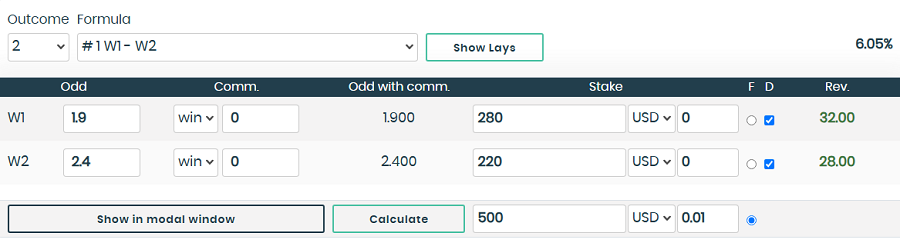
Suppose that in a match between Barcelona and Real Madrid, Bookmaker 1 offers odds of 1.9 for Under 2.5 goals, while Bookmaker 2 offers odds of 2.4 for Over 2.5 goals.
Let’s say we have $500 available for betting:
– We place $280 on Under 2.5 goals
– We place $220 on Over 2.5 goals
Now, let’s calculate:
a) If the match ends with 2 or fewer goals (Under 2.5), we get: 280 × 1.9 = $532.00 Profit: $32 of net income.
b) If the match ends with 3 or more goals (Over 2.5), we get: 220 × 2.4 = $528.00 Profit: $28 of net income.
As you can see, regardless of the outcome, you win a minimum of $28 in profit. And that’s just from one match! In a day, you can place many such arbitrage bets.
The only challenge is that finding and calculating these opportunities manually can be quite difficult.
How to Find Arbitrage Opportunities?
Manually finding arbitrage situations requires certain skills and is very time-consuming. For this reason, many arbers in the past lost a significant share of their potential profits.
Today, however, this problem is practically non-existent thanks to arbitrage betting scanners — tools created specifically to assist professional bettors. The main task of these scanners is to provide users with a constantly updated list of arbitrage opportunities from dozens or even hundreds of bookmakers around the world.
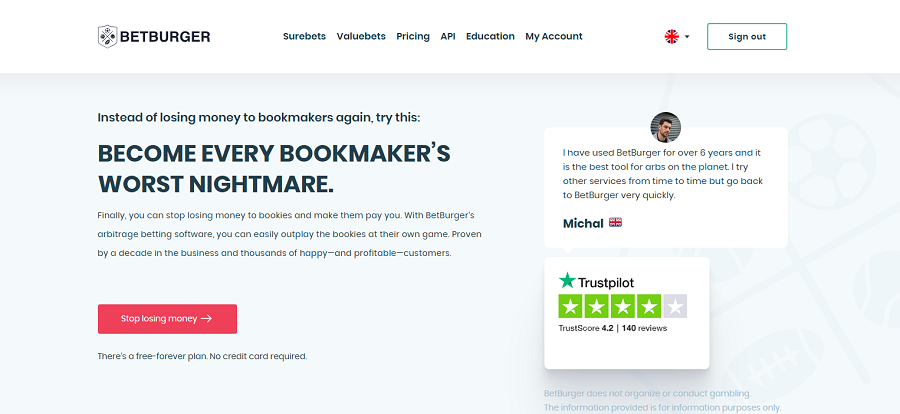
Betburger is currently the leading arbitrage scanner service. This platform gathers information from 400 bookmakers across 50 sports for both live and prematch events, analyzes the data, and presents a list of current arbitrage opportunities to its users.
Users of the service also have access to a convenient calculator, allowing them to make all necessary betting calculations in just a few clicks. Additionally, bets can be tracked through the built-in Accounting function.
And that’s not all — the Betburger platform offers many more tools for working with arbitrage betting, plus a library of educational articles to help you master the strategy. Moreover, you can try arbitrage betting free because the service has a free plan with limited functionality.
Conclusion
Nowadays, more and more bettors are choosing arbitrage betting, and this is quite logical: it’s one of the very few strategies that can genuinely bring a significant and consistent income.
However, if you want to maximize your profits with this strategy, it’s essential to use a high-quality arbitrage scanner.
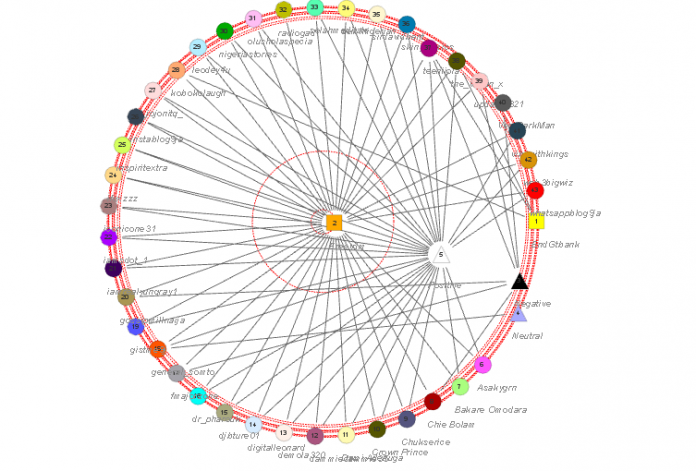
Source: X Accounts, 2025; Infoprations Analysis, 2025
In a world where public opinion forms and spreads within minutes, controversies aren’t shaped solely by the people involved. They’re driven by a web of hashtags, sentiments, influencers, and platforms working together to influence what people believe, share, and ultimately do. The recent clash between VeryDarkMan and GTBank is a perfect case study, not just of personalities at war, but of how influence is built and shared in the digital age.
What began as a confrontation between a popular online activist and a major financial institution quickly spiraled into a national talking point. But beneath the noise, something deeper was happening. Certain voices gained traction, while others faded. Some messages spread like wildfire, while others barely made a ripple. So, who really held the power in this storm?
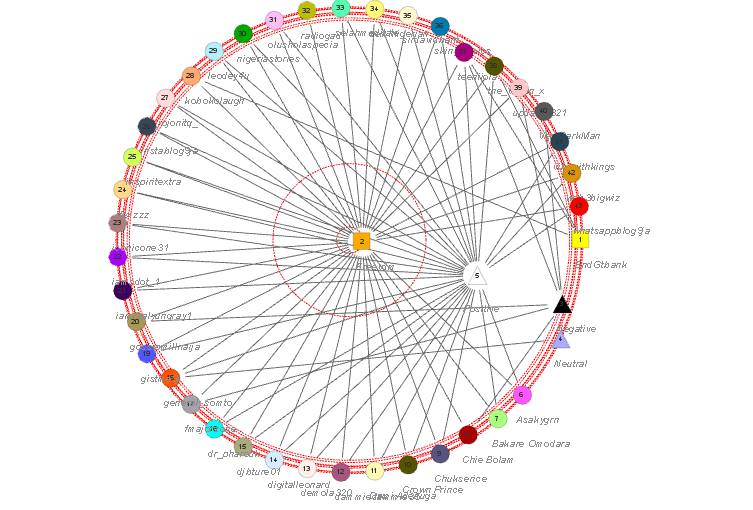
Let’s begin with what many saw trending: #FreeVDM. On the surface, it appeared to be a campaign to support VeryDarkMan, who many felt had been unfairly treated. But it was more than just a hashtag, it became the beating heart of the conversation. It connected people across various platforms, drawing attention, building momentum, and giving others a reason to engage. Based on our analysis, this single phrase had the strongest presence in the digital space. It was mentioned often, shared quickly, and served as a common ground for both supporters and commentators.
Meanwhile, another message, #EndGTBank, didn’t carry the same weight. Although it was central to the issue at hand, it struggled to rally people. It lacked the emotional pull or clarity that could make it go viral. Even though people were angry, frustrated, or curious, this particular call to action didn’t stick. It was mentioned, but rarely became the focal point of discussions. This suggests that while people sympathized with VeryDarkMan, they weren’t necessarily ready to boycott or go after GTBank, at least not in a sustained or meaningful way.
Exhibit 1: Stress centrality in the VeryDarkMan vs GTBank controversy network, showing #Freevdm and positive as most stressed non-human actors by human actors
Source: X Accounts, 2025; Infoprations Analysis, 2025
Beyond hashtags, sentiment played a major role. We examined the emotional tone of the conversations and found that positive messages, those calling for calm, fairness, or understanding — had far more reach than the negative ones. People leaned more toward balanced or hopeful tones than harsh attacks. It seems audiences were more interested in fair engagement than blind rage.
Interestingly, those who tried to stay neutral had the least influence. Messages that didn’t take a clear stand or felt too cautious didn’t attract much attention. In moments like these, the online crowd often seeks clarity. Sitting on the fence rarely moves the needle.
Now, let’s talk about the people, the everyday influencers, commentators, and content creators who made this issue visible. While VeryDarkMan was the face of the conflict, he wasn’t the loudest voice in the room. In fact, many others, from lifestyle influencers to gossip accounts, had far more reach in keeping the conversation alive. People like Teeniiola, GossipMillNaija, General Somto, and Chie Bolam weren’t just observers. They played key roles in how people interpreted the issue and which direction the public sentiment tilted.
This brings us to an important insight: the power to shape narratives doesn’t always rest with the people involved in the event. Sometimes, it’s those who pick up the story, interpret it, and share it in compelling ways that truly drive influence. In this case, the likes of VeryDarkMan and GTBank were more like symbols, while others became the real storytellers.
What does this mean for brands, activists, and public figures? It means that influence today is no longer about titles, fame, or resources. It’s about being part of the flow — knowing which messages resonate, which words travel, and who is best placed to amplify them. Whether you’re defending your name, pushing a cause, or launching a product, the real game is being able to tap into the right conversations at the right time.
In the digital age, hashtags are not just words; they are movements. Sentiment is not just emotion; it’s strategy. And influence is not about shouting the loudest, but about being the most connected.
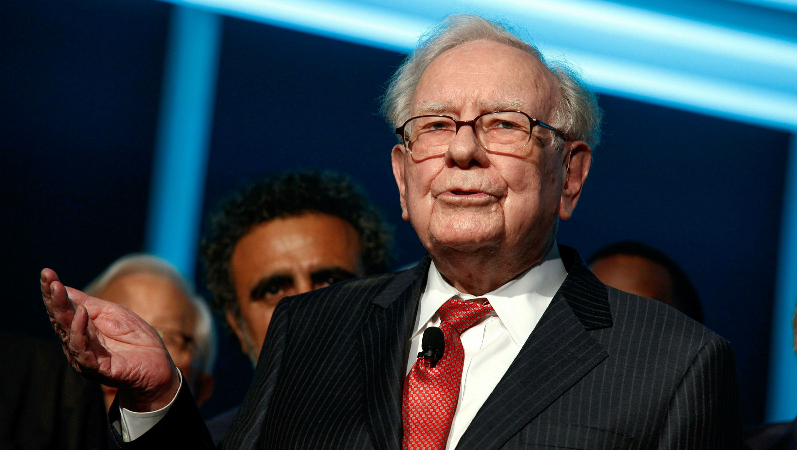
American billionaire investor and philanthropist Warren Buffett, often hailed as the “Oracle of Omaha,” has announced plans to step down as Berkshire Hathaway’s Chief Executive Officer (CEO), marking the end of an extraordinary era in global finance.
At the end of the company’s annual shareholder meeting, Buffet disclosed, “I think the time has arrived where Greg should become the chief executive officer of the company at year-end.”
Buffett took control of Berkshire Hathaway in the mid-1960s, initially as a value play. But instead of trying to salvage the declining textile business, he used it as a holding company to acquire undervalued but fundamentally sound companies. His investment philosophy centered on value investing, long-term growth, and ethical business practices has made him a revered figure in the financial world. Under his leadership, Berkshire Hathaway acquired and grew stakes in iconic companies such as Coca-Cola, Apple, American Express, and BNSF Railway.
Buffett built Berkshire into a $900+ billion powerhouse, investing with a mindset that emphasized long-term value, emotional discipline, and intelligent risk management. His position as CEO since 1970, led the company to a 19.9% annualized return, far outpacing the S&P 500’s 10.4%, turning $10,000 into over $500M. Q1 2025 earnings fell 14.1% to $9.64B, but cash reserves hit $347.7B.
However, Buffett has previously indicated that succession plans are firmly in place. Greg Abel, who oversees Berkshire Hathaway’s non-insurance operations, is widely expected to assume the CEO role upon his departure.
Announcing his step down as CEO at an annual shareholder’s meeting, Buffett hailed Abel’s performance in front of some 40,000 shareholders, saying his more hands-on managerial style is working better for Berkshire’s 60-plus subsidiaries.
“It’s working way better with Greg than with me because, you know, I didn’t want to work as hard as he works,” Buffett said. “I could get away with it because we’ve got a basically good business, very good business.”
Greg Abel assumed a broader role at the company in 2018 thanks to a promotion that tasked him with supervising Berkshire’s non-insurance businesses. Now, pending board approval, the 62-year-old will oversee a conglomerate with nearly 400,000 employees. A native of Edmonton and former hockey player, Abel has worked closely with Buffett since 2000 when Berkshire acquired MidAmerican, where he was president. He rose steadily through the ranks, most recently as vice chairman, and was worth an estimated $484 million in 2021.
Buffett has praised Abel’s business acumen and leadership, saying in 2023, that Abel “does all the work and I take all the bows.” Abel plans to uphold the company’s core investment philosophy and maintain its “fortress of a balance sheet” to avoid outside financial reliance.
Investors and shareholders expect that if Abel does assume the role, he will maintain Berkshire Hathaway’s investment philosophy. Last week, he disclosed to shareholders that he would start by maintaining the company’s fortress of a balance sheet, which allows it to make large investments without relying on banks,
Buffett, who owns more than $160 billion in Berkshire as its largest shareholder, said he wouldn’t sell a single share of the stock after he transitions to this new phase. His decision signals a historic transition for the company he transformed into a $700 billion enterprise.
Despite his departure as CEO of Berkshire, the “Oracle of Omaha” said he will still hang around to help, but the final word on company operations and capital deployment would be with Abel, 62, currently the vice chairman of non-insurance operations for Berkshire.
As Buffett steps aside, the financial community reflects on a legacy defined by wisdom, discipline, and humility. While his formal role may change, his influence on Berkshire Hathaway and generations of investors will endure. His departure will test the market’s confidence in the company’s future leadership and performance without its iconic figurehead. However, the fact that he stayed on so long, gradually delegating duties, is likely to ease investor concerns.