DD
MM
YYYY

PAGES

DD
MM
YYYY

spot_img

PAGES

Home Blog Page 1539

How Visual Storytelling Enhances Business Communication in the Digital Age

0

In today’s hyper-connected digital ecosystem, communication is no longer just about exchanging information — it’s about making an impact. Businesses operate in a world overflowing with data, content, and constant notifications. Amidst this noise, getting your message across clearly and memorably is a challenge. Whether you’re a startup pitching to investors, a corporate team sharing quarterly results, or a consultant presenting strategies to clients, the question remains: how do you make your audience not just listen — but truly understand and remember?

The answer lies in visual storytelling.

Visual storytelling goes beyond pretty slides or decorative graphics. It is the strategic use of visuals—charts, icons, infographics, timelines, and more—woven together with a clear narrative to communicate complex ideas effectively. Today, professionals are turning to impactful PowerPoint templates to enhance the clarity and appeal of their business presentations. It taps into the human brain’s natural preference for images and stories, making communication not only faster but also far more engaging and persuasive.

In this article, we explore why visual storytelling is reshaping business communication, how it simplifies complexity, and how tools like SlideUpLift empower professionals to craft visually compelling stories that drive results.

The Shift: From Text-Heavy to Visual-First Communication

Historically, business communication leaned heavily on text — long emails, detailed memos, static documents. But now, executives, investors, and employees alike are expecting something more engaging and efficient. Why? Because visuals are processed 60,000 times faster than text by the human brain. That means a single infographic or slide can communicate what a paragraph might struggle to express.

Enter visual storytelling — a method that combines graphics, data, icons, and narrative flow to convey ideas in a more compelling way.

Why Visual Storytelling Works in Business

  1. Simplifies Complexity
    Business data, processes, and strategies can be complex. Visual storytelling breaks them down into digestible pieces — using diagrams, timelines, charts, or frameworks. This helps teams make better decisions faster. PowerPoint SmartArt templates are particularly effective here, allowing presenters to visualize steps, comparisons, and connections clearly and intuitively. This helps teams make better decisions faster.
  2. Boosts Engagement and Retention
    A well-designed slide with relevant visuals can increase retention by up to 42%. In meetings and presentations, this keeps the audience attentive and aligned.
  3. Supports Cross-Functional Understanding
    In global, digital teams, language barriers and functional silos can create communication gaps. Visuals act as a universal language, fostering better understanding across departments and geographies.
  4. Drives Action and Persuasion
    A strong narrative paired with visuals is persuasive. Whether you’re presenting to clients, stakeholders, or leadership, a visual story builds emotional connection and trust — crucial in decision-making. 

Real-World Application: Presentations that Speak Volumes

Consider this scenario: You’re an entrepreneur pitching to investors. You only have 10 minutes. You could either read through a text-heavy deck — or tell a clear story with visual slides that show the market opportunity, product roadmap, traction, and revenue model. The latter not only saves time but leaves a lasting impression.

SlideUpLift provides ready-to-use, professionally designed PowerPoint templates tailored for business scenarios — from investor decks and OKR reports to project planning and marketing strategies. These templates help you visually structure your content and maintain consistency in tone and style, even if you’re not a designer.

The Future: Visual-First Workplaces

As remote work, hybrid teams, and asynchronous communication continue to rise, visual storytelling isn’t just a “nice-to-have” — it’s a business necessity. Teams using visuals are more aligned, more productive, and more effective in communication.

Final Thoughts

In the digital age, communication is currency — and visual storytelling is one of its most valuable forms. Businesses that harness it are not only better at expressing ideas but also at driving innovation, collaboration, and growth.

Whether you’re preparing a board presentation or crafting internal training materials, remember: people may forget what you said, but they’ll remember what they saw.

Upgrade your next business communication — start with a story, and let visuals do the talking.
Pascal Dozie: A Banking Legend Departs

0

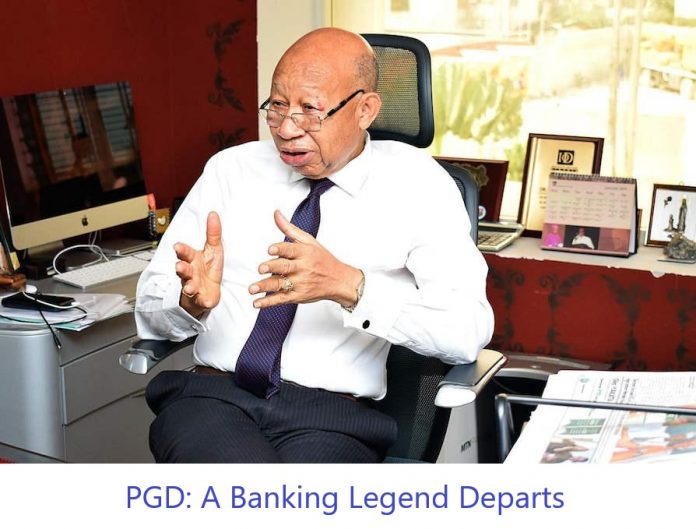
A legend departs from the solid bounds of the earth to the ecclesiastical heaven where cymbals, tapestries and flutes, with cherubic melodies welcome a man who raised a generation of young people, pushing them into the path of prosperity and abundance.

In November 2023, a phone rang, and I picked it. And from the other side, an unmistakable voice said, ‘Prof Ekekwe, I am PGD, your colleague in Diamond Bank”. I jumped and shouted “Ifeoma [my wife], come over here because a Legend is on the line”. Yes, a banking legend, Pascal Dozie, Founder of Diamond Bank, called one of his boys.

I was to be hired for the Owerri branch of the bank, but during the final level interview, the leadership decided to post me to the headquarters. And in just three years, I experienced transformation, turning a village boy-FUTO-educated engineer into a top-grade professional. While in the bank, they paid for my two master’s degrees and a correspondence doctoral degree in banking and finance.

As we spoke, I thanked our Chairman for his grace, kindness and generosity, reciting Diamond Bank’s mission and vision statements which I memorized while in the training school. Great leaders inspire generations and PGD served.

Chairman remembers everything. Many years ago, on a January morning, I came to the bank to drop my resignation letter; I was to fly into New York that day. Hours before, the bank had paid my upfront, a big chunk of my yearly salary. I quickly updated the letter, and asked the bank to reverse the entry as I was leaving the country and would not be around to earn the money. To cut the story short, our Chairman later approved for me to keep the money, covering it for the Bank.

In the world of African banking, PGD was peerless on innovation. He pioneered the integrated banking system (DIBS) which used technology to link branches together, making operations of accounts agnostic of location. In short, during the research of my undergraduate final year seminar in FUTO, I came into contact with DIBS and the Valucard system, and decided that it would be fun to work in Diamond Bank. I got in and right in the training school, I received a message that I needed to visit Schlumberger in PHC, to decline a job, because then it was a heritage in FUTO that best graduating engineering students were given multiple job offers. I flew the first time to decline that, because I wanted to work in Diamond Bank.

Chairman ascended to heaven today, aged 85, leaving behind a generation of men and women he inspired. An icon of African business, innovator personalized, THANK YOU for all you did for a village boy to understand the physics of finance.

Exploring Alabama’s Legislation on Bitcoin Investments

0

Alabama has introduced legislation to allow state investment in Bitcoin. In March 2025, House Bill 482 (HB482) was introduced in the Alabama House of Representatives, followed by its companion, Senate Bill 283 (SB283), filed in early April 2025 by Senator April Weaver. These bills propose that the Alabama State Treasurer be permitted to invest up to 10% of certain state funds in digital assets, provided those assets have a market capitalization exceeding $750 billion over the preceding 12 months. As of now, Bitcoin is the only cryptocurrency that meets this criterion, effectively making it the focus of the legislation, though it isn’t explicitly named in the bills.

The legislation stipulates that these digital assets must be held directly by the State Treasurer, a qualified custodian, or through exchange-traded products, and it would take effect on October 1, 2025, if passed. The bills have bipartisan support and are currently under review, with HB482 assigned to the House Ways and Means General Fund Committee. This move aligns Alabama with a growing number of U.S. states exploring Bitcoin as part of their financial reserves, reflecting a broader trend of institutional interest in cryptocurrency.

The implications of Alabama’s proposed bills HB482 and SB283 to allow state investment in Bitcoin are multifaceted, spanning economic, political, and social dimensions. Allowing up to 10% of certain state funds to be invested in Bitcoin could diversify Alabama’s financial portfolio. Bitcoin’s historically high returns—despite its volatility—might offer a hedge against inflation or underperforming traditional assets like bonds, especially in an era of rising national debt and fiat currency concerns. Bitcoin’s price is notoriously volatile. A significant drop could strain state finances, especially if the investment coincides with a market downturn.

Critics might argue this introduces unnecessary risk to taxpayer funds, which are typically held in safer, more liquid assets. Alabama joining states like Texas or Wyoming in embracing Bitcoin could signal broader governmental acceptance, potentially boosting Bitcoin’s price and adoption. Even a modest state investment e.g., millions from Alabama’s $14 billion General Fund could amplify this effect if other states follow suit. Direct custody or reliance on qualified custodians/exchange-traded products would require new infrastructure, expertise, and fees, potentially offsetting some financial benefits. The bills’ bipartisan backing suggests cryptocurrency is becoming less of a partisan issue, which could encourage similar legislation elsewhere. This might reshape state-level fiscal policy debates nationwide.

While states have autonomy over their treasuries, significant Bitcoin adoption could draw scrutiny from federal regulators or the Treasury Department, especially if it’s perceived as undermining the U.S. dollar’s dominance or complicating monetary policy. In a politically polarized state, embracing Bitcoin could appeal to libertarian-leaning voters or younger demographics while alienating traditionalists wary of “speculative” assets. It might become a 2026 election talking point. State investment could normalize cryptocurrency in Alabama, encouraging businesses and individuals to adopt it. This might position Alabama as a forward-thinking, tech-friendly state, attracting blockchain-related industries.

Most Alabamians might lack the knowledge to understand or support this shift. Public backlash could emerge if losses occur, especially without clear communication about risks and benefits. Pairing this with Alabama’s growing tech sector (e.g., Huntsville’s aerospace hub) could amplify its reputation as an innovation leader, though it hinges on successful execution. If passed, Alabama would join a small but growing list of states experimenting with Bitcoin—Texas has crypto-friendly laws, and Wyoming has pioneered blockchain legislation.

Globally, nations like El Salvador which adopted Bitcoin as legal tender provide a precedent, though Alabama’s approach is more conservative, focusing on investment rather than currency status. The $750 billion market cap threshold ensures a focus on Bitcoin currently ~$1.5 trillion as of early 2025 estimates, excluding riskier altcoins. In summary, this could be a bold economic play with significant upside if Bitcoin’s value rises, but it carries risks of financial loss and political blowback. Its success might hinge on market timing, public education, and whether other states amplify the trend.

Fidelity’s Crypto IRA Bridges Gap Between TradFi and Blockchain

0

Fidelity Investments recently launched a new product called the “Fidelity Crypto IRA,” allowing U.S. investors to trade Bitcoin (BTC), Ethereum (ETH), and Litecoin (LTC) within a tax-advantaged retirement account. This offering, introduced on April 2, 2025, provides options for a Roth IRA, Traditional IRA, or Rollover IRA, with no fees for account opening, maintenance, or crypto custody. However, a 1% spread is applied to buy and sell transactions. The service is available to U.S. citizens aged 18 and older in states where Fidelity Digital Assets operates, and it requires a linked Fidelity brokerage IRA for funding. This move reflects growing mainstream interest in integrating cryptocurrencies into retirement planning.

The introduction of Fidelity’s Crypto IRA for trading Bitcoin, Ethereum, and Litecoin carries several significant implications for investors, the cryptocurrency market, and the broader financial landscape. By offering crypto trading within IRAs, Fidelity allows investors to potentially grow their retirement savings with digital assets while benefiting from tax advantages e.g., tax-deferred growth in Traditional IRAs or tax-free withdrawals in Roth IRAs. This could appeal to long-term investors betting on crypto’s appreciation. Mainstream investors who were hesitant to navigate crypto exchanges now have a familiar, regulated institution to enter the market, lowering the barrier to entry.

Adding crypto to an IRA provides another asset class for diversification, though it comes with high volatility and risk, which may not suit all retirement-focused investors. The 1% spread on trades could add up over time, especially for active traders, potentially eating into returns compared to direct crypto exchange trading with lower fees. Fidelity, a major financial institution managing over $11 trillion in assets, entering the crypto IRA space further legitimizes digital assets as a viable investment, potentially attracting more institutional and retail participation.

Increased adoption through retirement accounts could drive demand for Bitcoin, Ethereum, and Litecoin, potentially influencing their prices, especially if significant retirement funds flow into these assets. This move signals a shift toward integrating crypto into traditional financial products, suggesting the market is maturing beyond speculative trading into long-term investment vehicles. Fidelity’s offering may push other traditional financial giants e.g., Vanguard, Schwab to develop similar products, accelerating the convergence of legacy finance and crypto. As crypto enters regulated retirement accounts, regulators like the SEC and IRS might intensify oversight to protect investors, potentially leading to clearer guidelines or new restrictions.

This could spur further innovation in crypto-related financial products, such as ETFs, trusts, or hybrid accounts, blending traditional and digital assets. Younger investors, more comfortable with crypto, might see this as a way to shift retirement planning away from traditional stocks and bonds, altering generational wealth strategies. While it broadens access, it also exposes retirement savers to crypto’s volatility, which could lead to significant gains—or losses—affecting financial stability in later years.

Over time, widespread adoption of crypto in IRAs could influence monetary policy debates, especially as Bitcoin and Ethereum operate outside central bank control. Fidelity’s Crypto IRA bridges a gap between traditional finance and the crypto world, offering new opportunities while introducing risks and competitive shifts. It’s a step toward mainstreaming digital assets, but its long-term success will depend on market performance, investor behavior, and regulatory developments.

Apple Stock Continues to Plunge, Drops 3.7% Impacted by Trump’s Tariff Policies

0

Tech giant Apple is reportedly facing a turbulent period, as its stock continues to plunge, dropping 3.7% on Monday, as fears intensified over the potential impact of President Donald Trump’s tariff policies.

The Cupertino giant’s stock has now plunged 19% over three consecutive trading sessions, erasing a staggering $638 billion in market value. Analysts warn that Apple remains one of the most vulnerable companies in the escalating trade war, largely due to its heavy dependence on China, which is now subject to tariffs as high as 54%.

Reports reveal that Trump on Monday stated that the U.S. will apply an additional 50% tariff on imports from China if the Asian nation doesn’t withdraw its plan to impose a retaliatory 34% import fee on American products. Although Apple has diversified its production footprint to include India, Vietnam, and Thailand, these nations are also caught in the net of new U.S. tariffs under Trump’s sweeping trade plan.

Among the seven major tech giants, Apple is bearing the brunt of the market’s anxiety. On Monday, it was one of only three megacap tech stocks to decline, alongside Microsoft and Tesla.

Analysts at JPMorgan Chase predict that Apple could raise its prices by 6% across the world to offset the U.S. tariffs. Also, Barclays analyst Tim Long noted that he expects the tech giant to increase the prices of its products, or it could suffer as much as a 15% cut to earnings per share.

Recall that last week, Morgan Stanley analysts stated that Apple could absorb additional tariff costs of about $34 billion annually. Analysts believe that Apple may be forced to choose between raising prices or absorbing the additional costs brought on by the tariffs. According to UBS estimates, the price of Apple’s top-tier iPhone could jump by roughly $350, or about 30%, from its current price of $1,199 if the full weight of the tariffs is passed on to consumers.

Tim Long, an analyst at Barclays, noted that while Apple could consider raising prices, the alternative could be a significant 15% hit to its earnings per share. He also suggested that the company might look to restructure its supply chain, sourcing more imports from countries facing lower tariff rates.

In the broader tech space, other giant tech companies are also feeling the pressure of the new tariff policies. Last week, Meta Platforms and Amazon fell about 9% each, while Nvidia dropped nearly 8%. Giant EV maker, Tesla, slumped more than 5%, while Microsoft and Alphabet both fell about 2% and 4%, respectively.

Notably, analysts predict that makers of PCs and AI servers will be hit hard as well. It is understood that the U.S. imported nearly $486 billion in electronics last year, the second-biggest sector for imports, after machinery, according to Census Bureau data. Therefore, in line with Trump’s recent tariff policies, PC makers, including Dell and HP, could face cost increases of about 10% – 25%, adding between $200 and $500 in costs per unit.

Amidst the chaos from his controversial Tariff policies that sent shockwaves to stock markets across the globe, Trump has held firm on his aggressive global tariff plans, with an initial unilateral 10% tariff went into effect last week Saturday. Meanwhile, Wall Street hoped for progress on negotiations between the administration and other countries or news of a possible delay in reciprocal tariffs slated for April 9.

The plan has already received widespread backlash in corporate America. JPMorgan Chase CEO Jamie Dimon said Monday that the new levies will hike prices on domestic and imported goods and pressure the slowing U.S. economy. Also, many car companies have already announced a pause in shipments, price hikes, and other measures.

Nissan Motor’s luxury Infiniti brand has indefinitely paused production of two Mexico-built crossovers for the U.S. in response to the newly imposed 25% tariffs on imported vehicles by Trump. Also, in a memo to the brand’s retailers, Infiniti Americas Vice President Tiago Castro said QX50 and QX55 output for the U.S. is halted “until further notice” due to the tariffs.

“I don’t want anything to go down, but sometimes you have to take medicine to fix something,” Trump told reporters on Sunday night, downplaying the recent market meltdown.

The tariffs, which threaten to destabilize the world trade order and unsettle businesses, mark a sharp reversal from just a few months ago when hopes of business-friendly policies under the Trump administration pushed U.S. stocks to record highs.

Looking Ahead

With the imposed Tariff policies, Donald Trump sees an opportunity to “change the fabric” of the United States.

But even as the president, administration officials, and key allies say he will not back down from his tariff plan. However, they are looking for ways to ease the concerns of wary supporters. Two administration officials confirmed that members of the administration were taking calls from business groups and setting up private meetings to allay concerns. 

“The Trump administration maintains regular contact with business leaders, industry groups, and everyday Americans, especially about major policy decisions like President Trump’s reciprocal tariff action,” White House spokesman Kush Desai said in a statement.