DD
MM
YYYY

PAGES

DD
MM
YYYY

spot_img

PAGES

Home Blog Page 1618

XRP and Solana Investors Eye RCO Finance for a Quick 100x Boost to their Portfolios

0

Solana (SOL) and XRP (XRP) suffered significant double-digit losses this week, prompting investors to turn to RCO Finance (RCOF) for substantial gains in 2025. This is mainly because the emerging AI altcoin, due to its impressive features, has unlimited growth potential.

RCO Finance has raised over $13 million during an ongoing token presale. It has grabbed the attention of smart money and retail investors, positioning it as the best altcoin to hold after it launches on secondary exchanges.

Solana and XRP On the Slide

Investors in XRP (XRP) and Solana (SOL) saw their altcoins dip significantly this week. XRP is down 15% in the past seven days, taking its price to $2.07. As it edges close to the $2 mark, analysts believe the bleeding is about to stop.

On the other hand, Solana has not fared any better. The layer-1 network is down 14% in the same period, taking its price to $124.13. This comes after SOL has surged to $140, giving investors hope that it could charge to $200.

However, analysts claim the decline in XRP and Solana is a normal part of the bull cycle as capital rotates from blue chips to emerging assets.

Solana and XRP are projected to start a steady climb as the bull market resumes.

Investors Eye RCO Finance for Portfolio Growth

With the bulls still fighting to take control of the market, investors are shifting to RCO Finance in anticipation of a 10,000% surge after public listing on secondary exchanges.

Priced at just $0.1 during the presale’s fifth round, RCOF is regarded as the most undervalued altcoin as it generates momentum for an explosive surge.

Analysts say that its set of features make it a hit with long-term investors and traders seeking to beat the market consistently. Its appeal lies in its flagship feature – an AI-powered Robo Advisor.

The Robo Advisor uses machine learning to offer personalized investment strategies and recommendations that align with users’ financial goals and risk appetite. The tool monitors reputable financial news feeds to remove emotional bias and fine-tune asset allocations for maximum gains.

The Robo Advisor can be used by novice and experienced traders to earn sizable profits and minimize losses. Users of the Robo Advisor tool would have been recommended to invest in DOGO (DOGO) before it surged over 1,900% in 24 hours.

To give users a taste of the platform’s capabilities, RCO Finance rolled out its beta platform for public testing. It has now garnered over 10,000 users. Additionally, the beta platform and the Robo Advisor are undergoing upgrades under the hood.
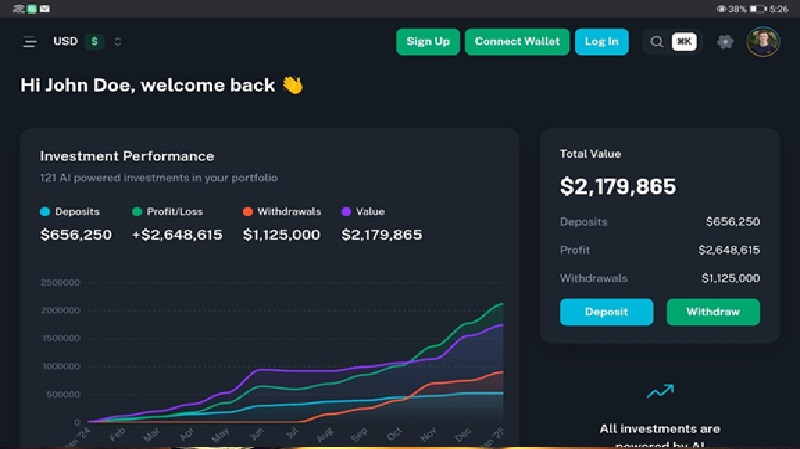
Apart from the Robo Advisor tool, RCO Finance sticks to the principles of decentralized finance by offering a KYC-free trading platform for its users. This enhances users’ privacy and anonymity.

Furthermore, the project introduces a debit to enable users to spend their crypto to pay for goods and services in the real world.

RCO Finance also gives users access to over 120,000 assets, allowing them to diversify their portfolios and earn tangible gains.

Security Audit Eases Investor Worries

RCO Finance has taken a giant step to ensure platform security after undergoing a rigorous smart contract audit with SolidProof, a leading Web3 security firm.

The smart contract audit addresses known and emerging security threats to eliminate potential loopholes that could jeopardize users’ investments.

Be an Early Investor in RCOF to Earn Massive Gains

Investors are flocking to invest early in RCO Finance for 10,000% gains after the public launch. At only $0.1, RCOF is the best altcoin to buy in Q2.

Traders are turning to the DeFi trading platform to conquer the market and grow their portfolios. With leverage of up to 1,000X, RCOF is the go-to trading platform for investors looking to build life-changing wealth.

The development team is also adding enhancements to the beta platform and the Robo Advisor to fine-tune its offerings to its over 10,000 users.

Invest in RCO Finance’s token presale today for a 10,000% surge and turn $1K into $100K in Q2.


For more information about the RCO Finance Presale:

 Visit RCO Finance Presale

Join the RCO Finance Community

ITAD, DOGE and Tariffs Shake Up Hitting Climate Tech

0

ITAD refers to the process of disposing of obsolete or unwanted IT equipment in a secure and environmentally responsible way. Acquisitions in this space typically involve companies buying or merging with ITAD providers to expand services, improve sustainability, or meet regulatory demands. The ITAD market has been growing due to increased focus on circular economy principles and e-waste management, especially as businesses seek cost-effective ways to refresh hardware amid supply chain disruptions—like those potentially caused by tariffs.

Trump Tariffs

Donald Trump’s tariff policies, as of early 2025, have been a major economic talking point. Reports indicate he’s imposed sweeping tariffs, including a 10% levy on Chinese imports (with threats of higher rates), 25% on Canada and Mexico (later suspended in some cases), and reciprocal tariffs on other nations. These tariffs aim to boost domestic manufacturing but have sparked fears of trade wars, higher costs, and supply chain chaos. For climate tech, this is a double-edged sword: tariffs on imported steel, batteries, and rare earth minerals (critical for solar panels, wind turbines, and EVs) could raise costs, slowing deployment. Conversely, they might encourage U.S.-based production if incentives align, though short-term disruption seems more likely.

Climate Tech

Climate tech—encompassing renewable energy, EVs, and carbon reduction innovations—faces significant pressure from Trump’s policies. Tariffs increase the cost of imported components (e.g., $4 billion in Chinese lithium-ion batteries last year), potentially stalling projects. Cuts to federal programs, like those under the Department of Energy, could also slash funding for cleantech R&D. Experts note that while fossil fuel industries might also face higher costs (e.g., steel for pipelines), climate tech’s reliance on global supply chains makes it particularly vulnerable. China might redirect its clean tech exports to the EU, leaving the U.S. lagging in this sector.

Department of Government Efficiency (DOGE)

DOGE, led by figures like Elon Musk, aims to cut federal spending (targeting $2 trillion from a $6.75 trillion budget) and modernize government tech. Trump establishes DOGE via executive order, focusing on efficiency and tech upgrades. Over 101,000 federal jobs cut, hitting agencies like the EPA and NOAA, hampering climate research. Reports of DOGE clashing with agencies (e.g., U.S. African Development Foundation takeover) suggest aggressive cost-cutting, potentially affecting ITAD-related government contracts. DOGE’s push for efficiency could boost ITAD by encouraging agencies to offload outdated tech, but its climate tech impact is negative—reduced funding and staff for green initiatives signal a retreat from federal climate leadership.

Tariffs could drive ITAD acquisitions as companies seek to mitigate rising hardware costs by extending equipment lifecycles. U.S. firms might acquire ITAD providers to localize supply chains, avoiding tariffed imports. Tariffs threaten climate tech’s growth by inflating costs and disrupting supply chains. While DOGE’s efficiency goals might indirectly support sustainable IT practices (like ITAD), its broader cuts undermine climate tech funding. DOGE’s aggressive timeline prioritizes cost over climate, potentially stalling cleantech while creating opportunities for ITAD as government tech modernizes.

Tariffs kick in, ITAD firms see demand spike as businesses delay new purchases. DOGE cuts hit climate agencies; ITAD acquisitions rise to handle surplus federal tech. Current state—tariffs fuel trade tensions, climate tech falters, DOGE’s efficiency push indirectly aids ITAD but not cleantech. In short, Trump tariffs and DOGE’s timeline could inadvertently boost ITAD acquisitions by forcing cost-saving measures, but they pose a net negative for climate tech due to higher costs and reduced federal support.

Solana, Ripple (XRP) Or Remittix? Why One Of These Will 50x By Summer Claims Early Crypto Investors

0

The current high-stakes crypto market race has three top viable candidates: Solana (SOL), Ripple (XRP) and Remittix (RTX). At the moment, Solana price and all the other projects present separate essential elements which include modern scaling technology together with broad financial utility capabilities. Many crypto groups pushed forward a daring summer forecast that one specific token will generate a mind-boggling 50x gain.

Solana Price Gains Momentum on PayPal News

Observers of Solana price have witnessed an outstanding price rise of about 6% during Friday’s trading session. Analysts identify PayPal and Venmo’s plan to let account holders handle Solana transactions directly as the main reason behind Solana’s price surge. The decision showcases PayPal’s dedication to the developing digital currency ecosystem while creating new confidence for Solana supporters.

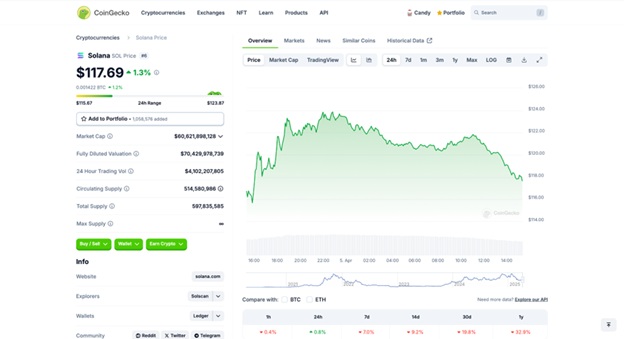
Despite this update, recent data obtained from blockchain platforms indicates upcoming challenges to the market conditions. More than 221 million dollars worth of short positions concentrates at the $129 price level according to the Coinglass liquidation map. The Solana price upward movement might lead to sizable short positions being liquidated which will intensify market fluctuations.

source: coingecko.com

This April, Onchain Lens blockchain analytics also detected 425,266 Solana worth nearly $50 million being unstaked which stood as the largest upcoming schedule of unlocked SOL until 2028. Solana price has also gained from growing stablecoin activities that rose from $5 billion in January to exceed $12.6 billion based on DefiLlama data.

Ripple (XRP) Sets Sights On Lofty Targets

A recent speculative $10,000 prediction for XRP token has sparked widespread interest within the cryptocurrency conversations despite existing enthusiast and doubtful factions surrounding Ripple. Through social media X Remi Relief X stated that XRP held exceptional utility which could transform the global financial structure. XRP’s ability to achieve widespread adoption explains the basis of the $10,000 price target according to some observers even though skeptics see it as overhyped.

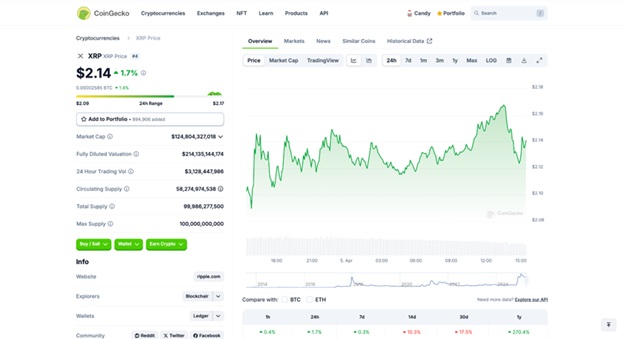
Also, Ripple Labs obtained some relief from the prolonged court proceedings when the firm accepted to pay reduced civil penalties totaling $50 million despite the initial proposals of $125 million. The SEC is planning to lift a crucial regulation that would require future securities registrations which indicates XRP has a better regulatory standing.

source: coingecko.com

The demand for RLUSD and blockchain-based settlement products from institutions may lead to XRP’s wider adoption in the market. Also, Armando Pantoja the prominent angel investor has defended XRP against its “dead coin” critics using data that shows $112.8 billion market capitalization with position as a top five cryptocurrency asset. XRP has not achieved a new all-time high for several years yet its position as a liquid and partnership-backed cryptocurrency reflects its potential to impact the evolving digital payment methods.

Remittix: The Next Crypto To Boom This Year

Investors are showing rising interest in Remittix (RTX) despite the ongoing discussions about the Solana price and XRP’s future targets. Remittix operates to decrease global remittance barriers through its efficient solution platform that lowers expenses and advances international fund transfers. Numerous market participants bought 526 million RTX tokens at $0.0734 each which led to the project raising more than $14 million thus demonstrating belief in its utility-focused strategy.

Remittix attracts users through international payment solutions which focus on the powerful financial sector segment while resembling the user base of Solana and XRP. The Remittix platform presents an easy-to-use payments system with full transparency which draws everyday users but also business clients from major institutions interested in modernizing their international money transfer systems. Price appreciation on a significant scale will occur when the project achieves mainstream status because it addresses two distinct audiences.

Pursuit of significant crypto success this year rests highly on Remittix’s capability to deliver measurable worldwide benefits according to those investors focused on forthcoming success in the market. An early investment into RTX presents an opportunity for investors to achieve potential gains that would reach Ethereum and Binance Coin levels during their past market cycles.

Remittix Will Dominate The Subsequent 50x Movement

Solana price along with XRP’s market cap draw significant investor capital but Remittix (RTX) emerges as a disruptive force because it unites practical real-world usage with extensive strategic expansion plans. The first investors who adopted Ethereum along with Binance Coin attribute their success to actual real-world usage of these cryptocurrencies. Remittix adopts this path toward extraordinary market returns by dedicating itself to the transformation of the everyday payment sector across international borders.

Discover PayFi with Remittix by checking out their presale here:

Website: https://remittix.io/

Socials: https://linktr.ee/remittix

Giveaway: https://gleam.io/FHtn5/250000-remittix-giveaway

This Major Move By Grayscale Could See Cardano And XRP ETFs Debut Soon, Why WallitIQ (WLTQ) Is Leading

0

Grayscale is one of the largest digital asset managers with $15.9 billion AUM and is moving for approval for Cardano (ADA) and XRP exchange-traded funds (ETFs). With regulatory approval in the pipeline, the possibility of these ETFs debuting soon is becoming more realistic. This news could lead to an uptick in the price of these tokens, as seen when the Bitcoin ETF debuted.

However, while Cardano and XRP’s ETFs are still under consideration, another digital token is attracting interest from institutional and retail investors—WallitIQ (WLTQ). The AI-powered crypto wallet and investment platform is in the news for its advanced AI-driven trading strategies, superior security, and impressive presale performance.

Grayscale’s Influence on Potential Cardano and XRP ETFs

According to Grayscale on X, the asset management company has filed an updated S-3 registration statement for its Digital Large Cap ETF (GDLC). The GDLC ETF aims to provide crypto exposure for its tokens, including Bitcoin (BTC), Ethereum, XRP, Solana, and Cardano.

As part of the approval process, NYSE Arca submitted a 19b-4 application in October 2024 to list GDLC, with the SEC set to decide by July 2. With this, Cardano and XRP ETFs could open the floodgates for institutional investments, driving up liquidity and market stability if approved.

Meanwhile, co-founder of ETF Institute Nate Geraci sees a high likelihood of index-based crypto ETFs emerging before year-end. If approved, GDLC’s conversion from a private fund to a public ETF would improve accessibility for retail and institutional investors.

Despite the news, XRP and  Cardano showed little price reaction as the market gears up for upcoming trade tariffs. Cardano is trading at $0.6693, a 1.0% drop in the past day, reflecting a 34% drop in the past month. Similarly, XRP is trading at 2.11, a 0.7% drop in the past day and a 21.8% drop in the past month.

WallitIQ (WLTQ): Leading The Institutional Interests Race

While Cardano and XRP ETFs are closer to regulatory approval, WallitIQ (WLTQ) is leading the race in attracting institutional investments. Unlike traditional crypto projects, this project uses advanced AI-driven technology to power trading decisions, minimize risks, and maximize profitability.

Recent downtime wiped out billions in the market, affecting major assets such as Bitcoin and Ethereum. However, WallitIQ (WLTQ) has defied the odds, maintaining investor interest and demonstrating resilience. Analysts attribute this to the platform’s innovative AI-driven features, which include market trend analysis, risk assessment tools, and automated trading strategies.

Why Investors Continue to Flock to WallitIQ (WLTQ)

WallitIQ’s (WLTQ) empowers users to trade effectively despite extreme volatility.  The platform’s AI-powered analytics help users identify profitable opportunities even during bearish conditions. This resilience makes the project a top choice among investors seeking long-term gains.

Additionally, institutions care about where they invest funds, and security is one of their concerns. WallitIQ (WLTQ) excels here as it recently underwent a smart contract audit by SolidProof. This cements the project’s commitment to transparency and user protection. Moreover, anomaly detection, biometric authentication, and motion-sensitive security measures allow this platform to set new standards for crypto wallet safety.

WallitIQ’s (WLTQ) mobile app is also one of the top reasons for its bullish narrative. The app integrates real-time price tracking through CoinGecko, interactive candlestick charts, and a transaction simulation feature that allows users to practice crypto trading in a risk-free environment. Including an AI chatbot further improves the user experience by providing intelligent recommendations based on real-time market data.

WallitIQ (WLTQ) has shown exceptional growth potential. The project’s presale has already witnessed a significant influx of investors, with early adopters securing gains of over 200%. The presale is selling faster among Institutional investors, outpacing retailers. Meanwhile, the current price of $0.0420 serves as a juicy entry as the price is set to surge in days.

WallitIQ’s (WLTQ) Future Projections

While Grayscale’s push for ADA and XRP ETFs is a major milestone for the industry, WallitIQ (WLTQ) is already making an impact with institutional interest. Its AI-driven investment tools, robust security measures, and up to 180 APY staking rewards make it a leading project in the current market.

Investors seeking high returns and long-term stability should invest now at a low entry price of $0.420, as analysts project a 7000% run in the second quarter of 2025.


Join the WallitIQ (WLTQ) presale and community:

Website: https://wallitiq.io/

Whitepaper: https://wallitiq.gitbook.io/wallitiq

 Telegram: https://t.me/wallitiqofficial

 Twitter/X: https://x.com/wiqnetwork

Instagram: https://www.instagram.com/wallitiqnetwork


Implications of Argentina-USA Zero Tariff Frameworks

0
TOPSHOT - Argentine presidential candidate for the La Libertad Avanza alliance Javier Milei waves to supporters after winning the presidential election runoff at his party headquarters in Buenos Aires on November 19, 2023. Libertarian outsider Javier Milei pulled off a massive upset Sunday with a resounding win in Argentina's presidential election, a stinging rebuke of the traditional parties that have overseen decades of economic decline. (Photo by Luis ROBAYO / AFP) (Photo by LUIS ROBAYO/AFP via Getty Images)

Argentine President Javier Milei has expressed intentions to negotiate a trade deal with the United States that could eliminate tariffs on certain exports, aligning with his libertarian free-market policies and his ideological affinity with U.S. President Donald Trump. Reports suggest that discussions have focused on achieving a zero-tariff framework for 50 Argentine export products, aiming to enhance bilateral trade. Currently, the U.S. has imposed a baseline 10% tariff on Argentine goods as part of a broader reciprocal tariff policy announced by Trump, effective April 5, 2025, with higher rates applied to other countries.

Argentina’s government views its placement in the minimum tariff bracket as a diplomatic success and is leveraging this position to push for an exemption or a full zero-tariff deal. Milei has highlighted progress in resolving trade barriers, with negotiations reportedly addressing regulatory adjustments to meet U.S. reciprocity demands. While no official agreement has been signed yet, the groundwork is being laid through high-level meetings, such as those between Argentine Foreign Minister Gerardo Wertheim and U.S. Secretary of State Marco Rubio, as well as Milei’s planned discussions with Trump.

Eliminating tariffs on key Argentine products—potentially including agricultural goods like beef, soybeans, and wine, or industrial items—would make them more competitive in the U.S. market. This could increase export revenues, critical for Argentina’s economy, which has been grappling with high inflation and foreign currency shortages. American consumers might see lower prices for Argentine imports, particularly in food and raw materials, enhancing purchasing power and diversifying supply chains away from other global suppliers.

A trade deal could encourage U.S. companies to invest in Argentina, drawn by cheaper access to the U.S. market and Milei’s pro-business reforms (e.g., deregulation, tax cuts). This could spur job creation and economic growth in Argentina. Argentina might reduce its trade deficit with the U.S. if exports surge, though this depends on whether the U.S. also gains tariff-free access to Argentina, potentially increasing American exports like machinery or tech goods. A zero-tariff deal would signal a deepening alliance between Milei and Trump, rooted in shared ideological principles like free-market capitalism and anti-socialism. This could elevate Argentina’s geopolitical standing as a favored U.S. partner in

For Milei, securing this deal would bolster his domestic credibility, proving his unconventional approach delivers results. For Trump, it could showcase his “America First” policy adapting to strategic partnerships, countering criticism of isolationism. Argentina’s pursuit of a bilateral deal risks straining relations with Mercosur partners (Brazil, Paraguay, Uruguay), who may see it as a violation of the bloc’s common external tariff rules. This could lead to diplomatic friction or even Argentina’s exit from Mercosur, a move Milei has hinted at favoring. A U.S.-Argentina deal might pressure other Latin American countries to seek similar arrangements, potentially reshaping regional trade patterns. Brazil, a Mercosur heavyweight, could view this as a competitive threat, prompting counter-negotiations.

Argentina’s pivot toward the U.S. could weaken China’s economic foothold in the region, where Beijing has been a major buyer of Argentine commodities and an investor in infrastructure. This aligns with U.S. efforts to counter Chinese dominance in the Global South. If successful, this could inspire Trump to pursue zero-tariff deals with other ideologically aligned nations, shifting U.S. trade policy from broad tariffs to selective partnerships. However, it might also provoke retaliatory tariffs from excluded countries.

Risks and Uncertainties

Regulatory alignment, U.S. Congressional approval (if required), and Mercosur’s response could delay or derail the deal. Argentina’s economic instability might also undermine its capacity to sustain increased trade. If the deal heavily favors U.S. exports or specific Argentine sectors (e.g., agribusiness), it could exacerbate inequality within Argentina or strain U.S. domestic industries facing cheaper imports. The agreement’s longevity could hinge on Milei and Trump remaining in power, as successors might not prioritize or honor it. A zero-tariff pact could turbocharge Argentina’s economy and cement a strategic U.S. partnership, but it risks regional backlash and depends on navigating complex trade-offs.

If successful, this could mark a significant shift in trade relations, potentially making Argentina the first country to secure a zero-tariff arrangement with the U.S. under Trump’s administration. However, challenges remain, including Argentina’s obligations under Mercosur, which restricts individual members from negotiating bilateral free trade agreements outside the bloc. For now, the zero-tariff goal remains aspirational pending formal ratification and resolution of these regional constraints.