DD
MM
YYYY

PAGES

DD
MM
YYYY

spot_img

PAGES

Home Blog Page 1650

The Abundance of Nations and Preview of Next Investment Cycle’s 17 Startups

0

Last night, I read Larry Fink’s 2025 Annual Chairman’s Letter to investors. Fink is the Chairman of Blackrock, the world’s largest asset manager, managing close to US$12 trillion. He wrote about the democratization of investing: “When the world’s first stock exchange opened in Amsterdam in 1602, investing became a more democratic enterprise. Until then, investing was mostly reserved for wealthy merchants. And indeed, about 90% of the original 1,143 investors at Amsterdam’s exchange were wealthy. But the remaining investors were ordinary people. They included 53 artisans, eight shopkeepers, six silk weavers, four soap makers—and at least two maids who each invested 50 guilders, about enough to rent a modest cottage for a year.

A few years ago, I was in Amsterdam on the invitation of The Netherlands Academy of Engineering, to speak on microelectronics and neuromorphics. They took me to a building, and shared the story of New Amsterdam, and what we call now New York City. As we toured the place, my mind flashed how capital has moved from Amsterdam, to the modern New York City, and massively democratized investing. In Fink’s letter, he wrote “Economies run on capital” and humans control capital.

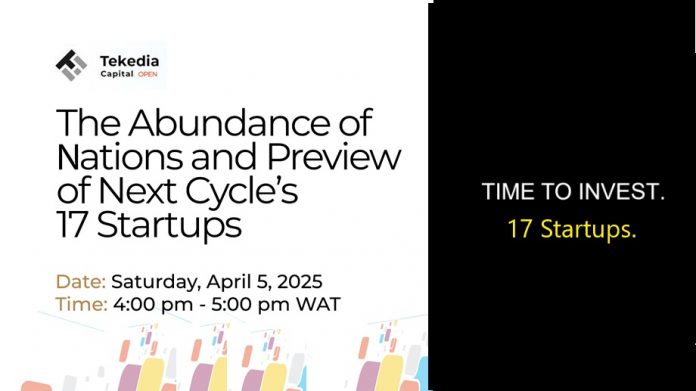
On Monday, April 7 2025, Tekedia Capital will begin our twice yearly tradition where ordinary citizens come together, pool resources, and take positions in startups and empires of the future. As that next week arrives, we will have Tekedia Capital Open, a free and open event for all, titled “The Abundance of Nations”, and during that share a top-level synthesis of 17 startups joining our next investment cycle.

  • Event: Tekedia Capital Open
  • Topic: The Abundance of Nations and Preview of Next Tekedia Capital Investment Cycle’s 17 Startups
  • Date: Saturday, April 5, 2025
  • Time: 4-5pm WAT
  • Zoom link: here 

To learn more about Tekedia Capital and join our community, go here.

Find below the key dates for the next Tekedia Capital investment cycle.

  • Duration: April 7 – May 15, 2025
  • Startups Unveiling in Portal: April 7
  • Demo Day: April 26, 2025

BlockDAG’s $6K Testnet Rewards Set It Apart as SOL & ADA Eye Price Action

0

When a project ties real rewards to real testing, the impact goes far beyond speculation. As Solana and Cardano work to reinforce their positions—with prediction platform support and technical breakouts—BlockDAG is taking a more direct route: paying participants to engage.

While Solana gains traction through Polymarket and Cardano navigates key resistance levels, BlockDAG’s Beta Testnet raises the stakes. With $6,000 in BDAG rewards on offer, developers, miners, and users are already participating hands-on. With smart contracts running live and a presale total of $209.5 million, BlockDAG is proving that early action can unlock more than future potential—it’s creating value now.

Solana’s Polymarket Integration Builds Momentum Toward $170 Mark

Polymarket, a top prediction market, has added Solana (SOL) support, allowing faster deposits and lower fees for its users. This move taps into Solana’s high-speed, low-cost structure, giving users a smoother experience compared to Ethereum’s congested network.

The integration could bring in more users and boost liquidity on Polymarket, while also showing the platform’s commitment to supporting multiple blockchains. It positions both Polymarket and Solana well in the broader Web3 space.

On the charts, SOL recently hit resistance around $144 and is now holding support near $138. Technical signs, including an oversold Relative Strength Index (RSI), hint at fading selling pressure and possible recovery. If SOL stays above $138, analysts see a possible push toward $141–$146. That said, it needs fresh momentum to break higher.

Cardano Consolidates as Traders Watch for a Move

Cardano (ADA) is currently trading between $0.695 and $0.75, showing signs of price consolidation. A breakout above $0.756, confirmed by a daily close, could set the stage for a 12% jump toward $0.85. On the downside, a drop below $0.69 might trigger a fall toward $0.65.

Technically, ADA is testing the 200-day Exponential Moving Average (EMA), a key level many traders watch. Market sentiment remains optimistic, with $17 million in long positions and a 40% rise in trading volume in the past 24 hours—both signs of growing interest.

As the price continues to coil, investors are focused on these key support and resistance zones. The next few sessions could decide whether ADA breaks out or pulls back further.

BlockDAG’s Beta Testnet Offers $6K in BDAG to Early Contributors

BlockDAG’s Beta Testnet, named “Primordial,” isn’t just about testing code—it’s about rewarding those who help shape the network early. With $6,000 in total BDAG rewards up for grabs, the top 10 wallets by activity, top 10 miners, and top 10 holders will each split $2,000 in BDAG, valued at $0.05 per token. Crucially, these are real mainnet tokens—not just testnet assets.

For developers, the Beta Testnet offers more than a sandbox. It provides real incentives to deploy contracts, test performance, and improve functionality. With tools like a block explorer, integrated development environment (IDE), and EVM support, building on BlockDAG is straightforward and developer-friendly.

The incentives come on the heels of an already successful presale—$209.5 million raised to date, with Batch 27 pricing tokens at $0.0248. That’s a 2,380% return since Batch 1, and over 19 billion coins sold—evidence that the project has strong community backing and market interest.

Running until May 31, the testnet invites real participation. Whether you’re coding, mining, or exploring the ecosystem, BlockDAG is turning early engagement into lasting rewards. And with mainnet approaching, every action now could count for more later.

Testnet in Action: Why BlockDAG’s Strategy Stands Out

Speculation might drive early excitement, but lasting value comes from actual usage. While Solana continues to expand its integrations and Cardano tests key resistance levels, BlockDAG is building something more grounded—an active, hands-on ecosystem with direct incentives.

With more than 19 billion tokens already sold and rewards tied to real participation, BlockDAG is showing that it’s ready for the next stage. As the May 31 Testnet deadline nears, users and builders aren’t just observing—they’re shaping the network’s future.

In an industry that often runs on promises, BlockDAG is proving that delivering tools, rewards, and working infrastructure can shift momentum—and set a new benchmark for early-stage blockchain projects.


Presale: https://purchase.blockdag.network

Website: https://blockdag.network

Telegram: https://t.me/blockDAGnetworkOfficial

Discord: https://discord.gg/Q7BxghMVyu

Eric and Donald Trump Jr Partner with Hut8 on Bitcoin Mining

0

Eric Trump and Donald Trump Jr have invested in a Bitcoin-mining company. It was reported that the two brothers partnered with Hut 8, a publicly traded cryptocurrency infrastructure firm, to launch a new venture called American Bitcoin. The Trump brothers merged their company, American Data Centers, with Hut 8, securing a 20% stake in American Bitcoin, while Hut 8 holds the remaining 80%. Eric Trump has taken on the role of Chief Strategy Officer for the new company, which aims to leverage Hut 8’s 61,000 mining machines to become a major player in Bitcoin mining. The venture also plans to build a “Bitcoin reserve” by retaining mined coins, with intentions to capitalize on low U.S. energy costs for efficient operations. This move marks a significant expansion of the Trump family’s growing involvement in the cryptocurrency industry.

The investment by Eric and Donald Trump Jr. in a Bitcoin-mining company like American Bitcoin, in partnership with Hut 8, carries several potential implications across economic, political, and environmental spheres. The Trump family’s high-profile involvement could lend legitimacy and visibility to Bitcoin and cryptocurrency mining, potentially encouraging more institutional and retail investment in the sector. Their participation might signal to others that crypto is a viable long-term asset class. With a 20% stake in a company tied to Hut 8’s infrastructure (61,000 mining machines), the Trumps could influence Bitcoin’s supply dynamics if American Bitcoin’s “Bitcoin reserve” strategy succeeds in hoarding mined coins, potentially driving up prices during scarcity periods.

Bitcoin mining operations, especially if scaled in the U.S. with a focus on low energy costs, could create jobs in regions hosting data centers, aligning with broader economic development narratives. This venture strengthens the Trump family’s pivot toward tech and finance, diversifying their business portfolio beyond real estate and media. It could also bolster their appeal among libertarian-leaning or crypto-enthusiast voter bases, especially if tied to deregulation or “America First” energy policies.

Given their political connections—particularly with Donald Trump Sr.’s past presidency and potential future influence—the brothers might push for crypto-friendly legislation, such as tax incentives for miners or relaxed regulations on energy use, shaping the U.S. crypto landscape. Their involvement might polarize opinions on crypto further. Supporters may see it as a bold move toward innovation, while critics could view it as another opportunistic venture by a controversial family, especially if linked to speculative bubbles or environmental concerns.

Bitcoin mining is notoriously energy intensive. American Bitcoin’s focus on leveraging “low U.S. energy costs” could reignite debates about sustainability, especially if operations rely on fossil fuels rather than renewables. Critics may point to the carbon footprint, while proponents might argue it drives energy infrastructure investment. Depending on where mining facilities are located, local ecosystems and power grids could face strain, particularly in areas with cheap but non-renewable energy sources. This could lead to community pushback or, conversely, economic revitalization in energy-rich regions.

American Bitcoin enters a crowded field with established players like Marathon Digital and Riot Platforms. The Trump name might give it a branding edge, but success will hinge on operational efficiency and market conditions (e.g., Bitcoin price volatility or mining difficulty). If Bitcoin’s price drops or mining profitability wanes (due to halving events or regulatory crackdowns), the venture could face financial strain, impacting the Trumps’ reputation and Hut 8’s stock performance. The Trump brothers’ involvement might deepen the cultural divide around cryptocurrency—seen by some as a revolutionary tool and by others as a speculative fad. Their polarizing personas could amplify this split.

By framing it as an “American” endeavor, they might tap into nationalist sentiment, positioning Bitcoin mining as a patriotic counter to foreign dominance (e.g., China’s past mining supremacy). In summary, this investment could ripple through markets, policy, and public discourse, amplifying both opportunities and risks in the crypto space. Its success—and broader impact—will likely depend on Bitcoin’s trajectory, energy strategies, and the Trumps’ ability to navigate their unique blend of business and political capital.

A Foray into Solana Compute Unit Proposal

0

The Solana community is currently discussing proposals to increase the Compute Unit (CU) limit per block from its existing cap of 48 million. Compute Units on Solana serve a purpose similar to Ethereum’s gas, acting as a measure to limit transaction complexity and ensure equitable resource allocation across the network. This debate stems from a desire to enhance transaction throughput and network efficiency, particularly as Solana continues to grow in usage and adoption.

Two key proposals have emerged: SIMD-0207 suggests a modest increase to 50 million CUs, while SIMD-0256 proposes a more substantial jump to 60 million CUs. The goal is to allow more transactions to fit within each block, potentially reducing congestion during peak times and enabling support for more computationally intensive operations. Proponents argue this could improve user experience by lowering transaction delays and failures, especially as demand for block space rises.

However, the discussion isn’t without trade-offs. Raising the CU limit could place additional strain on validators and node operators, potentially affecting network stability if not implemented carefully. Solana’s developers appear to favor a gradual approach, avoiding drastic changes—like a previously considered 96 million CU target—due to concerns about infrastructure readiness. Other block parameters, such as the 12 million CU limit per account write lock and 36 million CU cap for vote transactions, would remain unchanged to maintain balance in core functions like consensus.

The debate reflects Solana’s ongoing efforts to scale while preserving performance. No final decision has been confirmed, but the community’s focus on incremental adjustments suggests a cautious yet forward-looking strategy. Raising the Compute Unit (CU) limit on Solana from the current 48 million per block would have several potential impacts—both positive and negative—on the network, its users, developers, and validators. A higher CU limit (e.g., 50M or 60M) would allow more transactions to be processed per block. This could reduce congestion during high-traffic periods, such as NFT mints or DeFi spikes, leading to fewer dropped or failed transactions and a smoother user experience.

More CUs per block would enable developers to build and execute more computationally intensive smart contracts or programs. This could attract new projects to Solana, enhancing its ecosystem and competitiveness against chains like Ethereum or newer rivals. With less contention for block space, users might see faster transaction confirmations and lower retry rates. This could bolster Solana’s reputation as a high-performance blockchain, especially for real-time use cases like gaming or payments. By fitting more transactions into each block, developers and dapps could see reduced costs per transaction in terms of priority fees, as competition for limited CU resources eases slightly.

Processing more CUs per block requires greater computational power, memory, and bandwidth. Validators running on lower-spec hardware might struggle to keep up, potentially leading to missed blocks or degraded performance. This could raise operational costs for node operators. If the CU increase outpaces the capabilities of smaller validators, the network might unintentionally favor larger, better-resourced operators. This could erode Solana’s decentralization over time, a concern given its already high validator hardware requirements.

Pushing the CU limit too high, too fast (e.g., to 60M or beyond) might strain the network’s consensus mechanism or amplify existing bottlenecks, like state bloat or memory usage. Past Solana outages, often tied to resource overload, highlight this risk. Not all transactions need more CUs—simple transfers use far less than complex DeFi operations. Raising the limit might disproportionately benefit specific dapps or users, potentially skewing network priorities and leaving simpler use cases unaffected.

A modest increase (e.g., to 50M) might offer quick wins with minimal disruption, while a larger jump (e.g., 60M) could set the stage for future growth but require more testing and infrastructure upgrades. If successful, this could solidify Solana’s position as a scalable blockchain, attracting more developers and capital. However, if mishandled, it might fuel criticism about reliability or centralization. While base fees are fixed, priority fees (paid to validators for transaction inclusion) could drop as CU scarcity decreases, subtly shifting validator revenue models.

Nigeria’s Economy Expands by 3.84% To N22.61tn in Q4 2024, Driven By Non-Oil Sector – CBN

0

Nigeria’s domestic economy recorded an expansion of 3.84% year-on-year in the fourth quarter of 2024, reaching N22.61 trillion, according to the latest economic report from the Central Bank of Nigeria (CBN).

This growth, largely driven by the non-oil sector, highlights the deepening structural shift in the country’s economic composition as the oil sector continues to underperform.

While the non-oil sector expanded by 3.96%, the oil sector lagged behind with a modest 1.48% growth, reflecting persistent challenges in the country’s crude oil production. Economists believe that the performance of the non-oil sector underscores the struggles of Nigeria’s once-dominant oil industry, which has faced years of declining output due to pipeline vandalism, oil theft, regulatory uncertainties, and underinvestment in upstream activities.

For years, Nigeria has struggled to meet its crude oil production targets, significantly impacting overall GDP growth. Despite being Africa’s largest oil producer, the country has consistently fallen short of its OPEC quota, limiting the oil sector’s contribution to economic expansion.

Recently, Nigeria briefly exceeded its OPEC production quota of 1.5 million barrels per day (mbpd) for the first time in a long while, signaling a potential rebound. However, this progress was short-lived as output declined again in subsequent months, hampering the government’s push to achieve its ambitious target of 2.2mbpd.

The drop in oil production has been linked to ongoing security issues in the Niger Delta, where crude theft and pipeline sabotage remain widespread. Additionally, logistical and technical challenges at key oilfields have slowed production recovery efforts.

The CBN’s report noted that while increased crude oil production from 1.33mbpd to 1.43mbpd helped moderate the slowdown in the oil sector, the overall contribution of oil to GDP growth remained marginal. In total, the oil sector contributed just 0.07 percentage points to the economy’s 3.84% growth in Q4 2024, further underscoring its diminished role in driving Nigeria’s economic expansion.

Economic analysts have consistently emphasized that increased crude oil output could significantly accelerate Nigeria’s GDP growth. Historically, when oil production surged above 2mbpd, the economy experienced higher expansion rates. However, the country has struggled to sustain such levels, with recent production figures falling well below expectations.

According to industry experts, achieving the government’s 2.2 mbpd target would not only boost export earnings but also strengthen Nigeria’s foreign exchange reserves, stabilize the naira, and provide much-needed fiscal revenues to support economic development.

Although the uptick in the non-oil sector’s performance is seen as a sign of economic diversification, analysts caution that relying on it as the primary growth driver without addressing structural issues in the oil sector could limit Nigeria’s long-term economic potential. Given that crude oil still accounts for the bulk of Nigeria’s foreign exchange earnings and government revenue, the sector’s weak performance poses a significant risk to fiscal sustainability.

The non-oil sector’s 3.96% growth in Q4 2024 outpaced the previous quarter’s 3.37% expansion, contributing a substantial 3.77 percentage points to total GDP growth. The CBN report emphasized that the non-oil sector expanded at a faster pace, making it the primary driver of economic growth.

Key industries leading this expansion include financial services, information and communication, trade, crop production, and transportation. The financial and insurance sector recorded significant growth due to the increasing adoption of financial technology, higher banking penetration, and rising investment inflows into capital markets. The expansion of digital banking services and mobile payment solutions contributed to stronger financial sector performance.

The information and communication sector also continued its upward trajectory, benefiting from improved internet penetration, rising demand for data services, and increasing digital transformation across various industries.

The trade and agricultural sectors remained robust, particularly in crop production, which was supported by favorable weather conditions and government interventions aimed at boosting food security. Trade activities surged due to increased logistics efficiency and a recovering consumer demand.

The transportation and storage sector also saw significant improvements, driven by government investments in infrastructure projects and growing e-commerce logistics networks.

However, Nigeria’s electricity and gas subsector contracted by 5.05% in Q4 2024, highlighting ongoing challenges in the country’s energy sector. The downturn was attributed to increased electricity tariffs, continued grid collapse, and a growing shift towards alternative energy sources such as solar power.

Looking ahead, the CBN projects that Nigeria’s economy will continue on a growth trajectory in 2025, supported by government policies, increased investor confidence, and exchange rate stabilization. However, the ability to sustain this momentum will depend on several factors, including oil production recovery, inflationary pressures, exchange rate stability, and infrastructure development. Achieving and maintaining higher crude oil output remains critical for overall economic performance.