DD
MM
YYYY

PAGES

DD
MM
YYYY

spot_img

PAGES

Home Blog Page 1660

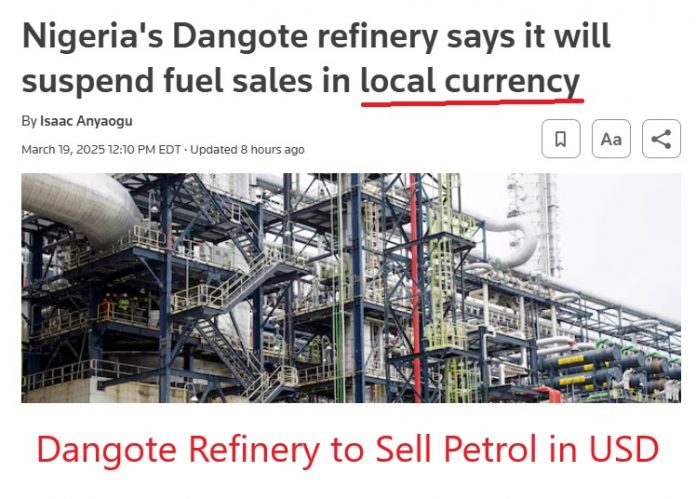
The Dangote Refinery’s Dollarization of Petrol Sales in Nigeria

1

Last week, I deleted a post here on this matter when I posited that if Nigeria refuses to offer Dangote Refinery a new Naira deal on crude oil, it could impose a USD-denominated transaction in the local market, especially for aviation-related products. I got a note from a minister’s office and I deleted; too much extrapolative modelling. (In the midst of technical analysis, I do delete when it could cause trouble for the economy.)

But today, we are reading that what I posited has happened: ‘Nigeria’s huge Dangote Petroleum Refinery announced on Wednesday that it was temporarily suspending fuel sales in the local naira currency to avoid a mismatch between sales in naira and purchases of crude in dollars….”To date, our sales of petroleum products in Naira has exceeded the value of Naira-denominated crude we have received. As a result, we must temporarily adjust our sales currency to align with our crude procurement currency” the company said in a statement.’ – Reuters

My position remains that Nigeria does not have the capacity to float its currency, and in the way we have it, someone must still subsidize the Naira against currencies like US dollars. It used to be the government. But the nation has moved it to companies like MTN, MultiChoice, and manufacturers which have lost billions of Naira over this.

On the Dangote Refinery one, the refinery does not want to absorb the cost, and is taking a drastic position which could rattle the economy. Indeed, it cannot pay USD and sell in Naira at a loss thereby subsidizing Naira! The Naira floating policy is transferring the subsidy to private companies but here we are seeing a category-king company at a solid positioning rejecting it.

Expected conclusion: the government will enter a new deal to sell in Naira to Dangote Refinery, and by doing that, it is subsidizing Naira, not via the central bank, but via petrol pumps! When a bird flies from the ground to perch on an anti-hill, it is still on the ground!

Tekedia Mid-Week Blockchain Recaps

0

The CME Group launched Solana (SOL) futures. This initiative introduced two contract sizes: a standard contract of 500 SOL and a micro-sized contract of 25 SOL. These futures are cash-settled, based on the CME CF Solana-Dollar Reference Rate, which provides a daily benchmark price for Solana in U.S. dollars. The launch reflects growing institutional interest in Solana and responds to increasing demand for regulated cryptocurrency products to manage price risk.

It also marks a significant step in the broader adoption of Solana within traditional financial markets, potentially paving the way for future Solana-based exchange-traded funds (ETFs). Trading began following regulatory approval, with initial transactions executed by firms like FalconX and StoneX.

South Korea’s central bank, the Bank of Korea (BOK), has explicitly rejected the idea of a Bitcoin strategic reserve as of March 2025, citing volatility, liquidity risks, and misalignment with IMF reserve asset standards. This cautious stance mirrors much of the global regulatory landscape, though it contrasts with emerging pro-crypto shifts elsewhere.

In the United States, the Trump administration has pivoted toward a crypto-friendly framework. An executive order in January 2025 established a working group to draft new regulations and explore a national digital asset stockpile from seized cryptocurrencies. The U.S. has also repealed stringent IRS DeFi broker rules and paused SEC enforcement actions, signaling a lighter regulatory touch.

Bitcoin market trends reflect a dynamic landscape shaped by a mix of historical patterns, macroeconomic factors, and recent developments. Bitcoin has experienced significant growth over the years, with its market capitalization currently hovering around $1.5 trillion to $2 trillion, depending on price fluctuations.

In 2024, it saw a remarkable rally, climbing over 150% and surpassing $100,000 in December, driven by factors like the approval of spot Bitcoin ETFs in the U.S., the April 2024 halving event (which reduced the supply issuance rate), and optimism around regulatory shifts under a pro-crypto U.S. administration.

World Liberty Financial (WLFI), a cryptocurrency venture backed by the Trump family, recently expanded its digital asset portfolio by purchasing $2 million worth of Avalanche (AVAX) and $2 million worth of Mantle (MNT) tokens. This acquisition included 103,911 AVAX tokens and 2.45 million MNT tokens, adding to WLFI’s existing investments in 11 different cryptocurrencies, which total approximately $340 million.

Despite these new purchases, the portfolio is currently experiencing significant unrealized losses, estimated at around $115 million, with Ethereum (ETH) alone accounting for a substantial portion of the downturn. These investments are part of WLFI’s broader strategy, though some analysts speculate that such moves might involve token swap arrangements or efforts to diversify holdings amid market challenges.

A French court has granted permission for Pavel Durov, the founder of Telegram, to leave France and travel to Dubai. This decision, made on March 13, 2025, temporarily modifies the conditions of his judicial supervision, allowing him to depart the country for several weeks. Durov had been under restrictions following his arrest in August 2024 at Le Bourget Airport near Paris, where he faced charges related to alleged criminal activities on Telegram, including facilitating illegal content.

Pavel Durov was released on a €5 million bail but was initially barred from leaving France. The court’s decision to allow his travel has sparked discussions about jurisdiction, privacy, and the responsibilities of tech leaders, particularly given Dubai’s lack of extradition agreements with many countries.

Binance Smart Chain (BSC) has recently surpassed Solana in weekly decentralized exchange (DEX) trading volume, marking a significant shift in the competitive landscape of blockchain networks. This development is notable as Solana has long been a dominant player in DEX volume, particularly fueled by its popularity in the memecoin trading space. BSC’s rise is attributed to its robust activity, lower transaction fees, and increasing adoption for memecoin trading, supported by strategic moves from Binance.

Additionally, Changpeng Zhao (CZ), the former CEO of Binance, has reportedly entered the memecoin market by purchasing two tokens, MUBARAK and TST, spending 1 BNB on each. This move is seen as part of a broader strategy to bolster BSC’s ecosystem, especially in the memecoin sector, potentially driving further trading volume and interest.

Goldman Sachs mentioned cryptocurrencies for the first time in its 2024 annual shareholder letter, marking a significant acknowledgment of the growing influence of digital assets in the financial industry. The letter, released in March 2025, highlights the increasing competition driven by new technologies, including cryptocurrencies, blockchain, and artificial intelligence, which are reshaping financial markets.

Specifically, the bank noted that some competitors offer crypto-related financial products that Goldman Sachs currently does not provide, potentially influencing client preferences. This mention reflects a shift in Wall Street’s perspective, driven by factors such as Bitcoin’s success, the approval of spot Bitcoin ETFs, and broader institutional interest in blockchain technology. However, the bank also cautioned about the risks associated with these technologies, such as cybersecurity vulnerabilities and the nascent nature of the market.

No Guarantees that United States Will Avoid a Recession, Treasury Secretary Scott Bessent

0

Treasury Secretary Scott Bessent has recently stated that there are “no guarantees” that the United States will avoid a recession. During an interview on NBC’s “Meet the Press”, he emphasized the unpredictability of economic downturns by saying, “You know that there are no guarantees, like who would have predicted Covid, right?” He further elaborated that while the Trump administration is implementing “robust policies” intended to be durable, an economic adjustment could occur, though he maintained there is “no reason” it must lead to a recession. This reflects his stance of not ruling out the possibility while expressing confidence in the administration’s approach to managing the economy.

The implications of Treasury Secretary Scott Bessent’s statements about not ruling out a recession are multifaceted, affecting economic policy, public perception, and market behavior. Bessent’s acknowledgment of a possible recession, even while expressing confidence in “robust policies,” suggests the Treasury may prioritize defensive strategies—such as maintaining fiscal flexibility or preparing stimulus options—to cushion any potential downturn.

His emphasis on durable policies implies a focus on long-term structural adjustments (e.g., tax reforms, deregulation, or infrastructure spending) rather than short-term fixes. However, the lack of specifics leaves open questions about how adaptable these policies are to sudden shocks. The administration may face pressure to balance growth-oriented initiatives with safeguards against an “economic adjustment,” potentially leading to debates over spending priorities or interest rate coordination with the Federal Reserve.

Bessent’s refusal to dismiss recession risks could signal to investors that volatility remains a concern, even if not imminent. This might dampen stock market enthusiasm, increase demand for safe-haven assets like bonds or gold, or prompt closer scrutiny of economic indicators (e.g., unemployment, consumer spending, inflation). His optimistic tone (“no reason” for a recession) may reassure some market participants, but the caveat about unpredictability (e.g., citing COVID) could keep businesses and investors on edge, potentially slowing investment or hiring decisions.

By framing the economy as manageable yet vulnerable, Bessent aims to project competence without overpromising stability. This could bolster public trust if policies succeed but risks criticism if conditions worsen, especially given his high-profile role. As part of the Trump administration, his comments tie economic outcomes to political fortunes. A recession—or even a significant adjustment—could fuel opposition narratives while avoiding one might strengthen the administration’s credibility ahead of future elections.

Given the U.S.’s central role in the global economy, Bessent’s cautious outlook could ripple outward, prompting foreign governments and markets to reassess their own forecasts. Countries reliant on U.S. trade or investment might brace for reduced demand. Uncertainty about a U.S. recession could affect the dollar’s strength. A flight to safety might bolster it, but prolonged concerns could weaken it if growth falters.

If households interpret Bessent’s remarks as a warning, they might tighten spending, which could slow growth and inadvertently heighten recession risks—a self-fulfilling prophecy. Conversely, his confidence might encourage sustained consumption if perceived as credible. Companies may adopt a wait-and-see approach, delaying expansion or stockpiling cash, particularly in sectors sensitive to economic cycles (e.g., manufacturing, retail).

Bessent’s remarks come at a time when the U.S. economy is navigating post-pandemic recovery, inflationary pressures, and geopolitical uncertainties. His reference to unpredictable events like COVID underscores a lesson from recent history: black swan events can upend even the best-laid plans. The implication is a call for vigilance—neither panic nor complacency—while signaling that the administration is prepared to adapt, though the effectiveness of that adaptation remains untested.

Key Trends Driving Scalable Web3 Payments

0

The future of scalable Web3 payments is a topic of growing interest as blockchain technology and decentralized systems continue to evolve. Web3 payments, built on principles of decentralization, blockchain, and cryptocurrencies, promise to transform how value is exchanged globally by offering faster, cheaper, and more inclusive alternatives to traditional financial systems.

Scalability is critical for Web3 payments to achieve mainstream adoption. Traditional payment systems like Visa and Mastercard process thousands of transactions per second (TPS), while early blockchain networks like Bitcoin (7 TPS) and Ethereum (15-30 TPS) fall short of this benchmark. For Web3 payments to compete, they must handle high transaction volumes efficiently without compromising decentralization or security.

Layer-2 scaling solutions, such as Ethereum’s Optimistic Rollups and zk-Rollups, are enhancing scalability by processing transactions off-chain while leveraging the security of the main blockchain. For instance, networks like Polygon and Arbitrum reduce costs and increase throughput, making payments faster and more affordable. These solutions could push TPS into the thousands, rivaling traditional systems.

The fragmented nature of blockchains has historically limited scalability and usability. Projects like Chainlink’s CCIP (Cross-Chain Interoperability Protocol) and Polkadot aim to connect disparate networks, enabling seamless value transfer across ecosystems. This interoperability reduces silos, improves liquidity, and simplifies the user experience—key for scalable payments.

Stablecoins like USDC and Tether, pegged to fiat currencies, mitigate cryptocurrency volatility, making them practical for payments. Their integration with smart contracts allows for “programmable money,” where transactions can execute automatically under predefined conditions. This capability supports scalable micropayments and complex financial instruments, broadening use cases.

DeFi protocols are driving payment innovation by offering peer-to-peer lending, instant settlements, and decentralized exchanges—all without intermediaries. As DeFi platforms scale with improved infrastructure, they could handle large-scale payment flows, especially for cross-border transactions, which traditionally suffer from high fees and delays. Complexity has been a barrier to Web3 adoption. Innovations like account abstraction (simplifying wallet management) and gas abstraction (hiding transaction fees from users) are making payments more intuitive. Seamless UX will be crucial for scaling to billions of users.

Scalability vs. Decentralization Trade-Off

The “blockchain trilemma” suggests that it’s hard to achieve scalability, security, and decentralization simultaneously. While solutions like sharding (e.g., Ethereum 2.0) and layer-2 networks address this, maintaining true decentralization at scale remains a technical challenge. Governments are still grappling with how to regulate cryptocurrencies and Web3 payments. Compliance with anti-money laundering (AML) and know-your-customer (KYC) rules could slow adoption or limit scalability in certain regions.

Proof-of-Work blockchains like Bitcoin consume significant energy, raising environmental concerns. Transitioning to Proof-of-Stake (as Ethereum did) or energy-efficient alternatives is vital for sustainable scaling. Merchants and consumers need incentives to switch from familiar systems. Education, infrastructure (e.g., wallet accessibility), and competitive fees will determine how quickly Web3 payments scale.

The Internet Computer, developed by DFINITY, aims to host scalable Web3 applications on-chain with high TPS and low costs. Its “canister” smart contracts could power payment dApps capable of mainstream adoption. Platforms like PayBolt integrate with multiple blockchains (e.g., Ethereum, Polygon) to offer merchants scalable crypto payment options. Features like QR-code-based in-store transactions demonstrate practical scalability.

Visa and Mastercard Initiatives

Traditional payment giants are exploring Web3. Visa’s partnerships with crypto firms and Mastercard’s crypto-backed cards show how hybrid systems could bridge Web2 and Web3, scaling payments through existing networks. In the next 5-10 years, Web3 payments could become a cornerstone of the global economy. Cross-border transactions, currently plagued by delays and fees, might settle in seconds for pennies. Micropayments could unlock new business models, like pay-per-use content or gaming economies.

Financial inclusion could soar as unbanked populations access decentralized systems via mobile devices. However, achieving this vision requires overcoming technical and regulatory hurdles. By 2030, we might see a hybrid landscape where Web3 payments complement traditional rails, with scalable blockchains handling billions of TPS. Innovations like AI-driven fraud detection, quantum-resistant cryptography, and central bank digital currencies (CBDCs) integrated with Web3 could further accelerate this shift. In short, the future of scalable Web3 payments lies in balancing technological breakthroughs with practical adoption.

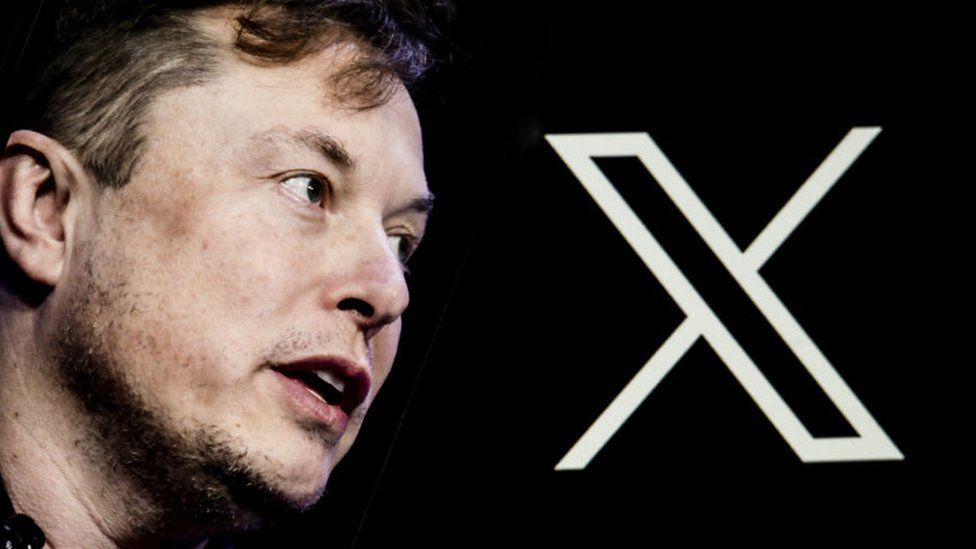
Did Elon Musk Overpay to Acquire X?

0

In February 2025, Bloomberg News reported that Elon Musk’s X was in discussions with investors to raise funds at a $44 billion valuation—the same amount Musk paid to acquire the company in 2022. However, these talks were described as ongoing, with details subject to change, and no final deal has been confirmed. This means that while X may be targeting that valuation, it’s not yet an established fact that it has achieved it. Earlier valuations, like Fidelity’s estimate in late 2024, had pegged X at a much lower value—around $12.32 billion—highlighting the uncertainty around its current worth.

Valuation fluctuations refer to changes in the estimated worth of a company, asset, or investment over time. For a company like X (Twitter), these shifts can be influenced by a mix of internal performance metrics, market conditions, investor sentiment, and external events.  A company’s ability to generate income and turn a profit is a core driver of its valuation. If X boosts ad revenue or cuts costs (e.g., through layoffs or tech efficiencies), its value might rise. Conversely, losing advertisers—as X did post-2022 acquisition due to content moderation concerns—can tank its valuation.

For social platforms, active users and how much they interact matter. More users or higher engagement can signal future revenue potential, lifting valuation. A drop-off, like the reported decline in X’s daily active users in 2023, can spook investors and drag it down. Broader economic factors—interest rates, inflation, or tech sector trends—play a role. When rates rise, investors often discount future cash flows more heavily, lowering valuations. The 2022-2023 tech slump hit many firms, including X, harder than earlier boom years.

User engagement on a platform like X (or any social media) is influenced by a range of factors that determine how often people use it, how long they stay, and how actively they interact (posting, liking, sharing). Users stick around if the content they see—posts, threads, news—matches their interests. Algorithms that prioritize trending topics or personalized feeds can boost engagement. On X, Musk’s push for “unfiltered” takes and less moderation has kept some users hooked but alienated others who dislike the noise or misinformation spike.

Tools that make interaction easy or fun—like X’s 280-character limit (upped from 140), quote posts, or the newer long-form content option—can drive engagement. Features like Spaces (live audio) or Premium perks (blue checks, higher visibility) also play a role, though their uptake varies. People engage more when their friends, influencers, or communities are active. X’s strength has been its real-time chatter—think breaking news or meme storms. But if key voices (e.g., journalists, celebs) leave for rivals like Threads or Bluesky, engagement can dip as the network shrinks.

Perception is huge. Musk’s $44 billion buyout in 2022 was seen by some as overpaying, especially as Fidelity later slashed its estimate to ~$12 billion by 2024. But if X’s fundraising talks at $44 billion succeed in 2025, it shows renewed confidence—sentiment can swing fast. New features (like X Premium subscriptions), legal battles, or big announcements (e.g., Musk’s AI integration plans) can jolt valuations. Reports of X regaining advertisers or losing them to rivals like Threads shift the narrative and the numbers.

Valuations often benchmark against peers. If Meta or TikTok see their multiples (e.g., price-to-earnings ratios) climb or crash, X’s valuation might follow suit, adjusted for its unique position. For X specifically, its journey from $44 billion in 2022 to a low of $12-19 billion in 2023-2024 (per Fidelity and other estimates) and now potentially back to $44 billion in 2025 talks reflects this volatility.

The drop came from advertiser pullbacks, debt from the leveraged buyout, and a shaky transition under Musk. The potential rebound? Maybe operational tweaks, a stabilizing user base, or just Musk’s knack for drumming up hype. Valuations aren’t static—they’re a snapshot of data and belief, constantly reshaped by what’s happening inside and outside the company.