DD
MM
YYYY

PAGES

DD
MM
YYYY

spot_img

PAGES

Home Blog Page 1666

Tinubu Signs Investment and Securities Act 2024 Into Law, Paving Way for Capital Market Reforms

0
SEC Nigeria

President Bola Ahmed Tinubu has signed the Investment and Securities Act (ISA) 2024 into law, marking a significant overhaul of Nigeria’s capital market regulatory framework.

The legislation, which repeals the Investment and Securities Act No. 29 of 2007, aims to strengthen investor protection, improve market transparency, and align the country’s financial markets with global best practices.

The Securities and Exchange Commission (SEC), in a statement on Friday, described the new law as a transformative step that will enhance regulatory oversight, introduce new asset classes, and foster sustainable growth in the capital market. The Commission noted that the enactment reaffirms its authority as the apex regulator and equips it with broader powers to tackle financial misconduct and market instability.

One of the biggest changes introduced by the ISA 2024 is the expansion of SEC’s regulatory powers to ensure Nigeria meets global standards set by organizations such as the International Organization of Securities Commissions (IOSCO). The SEC emphasized that the new provisions will help Nigeria maintain its “Signatory A” status under IOSCO’s Enhanced Multilateral Memorandum of Understanding (EMMoU), which is a critical benchmark for credibility in the global financial landscape.

The law introduces structural reforms and innovations addressing key sectors including stock exchanges, commodities trading, digital assets, and systemic risk management. It also provides a clearer legal framework for financial market infrastructures, such as clearing houses, trade depositories, and central counterparties, which are essential for a stable and efficient capital market.

A key highlight of the Act is the restructuring of stock exchanges, introducing a classification system that differentiates between Composite and Non-composite exchanges. Composite exchanges will be allowed to list and trade all categories of securities and products, while Non-composite exchanges will be limited to specific asset classes. This differentiation is aimed at promoting specialization and enabling better regulatory oversight tailored to the activities of each exchange.

For the first time, Nigeria’s capital market law explicitly recognizes digital assets and investment contracts as securities. Virtual Asset Service Providers (VASPs), Digital Asset Operators (DAOPs), and Digital Asset Exchanges will now be subject to SEC regulation. The move is expected to ensure investor protection, increase accountability, and prevent abuses in the fast-growing digital asset sector. With the increasing adoption of cryptocurrencies and blockchain-based investments, this provision brings much-needed clarity and legal backing to digital asset trading in Nigeria.

The Act also introduces a legal framework for commodity exchanges and warehouse receipt systems, a move that is expected to stimulate growth in agriculture, mining, and other commodity-driven industries. The law enables structured financing for commodities and reduces risks for market participants, a development that could boost Nigeria’s agricultural value chain by allowing farmers and commodity traders to access financing while stabilizing prices.

The ISA 2024 grants sub-national governments and their agencies more flexibility in raising funds from the capital market. This reform is expected to open new financing windows for infrastructure development, reducing the reliance of state governments on federal allocations and commercial loans. The Act seeks to enhance economic growth at both state and local government levels by providing states with alternative funding mechanisms.

A crucial aspect of the new law is its crackdown on Ponzi schemes and fraudulent financial activities. It introduces stricter penalties against financial scams, explicitly prohibiting illegal investment schemes and prescribing tougher consequences, including lengthy jail terms for individuals found guilty of promoting fraudulent investments. This provision is a direct response to the proliferation of Ponzi schemes in Nigeria, which have defrauded thousands of citizens of billions of naira. The government’s decision to strengthen enforcement in this regard signals a renewed commitment to cleaning up the investment landscape and protecting retail investors.

To prevent financial shocks from destabilizing the market, the Act introduces special exemptions for transactions processed through key market infrastructures such as clearing houses and central counterparties. These transactions will no longer be affected by general insolvency laws, ensuring market stability in times of financial distress. The SEC is also empowered to monitor and manage systemic risks to prevent disruptions that could arise from financial crises.

The law also expands capital market access by allowing a wider range of entities to issue securities to the public. This provision could lead to increased diversity in financial products available in Nigeria, unlocking new capital-raising opportunities for both the public and private sectors.

To enhance transparency and traceability in capital market transactions, the Act mandates the use of Legal Entity Identifiers (LEIs) for all market participants. LEIs are globally recognized tools that improve fund flow monitoring and help regulators detect irregularities more effectively. This requirement is expected to make Nigeria’s capital market more transparent and reduce the likelihood of fraudulent activities.

The ISA 2024 also strengthens the operations and independence of the Investments and Securities Tribunal, enhancing its capacity to resolve capital market disputes. Changes to the tribunal’s composition, jurisdiction, and appointment process have been introduced to make it more efficient and responsive to the needs of investors.

Reacting to the signing of the Act, SEC Director-General Dr. Emomotimi Agama described it as a milestone that will boost investor confidence and drive capital market development. He stated that the ISA 2024 reflects the SEC’s commitment to building a dynamic, inclusive, and resilient capital market.

“The ISA 2024 reflects our commitment to building a dynamic, inclusive, and resilient capital market,” said Dr. Agama. “By addressing regulatory gaps and introducing forward-looking provisions, the new Act empowers the SEC to foster innovation, protect investors more efficiently, and reposition Nigeria as a competitive destination for local and foreign investments.”

The SEC also acknowledged the National Assembly’s bipartisan support throughout the legislative process. It credited the Minister of Finance and Coordinating Minister of the Economy, as well as the Minister of State for Finance, for their role in shaping the Act to align with Nigeria’s broader economic vision.

The enactment of ISA 2024 is expected to attract renewed interest from both local and international investors, particularly in emerging asset classes such as digital assets and commodities. By strengthening investor protection, increasing market transparency, and introducing stricter penalties for financial crimes, the new law sets the stage for deeper capital formation and economic diversification.

It provides a more level playing field for issuers, exchanges, and operators while giving regulators stronger tools to clamp down on market abuses. Additionally, it presents greater financing opportunities for state governments and businesses.

With this new legal framework, Nigeria takes a bold step toward building a capital market that is more inclusive, innovative, and resilient. The ISA 2024 aligns Nigeria’s capital market with international standards while addressing the country’s unique financial industry. The reforms are expected to position Nigeria as a stronger player in the global investment space, attracting foreign investments and boosting confidence in the country’s economic outlook.

Elon Musk’s xAI Acquires X in $33bn All-Stock Deal, Solidifying AI-Social Media Merger

0

Elon Musk has further deepened his control over the intersection of artificial intelligence and social media by merging two of his most ambitious ventures. On Friday, the billionaire entrepreneur announced that xAI, his AI startup, has acquired X (formerly Twitter) in an all-stock deal.

“xAI has acquired X in an all-stock transaction,” Musk wrote in a post on X. “The combination values xAI at $80 billion and X at $33 billion ($45B less $12B debt).”

Musk emphasized that the futures of xAI and X are now permanently intertwined, stating, “Today, we officially take the step to combine the data, models, compute, distribution, and talent.”

The acquisition represents the next phase of Musk’s vision for an AI-powered everything app, leveraging X’s massive user base and vast data reserves to fuel xAI’s development.

Musk originally purchased X for $44 billion in October 2022, but the platform’s value has fluctuated dramatically in the wake of his sweeping changes. At its lowest point, Fidelity estimated that X was worth less than $10 billion, reflecting major losses in advertising revenue and investor skepticism over Musk’s radical restructuring, including his shift toward paid subscriptions.

However, recent months have seen X’s valuation rebound to $33 billion, a shift Musk has credited to its growing influence in the political and social discourse. Since the inauguration of President Donald Trump, for whom Musk campaigned aggressively, investors have viewed X as an increasingly powerful media force. The platform remains the go-to space for real-time updates and political debate, making it a crucial tool in shaping public opinion.

Meanwhile, xAI has surged in value, quickly becoming a dominant force in the artificial intelligence space. Founded in 2023 as Musk’s direct competitor to OpenAI, the company has been rapidly scaling. In February, xAI was reportedly in talks to secure $10 billion in funding at a $75 billion valuation. Now, following the X acquisition, Musk pegs its worth at $80 billion.

One of the most significant shifts accompanying this acquisition is Musk’s decision to make xAI’s chatbot, Grok, free for all X users in a bold bid to expand its reach. Previously, access to Grok was restricted to premium subscribers on X, but Musk has now removed that paywall, betting that mass adoption will increase engagement and further integrate AI into everyday conversations.

The chatbot, which is embedded directly into X, has already become a key part of the platform’s experience. Users frequently interact with Grok using the #AskGrok feature, treating it as a search engine, an advisor, and even an entertainment source. Whether asking for historical facts, investment advice, or humorous takes on trending topics, X users are increasingly relying on the chatbot to generate answers instantly.

Beyond answering text-based queries, Grok has expanded into new capabilities, including image editing, giving users tools to modify and enhance pictures within the X app. This move puts it in competition with advanced AI image-generation models, further strengthening xAI’s foothold in the market.

Musk has also celebrated Grok’s growing dominance in the AI space. On Thursday, he acknowledged that Grok now tops the Android charts, surpassing rival chatbots. “Grok is #1 on Android,” Musk posted on X. Grok’s biggest competitor, ChatGPT, is ranked third.

The Data Advantage: Why Musk Needed X for xAI’s Future

The acquisition of X provides a crucial advantage to xAI in the ongoing AI arms race. Unlike other AI companies that struggle with acquiring large-scale training data, Musk now controls a platform with years of real-time, user-generated content.

Social media conversations provide an unparalleled dataset for training AI models, allowing Grok to stay updated on real-world events faster than its competitors. Musk had already begun leveraging this advantage by granting Grok access to real-time posts on X, allowing it to generate more current and context-aware responses compared to AI models like OpenAI’s ChatGPT, which relies on periodic updates rather than continuous information streams.

With the full merger now in place, experts predict that Grok’s integration with X will become even deeper, with features such as AI-powered content recommendations, real-time sentiment analysis, and automated post generation potentially being added.

The acquisition signals a fundamental transformation for X, which Musk has long envisioned as an all-in-one platform capable of handling payments, video streaming, and advanced social networking. Now, with AI deeply embedded into its infrastructure, X is poised to become a key testing ground for next-generation AI models.

The deal also solidifies Musk’s ambition of challenging OpenAI, Google DeepMind, and Anthropic in the battle for AI supremacy. With a massive user base, real-time training data, and free access to AI-powered tools, xAI is positioning itself as a formidable competitor in the artificial intelligence market.

Elon Musk said his xAI artificial intelligence startup will acquire the X social media platform, formerly known as Twitter, for $33 billion in an all-stock deal. “The combination values xAI at $80 billion and X at $33 billion,” Musk said in a social media post on the platform on Friday. With $12 billion of debt factored in, the X value is $45 billion, he said, adding that the tie-up combines ”xAI’s advanced AI capability with X’s massive reach.” Musk bought Twitter for $44 billion including debt in 2022.

Tekedia Capital Commends Nigeria On Investments And Securities Act 2025 Becoming Law

1

This is a good policy as Nigeria needs to do more to deepen the capital market: “The Securities and Exchange Commission (SEC) is pleased to announce that His Excellency, President Ahmed Bola Tinubu GCFR, has assented to the Investments and Securities Act (ISA) 2025, which repeals the Investments and Securities Act No. 29 of 2007”. Today, the stock market of South Africa is more than $1 TRILLION while Nigeria is about $70 billion. So, the status quo makes no sense. I commend the Securities and Exchange Commission (SEC), the National Assembly and the president for making the the Investments and Securities Act (ISA) 2025 the law of the land.

Tekedia Capital congratulates Nigeria as we hope this will bring a new dawn in Nigeria’s broad financial market. Nigeria needs to create new asset classes and innovate in ETP, ETF, derivatives, digital assets, commodities, etc while ensuring investor protection and market resilience.

SEC DG Emomotimi John Agama, you are doing well. Your era has been one of action and transformation. As players in the startup ecosystem, your nuanced playbook on using regulation to drive growth has been superb. We commend the clarity you brought on digital assets after Nigeria wasted a decade with no plan. Keep serving your nation!


Nigeria Securities And Exchange Commission Announces Presidential Assent To Investments And Securities Act 2025

The Securities and Exchange Commission (SEC) is pleased to announce that His Excellency, President Ahmed Bola Tinubu GCFR, has assented to the Investments and Securities Act (ISA) 2025, which repeals the Investments and Securities Act No. 29 of 2007. This landmark legislation strengthens the legal framework of the Nigerian capital market, enhances investor protection, and introduces critical reforms to promote market integrity, transparency, and sustainable growth.

The enactment of the ISA 2025 reaffirms the authority of the SEC as the apex regulatory authority of the Nigerian Capital Market. The new Act also introduces transformative provisions to further align Nigeria’s market operations with international best practice.

Key highlights of the ISA 2025:

The Act enhances the regulatory powers of the SEC in a manner comparable with benchmark global securities regulators. These enhanced powers and functions ensure full conformity with the requirements of IOSCO’s Enhanced Multilateral Memorandum of Understanding (EMMoU), enabling the SEC retain its “Signatory A” status and enhancing the overall attractiveness of the Nigerian capital market.

Other notable provisions of the ISA 2025 include:

  • Classification of Exchanges and inclusion of provisions on Financial Market Infrastructures- The Act classifies Securities Exchanges into Composite and Non-composite Exchanges. A Composite Exchange is one in which all categories of securities and products can be listed and traded, while a Non-composite Exchange focuses on a singular type of security or product. There are also new provisions on Financial Market Infrastructures such as Central Counter Parties, Clearing Houses and Trade Depositories. 
  • Expansion of the definition and Understanding of Securities – The Act explicitly recognises virtual/digital assets and investment contracts as securities and brings Virtual Asset Service Providers (VASPs), Digital Asset Operators (DAOPs) and Digital Asset Exchanges under the SEC’s regulatory purview.
  • Comprehensive Insolvency Provisions for Financial Market Infrastructures – The Act introduces provisions that exempt transactions facilitated through or otherwise involving Financial Market Infrastructures from the application of general insolvency laws.
  • Management of Systemic Risk – The Act introduces provisions for the monitoring, management and mitigation of systemic risk in the Nigerian capital market.
  • Expansion of the Category of Issuers to the Public– The Act expands the categories of issuers, as a key step towards the introduction of a wide range of innovative products and offerings as well as the facilitation of “commercial and investment business activities”, subject to the approval of the Commission and other controls stipulated in the Act.
  • Legal Framework for Commodities Exchanges – The Act contains a new Part which provides for the regulation of Commodities Exchanges and Warehouse Receipts. These provisions are essential to allow for the development of the entire gamut of the Commodities ecosystem.
  • Issuance of Securities by Sub-Nationals and their Agencies- Salient provisions of the Act address existing restrictions in respect of raising of funds from the capital market by Sub-Nationals to allow for greater flexibility in this regard.
  • Transparency in Securities Transactions – The Act introduces the mandatory use of Legal Entity Identifiers (LEIs) by participants in capital market transactions. This stipulation is designed to improve transparency in the conduct of securities transactions.
  • Enforcement Against Illegal Investment Schemes – The Act expressly prohibits Ponzi Schemes and other unlawful investment schemes, while prescribing stringent jail terms and other sanctions for the promoters of such schemes.
  • Strengthening the Investments and Securities Tribunal- The Act amends some key provisions in the repealed ISA 2007 pertaining to the Composition of the Tribunal, constitution of the Tribunal, qualification and appointment of the Chief Registrar as well as the jurisdiction of the Tribunal to enhance the ability of the Tribunal to optimally discharge its mandate.

Commenting on this milestone, the Director-General of the SEC, Dr. Emomotimi Agama, lauded the President’s assent as a transformative step for the capital market and stated: “The ISA 2025 reflects our commitment to building a dynamic, inclusive, and resilient capital market. By addressing regulatory gaps and introducing forward-looking provisions, the new Act empowers the SEC to foster innovation, protect investors more efficiently and reposition Nigeria as a competitive destination for local and foreign investments. We commend all stakeholders within and outside the capital market community for their unwavering solidarity towards the achievement of this historic milestone and solicit their continued collaboration in respect of the effective implementation of the ISA 2025 for the benefit of our economy.”

The SEC extends its profound appreciation to the National Assembly for its patriotism and dedication in enacting this new legal framework for the Nigerian capital market. The meticulous deliberations, extensive stakeholder engagements, and bi-partisan support demonstrated throughout the legislative process highlight the National Assembly’s resolve to foster economic growth and enhance investor confidence.

We also commend the Honourable Minister of Finance and Coordinating Minister of the Economy of Nigeria as well as the Minister of State for Finance for their invaluable contributions to the realisation of this groundbreaking project. Their strategic guidance, policy expertise, and steadfast support have ensured that the ISA 2025 aligns with Nigeria’s broader economic objectives.

The SEC would continue to engage with market operators, investors, and all stakeholders to ensure a seamless transition from the repealed ISA 2007 to the new legal regime established under the ISA 2025.

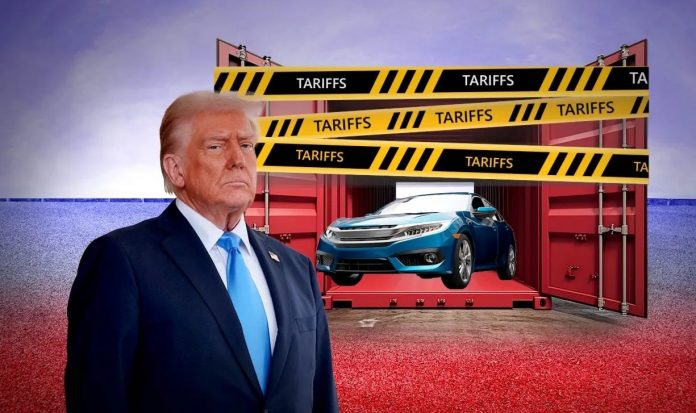
Trump Warns U.S. Automakers Not To Raise Prices As His 25% Tariff On Cars And Auto Parts Takes Effect

0

In his characteristic style of deal-making and economic brinkmanship, President Donald Trump has issued a blunt warning to some of America’s top automakers: do not raise car prices.

According to WSJ, in a recent call with industry leaders, Trump warned them not to raise car prices in response to his newly imposed 25% tariff on imported vehicles and auto parts, which will take effect on April 2.

He said the White House would take a dim view of any price hikes blamed on the tariffs. The president sought to reassure the executives, saying they should be grateful for his decision to roll back what he called Biden’s “electric-vehicle mandate”, which he argued had been an unnecessary burden on the industry.

“The tariffs will be great,” Trump said during the call, according to one of the participants who spoke to WSJ. He pitched the policy as a move that would strengthen American manufacturing and insisted that rather than complain about increased costs, automakers should view his tariffs as a positive development for the industry.

“You’re going to see prices going down, but going to go down specifically because they’re going to buy what we’re doing, incentivizing companies to—and even countries—companies to come into America,” Trump said publicly at an event announcing the tariffs.

But while Trump framed the tariffs as a way to rebuild American industry, the reaction from automakers was far less enthusiastic. Some executives left the call rattled and frustrated, worried about what form of “punishment” the administration might pursue if they increased prices anyway.

Automakers Have No Choice but to Raise Prices

Despite Trump’s warning, the reality is that automakers cannot absorb the costs of the tariffs without passing them on to consumers. Many American-made vehicles still rely heavily on foreign parts and raw materials, meaning that even domestic production will see significant cost increases.

“Tariffs, at any level, cannot be offset or absorbed,” wrote Ray Scott, CEO of Lear, a major auto parts supplier, in an email to employees. “A holistic, industrywide approach will be necessary to mitigate the impact.”

The financial consequences of Trump’s move are already being calculated. Analysts at Morgan Stanley predict that vehicle prices could rise by 11% to 12% to offset the tariffs. Automakers are preparing for this reality, stockpiling a two- to three-month supply of new cars, but industry insiders warn that by May, the impact will be unavoidable.

One auto executive, speaking anonymously, summed up the industry’s reaction saying: “The math would tell you, that’s going to cost us multibillions of dollars. So who pays for that?”

Trump’s insistence that automakers keep prices steady comes at a delicate political moment. Inflation has been a central issue in his administration, with voters increasingly concerned about the rising cost of living. Trump’s economic advisers are privately worried that tariffs will drive up consumer prices, even if Trump himself does not frequently address these concerns publicly.

“It is difficult to see how imposed tariffs over time would not have some impact on prices,” said Matt Blunt, president of the American Automotive Policy Council, which represents GM, Stellantis, and Ford.

Other industries have expressed similar concerns. Oil and gas executives from the American Petroleum Institute have warned Trump that tariffs could push gasoline prices higher, particularly in the Midwest. Although gas prices have slightly declined since Trump took office, according to AAA, analysts say that prolonged trade restrictions could reverse that trend.

The food industry is also bracing for higher costs. White House officials say that food companies have argued that tariffs will drive up prices on products Americans rely on, further complicating Trump’s strategy.

Even some of Trump’s usual allies in the business world are questioning his approach.

“Trump is obviously very fond of tariffs, but the American public dislikes higher prices as the 2024 election results clearly demonstrated,” said Clark Packard, a tariff expert at the Cato Institute.

Auto Industry Pushes Back

Rather than quietly accept Trump’s directives, automakers are mobilizing against the tariffs. Stellantis has already begun encouraging U.S. dealers to pressure lawmakers, warning that the policy favors European and Asian rivals at the expense of American manufacturers.

“We encourage you to contact your federal and state representatives to share your opinion on a matter that threatens to disrupt our business,” read an email Stellantis sent to dealers, which was viewed by The Wall Street Journal.

Many in the industry believe the tariffs could severely disrupt supply chains, making it harder for American automakers to compete globally. And while Trump argues that his policies will bring manufacturing jobs back to the U.S., experts warn that such shifts take years to materialize—far too long for automakers to absorb immediate tariff costs.

With the tariffs set to take effect on April 2, the next few months will determine whether automakers openly defy Trump’s warning. Many companies are already planning price increases, knowing that there is no realistic alternative.

The bigger question is how Trump will react if automakers refuse to comply with his demand. Could the White House use regulatory agencies as leverage against manufacturers who raise prices? Some fear government retaliation, given Trump’s history of targeting law firms, companies, and entire industries that do not align with his economic agenda.

As one industry insider put it, the situation is as much about politics as it is about economics: “Trump is telling us we can’t raise prices. But tariffs are a tax. So who’s going to pay for it? The consumer, or us?”

However, the auto industry appears determined to make its case, even as it braces for potential backlash from the White House. But if Trump’s tariffs lead to significantly higher vehicle prices in the months ahead, it may not just be automakers he finds himself at odds with—it could be the American consumer as well.

Customer Validation and Building What Customers Really Want – Ndubuisi Ekekwe

0

Join us today and let us have a conversation on customer validation and how to build what customers really want. In the grand scheme of business growth, any company which begins scaling without first attaining a product-market fit will waste money. Simply, you must have a validation before that growth pedal is pushed at scale.

I will take you to Oriendu Market Ovim to understand that ancestral Igbo proverb of “ahia oma na-ere onwe ya” which means that a great product will sell itself. It is not saying that you do not need to advertise. Rather, the proverb is saying that if the product is great, customers will come, and they will repeat, and they will recruit other customers, because great products create fandom.

Hahaha – that fandom is the validation as you must overcome the inertia customers face, to support your mission, by getting them to pay. Remember: customers are the greatest investors in any market system, and validating a product use-case will remain central in any entrepreneurial playbook. In my lecture, I will explain the mechanics of that validation, and how we can use the perception demand framework to win in markets.

Join us and pick a seat here for our next edition 

Sat, March 29 | 7pm-8.30pm WAT | Customer Validation and Building What Customers Really Want – Ndubuisi Ekekwe | Zoom link