
DD
MM
YYYY

PAGES

DD
MM
YYYY

spot_img

PAGES

Home Blog Page 18

ECB Must Stand Ready to Raise Rates Quickly if Energy Shock from Iran War Fuels Persistent Inflation, Bulgarian Central Bank Chief Warns

0

The European Central Bank must be prepared to raise interest rates swiftly if surging energy costs triggered by the Iran war begin to feed into broader price pressures and inflation expectations, ECB policymaker Dimitar Radev warned on Tuesday.

Radev, who heads Bulgaria’s central bank and is one of the newest members of the ECB’s Governing Council, said the balance of risks has shifted in an unfavorable direction as the conflict enters its sixth week and continues to disrupt global energy supplies.

“The balance of risks has shifted in an unfavorable direction,” Radev told Reuters in an interview. “While the baseline remains our reference, the likelihood of a more adverse scenario has increased, particularly in light of the energy shock and the elevated level of uncertainty.”

He was referring to the three economic scenarios, adverse, baseline, and severe, that the ECB outlined last month. Surging energy prices have already pushed eurozone inflation well above the ECB’s 2% target. Policymakers are now actively debating whether they need to tighten policy to prevent this one-off shock from becoming embedded in wages, margins, and broader prices, setting off a self-reinforcing spiral.

A major concern is that households and businesses, still scarred by the runaway inflation that followed Russia’s 2022 invasion of Ukraine, could rapidly adjust their expectations upward. That behavioral shift would make it far more difficult and costly for the ECB to bring inflation back under control.

“Recent inflation developments appear to have increased the responsiveness of expectations, meaning that pass-through from new shocks can occur more quickly than under normal conditions,” Radev said.

His comments echo similar warnings from several other ECB officials, who have stopped short of explicitly calling for immediate rate hikes but have stressed the need for the bank to stand ready to act decisively. For now, market-based inflation expectations remain anchored around the 2% target, and there are no clear signs of second-round effects in the data.

The March inflation flash estimate showed a sharp jump driven by energy, but service price pressures were actually easing.

Radev cautioned, however, that the ECB cannot take a benign outcome for granted in such a fragile environment.

“If the shock persists and begins to affect wages, margins and expectations, the cost of inaction would increase,” he said. “In such a situation, acting in a timely manner would be the more prudent course.”

Financial markets have already priced in more than two ECB rate hikes this year, with the first move now expected as early as June. Radev said it was too early to know whether the bank would have enough hard data by its April 30 policy meeting to justify an immediate decision, but there would be sufficient information for a more structured and concrete policy discussion.

The ECB will pay particular attention to various measures of inflation expectations, underlying price trends, sentiment indicators, energy price developments, and — crucially — any signals about the likely duration of the Iran conflict and its economic fallout.

While the painful experience of 2022 could make consumers and businesses quicker to adjust their behavior this time, Radev noted that the eurozone is entering this crisis from a stronger position than four years ago. Interest rates are already significantly higher, and inflation expectations remain better anchored.

Still, he flagged a fresh risk: governments responding to higher energy costs with new subsidies or fiscal support measures that could unintentionally add fuel to the inflationary fire.

The Bulgarian central banker’s remarks underscore a growing sense of unease within the ECB. After spending the past two years successfully bringing inflation down from double-digit levels, policymakers now face the prospect of a new energy-driven surge that could undo much of that progress.

With the war showing no signs of ending quickly and the Strait of Hormuz remaining largely closed, the ECB finds itself in a classic policy bind — forced to weigh the risk of doing too little against the danger of tightening policy into an already slowing economy.

Radev’s call for readiness to act swiftly reflects a broader recognition inside Frankfurt that, in the current environment, hesitation could prove far more expensive than a timely response.
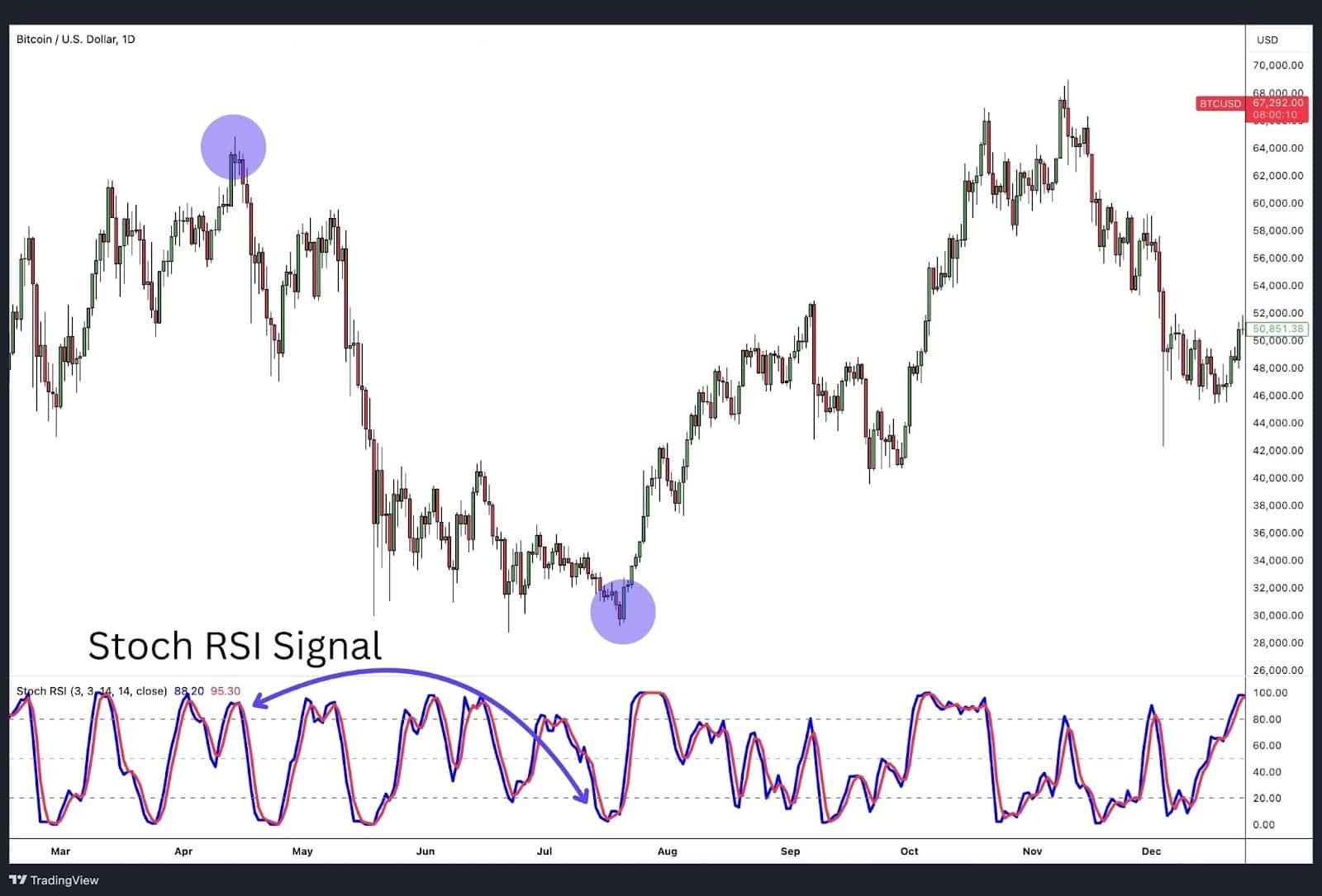

Bitcoin’s RSI Mirroring the Double Bottom Pattern Seen in 2022

0

Bitcoin’s stochastic RSI a momentum oscillator that smooths the standard RSI is drawing significant attention today, with analysts noting it is mirroring the double-bottom pattern observed at the end of the 2022 bear market nearly perfectly.

Bitcoin is trading in the $67,000–$68,000 range, following a period of consolidation and downward pressure after higher levels in late 2025. Recent daily RSI readings have hovered in the low-to-mid 40s around 42 recently which is neutral-to-weak but not extremely oversold on the standard 14-period RSI.

The standout signal comes from the stochastic RSI on daily charts, which analysts say is repeating the exact setup seen in late 2022—just before Bitcoin’s major recovery into 2023. In that prior instance: Price and stochastic RSI formed a double bottom. A breakout above a key resistance level on the indicator preceded a strong bullish move.

Traders are highlighting that Bitcoin’s current stochastic RSI is at the EXACT SAME point as in 2022, with potential for a similar upside if it breaks above a corresponding blue line/resistance level on the chart.

What Is Stochastic RSI, and Why Does This Matter?

Standard RSI (14-period) measures the speed and change of price movements on a 0–100 scale. Below 30 is traditionally oversold; above 70 is overbought. Stochastic RSI applies the stochastic formula to RSI values themselves, making it more sensitive to recent momentum shifts. It often highlights turning points earlier, especially double bottoms or divergences in ranging and bearish phases.

In 2022’s bear market bottom around November–December, the stochastic RSI showed capitulation followed by a clear double bottom and bullish crossover, aligning with the price low near $16,000 before the multi-month rally. Current charts are being compared directly to that period, suggesting the selling pressure may be exhausting and a relief bounce or trend reversal could be forming.

Historical Precedent vs. Current Differences

Past cycles show Bitcoin’s weekly RSI often hitting extreme lows near bear market bottoms (e.g., 2015, 2018, 2022), sometimes preceding strong recoveries. However:In 2022, the weekly RSI reached oversold levels mid-year but the actual price bottom came months later after consolidation.

Today’s environment includes different macro factors: spot Bitcoin ETFs, institutional involvement, post-halving dynamics, and varying liquidity conditions. Some analysts note this could be a liquidity-driven shakeout rather than a full classic bear market repeat.

Technical patterns like this are probabilistic, not guarantees. Bitcoin has seen oversold RSI readings multiple times without immediate massive rallies, and external events; regulation, macro news, ETF flows can override chart signals. Recent data shows Bitcoin near support zones around $65,000–$67,000, with mixed momentum indicators e.g., MACD still cautious in some timeframes.

This stochastic RSI alignment is generating buzz as a potential early sign that the current downtrend is losing steam, similar to how 2022’s bear market concluded. Traders are watching for confirmation via: A decisive break higher on the stochastic RSI. Increased volume. Bullish candlestick patterns.

If it plays out like the 2022 analog, it could signal the early stages of recovery. That said, always manage risk—crypto remains highly volatile, and past performance doesn’t dictate future results. Always verify and check for valid plans before FOMO drives rapid rotations.

BOJ to Hike Rate in July Hike as Iran War Turns Oil Shock Into a Policy Test for Japan

0

The Bank of Japan is moving closer to another interest-rate increase, with former board member Seiji Adachi warning that the central bank risks falling behind the curve as the Iran war drives a fresh oil shock through Japan’s import-dependent economy.

In remarks that sharpen expectations for further monetary tightening, Adachi said the BOJ will likely raise rates by July, and possibly as early as April or June, as rising crude prices and supply disruptions intensify inflation risks.

“The BOJ will probably raise rates again in April, June or July,” Adachi told Reuters, adding that “with the Middle East conflict, the risk of the BOJ falling behind the curve in dealing with inflation has heightened somewhat.”

That assessment is particularly important because it captures the increasingly difficult position facing the BOJ: contain imported inflation without derailing a still-fragile domestic recovery.

Japan’s economy is uniquely exposed to the conflict. As one of the world’s largest importers of crude oil and liquefied natural gas, Japan is highly vulnerable to disruptions in the Strait of Hormuz, through which roughly a fifth of global oil and gas flows pass. With the conflict constraining supply and keeping crude prices elevated, the country’s import bill is rising sharply, feeding directly into consumer prices, transport costs, and industrial margins.

This is where Adachi’s warning becomes more consequential. Unlike the United States or some European economies, Japan’s inflation dynamic remains heavily influenced by imported costs and the yen’s exchange rate.

The latest Tankan survey already showed five-year corporate inflation expectations rising to 2.5%, above the BOJ’s long-standing 2% target. That is a critical signal because it suggests businesses increasingly expect inflation to persist, not fade.

Adachi noted this shift in explicit terms. “Underlying inflation has already hit the central bank’s 2% target,” he said.

For years, the BOJ struggled to sustainably lift inflation expectations after decades of deflation and weak wage growth. Now, the risk has reversed: inflation may begin to embed itself more firmly in the economy, especially if the oil shock proves prolonged.

Adachi’s view is that rates need to move closer to neutral territory.

“It’s better for the BOJ to raise rates to levels deemed neutral to the economy as soon as possible,” he said, adding that Japan’s neutral rate “likely stood somewhere around 1.25%.”

That implies there may be room for two additional 25-basis-point hikes this year, taking the policy rate from 0.75% to 1.25%. Such a move would mark one of the most significant tightening phases in Japan’s monetary history, especially after decades of ultra-loose policy and negative rates.

Still, the uncertainty surrounds the timing. Adachi said the probability of an April move is “50-50,” acknowledging that policymakers must weigh inflation risks against war-driven market volatility and the broader economic fallout.

“But whether it hikes in April would be a tough call, as doing so would mean pulling the trigger when the economic impact of the war remains unclear,” he said.

This captures the BOJ’s core dilemma. Raise too slowly, and imported inflation worsens while the yen remains under pressure. Raise too quickly, and the central bank risks tightening into an economy where consumption and corporate investment are still recovering.

The political backdrop complicates matters further. Adachi noted that the government may not be fully aligned with aggressive near-term tightening.

“The fact dovish Prime Minister Sanae Takaichi appointed two reflationists to join the BOJ board is a sign the administration is opposed to further near-term rate hikes,” he said.

That is a crucial institutional insight because higher rates are expected to increase borrowing costs for businesses at a time when Tokyo is pushing investment into semiconductors, advanced manufacturing, defense, and clean energy.

“Rate hikes would push up the cost of corporate borrowing. That runs counter to the administration’s push to boost investment in growth areas,” Adachi added.

There is also a global market dimension that makes this story larger than Japan. A BOJ rate hike could strengthen the yen and trigger some repatriation of Japanese capital currently invested overseas, particularly in U.S. Treasuries and global equities.

That matters because Japanese institutions remain among the largest foreign holders of U.S. government debt. Any material shift in capital flows could place upward pressure on global bond yields and tighten financial conditions beyond Asia.

If the war evolves into a prolonged energy shock, Adachi suggested the BOJ may need to move faster.

“If the Middle East war turns into a protracted conflict that triggers a more than year-long oil shock, the BOJ may need to hike rates at a faster pace to push real borrowing costs out of negative territory,” he said.

“We’re not there yet,” he added. “But depending on how the conflict unfolds, the BOJ will face a very tough decision, sandwiched between rising inflation and low growth.”

That final point is perhaps the most important. The Iran war is no longer just a geopolitical or energy-market event. It is now directly influencing the policy trajectory of one of the world’s most systemically important central banks.

Waymo Partners with Lyft to Roll out Robotaxi in Nashville, its 11th City

0

Waymo’s long-anticipated Nashville rollout has now moved from testing to commercial service, marking another significant step in the autonomous ride-hailing company’s rapid U.S. expansion.

The formal launch is the latest front in what has become one of the most consequential races in urban mobility: the battle to dominate the robotaxi market before it matures into a multi-billion-dollar industry.

After months of mapping Nashville’s roads, manually driving vehicles, and then testing autonomous software with human safety operators, the Alphabet-owned company has now opened its service to the public, making the Tennessee capital the 11th city in its growing commercial network. The rollout begins within a 60-square-mile service area and, in a notable strategic twist, launches first through the Waymo app before later expanding to Lyft’s platform.

This dual-app structure is significant because it places Nashville at the center of a broader industry contest over who controls the customer relationship in autonomous transport. Waymo is not simply racing to deploy more self-driving cars. It is racing to secure territory, user habits, platform partnerships, and regulatory goodwill before rivals scale up.

The robotaxi competition is now unfolding along three major fronts: technology, platform access, and geographic footprint.

Waymo currently leads in real-world deployment. Its presence now spans Atlanta, Austin, Dallas, Houston, Los Angeles, Miami, Nashville, Orlando, Phoenix, San Antonio, and the San Francisco Bay Area. The company’s expansion pace has accelerated sharply over the past year, supported by fresh capital and Alphabet’s balance sheet. Nashville’s inclusion reinforces Waymo’s strategy of locking in high-demand urban corridors across the United States before competitors can establish themselves.

But the competitive pressure is intensifying. Tesla has now entered the commercial robotaxi conversation more aggressively, moving from years of promises into live public operations in Austin. That sets up what may become the defining rivalry in the autonomous vehicle sector: Waymo’s lidar-heavy, sensor-rich, safety-first model versus Tesla’s camera-based, software-centric approach.

Waymo has spent years building its reputation on slow, methodical deployment, extensive city-by-city mapping, and carefully geofenced operations. Tesla, by contrast, is pursuing a software scalability argument, betting that a vision-first architecture can be expanded more rapidly across cities and eventually through privately owned vehicles.

But this is where market share becomes central. In traditional ride-hailing, scale produces network effects: more vehicles reduce wait times, better availability attracts more riders, and higher ride volumes improve unit economics. The same logic applies to robotaxis, but with even higher stakes because the first company to scale safely across multiple cities could establish a durable moat.

Every city launch is therefore a land grab. Nashville is valuable not merely for its population, but for its transport patterns. It has dense tourism corridors, convention traffic, airport demand, and a vibrant nightlife economy centered around downtown entertainment districts. These are precisely the high-frequency trip zones where autonomous ride economics are most attractive.

Traditional Ride-hailing Operators Fight to Stay Alive

The larger fight, however, is no longer limited to vehicle makers. Ride-hailing platforms are themselves scrambling to avoid being cut out of the future mobility chain.

Lyft’s partnership with Waymo in Nashville is as much a defensive strategy as it is a growth initiative. By embedding Waymo’s vehicles into its ecosystem through Flexdrive’s fleet management and, eventually, app integration, Lyft is ensuring it retains relevance as transportation moves toward autonomy.

Uber is doing much the same, but on a broader scale. Having exited the business of building its own self-driving stack years ago, Uber is now positioning itself as the aggregator of autonomous fleets, partnering with multiple autonomous vehicle developers. Its recent tie-up with Zoox, Amazon’s autonomous vehicle unit, underscores that strategy.

This means the competition is no longer simply Waymo versus Tesla. It is increasingly: Waymo and Tesla for technology leadership, Uber and Lyft for distribution dominance,
and Amazon’s Zoox for platform disruption.

Zoox remains a serious contender, particularly because of Amazon’s capital strength and long-term logistics ambitions. Its custom-built, bidirectional robotaxi design is fundamentally different from retrofitted passenger vehicles and may appeal strongly in dense urban markets. Recent expansion plans in San Francisco and Las Vegas show it is moving to narrow the gap with Waymo.

There is also an international dimension to the race. Chinese players such as Baidu’s Apollo Go, Pony.ai, and WeRide are rapidly expanding and, in some cases, already handling large weekly ride volumes. That means the battle for market share is not just domestic but global, with companies trying to establish technological standards and city partnerships across multiple continents.

The central economic question is who can make the model profitable first. Robotaxis promise to remove the single biggest cost in ride-hailing: the human driver. In theory, that should dramatically improve margins. In practice, the industry still faces heavy capital costs tied to sensors, software development, remote assistance systems, charging infrastructure, insurance, and fleet maintenance.

Recent scrutiny over how frequently remote operators intervene shows that the “driverless” label still masks significant human oversight in many systems. That issue is of concern because profitability depends on minimizing those hidden labor costs while maintaining safety.

While Waymo appears to be ahead in commercial maturity and city-scale deployment, the race for market share is still in its early stages.

Strategy Reported a $14.46B Unrealized Loss on its Bitcoin Holdings for Q1 2026 

0

Strategy Inc. NASDAQ: MSTR, formerly MicroStrategy, led by Michael Saylor, reported a $14.46 billion unrealized loss on its Bitcoin holdings for Q1 2026.

This paper loss stems from accounting rules for digital assets. Bitcoin’s price dropped sharply in Q1—over 20% marking its worst first-quarter performance since 2018. At quarter-end, Strategy’s Bitcoin portfolio had a carrying value of about $51.65 billion against a total acquisition cost basis of roughly $58 billion, contributing to the gap.

The company also recorded an associated $2.42 billion deferred tax benefit and asset that partially offsets the loss on its books. During Q1 Strategy added ~88,316 BTC, purchasing roughly $7.25 billion worth amid the price decline. This reflects its long-standing Bitcoin treasurystrategy of aggressively accumulating BTC as a primary reserve asset.

The loss flows directly through the income statement, contributing to a large reported net loss for the quarter; per-share loss around -$16.53 in some analyses, exceeding some expectations. A $2.42 billion deferred tax benefit partially offsets it on the books, though valuation allowances were also recorded due to uncertainty around realizing those benefits soon.

This creates significant earnings volatility. Quarterly results now swing wildly with BTC price moves, making traditional financial analysis less useful. The software business remains small ~$111M revenue and secondary. No immediate cash outflow — these are paper losses that reverse with BTC price recovery. However, repeated large swings can affect investor perception and retained earnings.

Bitcoin now dominates the balance sheet >90% of assets in many views, amplifying overall company risk. The gap between cost basis and fair value weakens reported book value and optics, potentially complicating debt covenants or credit perceptions, though the company has stated no immediate liquidity crisis.


Post-Q1: The company resumed buying, acquiring another 4,871 BTC for ~$330 million average price ~$67,718 per BTC between April 1–5. Total holdings reached approximately 766,970 BTC by that point. Strategy remains the largest corporate Bitcoin holder.

Its average cost basis is often cited around $75,000+ per coin in recent analyses, meaning current BTC prices around $68,000–$82,000 range depending on exact timing have put parts of the stack underwater on an unrealized basis. The Q1 figure captures the full-quarter mark-to-market impact. Unrealized losses are non-cash and reflect temporary market fluctuations rather than realized sales or operational failures.

Strategy treats Bitcoin as a long-term holding, not something to sell during dips—Saylor has repeatedly emphasized a high-conviction, never sell approach. The company funds purchases partly through equity raises, convertible notes, and recently a perpetual preferred equity program (STRC), which adds leverage and dividend obligations but allows continued accumulation without forced selling.

The software business; its original BI/analytics segment reported Q1 revenue of ~$111 million, missing some estimates, and the overall per-share loss was reported at -$16.53 vs. lighter analyst expectations, but the narrative centers on the Bitcoin treasury. MSTR stock has been highly volatile and correlated with BTC price action; it fell significantly in the quarter alongside crypto markets.

Critics highlight the risks: leverage, funding costs, and exposure to BTC volatility could pressure the balance sheet or dilute shareholders if more capital is raised at unfavorable terms. Supporters view it as a leveraged bet on Bitcoin’s long-term appreciation, with the company effectively acting as a public proxy for BTC exposure often compared to a Bitcoin ETF but with added operational and capital structure complexity.

In short, this is consistent with Strategy’s playbook—buy more Bitcoin on dips, accept mark-to-market swings, and bet that BTC will eventually surpass the blended cost basis. Markets didn’t react dramatically to the filing, as the strategy is well-known and ongoing purchases signal continued conviction despite the paper loss.