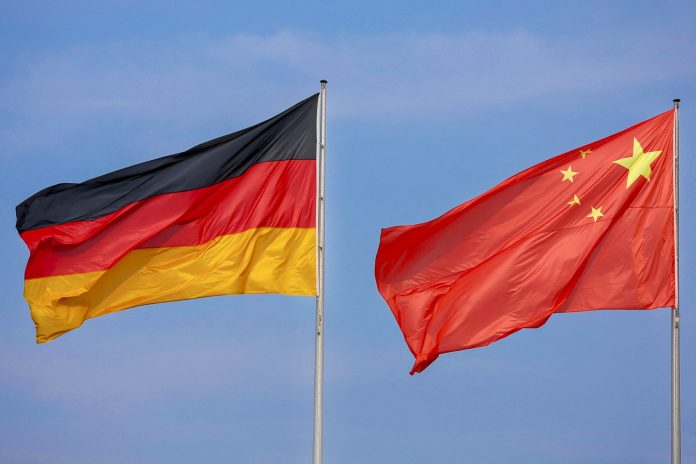
German money is flowing back into China at a pace not seen in four years, a shift that speaks less about renewed enthusiasm for Beijing and more about growing unease with Washington.
Data compiled for Reuters by the IW German Economic Institute show that German companies invested more than 7 billion euros in China between January and November 2025, a jump of more than 55% from the roughly 4.5 billion euros recorded in each of the previous two years. The figure also sits well above the long-term average for the past decade, marking a decisive change in corporate behavior.
At the heart of the move is President Donald Trump’s trade agenda. In his first year back in office, Trump reintroduced far-reaching tariffs on European imports and revived a confrontational approach to trade that many German executives thought belonged to an earlier era. For companies whose business models rely on predictable access to global markets, that uncertainty has become costly.
Rather than doubling down on transatlantic exposure, many firms are spreading their risk. China, already embedded in German industrial supply chains, has once again become central to that strategy.
“German companies are continuing to expand their activities in China – and at an accelerated pace,” said Juergen Matthes, head of international economic policy at the IW institute.
The motivation, he said, goes beyond growth. It is about insulation.
The logic is straightforward. By producing in China for Chinese customers, companies reduce their vulnerability to tariffs, export controls, and sudden policy shifts elsewhere. The aim is to make local operations viable even if global trade routes are disrupted.
This thinking is now widespread across boardrooms in Europe’s largest economy. Reuters reported last week that German companies nearly halved their investments in the United States during the first year of Trump’s second term. In parallel, China has reclaimed its position as Germany’s top trading partner, overtaking the U.S. after a brief reversal in 2024. Rising imports from China helped drive that change.
The German government finds itself navigating a narrow path. Berlin has hardened its language on China over issues ranging from market access to security risks, yet it remains wary of undermining a relationship that underpins large parts of its industrial base. Cars, chemicals, and advanced manufacturing still depend heavily on Chinese demand.
That dependence is evident in corporate spending patterns. Volkswagen, BASF, Infineon, and Mercedes-Benz all continue to channel significant resources into China, a market that absorbs a substantial share of global vehicle and chemical sales.
Volkswagen says its investments in China and the United States are being pursued independently, guided by local market strategies. What has changed is how China fits into its global footprint. Technologies and products developed there are increasingly deployed in other regions, including Southeast Asia, the Middle East, South America, and Africa.
“China is thus helping to further strengthen the Group’s global presence and competitiveness,” a company spokesperson said.
That shift points to a deeper transformation. China is no longer just a sales destination for German firms. It is becoming a development hub and a base for exporting know-how to other fast-growing markets, a role that insulates companies from political risk in any single country.
Geopolitics looms large in these decisions. Matthes said fears of major trade disruptions or conflicts are encouraging companies to build operations that can stand on their own.
“Many companies say: ‘If I’m only producing in China for China, I’m reducing my risk of being affected by possible tariffs and export restrictions,’” he said.
Mid-sized manufacturers are following the same path. Fan and motor maker ebm-papst invested 30 million euros last year to expand its Chinese operations, more than a fifth of its total capital spending. The company framed the move as a way to stay close to customers and shield itself from tariff shocks.
“This model has proven to be an important anchor of stability, especially in times of tariffs and geopolitical tensions,” ebm-papst said, while noting it also plans to grow its U.S. business this year.
Politically, the corporate pivot is echoed by diplomatic maneuvering across Europe and beyond. Britain is heading to China this week with a business delegation seeking deals in sectors from automobiles to pharmaceuticals. The European Union is edging closer to a trade agreement with South America. Canada is exploring expanded trade ties with China and India. Each move signals a quiet recalibration as allies look for alternatives in a more fragmented global economy.
German Economy Minister Katherina Reiche captured the mood this week when she spoke of the need to seek new alliances as established relationships grow more fragile. Her remarks underline a reality facing Europe’s export-driven economies: trade policy is no longer just an economic tool, but a source of strategic risk.
However, for German companies, the renewed surge in China investment is seen as less about choosing sides and more about survival in an era of unpredictable trade rules. Trump’s tariffs were designed to pull investment back toward the United States. Instead, they are accelerating a broader diversification, one that is redrawing the map of global capital flows and pushing U.S. allies to look elsewhere for stability.
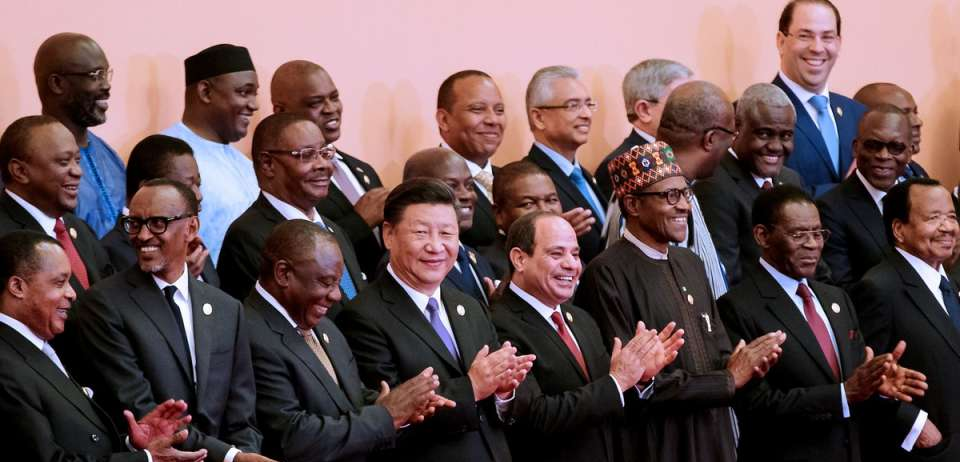
China’s transformation from a prolific lender to a net extractor of capital from many low- and middle-income countries has created a stark “great reversal” in development finance flows, with borrower nations—especially in Africa—now repaying more in debt than they receive in new loans, according to the inaugural report from the ONE Data initiative, released January 27, 2026.
This shift, dubbed “The Great Reversal,” highlights a decade-long trend where declining fresh financing from Beijing coincides with ongoing servicing of past debts, straining budgets and limiting investments in public services across the Global South.
The ONE Data report, produced by the anti-poverty organization ONE Campaign’s new Development Finance Observatory—a $4 million project backed by Google.org and The Rockefeller Foundation—integrates data from sources like the World Bank, OECD, and AidData to track inflows and outflows transparently.
It reveals that China, once transferring $48 billion in net flows to low- and lower-middle-income countries a decade ago, now sees a $24 billion net outflow from these nations in recent years.
Africa bears the brunt: From receiving $30 billion in net Chinese financing between 2015 and 2019, the continent shifted to a $22 billion net outflow between 2020 and 2024—a dramatic $52 billion reversal.
David McNair, executive director at ONE Data, explained the mechanics, saying: “The fact that there’s less lending coming in, but that previous lending from China still needs to be serviced—that’s the source of the outflows.”
He characterized the overall impact as “a net negative” for African nations, where governments grapple with funding essential services amid fiscal constraints, though he noted a potential silver lining in fostering greater domestic accountability as reliance on external aid diminishes.
This trend aligns with China’s more cautious lending posture since the late 2010s, with new commitments to Africa dropping from annual peaks of $28-41 billion to roughly $2 billion in 2024, per complementary data from Boston University and AidData.
Much of the existing debt stems from infrastructure projects under the Belt and Road Initiative, which matured into repayment phases without equivalent new inflows.
While Beijing has historically offered renegotiations, deferrals, or refinancing for distressed loans, the current net outflows reflect a portfolio maturation and risk aversion. Multilateral institutions have stepped in to mitigate the gap, increasing net financing by 124% over the past decade to become the dominant source, providing 56% of net flows—equivalent to $379 billion between 2020 and 2024.
Lenders like the World Bank and regional development banks now serve as the primary positive net contributors once debt repayments are accounted for.
The analysis excludes 2025 data, but McNair anticipates further declines, driven by the closure of the U.S. Agency for International Development (USAID) and reduced allocations from other developed countries, which have already impacted Official Development Assistance (ODA) to Africa.
Broader bilateral finance and private external debt flows have also waned, trends likely intensified by these 2025 cuts.
Complementary insights from the World Bank’s related 2024 report, “The Great Reversal: Prospects, Risks, and Policies in International Development Association (IDA) Countries,” echo these challenges for the 75 most vulnerable economies eligible for IDA support.
It notes that over 2020-2024, per capita incomes in half of IDA countries grew more slowly than in wealthy economies—the largest such share since the start of the century—marking a “historic reversal” in convergence.
One in three IDA countries is poorer today than pre-pandemic, with food insecurity affecting 651 million people in 2023—nearly double the 2019 figure. These pressures exacerbate vulnerabilities in fragile, conflict-affected states, where reducing extreme poverty requires addressing drivers of instability, per World Bank analyses.
Debt burdens also strain health financing, as noted in related discussions linking fiscal constraints to reduced global health investments.
As the Development Finance Observatory expands, it promises enhanced transparency to guide debt restructurings and aid strategies. But it also underlines a striking reality: China’s evolving role signals a recalibration in global finance, where past lending legacies weigh heavily on developing economies navigating tighter resources and heightened accountability demands.
U.S. Treasury yields nudged higher on Tuesday as investors stayed cautious ahead of the Federal Reserve’s interest rate decision and weighed renewed trade tensions sparked by President Donald Trump’s tariff threats.
The benchmark 10-year Treasury yield rose by just over one basis point to around 4.23%, signaling restrained positioning rather than a strong conviction trade. The 2-year yield, which is closely tied to expectations for Fed policy, eased slightly to about 3.59%, while the 30-year yield climbed more than one basis point to roughly 4.82%. Together, the moves point to a market waiting for clearer signals on both monetary policy and the broader economic outlook.
The Fed’s policy announcement on Wednesday is the central focus of the week. Investors broadly expect the central bank to keep its benchmark rate unchanged within the 3.5% to 3.75% range, extending a pause after three rate cuts delivered in 2025. With the decision itself largely priced in, attention is likely to shift quickly to Chair Jerome Powell’s press conference and the tone of the accompanying statement.
Markets are expected to listen closely for guidance on how policymakers view the balance between cooling inflation and signs of slowing momentum in parts of the economy. Any hints on the timing or conditions for future rate cuts could have an outsized impact on yields, particularly at the front end of the curve.
Interest rate futures suggest investors are penciling in two quarter-point cuts by the end of 2026, according to the CME FedWatch Tool. That view rests on the assumption that restrictive financial conditions will eventually weigh more heavily on growth, even as inflation pressures prove sticky in some sectors.
Beyond monetary policy, trade uncertainty has returned as a market concern. Trump on Monday threatened tariffs of up to 25% on South Korean autos, pharmaceuticals, and lumber, citing delays in Seoul’s legislature approving a trade agreement reached with Washington last summer. The comments revived worries that trade policy could again become a source of economic disruption, with knock-on effects for prices, corporate margins, and global growth.
For bond markets, tariffs present a complicated mix of forces that, on one hand, heightened uncertainty can drive demand for safe-haven assets such as Treasuries, and on the other hand, tariffs can fuel inflation and complicate the Fed’s task, particularly if higher import costs filter through to consumer prices. That tension was visible in the modest rise in longer-dated yields, which tend to embed expectations about inflation, growth, and fiscal policy over extended horizons.
Investors are also keeping an eye on upcoming economic data releases later in the week, which could further shape expectations around the Fed’s next moves. Currently, Treasury markets appear set to remain range-bound, with traders reluctant to take large positions ahead of clearer guidance from policymakers.
Analysts now see the small uptick in yields as underscoring a market caught between confidence that inflation is no longer accelerating and unease over policy uncertainty, trade risks, and the timing of the next phase of monetary easing.
Invent, innovate and drive organizational transformation, performance, and growth. Capture emerging opportunities in changing markets while optimizing innovation and profitability. Digitally evolve your business or functional area, turning digital disruption into a competitive capability and advantage. Master the concepts of building category-king companies, and thrive.
Registration for another edition of Tekedia Mini-MBA opens. Tekedia Mini-MBA, from Tekedia Institute, is an innovation management 12-week program, optimized for business execution and growth, with digital operational overlay. It runs 100% online. The theme is Innovation, Growth & Digital Execution – Techniques for Building Category-King Companies. All contents are self-paced, recorded and archived which means participants do not have to be at any scheduled time to consume contents. Our programs are designed for ALL sectors, from fintech to construction, healthcare to manufacturing, agriculture to real estate, etc.
More so, the sector- and firm-agnostic management program comprises videos, flash cases, challenge assignments, labs, written materials, webinars, etc and is delivered by a global faculty coordinated by Prof Ndubuisi Ekekwe. When we finish, we will issue a certificate from the Tekedia Institute, Boston USA.
Register and join us. You will emerge transformed with tools and capabilities that engineer confidence, performance and growth. Accelerate your leadership ascent with us! Here are our programs and costs.
Program Cost
Code
Description
Cost
MINI
Tekedia Mini-MBA. And WhatsApp School
US$170 or N120,000 naira
MINF
Annual Package: 3 consecutive MINI, and 2 optional capstones.
$340 or N180,000
MINR
(optional) Homework review; faculty will review your homework with feedback.
$30 or N10,000
CAPS
(optional) Tekedia capstone is a research paper, analogous to final college project.
Supply Chain Management, Global Partnership & Contracting – Adebayo Adeleke, ex-Chief of Contracting and Deputy Chief, Business Operations Division, US Army
Intellectual Property: Strategy, Management & Commercialization – Ifeanyi Okonkwo, University of Cape Town & Jackson, Etti & Edu
Business Relationship Management & Negotiation Skills - Charles Okeibunor, CEO IRMP
Due Diligence and Business Intelligence – Chike Obimma, Partner at NICCOM LLP (Commercial Law Firm)
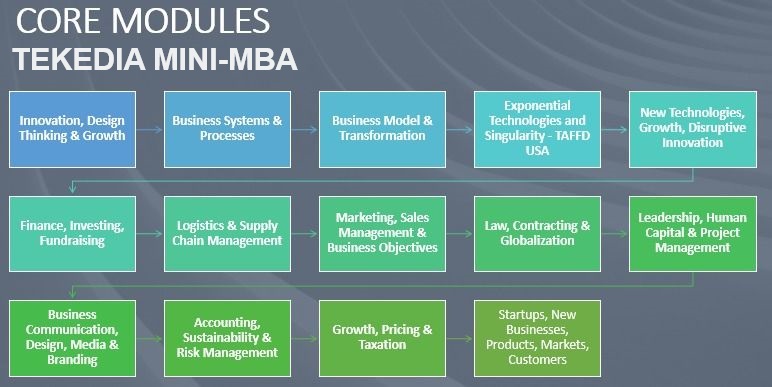
Week 10: Leadership, Human Capital & Project Management
Leadership, Knowledge Management – Prof. Ayodeji Oyebola, Saint Mary’s University of Minnesota
Human Resources Management - Adora Ikwuemesi, Director Kendor Consulting
Leading and Managing Teams, Stakeholder Management with NICER Model – Dr. Chisom Ezeocha, Project Delivery Manager, Shell
Career Planning – Precious Ajoonu, Manager, Jobberman
Tax Treaties and Their Benefits - Emmanuel Eze, Manager, Federal Inland Revenue Service (FIRS)
Regional Case: Tax Law and Compliance in Lagos State - Abimbola Abdur-Rahman Lekki, Lagos Internal Revenue Service
Effective Product & Service Pricing, Accelerated Revenue, Profit Maximization - Saima Khan, Partner, Strategic Pricing Management Group, Toronto, Canada
Establishing Business Consulting & Advisory Services - Mustafa Yusuf-Adebola, Founder, Provisio Professional
Driving Profitable Growth, Marginal Cost, Scaling – Prof. Ndubuisi Ekekwe
Stimulating New Markets Through Innovation and Perception Demand – Prof Ndubuisi Ekekwe
Week 14: Startups, New Businesses, Products, Markets, Customers
The Mechanics of Minimum Viable Product and Product Development - Prof Ndubuisi Ekekwe
The NEP Framework – Discovering and Listening to Customers - - Prof Ndubuisi Ekekwe
Customer Validation and Building for What Customers Really Want. - - Prof Ndubuisi Ekekwe
Knowing and Defining Your Market - Prof Ndubuisi Ekekwe
Navigating Business Growth Phases - Prof Ndubuisi Ekekwe
ChatGPT, DALL-E 2 and Emerging AI Innovations: Business Opportunities in Africa - Zion Pibowei, Head of Data Science, Periculum Canada
How to Scale a Business/Startup - Jane Egerton-Idehen, Head of Sales Middle East & Africa at Meta (Facebook parent company)
Final Week: Execution and Closure
The Call to Business Execution, Closure – Prof Ndubuisi Ekekwe
Graduation Day – Prof Ndubuisi Ekekwe
Tekedia Live: Optional Zoom session which holds thrice per week (Tue, Thur, Sat at 7pm WAT). It is archived for those unable to make the session live. Our faculty members and invited guests rotate to anchor the sessions. Live provides a platform for members to ask questions and get live responses.
Welcome! Unleash your leadership potential, master business excellence, and embrace transformation with Tekedia Mini-MBA. Join us and experience a cutting-edge business management & leadership program: online, self-paced, and world-class. At Tekedia Institute, we co-learn with thousands of professionals and students, from many countries, on the mechanics of business, connecting innovation, growth and operational execution, across market territories and industrial sectors.
Our faculty members come from Microsoft, Google, Shell, Flutterwave, Nigerian Breweries, NNPC, Jobberman, Coca Cola, PwC, BUA Cement, and other great organizations. Besides pre-recorded courseware, thrice weekly, we hold live Zoom sessions (Tue, Thur and Sat at 7pm WAT) – Prof Ndubuisi Ekekwe, Tekedia Institute Lead Faculty.
Access to any Facyber Certificate program for free. Facyber offers online cybersecurity programs on policy, technology, management, and forensics.
Capstone Program
Here are the 12 tracks:
CLSM: Certificate in Logistics and Supply Chain Management
CBIS: Certificate in Business Innovation, Growth & Sustainability
CMAB: Certificate in Media, Advertising & Branding
CSBM: Certificate in Startup and Small Business Management
CIBA: Certificate in Business Administration
CPFM: Certificate in Personal Finance & Wealth Management
CMSM: Certificate in Marketing and Sales Management
CDBG: Certificate in Digital Business Growth
CIAM: Certificate in Agribusiness Management
CHRM: Certificate in Human Resources Management
CETS: Certificate in Exponential Technologies and Singularity
CBPM: Certificate in Business Transformation & Project Management
The program is completely capstone-based. Tekedia capstone is a research paper or a case study exploring a topic, market, sector or a company. It is the project component of Tekedia Min-MBA.
Theme: Innovation, Growth & Digital Execution – Techniques for Building Category-King Companies
Introduction
Over the last few decades, digital technology has emerged as a very critical element in organizational competitiveness. It has transformed industrial sectors and anchored new business architectures, redesigning markets and facilitating efficiency in the allocation and utilization of factors of production. The impacts have been consequential: continents like Africa are moving towards knowledge-based economic structures and information societies, comprising networks of individuals, firms and states that are linked electronically and in interdependent relationships. In this program, we will examine this redesign within the context of fixing market frictions and deploying growth business frameworks in a world of perception demand where meeting needs and expectations of customers are not enough.
Program Time: Feb 9 – May 2, 2026
Venue & Format: Online via videos, articles, webinars, and flash cases. Program is self-paced which means you consume the materials at your own time and pace. It is completely online. Where you live or your time zone would not be an issue as program is not live-delivered.
Cost: US$170 (N120,000 naira). We have a payment plan, i.e. installment payment plan (email us for details)
Target Audience: This program is designed for professionals and students across functional areas like sales, marketing, technology, administration, legal, strategy, finance, etc across all business sectors and domains. The program is designed for:
Ambitious mid-level managers seeking to advance their careers by acquiring essential business knowledge and skills.
Busy professionals who value continued education but require a flexible alternative to a traditional MBA program.
Experienced professionals aiming to broaden their business acumen, enhance leadership capabilities, and explore new career opportunities.
Professionals in transition, committed to staying informed about business trends and developing skills for continuous professional growth.
Mid-level managers and executives across industries, driven to accelerate career growth and take on increased responsibilities.
Technology and innovation-focused professionals looking to strengthen business acumen and strategic thinking.
Aspiring entrepreneurs seeking a solid foundation in business management and growth strategies.
Consultants and advisors aiming to expand their knowledge base and provide comprehensive solutions to clients.
Professionals transitioning into new roles or industries, recognizing the value of upskilling for success.
Students and recent graduates seeking a competitive edge in the job market by combining academic qualifications with practical business skills.
Tekedia Mini-MBA program offers a flexible and comprehensive learning experience tailored to the needs of ambitious professionals, providing the tools and knowledge necessary to thrive in today’s dynamic business landscape. Participants will have the opportunity to acquire knowledge that has value and can be used in everyday business activities.
Learning Objectives: To innovate is to set a new basis of competition in an economy, business sector or market. Sometimes, it results in disruption. This program is designed for private (large, SMEs, startups, sole businesses), public and government institutions, and individuals. Participants will:
Master the mechanics of growth – the reward of innovation – through frameworks, cases and evolving strategies.
Understand how to undergo transformation journey that is fully aligned with corporate objectives through measurable and realizable benchmarks.
Acquire business capability tools that do not just RUN their firms but can TRANSFORM them.
Design corporate growth experiments in Lab sessions based on One Oasis Strategy, Aggregation Construct, Double Play Strategy, Accumulation of Capability Construct, and more.
ETC
Why Tekedia Institute
Interactive Online Learning: Engage with industry experts and fellow professionals through our state-of-the-art online learning platform, where you can access course materials, participate in discussions, and collaborate on real-world case studies.
Comprehensive Curriculum: Gain a deep understanding of key functional areas such as strategy, marketing, finance, operations, and more, equipping you with the knowledge and skills to excel in any business environment.
Practical Case Studies: Apply your learning to real-world scenarios through hands-on case studies and projects, allowing you to develop critical thinking and problem-solving skills.
Flexibility and Convenience: Access the program online from anywhere at your own pace, fitting your studies into your busy schedule without compromising your professional and personal commitments.
Expert Faculty: Learn from renowned industry practitioners and thought leaders who bring their expertise and real-world insights to the program, ensuring you receive the most relevant and up-to-date knowledge.
Benefits of Tekedia Mini-MBA
Enhance Your Leadership Potential: Unlock your leadership capabilities and develop the skills to lead teams, drive innovation, and navigate complex business challenges with confidence.
Master Business Excellence: Gain a holistic understanding of business functions, strategies, and best practices, enabling you to make informed decisions and contribute to organizational success.
Embrace Digital Transformation: Stay ahead of the curve by embracing digital technologies and leveraging them to transform your business and stay competitive in the digital age.
Accelerate Your Career: With the Tekedia Mini-MBA on your CV, you’ll stand out to employers, demonstrating your commitment to continuous learning and your readiness to take on new responsibilities.
Network and Collaboration: Connect with a diverse community of professionals, expand your network, and foster collaboration opportunities that can lead to future partnerships and career advancements.
Cost-Effective Investment: Enjoy the benefits of a comprehensive business education at a fraction of the cost of traditional MBA programs, maximizing the return on your investment.
We run optional three Live Zoom sessions (two weekdays and one Saturday). This provides a way for our members to ask our Faculty and experts live questions and get feedback.
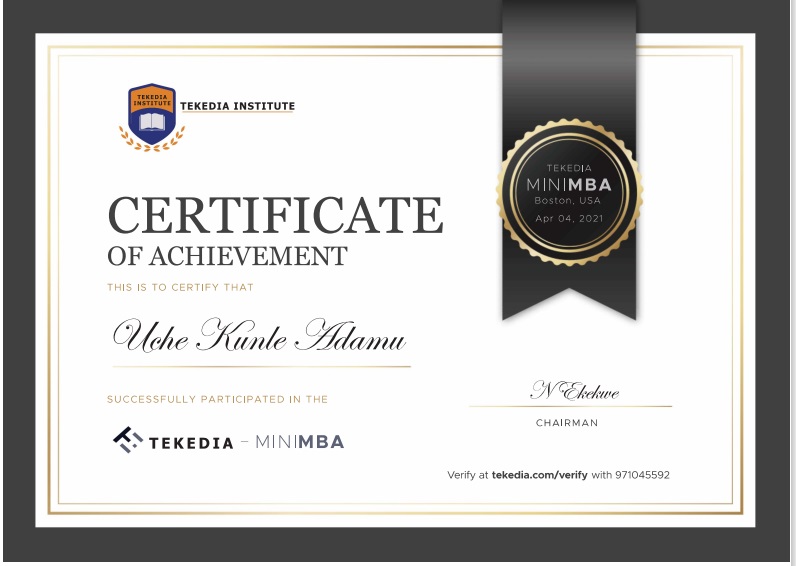
Tekedia Mini-MBA certificate sample
Tekedia Institute offers certificates at the end of all programs.
Our Contact Email: info@tekedia.com
Refund policy is full refund within 6 days from start of a program; after that, none, but we can defer as requested.
Lead Faculty of Tekedia Institute
Prof Ndubuisi Ekekwe is the Lead Faculty of Tekedia Institute
PhD, Electrical & Computer Engineering, Johns Hopkins University, USA
MBA, University of Calabar, Nigeria
BEng Electrical & Electronics Engineering ( Federal University of Technology, Owerri, Nigeria)
Prof Ndubuisi Ekekwe invented and patented a robotic system which the United States Government acquired assignee rights. Dr Ekekwe holds two doctoral and four master’s degrees including a PhD in engineering from the Johns Hopkins University, USA. He earned undergraduate degree from FUT Owerri where he graduated as his class best student. While in Analog Devices Corp, he co-designed an accelerometer for the iPhone. A recipient of IGI Global “Book of the Year” award, a TED Fellow, IBM Global Entrepreneur and World Economic Forum Young Global Leader, Prof. Ekekwe has held professorships in Carnegie Mellon University and Babcock University, and served in the United States National Science Foundation Committee.
The South African press called him “a doctor of innovation” for helping organizations on the mechanics of business innovation, strategy, and growth. Since 2009, the Chairman of Fasmicro Group which controls many startups and entities has been writing in the Harvard Business Review. He was recognized by The Guardian as one of 60 Nigerians Making “Nigerian Lives Matter” on Nigeria’s 60th Independence Day (Oct 1, 2020).
According to recent reports from CoinGecko Research, Tether (USDT) generated approximately $5.2 billion in revenue, accounting for 41.9% of the total revenue across 168 income-generating crypto protocols tracked that year.
This positions Tether as the clear leader in crypto protocol revenue for 2025, highlighting the dominance of stablecoin issuers. Key details include: Stablecoins as a category were the top revenue generators overall.
The top four stablecoin-related entities led by Tether, followed by Circle, Ethena, and others collectively produced around $8.3 billion, or a significant portion of the market. In comparison, trading-focused protocols showed more volatility tied to market conditions, with stronger performance early in the year but declines later.
Tron ranked second overall among protocols including blockchains with about $3.5 billion, largely boosted by its role as the primary network for USDT transactions. This underscores how Tether’s business model—primarily earning from interest on reserves backing USDT—creates highly scalable, relatively stable revenue compared to more market-dependent DeFi or trading protocols.
Note that some other analyses show slightly varying figures or concentrations like Tether capturing 50%+ in narrower scopes. The crypto market cap ended 2025 at around $3.0 trillion down ~10% YoY, yet stablecoins like USDT continued expanding in adoption and utility.
Tether’s capture of 41.9% of total crypto protocol revenue in 2025 approximately $5.2 billion out of the aggregate from 168 tracked protocols, per CoinGecko’s 2025 Annual Crypto Industry Report carries several significant implications for the cryptocurrency ecosystem, stablecoins, and even traditional finance.
Stablecoins as the Backbone of Crypto Profitability
Stablecoin issuers dominated the revenue rankings, with the top four (Tether leading, followed by Circle, Ethena, and others) collectively generating around $8.3 billion—over 65% of the top 10’s earnings.
This highlights a structural shift: while trading platforms and DeFi protocols depend heavily on volatile market conditions— strong early 2025 but declining later amid a ~10% drop in total crypto market cap to $3.0 trillion, stablecoins deliver predictable, high-margin revenue through interest on reserves primarily U.S. Treasuries.
Tether’s model—earning yield on fiat-backed assets while providing liquidity—proved far more resilient and scalable than market-dependent activities. Tether’s revenue dominance aligns with its broader financial performance: the company reported profits exceeding $10 billion in the first three quarters of 2025 alone, with full-year projections nearing $15 billion surpassing many major banks like Bank of America and approaching Goldman Sachs/Morgan Stanley levels.
This stems from massive reserve investments like $135+ billion in U.S. Treasuries by late 2025 amid elevated interest rates. Implications include: Tether operating as one of the world’s most profitable private companies on a per-employee basis with a tiny team relative to traditional banks.
Growing institutional and investor interest, including talks of massive funding rounds valuing it near $500 billion. Tether’s outsized role underscores concentration risk: USDT remains the default “digital dollar” for trading, cross-border payments, DeFi, and emerging-market remittances, often dominating networks like Tron which ranked second overall at ~$3.5 billion in revenue largely due to USDT traffic.
While this provides unmatched liquidity and adoption (USDT supply exceeded $140–180 billion across chains), it creates single points of failure—regulatory scrutiny, potential de-pegging events, or reserve issues could ripple across the entire ecosystem more severely than in diversified sectors.
Tether’s success illustrates stablecoins’ role in tokenizing fiat liquidity and reinforcing USD hegemony digitally. By investing heavily in Treasuries, Tether funnels crypto capital back into U.S. government debt, creating a symbiotic and sometimes criticized link between crypto and TradFi.
This has drawn regulatory attention like the ongoing U.S. investigations, MiCA compliance challenges in Europe, but also positions stablecoins as a mainstream payment rail. In emerging markets, USDT’s utility could accelerate shifts away from local currencies toward dollar-denominated digital assets.
Despite competition from regulated players like Circle (USDC) and yield-focused alternatives (e.g., Ethena’s USDe), Tether maintains dominance through network effects, liquidity, and first-mover advantage. The revenue gap suggests that stability and usability trump yield for most users in high-volatility environments.
However, declining interest rates, a looming 2026 challenge could pressure yields, while diversification into gold (XAUT), AI, mining, or tokenized assets may help sustain growth.
Overall, this 41.9% figure cements stablecoins—and Tether in particular—as the most economically sustainable layer of crypto in 2025, even in a down market. It signals maturation toward infrastructure-like profitability but also amplifies debates around decentralization, systemic risk, and regulatory evolution as crypto integrates deeper with global finance.