DD
MM
YYYY

PAGES

DD
MM
YYYY

spot_img

PAGES

Home Blog Page 2

China’s AI Boom Risks Worsening Supply-Demand Imbalance, Central Bank Adviser Warns

0

China’s artificial intelligence boom could deepen and prolong the economy’s long-running imbalance between strong industrial supply and weak domestic demand, a central bank adviser said, highlighting a growing tension between the country’s push to expand high-tech production and its struggle to get households spending more.

Huang Yiping, a member of the People’s Bank of China’s monetary policy committee, said Saturday that the rapid deployment of AI and faster technological innovation could increase productive capacity without generating a corresponding rise in domestic consumption.

“As AI is deployed more widely and innovation accelerates, the imbalance between strong supply and weak demand could worsen,” Huang said at an economic forum in Beijing.

“The contradiction between total demand and total supply may not disappear quickly in the short term, and may even persist for some time,” he added.

The warning points to a difficult policy problem for Beijing. China has made AI, advanced manufacturing and other technology industries central to its growth strategy. At the same time, household consumption remains constrained by the prolonged property downturn, pressure on local government finances and cautious consumer spending.

AI has nevertheless provided an important source of momentum. Demand for Chinese technology products and AI-related goods has supported exports this year, helping offset some of the weakness in the domestic economy.

That export-led growth, however, risks reinforcing the very imbalance Beijing is trying to address.

If AI allows Chinese manufacturers to produce more goods at lower costs while domestic consumption fails to keep pace, companies would turn to overseas markets to absorb excess output. That could intensify trade tensions with the United States and other major economies already pressing Beijing to shift its growth model toward household consumption.

China’s policymakers have spent years trying to reduce the economy’s dependence on investment and exports while increasing the role of consumption. The problem has become more pronounced as large investments have flowed into electric vehicles, batteries, solar equipment, semiconductors, robotics and AI-related manufacturing.

AI could accelerate that trend.

Productivity gains from automation and AI can allow companies to increase output without proportionately increasing employment or household incomes. If businesses expand production faster than demand grows, the result can be lower prices, weaker corporate margins and greater pressure to find customers overseas.

That creates a potential feedback loop. Companies facing weak domestic demand may increase exports, while governments and businesses continue investing in industries viewed as strategically important. Higher production then adds to international competition and can trigger trade barriers in overseas markets.

The United States and several trading partners have already called on Beijing to rebalance the Chinese economy toward consumption and away from exports. They note that excess industrial capacity is contributing to a surge of inexpensive Chinese goods in global markets. Beijing rejects the characterization that its exports are primarily the result of excess capacity and has argued that Chinese industrial competitiveness reflects investment, technological progress and market demand.

Huang’s comments suggest that the supply-demand problem is also being recognized from within China’s economic policy establishment. His proposed response goes beyond short-term stimulus. He called for deeper market-oriented reforms that would give markets a greater role in allocating resources and increase the share of household income in the economy.

That really matters because simply encouraging more investment could aggravate the imbalance if new capacity is created without sufficient demand to absorb it.

Huang also advocated greater overseas investment and industrial cooperation rather than relying exclusively on exports. Moving some production and capital overseas could give Chinese companies access to foreign markets while reducing pressure on domestic industries to continually expand output for export.

Balance Sheets Are Becoming A Central Problem

Huang also argued that Beijing should consider increasing central government borrowing to repair the balance sheets of local governments, financial institutions and companies.

The problem is that weak balance sheets can prevent economic stimulus from producing its intended effect. Local governments burdened by debt have less capacity to invest. Companies facing weak demand and financial constraints may be reluctant to expand. Households affected by falling property values can become more cautious about spending.

“Without restoring the capacity of these entities to undertake new economic activity, stimulus policies would have limited effect,” Huang said.

That argument places balance-sheet repair at the center of China’s economic challenge. Rather than simply injecting more liquidity or encouraging additional investment, policymakers may need to address the financial constraints preventing households, companies and local governments from spending and investing.

The AI boom makes that challenge more complicated.

China is simultaneously trying to secure a leading position in technologies that could generate substantial productivity gains and attempting to shift its economy away from an investment-heavy, export-dependent model. Those objectives can bolster each other if AI raises household incomes and creates new sources of demand. They can work in opposite directions if AI primarily increases production capacity while suppressing labor demand or corporate investment returns.

For now, China’s AI expansion is providing an important source of industrial and export growth. Huang’s warning is that technological success alone will not resolve the country’s demand problem.

The longer-term question is whether China can convert its gains in AI and advanced manufacturing into higher household incomes and broader domestic consumption, rather than relying on large volumes of exports to absorb rising production. If that adjustment does not occur, some economists believe the AI boom could make China’s supply-side strength even more pronounced while leaving the underlying weakness in domestic demand unresolved.


China Widens Online Travel Crackdown, Investigates Meituan and Alibaba Units

0

China’s market regulator has opened investigations into several major online travel and hotel-booking platforms, including units of Meituan and Alibaba, over suspected violations of unfair competition laws, widening Beijing’s scrutiny of an industry it sees as important to both consumer spending and digital-market competition.

The Beijing branch of the State Administration for Market Regulation is investigating Beijing Sankuai Information Technology, a Meituan unit, as well as Alibaba’s Hangzhou Taomei Aviation Services, Tongcheng Network Technology and Tujia Online Information Technology (Tianjin), state broadcaster CCTV reported on Saturday.

The investigations followed preliminary findings by regulators, CCTV said.

The China Hotel Association separately said the Beijing branch of SAMR had begun investigating four online hotel and travel-booking platforms over suspected unfair competitive practices. It did not identify the companies, but said the move followed a meeting involving SAMR and the Ministry of Culture and Tourism concerning the online booking industry.

The companies under investigation said they were cooperating with authorities. Meituan said it would cooperate with regulators, while Tongcheng and Tujia said their businesses were operating normally. Hangzhou Taomei also said it was cooperating with the investigation.

The action comes shortly after Beijing imposed a major penalty on Trip.com, China’s largest online travel platform.

Trip.com was fined 5.2 billion yuan ($776.4 million) over what regulators described as a monopoly in online hotel booking. The case established a significant enforcement precedent for China’s travel industry and signaled that regulators are paying close attention to how dominant platforms interact with hotels, airlines and other suppliers.

Competition Rules Meet China’s Consumption Push

The investigations are taking place against a difficult economic backdrop. China’s policymakers have been trying to strengthen domestic consumption as economic growth loses momentum and households remain cautious about spending. The government has increasingly relied on measures aimed at stimulating consumer activity while simultaneously seeking to reduce practices that could raise costs or restrict competition.

Online travel platforms sit at the intersection of those objectives.

They increasingly control the digital channels through which consumers search for hotels, flights and holiday services, giving large platforms significant influence over how businesses reach customers. Regulators can therefore view restrictive arrangements or practices between platforms and suppliers as a competition issue, while policymakers also have an interest in ensuring consumers have access to competitive prices.

The latest investigation suggests the regulatory campaign is not limited to one dominant company.

The involvement of businesses linked to Meituan, Alibaba, Tongcheng and Tujia indicates that authorities are examining practices across the sector rather than focusing exclusively on Trip.com. That is expected to increase compliance pressure throughout China’s online travel industry, particularly if regulators identify similar practices among multiple platforms.

Trip.com Fine Raises the Stakes

The Trip.com penalty provides important context for the latest investigations. The 5.2 billion yuan fine shows that China’s enforcement agencies are prepared to impose substantial financial penalties when they conclude that a platform has abused its market position.

The latest cases have not resulted in findings of wrongdoing. The companies are being investigated for suspected unfair competition, and the outcome will depend on regulators’ findings.

Still, the sequence is significant.

The Trip.com case demonstrated that online travel platforms are firmly within the scope of China’s broader antitrust and competition campaign. The subsequent investigations suggest regulators are now examining whether similar issues exist elsewhere in the market.

For companies operating in the sector, the consequences could extend beyond potential fines. Regulatory intervention can require changes to commercial arrangements, supplier relationships and platform practices, potentially altering how travel companies compete for hotels, airlines and consumers.

The uncertainty may also affect how platforms pursue growth.

China’s largest internet companies have spent years building ecosystems that combine payments, advertising, e-commerce, travel and other services. Their scale creates efficiencies for consumers and merchants, but it can also give the platforms considerable bargaining power.

Regulators are now focused on where that power crosses into practices that restrict competition.

A Broader Test for China’s Platform Economy

The investigations also show that Beijing’s approach to internet regulation has evolved beyond the earlier focus on individual technology giants. Regulators are now examining specific markets and commercial practices rather than targeting only the largest companies.

Travel is particularly sensitive because it involves large numbers of small and medium-sized businesses, including hotels and tourism operators that rely heavily on digital platforms to reach customers.

If regulators force platforms to change practices that limit how suppliers interact with competing booking services, the result could be greater choice for hotels and other businesses. At the same time, platforms could face higher compliance costs or lose some of the advantages created by tightly integrated ecosystems.

For consumers, the potential effects are less straightforward. Greater competition can put pressure on platforms to offer better prices and services, but changes to platform economics can also alter discounts, commissions and promotional programmes. That makes the latest investigations part of a broader tension in China’s technology policy: Beijing wants large digital platforms to support economic activity and innovation while preventing them from using their scale in ways regulators regard as anti-competitive.

The travel sector is now becoming an important test of that balance.

The investigations remain ongoing, and no final findings of wrongdoing have been announced against the companies named in the latest probe. But following the Trip.com penalty, the message to China’s online travel industry is becoming harder to miss: market dominance is drawing greater regulatory scrutiny, particularly where platform practices affect suppliers and consumer choice.

The Economics of Running an Online Store: Where the Money Really Goes

0

Think running an online store is cheap?

Most new retailers do. Free store rent. No store employees. Low electricity costs.

Here’s the problem:

Money doesn’t vanish…. it just moves.  If you don’t know where it goes your profit slowly leaks away one petty expense at a time.

This post explains exactly where your money goes when you sell online. And how to stop the leaks before they drain your store.

Time to dig in!

Inside this guide:

  • The Real Cost Of Your Store’s Platform
  • Why Certified Ecommerce Developers Save You Money
  • Marketing: The Biggest Monthly Bill
  • Returns & Shipping: The Silent Profit Killers
  • The Checkout Leak Nobody Talks About

The Real Cost Of Your Store’s Platform

Your platform is your store’s engine room. Every sale, product page and payment processed goes through it.

The majority of store owners begin on a low-cost monthly plan. That works for starters. Expenses can rapidly escalate as your store expands though:

  • Monthly platform fees
  • Paid apps and plugins
  • Payment processing fees on every sale
  • Hosting and security

Apps is the biggest culprit. You can easily rack up charges for 10x, 15x small apps at say $5 a month.

Add them all up and it gets scary.

Think about it:

Small monthly bills don’t seem like much. However they can add up to consume a large percentage of your annual profit.

Why Certified Ecommerce Developers Save You Money

Here’s where lots of store owners go wrong…

They attempt to cut corners by DIYing the store build. Or they find the cheapest freelancer available.

It’s intuitive, yes. However, poorly constructed stores cost you more money down the road. Slow pages, broken checkouts and sloppy code are losing you sales daily.

It’s also why emerging brands hire certified ecommerce developers. These developers have passed official certification exams for platforms such as Adobe Commerce, which means they understand how to build secure, optimised online stores that are easy to scale. Partnering with a trusted commerce development company will give you fewer bugs, fewer emergency hotfixes and significantly less cash burnt on problem remediation down the line.

Cheap builds are rarely cheap.

Certified ecommerce developers can help you stop paying for useless apps. Often times a feature can already be built into the store vs added on with another monthly plugin.

Marketing: The Biggest Monthly Bill

For most online stores, marketing is where the biggest slice of money goes.

Why? Because there’s no pedestrian traffic. People don’t stumble across your store. Each and every one of your customers has to be sought out….and being sought out isn’t free.

Most stores spend on a mix of:

  • Paid ads on Google and social media
  • Email marketing tools
  • Influencer deals
  • SEO and content

Paid advertising is the fastest way to build traffic. However, when you stop paying… there is no traffic.

And as you know…

Rising ad costs = Shrinking profit.

That’s why savvy retailers mix paid advertising with SEO and email. It takes longer to see those channels grow, but they keep sending customers without another bill every time someone clicks.

Ok, Here’s an Analogy.. Paid advertising is renting traffic. SEO and email are owning traffic. Renting is great if you need immediate sales but if you want your store to be profitable for years to come you need to own your traffic.

Before you spend another dime on advertising, know what percentage of your traffic is owned.  If its “little to none”, thats where you should be focusing your efforts.

Returns & Shipping: The Silent Profit Killers

Want to know one of the biggest hidden costs of selling online?

Returns.

Customers can’t feel or test drive your products before purchase. That means more of them are returning them. The National Retail Federation estimates that about 19.3% of online sales will get returned. That’s almost 1 in 5 orders heading back to your doorstep.

And every return costs you twice:

  1. You pay to ship it back, check it and restock it
  2. You lose the sale you thought you had

Here’s the kicker…

Free returns are now expected by customers. According to the same study, 82% of consumers ranked free returns as one of the most important aspects when shopping online. What’s even more alarming? Approximately 9% of all returns are fake.

Returns aren’t a minor admin issue. They’re an operational cost that requires an operational solution.

Ok but how do you reduce returns? First with improved product pages. Detailed sizing guides, descriptions, quality photos and honest reviews all help. The better informed a shopper is before purchase, the less likely a return.

Shipping is the other big expense. Carrier rates continue to increase. Packaging doesn’t cost nothing either. Many stores give away free shipping to secure sales… silently losing money on each micro order.

Tip: Offering free delivery when a customer spends a certain amount (£50 for example) will cover your costs and encourage customers to spend that extra bit!

The Checkout Leak Nobody Talks About

This is going to be surprising to you…

You can spend all the money in the world driving traffic to your store. But the majority of those people still aren’t going to buy. Studies indicate an average cart abandonment rate of 70.22%. In other words, seven out of ten visitors add an item to their cart, and leave.

Consider what that does to your marketing budget.  You spent money to attract those customers.  They loved your product enough to put it in their cart.  Then they left.

OK, but why do they leave? The biggest culprit is unexpected costs at checkout (39%).

Other common reasons include:

  • A long or confusing checkout
  • Being forced to create an account
  • Slow page speed
  • Not trusting the site with card details

The good news?

Easy fixes. Display all costs upfront. Include guest checkout. Speed up your pages. Display trust badges near your checkout button.

Optimizing your checkout is one of the least expensive methods to increase sales. You are not paying for additional traffic… you’re just retaining the customers you already attracted.

Pretty cool, right?

Counting The Real Cost

E-commerce isn’t necessarily low-cost. Costs aren’t disappearing — they’re just hidden from owners in places they’ll never look.

To quickly recap, your cash goes on:

  • Your platform — fees, apps and hosting that grow with your store
  • Development — where cheap builds often cost more later
  • Marketing — usually the biggest monthly bill
  • Returns and shipping — silent costs that eat into your margin
  • Lost checkouts — shoppers you paid for who never buy

Stop the bleeding and every pound you spend will stretch further. Attack the biggest leak first. Plug it. Attack the next.

Rinse and repeat.

ContiSX Opens Pre-order for ContiSX Phones

0

I have been building things since my days at FUT Owerri, where we launched the university’s first campus FM radio station. In industry, I served as a global lead ASIC design engineer, helping to develop the inertial sensors used in the early versions of the iPhone. I also invented a wafer-level chip-scale packaging technology for inertial sensors. Till today, the US Government has continued to honour royalties for using my PhD research and the patent that came out of it. I am a Nigerian and I build things!

Good People, when we engineered a native blockchain for Contisx Securities Exchange, we saw an opportunity to extend that operating system into a new category of secure communication. That vision led us to build the Contisx Phone, a cryptographically secured blockchain phone designed to deliver superior communication security for individuals, companies and governments.

Yes, blockchain-secured with absolute sovereignty. With ContiSX Phone, you get end-to-end secure communication,  across messaging, voice and video ,  with no eavesdropping or tampering, guaranteed by cryptographic encryption.

The Contisx Phone is now available for preorder, with shipments beginning on October 1, 2026. Preorder yours here: https://contisx.com/phone/

Every preorder comes with these benefits:

  • One year of complimentary Contisx Network services, including Contisx Mail, Contisx Audio and Contisx Video.
  • Zero-rated data access across the Contisx Exchange and CSD ecosystems for one year. Users will incur no telecommunications data charges when accessing core Contisx services.
  • Free access to the Tekedia Nigeria Capital Market Masterclass.
  • Free access to the Tekedia Mini-MBA.

From semiconductor systems to blockchain infrastructure, we continue to build the technologies of the future. Grow with ContiSX Phone contisx.com/phone

Ndubuisi Ekekwe, PhD

Engineer | Inventor | Nigerian & Ovim Village-Boy

More About ContiSX Phone and Services

Good People, we received nearly 50 orders overnight. I thank Nigerians for always supporting this village boy. Thank you. Let me respond to some of the questions here about the Contisx Phone.

– We have prepaid participating telecommunications companies in Nigeria. When you use the Contisx Phone for messaging through Contisx Mail, voice calls through Contisx Audio, or video calls through Contisx Video, you will not consume your mobile data because access to those services is covered within our native ecosystem. However, you will need your own mobile data to use external services such as YouTube, Facebook, etc.

– When we launch Contisx Securities Exchange, you will not need data to buy stocks, FGN bonds and other investment products within our ecosystem. We have prepaid the data costs. Our philosophy is Investment Inclusion, and we want to remove barriers that prevent citizens from participating in capital markets. We expect to extend this zero-rated access beyond the Contisx Phone to our web, Android, smartTV, Chrome Extension and iPhone platforms.

– The Contisx Phone works anywhere in the world. Outside Nigeria, however, users will need mobile data to access its services. The phone can call other types of phones, but you cannot install WhatsApp, Facebook, Instagram or similar applications because the Contisx operating system is different from Android and iOS.

The Contisx Phone also comes with these native solutions which are available:

  • Decision Lab: Gathers and interprets insights to help you make better decisions and run your business more effectively.
  • Contisx Sage: Captures and interprets meeting notes in Igbo, Hausa, Yoruba, English and Pidgin. We just completed the Hausa integration in our Kano Design Center where 5 brilliant native Hausa speakers executed the playbook (middle image).
  • Contisx Shield: Provides live threat intelligence and security alerts for organisations (right image)
  • Business Suite: Supports bookkeeping and accounting, inventory management, human resources, payroll and access to funding opportunities.
  • Boardroom: Powers board governance and preserves decisions on a sealed, tamper-evident record.

We are building a new system for secure communication, commerce, governance and investment inclusion. Preorder ContiSX Phone here https://contisx.com/phone .

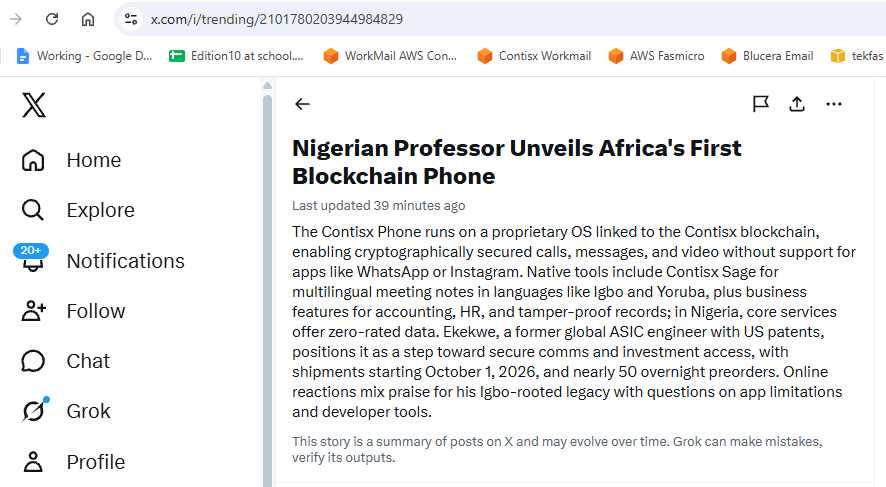
Trending on X

Contisx Phone trending on X

Volkswagen Plans More Than 4,000 More Porsche Job Cuts as Profit Crisis Deepens

0

Volkswagen is considering more than 4,000 additional job cuts at Porsche as part of its most sweeping restructuring yet, highlighting the depth of the crisis facing the German automaker as weak Chinese demand and a costly shift in electric vehicles weigh on its most prestigious brands.

Documents detailing a recent agreement by Volkswagen’s supervisory board call for about 4,100 positions to be eliminated at Porsche, with the measures aimed at addressing an estimated €700 million ($803.8 million) overhead shortfall, German business daily Handelsblatt reported on Saturday.

The cuts would come on top of existing agreements, the newspaper reported.

The scale of the restructuring underscores the pressure on Porsche, which has historically been one of Volkswagen’s most profitable businesses but is now confronting weaker sales in China, high costs and uncertainty over its electric vehicle strategy.

Porsche management and labor representatives agreed in July to an additional 5,000 job cuts, following 4,000 reductions already agreed earlier. Those measures would bring the number of currently agreed job cuts at the Stuttgart-based sports car manufacturer to about one in five employees by 2035.

Volkswagen’s parent company can recommend measures at Porsche but cannot impose them directly, adding another layer to the restructuring process.

The latest reported cuts come as Volkswagen itself has sharply reduced its expectations for the year.

On Friday, the group lowered its full-year operating margin target to as little as 1%, compared with its previous forecast of 4% to 5.5%.

The revision was largely linked to a write-down at Porsche, underscoring how problems at the sports car business are increasingly affecting the wider Volkswagen group.

Porsche’s difficulties are significant because the brand has traditionally provided Volkswagen with strong profitability and pricing power. A sustained deterioration therefore carries consequences beyond Porsche’s own financial performance.

Chief Executive Michael Leiters is under pressure to deliver a turnaround after the company suffered a sharp decline in sales in China and incurred substantial costs from changing course on its electric vehicle strategy.

The combination has exposed a difficult problem for Porsche: the company must invest in new technologies and products at the same time as it reduces costs and responds to weaker demand in one of its most important markets.

China and EV Strategy Drive the Reset

China has become a central weakness for Porsche.

The company’s premium positioning has not insulated it from the broader slowdown affecting foreign automakers in the Chinese market, where domestic manufacturers have strengthened their position through competitive pricing, electric vehicles, and sophisticated software.

The challenge is acute for European luxury brands because China’s auto market has shifted rapidly toward locally developed electric and hybrid models.

Porsche’s response has also been complicated by its electrification strategy.

The company invested heavily in electric vehicles as European and global regulations pushed automakers away from combustion engines. But weaker-than-expected demand for some EV models has forced Porsche to reconsider the pace and composition of its transition. That reversal comes with a substantial financial cost. Automakers cannot easily unwind years of investment in electric platforms, battery technology and production capacity without taking charges or restructuring operations.

For Porsche, the result has been pressure from both directions: the need to continue developing electric vehicles while maintaining profitable combustion-engine and hybrid models for customers who have not switched to EVs.

The reported 4,100 additional cuts suggest the company is now trying to bring its cost base into line with a weaker sales and earnings outlook.

Wider Volkswagen Restructuring

The Porsche measures form part of a much broader restructuring at Volkswagen. The group is attempting to reduce costs across its German operations while dealing with weak demand, intense competition from Chinese manufacturers and the capital requirements of the industry’s transition toward electric and software-defined vehicles.

The scale of the challenge weighs heavily for Germany, where Volkswagen has historically maintained a large manufacturing footprint and a powerful workforce.

Cost reductions therefore involve negotiations with employee representatives and can take years to implement fully.

At Porsche, the reported measures would extend an already substantial workforce reduction. If the latest plans are implemented alongside previously agreed cuts, the company would be reshaping a significant portion of its workforce over the coming decade.

The objective is not simply to reduce headcount. Volkswagen is trying to repair profitability at a time when the traditional advantages of European automakers are under pressure from changing consumer demand and a more competitive global market.

Porsche’s difficulties also reveal a wider problem facing established automakers: electrification has created new competitors while weakening some of the advantages built around traditional combustion-engine technology.

For Volkswagen, the immediate priority is restoring margins. But the scale of the reported Porsche restructuring suggests that the group is confronting a deeper question over how much of its existing cost structure can be sustained as competition, technology and demand patterns change.

The latest profit warning and reported job cuts indicate that the adjustment at Porsche is becoming a major part of Volkswagen’s broader effort to rebuild its financial performance.