DD
MM
YYYY

PAGES

DD
MM
YYYY

spot_img

PAGES

Home Blog Page 2111

Binance Exchange to Delist Non-MiCA Compliance Stablecoins by 31st March

0

Binance has announced that it will delist trading pairs involving stablecoins that don’t comply with the European Union’s Markets in Crypto-Assets (MiCA) framework for users in the European Economic Area (EEA) effective March 31, 2025. This move, detailed in a March 3, 2025, update from Binance, targets popular stablecoins like USDT, FDUSD, TUSD, USDP, DAI, AEUR, UST, USTC, and PAXG, which currently lack MiCA-compliant status.

The Markets in Crypto-Assets (MiCA) framework is the European Union’s ambitious attempt to regulate the Wild West of cryptocurrency, bringing clarity, consumer protection, and financial stability to the space. Passed in June 2023 after years of drafts and debates, MiCA is a comprehensive rulebook targeting crypto assets, issuers, and service providers within the 27-nation EU bloc (plus the broader European Economic Area, EEA).

It’s set to fully kick in by December 30, 2024, though some provisions, like stablecoin rules, started phasing in earlier—June 30, 2024, to be exact—which is why Binance is scrambling now in March 2025. The decision aligns with the EU’s push for stricter crypto regulations, requiring stablecoin issuers to meet standards like holding 1:1 liquid reserve, partnering with European banks, and passing regular audits—standards many existing stablecoins haven’t yet met.

For EEA users, this means spot and margin trading pairs with these non-compliant stablecoins will vanish by March 31, 2025, at 23:59 UTC. Binance isn’t banning custody outright—users can still hold, deposit, or withdraw these assets post-deadline—but trading functionality will be gutted. Leverage trading pairs will get the axe even earlier, on March 27, 2025, at 15:00 Beijing time, with automatic conversions to USDT and order cancellations to follow. Binance is nudging users toward MiCA-compliant alternatives like USDC or EURI, or even fiat EUR, via its Convert feature.

This isn’t Binance going rogue—it’s a reaction to MiCA’s phased rollout, with stablecoin rules tightening since June 2024. The framework’s endgame is full enforcement by December 2024, but exchanges like Binance, OKX (which ditched USDT pairs in 2024), and Uphold (delisting six stablecoins by July 2024) are preempting the March 31 cliff. MiCA’s core idea is to tame the crypto market without choking innovation. It splits crypto assets into three buckets: e-money tokens (EMTs, like stablecoins pegged to fiat), asset-referenced tokens (ARTs, stablecoins tied to broader assets), and everything else (think Bitcoin, Ethereum).

Stablecoins—EMTs and ARTs—face the toughest scrutiny because they’re marketed as steady value stores, and regulators fear a collapse (a? la TerraUSD in 2022) could ripple into traditional finance. Issuers of these “significant” stablecoins—think USDT or USDC if they hit scale—must hold 1:1 liquid reserve, partner with EU banks for custody, and submit to regular audits by the European Banking Authority (EBA).

Issuers need EU authorization as a crypto-asset service provider (CASP), not just an e-money license, and must be EU-based. Reserves: Full backing is required, but the mix can include cash, securities, or other assets—still liquid and audited. No fractional reserves allowed. Issuers must publish a whitepaper detailing the peg mechanism, risks, and governance, approved by regulators.

If an EMT or ART gets big—say, €5 billion in value, 10% of EU transactions, or systemic impact—it’s labeled “significant” by the EBA. Rules get tougher:
Higher capital requirements (up to 10% of reserves). Enhanced reporting to the EBA and European Securities and Markets Authority (ESMA). Caps on issuance or (trading) volume if regulators smell trouble—think TerraUSD’s 2022 crash as the nightmare they’re avoiding.

Liquidity could take a hit in the EEA if heavyweights like USDT fade, potentially spiking volatility or shifting volume to compliant coins. Non-EEA users? Untouched for now—business as usual. The real question is whether Tether and others scramble to comply or let Europe slip away. MiCA’s stablecoin rules aim to prevent runs (like Terra’s $40 billion wipeout), curb money laundering, and protect the euro’s turf. The EU handles €150 billion in stablecoin trades yearly—mostly USDT—and regulators worry unchecked growth could erode fiat sovereignty

Africa’s Start-Up Funding Landscape: How the Big Four And Emerging Markets Compare

0
Fund, money cash dollar

In an extended 2024 analysis of Africa’s start-up funding distribution, a report by Africa:The Big Deal, reveals significant disparities between the continent’s economic powerhouses and the countries attracting the most investment.

By comparing the share of start-up funding to each country’s relative weight in population and GDP, the analysis highlights how some nations, particularly Kenya, are outperforming expectations. In 2024, Kenya accounted for 29% of Africa’s start-up funding despite contributing only about 4% to the continent’s nominal GDP and population.

However, such an analysis has its limitations, as percentages shrink quickly when spread across Africa’s 54 nations. A comparison of relative positions, ranking each country based on funding, population, and GDP, provides further insight into these trends.

The four leading countries in Africa’s start-up funding, popularly known as the “Big Four”, which include Nigeria, Kenya, South Africa, and Egypt, continue to dominate the ecosystem.

Having raised $4.6 billion in start-up funding since 2019, this saw Nigeria earn the top-ranked country in this category. While Nigeria is the most populous country in Africa, its economic ranking has slipped to fifth place, partly due to the naira’s depreciation and other economic challenges.

East African country, Kenya, follows closely in second place, securing $3.4 billion in funding since 2019. Despite ranking seventh in both population and GDP, Kenya has significantly outperformed its economic weight, reinforcing its reputation as a start-up hub.

South Africa and Egypt round up the top four, securing the third and fourth positions in start-up funding, respectively. South Africa holds the top spot in GDP and ranks sixth in population, making its strong performance unsurprising. Egypt, with the third-largest population and the second-largest GDP, maintains a solid presence in the start-up ecosystem.

Beyond the Big Four, other countries have emerged as key players in the funding landscape. Ghana and Senegal stand out, ranking fifth and sixth in start-up funding despite their lower rankings in population and GDP. Ghana is ranked 14th in population and 11th in GDP, while Senegal ranks 25th and 18th, respectively. Their ability to attract investment highlights their growing influence in the start-up space.

Tanzania and Uganda also perform well, ranking higher in start-up funding than in GDP. Tanzania, which is the fifth most populous country and has the 10th largest GDP, ranks seventh in start-up funding. Uganda follows a similar trend, placing 10th in funding while ranking ninth in population and 13th in GDP.

However, not all economically strong nations translate their financial power into start-up funding success. Morocco and Algeria, despite being among Africa’s top economies, rank lower in funding relative to their GDP positions. Morocco, with the sixth-largest GDP and 11th-largest population, ranks eighth in start-up funding. Algeria, which has Africa’s third-largest GDP and ranks 10th in population, places ninth in start-up funding, reflecting a relatively weaker performance in attracting investment.

Just outside the top 10 are Tunisia and Benin, two nations that significantly outperform their economic rankings in start-up funding. Tunisia, ranked 31st in population and 15th in GDP, holds the 11th position in start-up funding, while Benin, ranked 28th in population and 25th in GDP, secures the 12th spot.

The rankings reveal a complex landscape where economic size and population do not necessarily dictate start-up funding success.

While some countries, like Nigeria and South Africa, align closely with their economic rankings, others countries particularly Kenya, Ghana, Senegal, Tunisia, and Benin have proven that a thriving start-up ecosystem can emerge even in markets with smaller economies.

This evolving dynamic underscores the importance of factors beyond GDP and population, such as regulatory environments, investor confidence, and innovation ecosystems, in shaping Africa’s start-up funding distribution.

The Dangote Refinery’s Dilemma on Nigeria’s Energy Independence

0

Algeria is coming to help Dangote Refinery: “Nigeria’s Dangote Refinery has acquired its first cargo of Algeria’s light sweet Saharan Blend crude, according to market sources cited by Argus Media, a global energy market intelligence provider. The refinery, Africa’s largest, secured 1 million barrels from trading firm Glencore, expected to be delivered between March 15 and 20. While neither party confirmed the deal or disclosed its price, this purchase marks a significant step for the 650,000 barrels-per-day refinery, which has been grappling with local crude supply shortages.”

Despite the Nigerian government’s earlier assurances to supply the refinery with sufficient domestic crude, Dangote has struggled to secure the requested 550,000 barrels per day (bpd) from local producers. So far, only 420,000 bpd of crude oil has been delivered to the refinery’s Lekki site this year, with 87% of this volume sourced from Nigeria, according to Vortexa data.

The refinery, which cost about $20 billion to build, aims to reduce Nigeria’s reliance on imported fuel and meet local demand. However, the persistent local crude supply challenges have forced it to look beyond Nigeria’s borders. The imported Saharan Blend crude, known for its light sweet quality, is competitively priced compared to Nigerian grades, aligning well with the refinery’s processing requirements.

Who would have thought  that access to crude oil will turn out to be a major risk vector for Dangote Refinery? Wonders shall never stop happening. I hope he does not relocate the refinery to Algeria!!! Lol.

In the Igbo Nation, the elders will say “agwa ogbenye ihe eji abu ogaranya, osi ka ya buru ogbenye ya bu [when you tell the poor what to do to become rich and wealth,  they would likely prefer to remain poor] because while most want to be rich, not many will be open to pay the price. For Aliko Dangote with his cement, farms, etc thriving, this refinery business is turning out to be a big headache in a country where all demons have sworn that Nigeria will never have ENERGY independence and that means no industrialization.

Dangote Refinery Imports Algerian Crude Amid Struggles to Secure Local Supply, Absorbs N16bn Loss for Nigerians

Dangote Refinery Imports Algerian Crude Amid Struggles to Secure Local Supply, Absorbs N16bn Loss for Nigerians

0

Nigeria’s Dangote Refinery has acquired its first cargo of Algeria’s light sweet Saharan Blend crude, according to market sources cited by Argus Media, a global energy market intelligence provider.

The refinery, Africa’s largest, secured 1 million barrels from trading firm Glencore, expected to be delivered between March 15 and 20. While neither party confirmed the deal or disclosed its price, this purchase marks a significant step for the 650,000 barrels-per-day refinery, which has been grappling with local crude supply shortages.

Despite the Nigerian government’s earlier assurances to supply the refinery with sufficient domestic crude, Dangote has struggled to secure the requested 550,000 barrels per day (bpd) from local producers. So far, only 420,000 bpd of crude oil has been delivered to the refinery’s Lekki site this year, with 87% of this volume sourced from Nigeria, according to Vortexa data.

The refinery, which cost about $20 billion to build, aims to reduce Nigeria’s reliance on imported fuel and meet local demand. However, the persistent local crude supply challenges have forced it to look beyond Nigeria’s borders. The imported Saharan Blend crude, known for its light sweet quality, is competitively priced compared to Nigerian grades, aligning well with the refinery’s processing requirements.

Market analysts suggest that sluggish demand for Saharan Blend in Europe, driven by seasonal refinery maintenance and ample light crude supply, may have encouraged the Algerian sellers to explore alternative markets such as Nigeria. The report indicates that Saharan Blend prices have dropped by $1 per barrel in March, at a 20¢ per barrel discount to the North Sea Dated benchmark on a free-on-board (fob) Algeria basis.

According to Devakumar Edwin, Head of the Dangote Oil Refinery, the facility has been operating at 85% capacity, with plans to reach 100% within 30 days. Initially, the refinery began processing diesel, naphtha, and jet fuel in January 2024 and added petrol processing in September of the same year. When fully operational, it aims to compete with European refineries.

Fuel Price Reduction Amid Importation

Amid the backdrop of importing crude, Dangote Refinery has announced a significant reduction in fuel prices. In a statement issued over the weekend, Dangote Petroleum Refinery & Petrochemicals disclosed it would absorb a N16 billion loss by refunding N65 per liter to marketers, ensuring Nigerians benefit from cheaper fuel.

The refinery has reduced its gantry price from N890 per liter to N825 per liter. It has pledged to refund marketers who bought Premium Motor Spirit (PMS) at higher rates before the price drop.

“The step, effective February 27, 2025, guarantees that none of our valued business partners will experience a loss due to the price change. More importantly, it ensures that the new, lower rate takes immediate effect nationwide for the benefit of the Nigerian people,” the statement read.

Dangote Refinery has urged marketers to pass on the benefits of the new pricing to consumers, warning against profiteering. It condemned practices where fuel purchased at N825 per liter is sold to consumers at N945 or more, describing this as “unpatriotic and detrimental to the welfare of Nigerians.”

To enforce this, the refinery encouraged consumers who purchase fuel above the advertised rates at key partners—AP (Ardova Plc), Heyden, or MRS—to report with receipts for a full refund of the excess amount. The refinery’s approved rates per liter vary by region, ensuring no Nigerian pays more than N900 per liter for PMS, regardless of location or petrol station.

The refinery emphasized that its price reduction initiative aligns with President Bola Tinubu’s Renewed Hope Agenda, which aims to stimulate Nigeria’s economy and promote self-sufficiency in critical sectors like energy. The company reaffirmed its commitment to providing eco-friendly, high-quality fuel that enhances vehicle performance and supports public health.

A Complex Energy Industry

Dangote Refinery’s crude importation underscores the challenges Nigeria faces in its quest for energy independence. While the government had promised sufficient local crude oil supply, the reality on the ground appears different, forcing the refinery to turn to international markets.

This development also raises questions about Nigeria’s broader oil production strategy, especially when a key domestic player must import crude to keep operations running. For consumers, however, the immediate benefit is the refinery’s initiative to lower fuel prices and absorb losses to ensure affordability.

President Trump to Host Whitehouse Crypto Summit on Friday

0

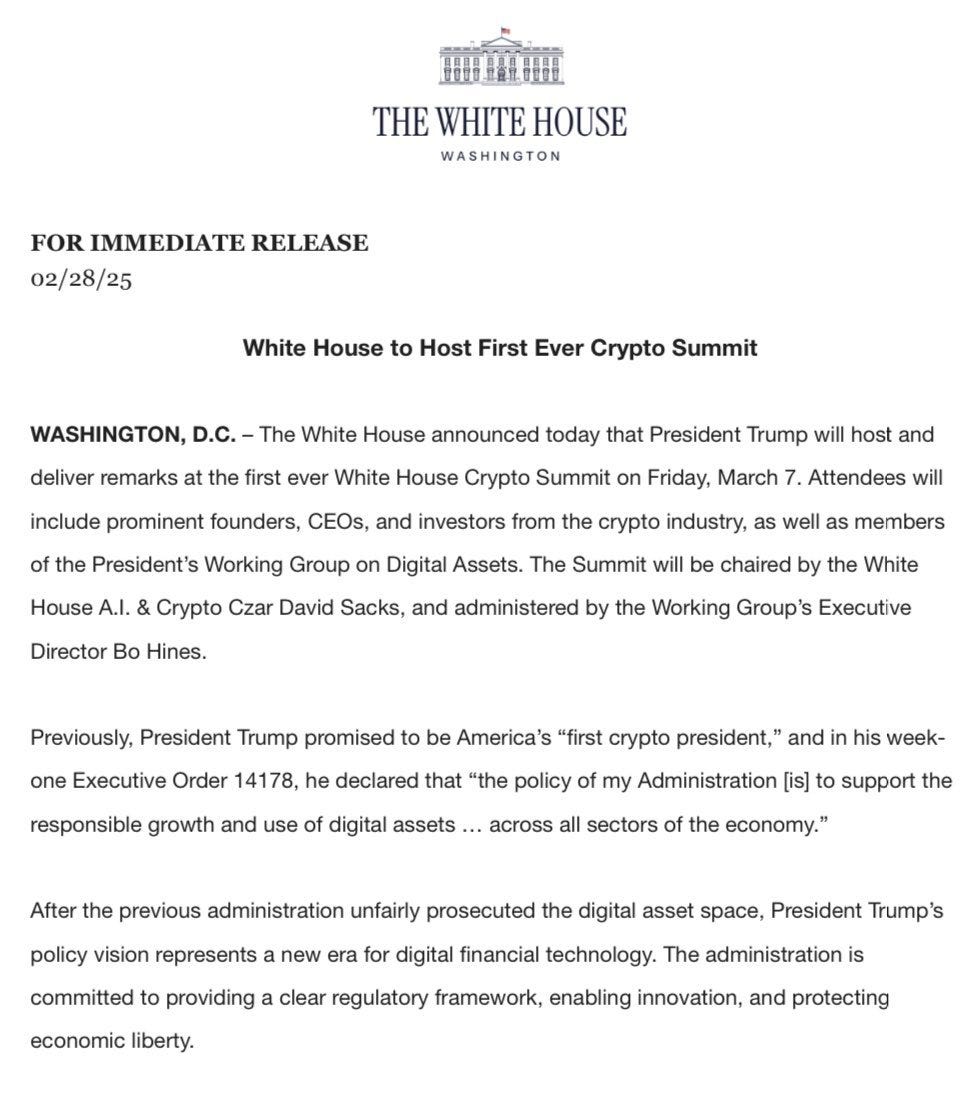
President Donald Trump will host and deliver remarks at the first-ever White House Crypto Summit on Friday, March 7, 2025. The summit will include prominent founders, CEOs, and investors from the crypto industry, as well as members of the President’s Working Group on Digital Assets. It will be chaired by White House A.I. & Crypto Czar David Sacks and administered by the Working Group’s Executive DirectorBo Hines.

President Trump signed Executive Order 14178 shortly after taking office, establishing a policy to support the “responsible growth and use of digital assets, blockchain technology, and related technologies across all sectors of the economy.” This order revoked Executive Order 14067 (March 9, 2022), which focused on ensuring responsible development of digital assets under the previous administration and directed the Treasury Department to revoke its “Framework for International Engagement on Digital Assets” from July 7, 2022.

The order explicitly prohibits the establishment of Central Bank Digital Currencies (CBDCs) in the U.S., citing threats to financial stability, individual privacy, and U.S. dollar sovereignty. It emphasizes protecting citizens’ ability to use public blockchain networks, promoting U.S. dollar sovereignty through stablecoins, and ensuring fair access to banking services for crypto companies.

The executive order created a Working Group on Digital Assets, chaired by White House A.I. & Crypto Czar David Sacks and administered by Executive Director Bo Hines. The group includes officials from key agencies such as the Treasury Department, Department of Justice, Securities and Exchange Commission (SEC), and Commodity Futures Trading Commission (CFTC). Within 180 days of the order, the Working Group is tasked with submitting a report to the President, proposing a federal regulatory framework for digital assets, including:

Governance of the issuance and operation of digital assets, such as stablecoins. Market structure, oversight, consumer protection, and risk management. Evaluation of a national digital asset stockpile, potentially using cryptocurrencies seized through law enforcement efforts, and criteria for establishing such a stockpile.

The summit, hosted by President Trump, aims to bring together prominent founders, CEOs, investors from the crypto industry, and members of the Working Group to discuss regulatory policies. It is expected to provide clarity on upcoming crypto regulations, with a focus on:

Stablecoin Regulation: There is significant interest in creating a regulatory framework for stablecoins to extend the U.S. dollar’s dominance internationally and ensure consumer protection.

Bitcoin and Digital Asset Reserves: The summit may address the feasibility and structure of a U.S. Strategic Crypto Reserve, which Trump has indicated will include Bitcoin (BTC), Ethereum (ETH), XRP, Solana (SOL), and Cardano (ADA), among other “valuable cryptocurrencies.” This aligns with state-level initiatives in at least 24 U.S. states exploring Bitcoin reserves.

Regulatory Clarity and Innovation: The administration is committed to providing a “clear regulatory framework” that enables innovation, protects economic liberty, and prevents the regulatory overreach seen under the previous Biden administration, which faced criticism for aggressive enforcement against crypto firms.

The SEC, under acting Chair Mark Uyeda, has taken steps to signal a pro-crypto stance, including Creating a “Crypto Task Force” to clarify the regulatory framework for crypto assets. Rescinding Staff Accounting Bulletin No. 121 (SAB 121), which had required crypto custodians to treat held assets as liabilities on their balance sheets, a move seen as stifling institutional adoption. This was replaced with new guidance (SAB 122) to encourage crypto custody.

Dropping or pausing lawsuits and investigations against major crypto firms like Coinbase, Binance, ConsenSys, Gemini, Uniswap and the Tron Foundation, reflecting a shift away from the Biden-era crackdown on fraud and money laundering. The administration has also pushed for bipartisan crypto-friendly legislation, with some Republican senators advocating to remove IRS reporting requirements for decentralized finance and new rules from the Consumer Financial Protection Bureau for digital wallets.

President Trump has positioned himself as “America’s first crypto president,” aiming to make the U.S. the “crypto capital of the world.” His administration seeks to reverse the previous administration’s tough regulatory approach, which included lawsuits against exchanges like FTX, Coinbase, and Binance, and to foster an environment where digital financial technology can thrive.

The policy emphasizes technology-neutral regulations, transparent decision-making, and well-defined jurisdictional boundaries to support a vibrant digital economy, permissionless blockchains, and distributed ledger technologies. The crypto community remains divided, with some skeptical of the administration’s motives, given Trump’s past criticism of crypto as a ”scam” and his family’s involvement in memecoins.

The Whitehouse Crypto event aims to support the responsible growth and use of digital assets across all sectors of the economy, reflecting President Trump’s commitment to providing a clear regulatory framework, enabling innovation, and protecting economic liberty in the digital financial technology space.