DD
MM
YYYY

PAGES

DD
MM
YYYY

spot_img

PAGES

Home Blog Page 212

Amazon’s Andy Jassy Says 14,000 Job Cuts Were About “Culture,” Not AI or Cost-Cutting

0
Andy Jassy, boss of AWS

Amazon’s CEO, Andy Jassy, following the company’s latest wave of layoffs that stunned the tech world, has said the decision to cut 14,000 corporate jobs this week was not about artificial intelligence or finances. It was, instead, about “culture.”

That word—simple yet loaded—has become Jassy’s new mantra as he seeks to redefine how the $1.8 trillion company operates in a post-pandemic world. During Amazon’s earnings call on Thursday, Jassy explained that as the company expanded over the years, it accumulated layers of management, processes, and bureaucracy that, in his view, diluted the sense of ownership among employees.

“As you grow and add more people, locations, and businesses, you end up with a lot more layers,” he said. “Sometimes without realizing it, you can weaken the ownership of the people that you have who are doing the actual work.”

Jassy’s approach is seen as part of his ongoing push to return Amazon to what he calls “the world’s largest startup”—a leaner, faster, and more disciplined company. He has made it a mission to root out inefficiency and restore a performance-driven mindset. Part of that effort includes an anonymous complaint line that has already generated 1,500 reports and resulted in more than 450 process changes.

But not everyone is convinced that “culture” fully explains the layoffs. Earlier reports from Reuters and The Wall Street Journal suggested the cuts—potentially affecting up to 30,000 corporate staff—were a response to overhiring during the pandemic and the growing role of AI in automating tasks. And while Jassy downplayed both factors, his own executives have hinted otherwise.

However, Beth Galetti, Amazon’s senior vice president of experience and technology, wrote that “this generation of AI is the most transformative technology we’ve seen since the internet, and it’s enabling companies to innovate much faster than ever before.” The comment reinforced concerns that automation is steadily reshaping the company’s workforce—even if Jassy prefers to frame the changes as cultural rather than technological.

Those concerns are not unfounded. Amazon has long been accused of quietly preparing to replace tens of thousands of warehouse workers with robots. The company denied that claim earlier this year, but it also unveiled two new warehouse robots designed to perform tasks traditionally handled by humans.

The layoffs come despite Amazon’s robust financial performance. The company’s third-quarter earnings exceeded Wall Street expectations, with revenue climbing to $180.17 billion and shares surging 14%. That success makes the timing of the job cuts all the more difficult for affected employees, many of whom see “culture” as a euphemism for efficiency drives and cost savings.

Jassy, who has led the company through years of restructuring and cost-cutting, however, insists the goal is to ensure Amazon doesn’t lose the agility that once defined it.

“It can lead to slowing you down as a leadership team,” he said. “We are committed to operating like the world’s largest startup, and that means removing layers.”

The company’s total headcount, which peaked at 1.6 million in 2021, stood at about 1.5 million at the end of last year—a figure likely to fall further as Jassy pursues his vision of a flatter, faster Amazon.

For those inside the company, Jassy’s message is that Amazon’s next chapter won’t just be about AI or automation. It will be about survival in a culture that rewards speed and precision over size—a return to its scrappy origins, even if it means leaving thousands behind.

Tekedia Capital Presents 18 Global Startups for Current Investment Cycle Ending in Nov

1

Tekedia Capital presents 18 global startups in the H2 2025 investment cycle. These companies cover space tech, quantum computing, finance, AI, fintech, rare earth metal processor, pharmacy tech, lending tech, robotics, trading exchange, drug manufacturing, and more, across economies and markets, from Estonia to US, Kazakhstan to UK, US/Nigeria to Germany, and beyond.

We welcome you to explore these startups and their overview videos by visiting membership area. This cycle will close in November 2025.

Affirm Expands $750m Partnership with New York Life as Fintech Funding Ties Deepen

0

Affirm is expanding its partnership with New York Life Insurance, marking another milestone in the growing alignment between traditional finance and fintech-driven consumer lending.

Under the new deal, New York Life will purchase up to $750 million worth of Affirm’s installment loans through 2026 — a move that strengthens Affirm’s funding pipeline and supports approximately $1.75 billion in annual loan originations.

The partnership, which began in 2023 when New York Life started investing in Affirm’s asset-backed securities and structured lending pools, has already funneled nearly $2 billion into the fintech’s collateral-backed assets. The expansion signals renewed institutional confidence in Affirm’s lending model at a time when fintech companies are under pressure to secure reliable, long-term funding amid volatile capital markets.

“We are proud to expand our relationship with such a trusted and forward-thinking partner in New York Life,” said Michael Linford, Chief Operating Officer, Affirm. “Through our collaboration, we will be even better positioned to responsibly increase access to our flexible and transparent payment options.”

Affirm has already financed more than $100 billion in transactions, with over 90% of its borrowers classified as repeat users — a metric the company touts as evidence of disciplined underwriting and strong customer retention.

The latest move comes amid a broader shift in institutional investment strategies, as insurers, private credit funds, and pension managers increasingly target consumer lending assets to capitalize on higher yields in a prolonged high-interest-rate environment. Insurers like New York Life see structured fintech loans as offering better risk-adjusted returns than traditional bonds or treasuries, especially given the predictable cash flows tied to installment loan repayments.

“As we continue to deploy capital to create lasting value for our policy owners, Affirm has distinguished itself by delivering superior credit outcomes that generate attractive returns,” said Brendan Feeney, Managing Director, New York Life. “We’re excited to take this next step in our relationship, which exemplifies how we collaborate with industry leaders to invest in growing, high-quality assets.”

The broader trend has seen several insurers and asset managers strike similar deals with leading fintechs. Affirm has established additional funding lines with Liberty Mutual Investments, PGIM, and Sixth Street Partners, securing billions in capacity to support its lending operations.

Rival Klarna has entered comparable loan-sale agreements with Nelnet and Pagaya, while PayPal’s $7 billion arrangement with Blue Owl Capital — followed by Blue Owl’s joint venture with Meta to finance the $27 billion Hyperion data center project in Louisiana — underscores the growing integration between fintechs and institutional finance.

These partnerships are becoming vital as consumer lenders navigate an uncertain macroeconomic environment. Although U.S. consumer spending has remained resilient, inflationary pressures and high borrowing costs have tightened credit conditions, prompting fintechs to rely increasingly on external investors for liquidity. Delinquency rates, while stabilizing, remain above pre-pandemic levels in some credit categories, leading to heightened investor scrutiny over underwriting quality and loan performance.

Affirm has managed to maintain strong credit metrics relative to industry peers, helped by its focus on prime and near-prime borrowers and its data-driven risk assessment tools. The company has also expanded partnerships with major retailers such as Amazon, Walmart, and Shopify, providing installment options to millions of consumers at checkout — a strategy that continues to drive transaction growth and steady revenue.

Analysts view the Affirm–New York Life partnership as part of a maturing BNPL sector where technology firms increasingly act as loan originators and distribution platforms, while established financial institutions supply capital and risk management expertise. The model allows fintechs like Affirm to scale responsibly without over-leveraging their balance sheets.

Financial analysts have noted that institutional partnerships are the next phase of fintech evolution — where growth becomes sustainable, not just fast. The collaboration, they said, demonstrates how legacy financial giants are adapting to the digital lending age by working alongside, rather than against, fintech disruptors.

For Affirm, the partnership represents both stability and validation. As the BNPL industry faces headwinds in the U.S. and abroad, aligning with a century-old insurer like New York Life provides credibility that could help reassure investors and regulators that fintech lending can operate safely within traditional finance frameworks.

Netflix explores the Potential Acquisition of Warner Bros Discovery’s Studio and Streaming Assets

0

Netflix is reportedly weighing a bid to acquire Warner Bros Discovery’s (WBD) studio and streaming operations, in what could become one of the most consequential mergers in modern entertainment history.

According to three sources familiar with the matter, who spoke to Reuters, the streaming giant has retained Moelis & Co., the investment bank that recently advised Skydance Media on its successful acquisition of Paramount Global, to evaluate the feasibility of such a deal.

Two of the sources said Netflix has already been granted access to Warner Bros Discovery’s financial data room, giving it the opportunity to review detailed figures about the company’s studio and streaming assets. This step is typically seen as a precursor to a formal offer.

Both Netflix and Warner Bros Discovery declined to comment on the development. Moelis & Co. also refused to confirm its role in the talks.

If completed, the acquisition would mark Netflix’s most audacious move since it transitioned from DVD rentals to global streaming more than a decade ago. Control of Warner Bros’ vast library — which includes iconic franchises such as Harry Potter, DC Comics, The Lord of the Rings, and Game of Thrones — would immediately strengthen Netflix’s position as Hollywood’s dominant content powerhouse.

Warner Bros’ television arm is also a prolific supplier of programming to Netflix, producing hits such as You, Running Point, and Maid. Analysts say full ownership could secure Netflix a more predictable pipeline of top-tier shows and reduce its long-term licensing costs.

The deal would also bring HBO and its streaming service, Max, under Netflix’s umbrella — adding a new dimension to its prestige content portfolio and potentially boosting its subscriber base in key international markets.

Netflix CEO Ted Sarandos, however, has consistently maintained that the company is “more builders than buyers.” Speaking during the company’s third-quarter investor video last week, Sarandos reiterated that Netflix is selective about acquisitions but open to opportunities that “strengthen the company’s entertainment offerings.”

“We’ve been very clear in the past that we have no interest in owning legacy media networks,” Sarandos said, explicitly ruling out an acquisition of Warner Bros Discovery’s linear television networks such as CNN, TNT, Food Network, and Animal Planet. “There is no change there.”

Warner Bros Discovery, led by CEO David Zaslav, announced last week that it was exploring strategic options after receiving multiple unsolicited acquisition offers, including one from Skydance Media, now known as Paramount Skydance. The company’s board is weighing whether to continue with its planned corporate split — which would separate its film, TV, and streaming operations from its traditional cable business — or to pursue an outright sale of parts or all of the company.

Comcast has also been named among potential bidders. President Mike Cavanagh hinted last Thursday that Comcast is evaluating “complementary” media assets that could enhance its portfolio. Addressing skepticism about regulatory hurdles, he said, “More things are viable than maybe some of the public commentary that’s out there.”

Analysts note that Netflix’s potential entry into the bidding war reflects how aggressively major streamers are repositioning amid intense competition and shifting consumer behavior. With Warner Bros Discovery struggling under heavy debt and Netflix looking to expand its original content ownership, a merger could reshape the global entertainment landscape.

If Netflix proceeds, it would represent its boldest attempt yet to integrate vertically, uniting content creation, distribution, and streaming under one roof, while cementing its dominance as both a studio and a global entertainment platform.

Nigerians React to US Military Warning with Defiance, Suspicion

6

A report published by Daily Trust which indicated that the United States Secretary of War, Pete Hegseth, said his department was preparing for possible military action in Nigeria has triggered a wave of mixed reactions across social media. This was gleaned from our analysis of public comments on the newspaper’s official Facebook page.

While the statement attributed to Hegseth suggested heightened geopolitical tension, Nigerians online did not respond uniformly. Instead, they negotiated the meaning of the report in different ways that reflect the country’s political consciousness, economic anxiety, and cultural orientation.

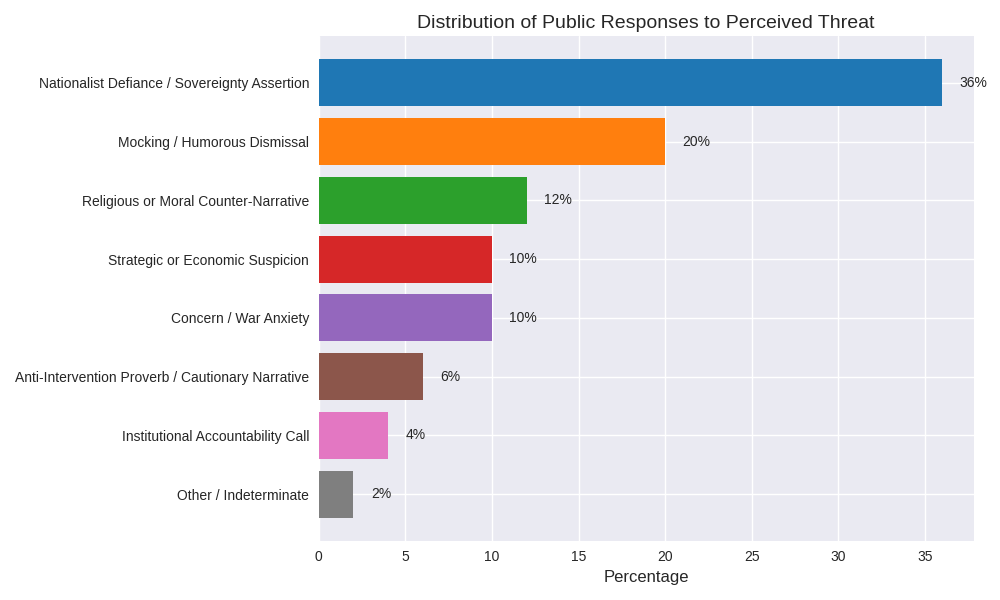
A significant portion of commentators reacted with a show of national confidence. They argued that Nigeria was capable of defending its sovereignty and would not be intimidated by an external power like the United States. These users acknowledged the potential seriousness of the threat but reframed it as an opportunity to assert Nigeria’s strength. Comments such as “We are ready for you, we will protect our sovereignty with all our hearts” and “Our generals are waiting for you” reflected this spirit of bold resistance. About 36 percent of the comments analyzed took this nationalist defiance approach.

Others embraced humor over fear. About 20 percent of the online reactions mocked the idea of a US attack, portraying it as exaggerated or unrealistic. Laughter emojis accompanied sarcastic questions and jokes such as “Secretary of war keh” and “Who go open gate for them.” Some users compared gun sounds in Nigeria with those in the United States as a way to downplay the scenario, turning a potentially alarming headline into comedy. This oppositional reading rejected the threat and challenged the credibility of the initial report through humour.

Source: Daily Trust’s Facebook, 2025; Infoprations Analysis, 2025

Religion played a central role in several reactions, particularly around narratives of persecution. Hegseth’s comment reportedly referenced concerns about religious freedom in Nigeria, but some Nigerians strongly objected to the suggestion that the country targets Christians. These reactions insisted that Islam in Nigeria is a peaceful religion and that Muslims have also been victims of terrorism. Messages encouraged unity and rejected what they perceived as foreign propaganda meant to divide communities. Religious or moral counter narratives made up around 12 percent of the responses.

Suspicion of foreign motives also surfaced frequently. Five out of the 50 analyzed reactions questioned whether the United States was interested in protecting human rights or if the real objective was to secure Nigeria’s strategic resources. Oil was a common focus of these suspicions. Users wrote comments like “Is US running short of crude oil” and warned that Western powers are often driven by economic agendas. Others suggested that Nigeria’s mineral wealth such as californium could be an attraction for intervention. These negotiated readings did not dismiss the threat entirely but framed it as self-serving geopolitical interference.

A visible minority expressed fear and worry that any military action would affect civilian lives. These users advised prayers and urged people to take the situation seriously. Some recalled the devastation in Libya as a cautionary example. For them, war is not an avenue for bravado or humor but a destructive force that would sweep up even those who support it. Around 10 percent of comments reflected this anxiety.

Another group redirected the attention inward. They interpreted the reported statement as a wake up call for Nigerian leaders to strengthen institutions, address insecurity and reduce the nation’s vulnerability on the world stage. These voices asked the government to reinforce internal governance instead of engaging in rhetoric. This accountability oriented view represented a smaller portion of comments but demonstrated that some citizens see international pressure as a reflection of domestic shortcomings.

Across all categories, the reactions highlighted the complexity of Nigerian public opinion when confronted with foreign threat narratives. The dominant pattern was not simple acceptance or rejection but a negotiation of meaning rooted in nationalism, lived insecurity, humor as coping strategy and distrust of global power intentions.

Although the credibility of the report and the existence of a United States Secretary of War have been questioned, the reactions offer insight into how Nigerians decode political information online. The conversation has shown that for many citizens, external pressure becomes a lens through which they reinterpret national identity, political grievances and global inequality.