DD
MM
YYYY

PAGES

DD
MM
YYYY

spot_img

PAGES

Home Blog Page 221

Netflix explores the Potential Acquisition of Warner Bros Discovery’s Studio and Streaming Assets

0

Netflix is reportedly weighing a bid to acquire Warner Bros Discovery’s (WBD) studio and streaming operations, in what could become one of the most consequential mergers in modern entertainment history.

According to three sources familiar with the matter, who spoke to Reuters, the streaming giant has retained Moelis & Co., the investment bank that recently advised Skydance Media on its successful acquisition of Paramount Global, to evaluate the feasibility of such a deal.

Two of the sources said Netflix has already been granted access to Warner Bros Discovery’s financial data room, giving it the opportunity to review detailed figures about the company’s studio and streaming assets. This step is typically seen as a precursor to a formal offer.

Both Netflix and Warner Bros Discovery declined to comment on the development. Moelis & Co. also refused to confirm its role in the talks.

If completed, the acquisition would mark Netflix’s most audacious move since it transitioned from DVD rentals to global streaming more than a decade ago. Control of Warner Bros’ vast library — which includes iconic franchises such as Harry Potter, DC Comics, The Lord of the Rings, and Game of Thrones — would immediately strengthen Netflix’s position as Hollywood’s dominant content powerhouse.

Warner Bros’ television arm is also a prolific supplier of programming to Netflix, producing hits such as You, Running Point, and Maid. Analysts say full ownership could secure Netflix a more predictable pipeline of top-tier shows and reduce its long-term licensing costs.

The deal would also bring HBO and its streaming service, Max, under Netflix’s umbrella — adding a new dimension to its prestige content portfolio and potentially boosting its subscriber base in key international markets.

Netflix CEO Ted Sarandos, however, has consistently maintained that the company is “more builders than buyers.” Speaking during the company’s third-quarter investor video last week, Sarandos reiterated that Netflix is selective about acquisitions but open to opportunities that “strengthen the company’s entertainment offerings.”

“We’ve been very clear in the past that we have no interest in owning legacy media networks,” Sarandos said, explicitly ruling out an acquisition of Warner Bros Discovery’s linear television networks such as CNN, TNT, Food Network, and Animal Planet. “There is no change there.”

Warner Bros Discovery, led by CEO David Zaslav, announced last week that it was exploring strategic options after receiving multiple unsolicited acquisition offers, including one from Skydance Media, now known as Paramount Skydance. The company’s board is weighing whether to continue with its planned corporate split — which would separate its film, TV, and streaming operations from its traditional cable business — or to pursue an outright sale of parts or all of the company.

Comcast has also been named among potential bidders. President Mike Cavanagh hinted last Thursday that Comcast is evaluating “complementary” media assets that could enhance its portfolio. Addressing skepticism about regulatory hurdles, he said, “More things are viable than maybe some of the public commentary that’s out there.”

Analysts note that Netflix’s potential entry into the bidding war reflects how aggressively major streamers are repositioning amid intense competition and shifting consumer behavior. With Warner Bros Discovery struggling under heavy debt and Netflix looking to expand its original content ownership, a merger could reshape the global entertainment landscape.

If Netflix proceeds, it would represent its boldest attempt yet to integrate vertically, uniting content creation, distribution, and streaming under one roof, while cementing its dominance as both a studio and a global entertainment platform.

Nigerians React to US Military Warning with Defiance, Suspicion

6

A report published by Daily Trust which indicated that the United States Secretary of War, Pete Hegseth, said his department was preparing for possible military action in Nigeria has triggered a wave of mixed reactions across social media. This was gleaned from our analysis of public comments on the newspaper’s official Facebook page.

While the statement attributed to Hegseth suggested heightened geopolitical tension, Nigerians online did not respond uniformly. Instead, they negotiated the meaning of the report in different ways that reflect the country’s political consciousness, economic anxiety, and cultural orientation.

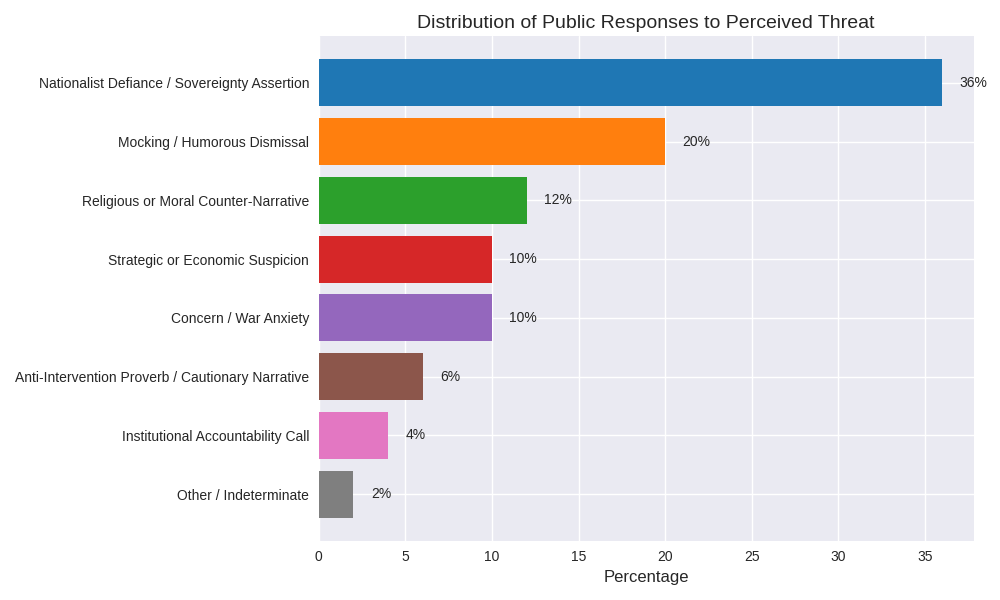
A significant portion of commentators reacted with a show of national confidence. They argued that Nigeria was capable of defending its sovereignty and would not be intimidated by an external power like the United States. These users acknowledged the potential seriousness of the threat but reframed it as an opportunity to assert Nigeria’s strength. Comments such as “We are ready for you, we will protect our sovereignty with all our hearts” and “Our generals are waiting for you” reflected this spirit of bold resistance. About 36 percent of the comments analyzed took this nationalist defiance approach.

Others embraced humor over fear. About 20 percent of the online reactions mocked the idea of a US attack, portraying it as exaggerated or unrealistic. Laughter emojis accompanied sarcastic questions and jokes such as “Secretary of war keh” and “Who go open gate for them.” Some users compared gun sounds in Nigeria with those in the United States as a way to downplay the scenario, turning a potentially alarming headline into comedy. This oppositional reading rejected the threat and challenged the credibility of the initial report through humour.

Source: Daily Trust’s Facebook, 2025; Infoprations Analysis, 2025

Religion played a central role in several reactions, particularly around narratives of persecution. Hegseth’s comment reportedly referenced concerns about religious freedom in Nigeria, but some Nigerians strongly objected to the suggestion that the country targets Christians. These reactions insisted that Islam in Nigeria is a peaceful religion and that Muslims have also been victims of terrorism. Messages encouraged unity and rejected what they perceived as foreign propaganda meant to divide communities. Religious or moral counter narratives made up around 12 percent of the responses.

Suspicion of foreign motives also surfaced frequently. Five out of the 50 analyzed reactions questioned whether the United States was interested in protecting human rights or if the real objective was to secure Nigeria’s strategic resources. Oil was a common focus of these suspicions. Users wrote comments like “Is US running short of crude oil” and warned that Western powers are often driven by economic agendas. Others suggested that Nigeria’s mineral wealth such as californium could be an attraction for intervention. These negotiated readings did not dismiss the threat entirely but framed it as self-serving geopolitical interference.

A visible minority expressed fear and worry that any military action would affect civilian lives. These users advised prayers and urged people to take the situation seriously. Some recalled the devastation in Libya as a cautionary example. For them, war is not an avenue for bravado or humor but a destructive force that would sweep up even those who support it. Around 10 percent of comments reflected this anxiety.

Another group redirected the attention inward. They interpreted the reported statement as a wake up call for Nigerian leaders to strengthen institutions, address insecurity and reduce the nation’s vulnerability on the world stage. These voices asked the government to reinforce internal governance instead of engaging in rhetoric. This accountability oriented view represented a smaller portion of comments but demonstrated that some citizens see international pressure as a reflection of domestic shortcomings.

Across all categories, the reactions highlighted the complexity of Nigerian public opinion when confronted with foreign threat narratives. The dominant pattern was not simple acceptance or rejection but a negotiation of meaning rooted in nationalism, lived insecurity, humor as coping strategy and distrust of global power intentions.

Although the credibility of the report and the existence of a United States Secretary of War have been questioned, the reactions offer insight into how Nigerians decode political information online. The conversation has shown that for many citizens, external pressure becomes a lens through which they reinterpret national identity, political grievances and global inequality.

Getty Images Jumps 19% after Striking Landmark Licensing Deal with Perplexity AI

0

Getty Images shares surged 19% on Friday after the company announced a multi-year licensing deal with artificial intelligence search startup Perplexity AI, marking one of the most significant partnerships yet between a traditional media asset platform and a rapidly growing AI company.

Under the agreement, Perplexity will gain access to Getty Images’ vast library of creative and editorial photos, which will be integrated into its AI-powered search tools. The partnership allows Perplexity to display high-quality visuals within its results while ensuring that photographers and content creators receive proper credit.

“Partnerships such as this support AI platforms to increase the quality and accuracy of information delivered to consumers, ultimately building a more engaging and reliable experience,” said Nick Unsworth, vice president of strategic development at Getty Images, in a statement announcing the deal.

Financial terms were not disclosed, but analysts say the agreement underscores the growing importance of licensed data in training and enriching AI systems. Getty Images — long a vocal advocate for protecting intellectual property in the age of generative AI — has struck similar licensing partnerships in the past year, including one with Nvidia to provide legally sourced visual data for AI model development.

The new arrangement will also improve how Perplexity displays imagery on its platform. The AI firm will begin showing image credits and direct links to the original source on Getty’s website, addressing one of the most persistent criticisms of AI tools — their tendency to use copyrighted content without attribution.

Perplexity, founded in 2022 and backed by investors such as Jeff Bezos and Nvidia, has quickly become one of the most prominent challengers to Google and OpenAI in the AI search space. Its conversational search engine gives users direct, concise answers to questions, accompanied by citations and external links to verified sources — a feature that has earned it a reputation for transparency and reliability.

The company recently expanded its ecosystem with Comet, an AI browser available globally for free. Comet allows users to browse, summarize, and query the web in real time using conversational AI. It competes directly with OpenAI’s new browser, ChatGPT Atlas, which was unveiled earlier this month, and Google’s Search Generative Experience (SGE), which blends generative AI answers into traditional search results.

For Getty Images, the deal represents another step in its broader strategy to remain relevant in an AI-dominated media landscape. The company has aggressively pursued partnerships with AI developers while simultaneously fighting unlicensed data scraping. In 2023, Getty sued Stability AI for allegedly using millions of its copyrighted images to train the Stable Diffusion model without permission.

By collaborating with Perplexity, Getty appears to be balancing protection and participation — asserting its rights over visual content while ensuring its vast archive remains integral to the AI revolution.

The deal is expected to serve as a model for how traditional content owners and AI firms can coexist through licensing rather than litigation. AI firms need credible, high-quality data, and content owners need to ensure they’re not erased from the value chain.

The news sent Getty Images’ stock soaring as investors cheered the company’s ability to monetize its library through AI integration. Analysts believe the collaboration could lead to similar deals across the AI industry as search companies race to enhance visual quality and source transparency in their products.

Amazon Surges 11% after Strong AWS Rebound, Upbeat Outlook Restores Investor Confidence in AI Strategy

0

Amazon shares jumped more than 11% in early trading Friday after the company’s cloud unit, Amazon Web Services (AWS), posted a sharp rebound in growth and offered a bullish sales outlook that eased concerns about its position in the artificial intelligence race.

The e-commerce and cloud computing giant reported that AWS revenue rose 20% in the third quarter — its fastest pace in nearly two years. Though the growth rate lagged behind Microsoft Azure’s 40% and Google Cloud’s 34%, AWS’s enormous scale magnified the result’s impact, with its $33 billion in revenue more than double Google Cloud’s $15.16 billion.

Wall Street analysts described the performance as a “turning point” for Amazon, suggesting that AWS — which had recently shown signs of slowing momentum — has now regained its footing.

“There was definitely concern about AWS losing market share to Microsoft Azure and Google Cloud,” said Jed Ellerbroek, portfolio manager at Argent Capital. “But now AWS is aboard the train as well and they’re seeing a big revenue increase.”

Ellerbroek added that investors had expected AWS’s acceleration to come later, either in the fourth quarter or early next year.

“But it’s already come this quarter,” he said.

The result triggered a wave of optimism on Wall Street, helping Amazon’s stock outperform its peers for the first time this year. Before Friday’s surge, Amazon shares had gained just 1.6% year-to-date, making it the weakest performer in the “Magnificent Seven” — a group that includes Apple, Microsoft, Nvidia, Alphabet, Tesla, Meta, and Amazon. The latest rally pushed Amazon’s gains past those of Tesla and Apple, whose shares are up about 11% and 8%, respectively.

AWS, long seen as Amazon’s most profitable engine, has been at the center of investor concern amid a new wave of AI-driven competition from Microsoft and Google. Analysts say the strong quarter shows Amazon is no longer playing defense in the cloud and AI markets.

Chief Executive Andy Jassy said AWS is “growing at a pace we haven’t seen since 2022,” citing a surge in demand for both AI and core cloud infrastructure services. He noted that customers are increasingly adopting AWS’s machine learning tools and foundation models for enterprise applications — a sign that the company’s long-term AI bets are starting to pay off.

Like its Big Tech rivals, Amazon also signaled a plan to raise capital expenditures next year to meet rising AI demand. The company is building new data centers and accelerating investments in proprietary chips such as Trainium and Inferentia, which are designed to cut costs for large-scale AI workloads.

“Amazon delivered one of the strongest performances of this earnings season, quieting any lingering doubts about its ability to execute at scale,” said eToro market analyst Farhan Badami.

He added that Amazon’s renewed focus on AI has reassured investors who had worried the company was ceding leadership to Microsoft and Google.

Amazon’s valuation metrics also reflected renewed confidence. Its forward 12-month price-to-earnings ratio now stands at 29.63 — higher than Alphabet’s 25.98 but still below Microsoft’s 31.72, suggesting investors are optimistic about further upside.

Beyond the cloud business, Amazon’s retail and advertising segments also posted impressive results. The company’s core e-commerce operation grew 11% year-over-year, a performance analysts described as exceptional for a retailer of Amazon’s scale.

“Amazon’s retail results were very good,” said Ellerbroek. “They’re growing 11% year over year. Name me another big retailer in America growing that fast — they don’t exist.”

Meanwhile, advertising revenue climbed 24% to $17.7 billion, driven by Amazon’s expansion of ad placements across its ecosystem — from Echo devices and Fire TVs to grocery carts and sponsored listings on its marketplace.

The combined strength of AWS, advertising, and retail segments prompted at least 23 brokerages to raise their price targets for Amazon shares. Analysts say the results show the company’s AI and digital commerce strategies are beginning to reinforce each other, positioning Amazon for a stronger 2026.

Between AWS’s rebound, ad strength, and the company’s investments in generative AI infrastructure, this may be the moment Amazon regains its edge among the Magnificent Seven.

Apple Doubles Down On AI Ambitions, Eyes M&A To Power Next-Gen Siri, Close Gap With Rivals

0

Apple CEO Tim Cook has reaffirmed the company’s commitment to artificial intelligence, signaling that Apple will pursue new acquisitions and partnerships to accelerate its AI roadmap.

His comments, made during the company’s Q4 2025 earnings call, mark a more aggressive tone from a firm long viewed as slow to embrace the AI revolution reshaping global technology.

For years, Apple stood out among the world’s major tech players for its conservative approach to artificial intelligence. While rivals like Microsoft, Google, Amazon, and Meta have poured tens of billions of dollars into AI infrastructure, large language models, and cloud systems, Apple has largely focused on privacy-preserving AI features within its devices. That stance has drawn criticism from analysts, who say the company risks falling behind in a market expected to transform both consumer electronics and enterprise computing.

In recent months, however, Cook has faced growing pressure from investors and analysts urging Apple to invest more heavily in AI. Several Wall Street analysts — including those from Morgan Stanley and Wedbush — have projected that Apple’s earnings could surge by as much as 10–15% annually if the company successfully integrates generative AI into its products and services.

If Apple can pull it off again by eventually implanting more AI features on the iPhone, Wedbush’s Dan Ives believes those breakthroughs could boost the company’s market share by another $1 trillion to $1.5 trillion.

According to a Bloomberg Intelligence forecast, AI integration could add over $100 billion to Apple’s market value within a few years, driven largely by demand for AI-enabled iPhones and Macs.

During the earnings call, Cook hinted that Apple’s strategy is shifting toward more aggressive expansion.

“We’re open to pursuing M&A if we think that it will advance our roadmap,” he said, responding to questions about Apple’s acquisition strategy.

The comment suggests Apple may soon begin snapping up smaller AI startups to fill gaps in its portfolio, following in the footsteps of rivals that have spent heavily on AI talent and infrastructure.

In a pre-earnings interview with CNBC, Cook revealed that Apple plans to announce more AI partnerships, building on its collaboration with OpenAI to integrate ChatGPT into Siri and Apple Intelligence.

“Our intention is to integrate with more people over time,” Cook said, signaling that Apple may look to diversify its AI collaborations to include other major model developers.

Apple’s relatively cautious AI rollout has often contrasted with the breakneck pace of its competitors. Microsoft has invested more than $13 billion in OpenAI and integrated generative AI tools across Windows, Office, and Azure. Google has built its own Gemini models and embedded them into search and productivity apps. Amazon has deployed AI to optimize logistics and expand its AWS cloud offerings. Even Meta has spent billions developing its open-source Llama models.

By contrast, Apple’s investments have been smaller and slower, with much of its focus on privacy-oriented machine learning within its ecosystem. The company’s flagship AI initiative, Apple Intelligence, unveiled earlier this year, relies on a combination of on-device computing and a proprietary cloud system known as Private Cloud Compute (PCC). Cook told investors the PCC technology — designed to process AI data securely — is already being used for certain Siri queries.

He added that Apple recently began manufacturing the servers used for Apple Intelligence in Houston, Texas.

“The manufacturing plant that makes the servers used for Apple Intelligence just started manufacturing in Houston a few weeks ago, and we’ve got a ramp planned there for use in our data centers,” Cook said.

Still, analysts argue that infrastructure upgrades alone may not be enough. “Apple cannot be looking at this AI Party through the window,” Ives told CNBC FastMoney in August. “The time has come for Cupertino to make a big move on AI innovation to avoid this ‘BlackBerry Moment.’”

Cook acknowledged during the call that AI is increasingly influencing consumer preferences. “I would say that Apple Intelligence is a factor, and we’re very bullish on it becoming a greater factor,” he said, implying that customers’ appetite for AI-powered devices could soon reshape Apple’s sales trajectory.

The broader industry context makes Apple’s pivot even more critical. Nvidia, whose chips power most large-scale AI systems, has become the world’s first $5 trillion company, while Microsoft’s market value has surged on the back of AI optimism. Global demand for AI infrastructure has also spurred massive investments in countries such as India, where Amazon, Google, and Nvidia are all helping build new data centers to meet the computing needs of the AI era.

The challenge now for Apple is to prove it can catch up — and perhaps redefine AI in a way that fits its longstanding brand of privacy, integration, and seamless hardware-software design.