DD
MM
YYYY

PAGES

DD
MM
YYYY

spot_img

PAGES

Home Blog Page 2276

Crypto Traders Predict Yeti Ouro To Have Same Phenomenon As Trumps Coin

0

The cryptocurrency market in 2025 shows a notable shift as traders draw parallels between Yeti Ouro (YETIO) as well as Trump’s Coin (TRUMP). A resemblance exists in how Trump’s Coin rose through political support or social media buzz. The Play-to-Earn (P2E) gaming model of Yeti Ouro together with its token structure, leads experts to predict success at a similar scale.

Yeti Ouro: A Game-Changer In Crypto Gaming

Yeti Ouro stands out in the crypto space through its Play-to-Earn (P2E) game Yeti Go which runs on the Unreal Engine. A player can earn YETIO tokens by racing or winning in this new gaming system. The platform connects blockchain features for a decentralized setup where users own their assets which adds value to the token.

The financial plan behind Yeti Ouro shows promise with its token design. A total supply of 1 billion tokens exists along with a 5% burn rate, to create less supply over time. The presale shows good results in Stage 2 with tokens at $0.017 as well as a 10% reward for new buyers. The presale has already sold over 152,000,000 tokens. These numbers point to solid market trust. The presale has also gone through a thorough audit by SolidProof, a reputable company, further strengthened investors confidence.

The setup rewards early buyers but also creates a base for long-term success. This makes YETIO an option worth looking at for people who want to join the growing P2E market. Due to global recognition and Yeti Ouro presale success, YETIO has become an important element in the GameFi and DeFi space.

Trump’s Coin (TRUMP): The Political Meme Coin Surge

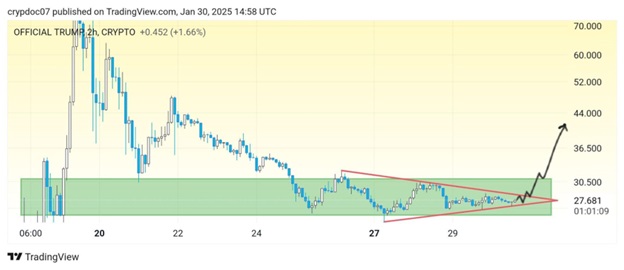
Trump’s Coin became a notable part of political backing and internet culture during Donald Trump’s campaign for re-election. The price increased from public figures’ support along with social media attention as well as its political story. The coin reached a $13 billion market value because of trading patterns plus a loyal group of followers. Yet price shifts occurred often because of the link between political news and public opinion.
  Source X

The coin’s financial appeal connected to politics with its price changes tied to Trump’s decisions, election news or public remarks. A large base of followers proved how a token could gain value through shared beliefs. But this also showed risks in assets that depend on one person or election results. A key lesson emerged for investors about high profits next to the random nature of internet-based tokens.

YETIO vs. TRUMP: Financial Dynamics

The comparison between YETIO and TRUMP Coin shows distinct financial patterns. TRUMP Coin based its value on politics and public excitement as YETIO builds its worth through a gaming system. Yetio enables investors to join an expanding gaming field where the token gains value from actual gameplay instead of speculation alone. The presale offers along with the Chinese New Year bonus add quick financial rewards for early buyers.

The mix of games and blockchain use in Yeti Ouro points to steadier growth compared to TRUMP Coin’s sharp price changes. YETIO lets people invest in game entertainment as well as blockchain development. The project offers quick profits from presale benefits next to potential future gains as the system expands.

Conclusion

While Trump’s Coin was a product of its time, fueled by political and meme culture, Yeti Ouro is positioning itself as a forward-looking investment in the Play-to-Earn gaming sector. If YETIO can capture the market’s imagination the way TRUMP Coin did, but with the added benefit of tangible utility, it might indeed replicate that phenomenon, providing investors with substantial financial opportunities in 2025.

With predictions for a 1000% return on investment, Yeti Ouro may be a life-changing opportunity investors are after. It is a standout option in the crypto – gaming  sector because of an advanced pairing and strategic market positioning.


Join the Yeti Ouro Community

Website: https://yetiouro.io/

X (Formerly Twitter): https://x.com/yetiouro

Telegram: https://t.me/yetiouroofficial

Discord: https://discord.gg/YtUsEZ2ZrV
How Global Media Leverage Trump’s Tariffs to Shape Geopolitical Decision-Making

0

Trade policies have always shaped the global economy. Still, few moments have garnered as much media frenzy as President Donald Trump’s tariff decisions on Canada, Mexico, China, and the European Union. The framing of Trump’s tariffs not only shaped public perception but also altered geopolitical relations, creating a self-perpetuating cycle of economic and diplomatic tensions. To provide insights that are relevant to new geopolitical developments, our analyst analyzes 20 news articles from international news outlets regarding the tariff trade war between the United States of America and other countries, particularly the CMC nations previously mentioned.

The Role of Moral Panic in Framing Trump’s Tariffs

Moral panic follows a specific trajectory, often beginning with the identification of a folk devil, an individual or group held responsible for a societal threat. In this case, the media positioned Trump and his tariffs as the central disruptors of global trade stability. Headlines such as “Trump says tariff ‘pain’ worth it for US as Canada and Mexico retaliate” and “Trump tariffs: which countries are affected and what does this mean?” illustrate how the narrative was framed as a global crisis rather than a standard economic policy decision.

Through exaggeration and sensationalism, media outlets amplified the perception of tariffs as a direct economic assault rather than a strategic policy manoeuvre. For instance, phrases like “Global alarm, condemnation as Trump tariffs hit Mexico, Canada and China” and “With tariffs and threats, Trump turns on America’s closest allies” evoke fear and instability. The media’s emphasis on pain, fallout, alarm, condemnation, and threats, the media shaped public perception makes the tariffs seem catastrophic rather than a routine element of trade negotiations.

From Economic Policy to Diplomatic Warfare

The media’s construction of moral panic around Trump’s tariffs had direct implications for geopolitics. It transformed what could have been measured trade disputes into diplomatic confrontations. The reciprocal tariffs from Canada and Mexico were framed as acts of resistance against an aggressor rather than economic countermeasures. Consider the framing in “Canada, Mexico announce retaliatory tariffs on US” and “Canada tariffs: Trudeau hits back against Trump with 25% levy”.

This adversarial narrative played a critical role in reinforcing nationalistic sentiments within affected countries. Canadian Prime Minister Justin Trudeau, for example, was portrayed as a leader rallying his country against economic aggression. The headline “Trump tariffs booed in Canada as Trudeau calls for national unity” suggests that tariffs were not just economic instruments but catalysts for political unity and defiance against perceived external threats.

Similarly, the European Union’s response was depicted as inevitable and justified. The headline “Trump says EU tariffs will ‘definitely happen’ as Mexico, Canada and China retaliate” presents retaliation as an unavoidable consequence rather than a negotiable policy response. This media-driven escalation further strained diplomatic relations and reinforced divisions between the US and its traditional allies.

The Lasting Impact on Global Trade and Alliances

The long-term consequences of media-driven moral panic around Trump’s tariffs extend far beyond his presidency. Countries now view trade disputes through a more adversarial lens, making compromise and negotiation more challenging. The rhetoric of economic nationalism, once amplified by media narratives, continues to influence protectionist policies worldwide.

Moreover, the media’s role in framing trade policies as crises has set a precedent for future economic reporting. Policymakers must now navigate a highly reactive media landscape, where trade decisions are instantly scrutinized and sensationalized. This creates a more volatile environment for global trade, where perception often outweighs economic realities.

As trade policies continue to evolve in a post-Trump world, leaders must be mindful of how media discourse influences public opinion and policy responses. In an era where perception is often more influential than reality, understanding the power of media-driven moral panics is essential for navigating the complexities of international trade and diplomacy.

El Salvador Bows to IMF Pressure, Limits Bitcoin Use in Exchange for $1.4bn Loan

0

El Salvador’s ambitious experiment with Bitcoin as legal tender has been significantly curtailed following an agreement with the International Monetary Fund (IMF) for a $1.4 billion loan.

The deal, reached last month, imposes restrictions on the government’s involvement in cryptocurrency activities, requiring that Bitcoin use in the private sector remain voluntary and that public sector participation be phased out. Additionally, the agreement mandates that taxes must only be paid in U.S. dollars—the country’s other official currency—while the government must gradually withdraw from its state-backed crypto wallet, Chivo.

The IMF insists that the loan is crucial to addressing El Salvador’s balance of payments needs and supporting economic reforms. However, the agreement effectively forces the government to scale back its Bitcoin policies, which President Nayib Bukele had championed as a revolutionary step toward financial inclusion and economic sovereignty.

The reform was swiftly adopted by the Bukele-aligned parliament late Wednesday, marking a notable shift in the country’s stance on cryptocurrency.

Bukele’s Radical Leap into Digital Finance

When El Salvador became the first country in the world to adopt Bitcoin as legal tender on September 7, 2021, the move was met with both enthusiasm and skepticism. Bukele, a self-styled visionary leader with a deep distrust of traditional financial institutions, framed the decision as a means to modernize El Salvador’s economy and free it from reliance on foreign monetary systems. He argued that Bitcoin adoption would provide financial access to the 70 percent of Salvadorans who lacked bank accounts, reduce remittance fees, attract foreign investment, and create new economic opportunities.

To encourage mass adoption, the government launched the Chivo Wallet, a state-backed digital payment platform designed to facilitate seamless Bitcoin transactions. Salvadorans were incentivized to use the platform with a $30 sign-up bonus, and the government also invested an undisclosed amount of public funds into Bitcoin, making large purchases to demonstrate confidence in the digital asset.

Bukele dismissed concerns about Bitcoin’s volatility, insisting that the cryptocurrency would stabilize over time and prove beneficial in the long run. However, the reality was starkly different.

Despite his high-profile efforts to integrate Bitcoin into everyday commerce, its adoption remained limited. According to a 2024 survey by the Central American University, an overwhelming 92 percent of Salvadorans did not use Bitcoin this year. Many businesses continued to conduct transactions in U.S. dollars, citing concerns over Bitcoin’s fluctuating value and the impracticality of using it for day-to-day purchases.

When El Salvador officially adopted the cryptocurrency in September 2021, it was trading at around $44,000. However, the price soon plunged, falling below $23,000 in 2022, leading to substantial losses on the government’s Bitcoin holdings. While the value has since rebounded, soaring by about 50 percent following Donald Trump’s election last November and surpassing $100,000, the IMF remained unconvinced about Bitcoin’s role in El Salvador’s financial system.

IMF’s Pressure and El Salvador’s Retreat from Bitcoin Policies

For more than two years, the IMF had urged El Salvador to reconsider its aggressive Bitcoin policies, warning that the cryptocurrency’s risks outweighed its potential benefits. Concerns included financial instability, regulatory challenges, and the possibility of illicit activities such as money laundering. Bukele, however, remained steadfast in his support for Bitcoin, even doubling down on purchases during market downturns.

But with El Salvador facing economic pressures and the need for international financial assistance, the government was forced to compromise. The IMF’s $1.4 billion loan came with clear conditions aimed at minimizing Bitcoin’s role in the country’s formal economy. Under the agreement, businesses will not be required to accept Bitcoin, the government will cease all participation in crypto-related activities, and the Chivo Wallet will be gradually unwound.

The most symbolic concession is the requirement that taxes be paid exclusively in U.S. dollars, reinforcing the dominance of the traditional financial system over Bitcoin in official transactions. This represents a contrast to Bukele’s original vision of Bitcoin as a tool for economic independence.

Nigeria Moves to Locally Produce HIV Drugs as U.S. Aid Suspension Raises Alarm

0

The Nigerian government has announced plans to commence domestic production of HIV test kits and antiretroviral drugs before the end of 2025, a move that comes amid growing concerns over the sustainability of HIV treatment programs following the suspension of U.S. foreign aid by President Donald Trump.

The decision, which affected funding through the United States Agency for International Development (USAID), has exposed millions of beneficiaries in Nigeria and other African countries to the risk of HIV spread.

At the forefront of this initiative is the National Agency for the Control of AIDS (NACA), whose Director-General, Temitope Ilori, disclosed the plan in Ilorin, Kwara State, over the weekend. Speaking at the inauguration of the Kwara Prevention of Mother-to-Child Transmission (PMTCT) and Paediatrics ART Acceleration Committee, Ilori stated that Nigeria must take decisive steps to reduce its dependency on foreign aid and ensure uninterrupted access to life-saving HIV treatments.

Ilori emphasized that the domestic production of HIV-related medical supplies was a crucial part of the government’s broader efforts to eliminate AIDS as a public health threat by 2030. She pointed out that Nigeria had long relied on external funding, particularly from PEPFAR and the Global Fund, but the Trump administration’s decision to suspend USAID support for certain global health programs had sent shockwaves through beneficiary countries, including Nigeria.

For years, Nigeria’s HIV/AIDS intervention programs have been largely dependent on international funding, with donor organizations providing antiretroviral therapy (ART), test kits, and prevention services. However, when Trump halted U.S. funding for international health initiatives, countries like Nigeria faced the looming threat of treatment disruptions. The absence of funding raised fears of drug shortages, stalled prevention programs, and an overall increase in HIV transmission rates.

The decision to establish local production of HIV treatment options is seen as a direct response to these vulnerabilities. Ilori highlighted that, despite existing HIV interventions, Nigeria still lags behind in pediatric HIV coverage, with mother-to-child transmission rates remaining high. According to the 2023 UNAIDS report, approximately 140,000 Nigerian children aged 0-14 are living with HIV, with 22,000 new infections and 15,000 AIDS-related deaths occurring annually. Despite global efforts to combat the epidemic, PMTCT and pediatric HIV coverage remain below 33 percent, a figure far from the 95 percent target.

The failure to meet these targets has been attributed to inadequate domestic funding, reliance on donor support, and gaps in program implementation. Even though international bodies like the Global Alliance have committed financial resources to the fight against AIDS, Ilori admitted that coverage remains suboptimal, emphasizing the need for government-led sustainability initiatives.

Nigeria’s HIV burden also varies significantly by region, with some local governments recording higher prevalence rates than others. In Kwara State, the HIV prevalence rate is 0.8 percent, which is lower than the national average of 1.4 percent. However, women remain disproportionately affected, with a prevalence rate of 1.3 percent compared to 0.4 percent in men. Ilori noted that while these figures show some progress, they remain unacceptable and called for targeted interventions in high-burden areas.

“Achieving an AIDS-free generation is within reach, and no child should be born HIV-positive in Kwara State,” Ilori said. She urged all partners to support the government in developing a comprehensive list of children born to HIV-positive parents, a critical step in ensuring nationwide access to pediatric ART.

Beyond Kwara, the federal government has intensified efforts to localize HIV treatment programs. The Minister of State for Health and Social Welfare, Iziaq Salako, recently established a National Acceleration Committee to oversee the expansion of HIV prevention and treatment strategies. The committee’s model is now being replicated at the state level, allowing for real-time monitoring and better program coordination.

However, the biggest challenge remains the financial sustainability of Nigeria’s HIV program. The sudden suspension of foreign aid, though partially reversed in later years, served as a wake-up call, exposing the dangers of over-reliance on external donors. Ilori revealed that in the past few days, she had received numerous calls expressing concerns about the implications of Trump’s 90-day foreign aid suspension, particularly on Nigeria’s HIV response.

“Over the past few days, I have received numerous calls regarding the implications of the 90-day foreign aid suspension on our HIV program. While we are relieved that HIV services remain exempt, this situation underscores the need for government-led sustainability efforts,” she said.

The move to produce HIV test kits and antiretroviral drugs locally is expected to lower costs, reduce dependence on volatile donor funding, and ensure that HIV-positive individuals have uninterrupted access to treatment. Experts warn, however, that success will depend on the government’s ability to invest in pharmaceutical manufacturing, enforce strict quality control measures, and strengthen supply chain management.

With over 1.9 million Nigerians currently living with HIV, the potential for spread is high. If successfully implemented, this initiative could position Nigeria as a leader in Africa’s fight against HIV/AIDS, providing a blueprint for other nations grappling with similar funding challenges.

However, health experts note that achieving this goal will require strong political commitment, increased financial investment, and continued engagement with stakeholders to ensure that the country’s HIV response remains effective, even in the face of donor uncertainties.

Dogecoin Price Projection: DOGE Falters At $0.3, Top Analyst Proclaim WallitIQ (WLTQ) As Best Bet For 50,000% Gains This Cycle

0

The cryptocurrency market is witnessing a significant shift, with investors seeking high-growth opportunities amid market fluctuations. While the Dogecoin price struggles to maintain its price levels, a new player, WallitIQ (WLTQ), is capturing the spotlight with its revolutionary approach to decentralized wallets and AI-powered security. Analysts predict massive gains for WallitIQ (WLTQ), making it the top investment choice for those looking to capitalize on the next big crypto surge.

WallitIQ (WLTQ) Poised For 50,000% Surge As It Revolutionizes Crypto Wallets

WallitIQ (WLTQ) is poised to become the most revolutionary force in the cryptocurrency wallet sector, with analysts projecting an explosive 50,000% surge after its presale. The project has already generated massive investor interest, with thousands rushing to secure tokens before they sell out. WallitIQ (WLTQ) is quickly becoming the most sought-after investment of this cycle.

Security and usability are at the core of WallitIQ (WLTQ), featuring AI-powered fraud detection, Advanced Encryption Standard (AES) and Elliptic Curve Cryptography (ECC), and a seamless user interface. Unlike outdated wallets that leave users vulnerable, the crypto wallet enables ironclad protection for digital assets. It also supports over 1,000 cryptocurrencies, making it the ultimate all-in-one solution for crypto investors.

As the presale gains momentum, analysts emphasize that early buyers will benefit the most. Investors are jumping on this rare opportunity, seeing WallitIQ (WLTQ) as a game-changer in decentralized wallets with the potential for massive returns. With its recent listing on CoinMarketCap, the DeFi token is set to change the landscape of digital asset management. Additionally, the highly anticipated beta platform is launching soon, further solidifying WallitIQ’s (WLTQ) position as a leader.

The platform’s multilingual AI chatbot, equipped to communicate in various languages, improves user experience by offering tailored assistance. Additionally, it’s important to note that the platform has boosted investor confidence by successfully undergoing a smart contract audit conducted by the well-respected SolidProof firm.

WallitIQ’s (WLTQ) MVP mobile app establishes it as a leader in crypto wallet innovation. It simplifies wallet management with key features like simulated ETH and USDT transactions, QR code payments, and real-time market insights powered by the CoinGecko API.

Users can access interactive candlestick charts, practice daily transfers, and enjoy an intuitive interface designed for both beginners and experienced traders. Upcoming updates are set to introduce AI-driven trading, price notifications, and additional features to adapt to evolving user needs.

Currently priced at $0.0420, WallitIQ (WLTQ) stands out in the crypto market as the top bet for massive gains, with analysts proclaiming it as the best opportunity for a 50,000% surge this cycle, especially as the Dogecoin price struggles at $0.3.

Dogecoin Price Struggles To Maintain Momentum At $0.3

The Dogecoin price has been a staple in the crypto market, driven by its strong community and meme appeal. However, its price has struggled to hold the $0.3 mark, with analysts questioning its ability to break past key resistance levels. Despite occasional surges fueled by social media hype and endorsements, the Dogecoin price lacks the fundamental backing to sustain long-term gains.

Analysts warn that without significant utility upgrades, the Dogecoin price could remain stuck in a volatile cycle. Market participants have also noticed a decrease in transaction volume, indicating waning interest from investors. While the Dogecoin price still holds value as a community-driven asset, its growth potential is overshadowed by newer, more innovative projects that offer real-world use cases and high-yield investment opportunities.

WallitIQ (WLTQ) Remains The Top Choice

The Dogecoin Price continues to face uncertainty, struggling to maintain its position at $0.3. Meanwhile, WallitIQ (WLTQ) is dominating the investment landscape, with analysts touting it as the best bet for 50,000% gains. The presale success speaks for itself, millions raised, thousands of investors onboard, and a rapidly selling-out supply.

This is a rare opportunity to invest in a revolutionary project before the price soars. Don’t wait until it’s too late, WallitIQ (WLTQ) is on track to transform the crypto wallet industry and generate unprecedented returns.

Secure your spot in the presale now and position yourself for exponential gains.

Join the WallitIQ (WLTQ) presale and community:

Join WallitIQ (WLTQ) Presale

Join the WallitIQ (WLTQ) Community