DD
MM
YYYY

PAGES

DD
MM
YYYY

spot_img

PAGES

Home Blog Page 2306

Deepseek’s Emergence: A New Chapter in the Global AI Landscape

0

In recent years, the rapid evolution of large language models has ignited competition across the globe, with companies racing to innovate and redefine the AI landscape. Among these developments, the emergence of Deepseek, a significant player in the large language model market, has sent ripples through both the tech community and broader geopolitical discussions. While US-based giants such as OpenAI and Google have long dominated this space, Deepseek’s ascent challenges the narrative, signaling a potential shift in global AI dynamics.

A glance at search interest data across the United States provides intriguing insights into public curiosity and sentiment surrounding Deepseek, particularly about China and the United States. The data reveals that states with historically high engagement in technology, such as California, Washington, and Massachusetts, exhibit a modest interest in Deepseek, with percentages hovering between 11% and 16%. Meanwhile, the interest in China consistently outpaces both Deepseek and the United States, stressing the age-long of people’s awareness and attention toward China’s technological ambitions and geopolitical role.

Exhibit 1: Public interest in Deepseek
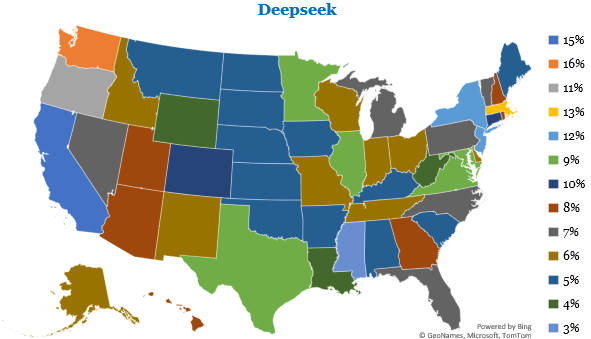
Source: Google Trends, January 1-28, 2025

However, beyond these figures lies a more important story, one that links technology, geopolitics, and public perception. The relatively low interest in Deepseek compared to China and the United States might initially suggest skepticism or limited awareness. Yet, this disparity could also reflect the entrenched dominance of US-based companies in the large language model market. For decades, US firms have set benchmarks in innovation, shaping how AI is perceived and utilized globally. In contrast, Deepseek’s emergence challenges these benchmarks, representing not only an alternative technological pathway but also a broader shift in the narrative surrounding global innovation.

Deepseek’s association with China adds further layers of complexity. As a country often portrayed as a rival to the United States, China’s advancements in AI are frequently met with both intrigue and apprehension. States such as New York, Maryland, and Hawaii demonstrate a particularly high interest in China, with search percentages exceeding 50%. This reflects an acute public awareness of China’s pivotal role in shaping the future of AI and emphasises the geopolitical undertones that often accompany discussions about technological innovation.

Exhibit 2: Public interest in China

Source: Google Trends, January 1-28, 2025

What does this mean for the global AI landscape? Deepseek’s rise is not merely about market competition; it signals a reimagining of how technological leadership is perceived. For the longest time, US-based companies have led the narrative around AI development, championing values of innovation, transparency, and scalability. Deepseek, emerging from a different geopolitical context, represents a broader diversification of thought and approach in the field of AI. Its presence forces a reevaluation of what innovation means and challenges established norms.

This shift carries significant implications for stakeholders across the board. For US-based companies, Deepseek’s emergence serves as a wake-up call, urging them to double down on innovation and public engagement. The data reveals that states with lower search interest in Deepseek, such as those in the Midwest and South, may benefit from targeted campaigns that demystify the company’s capabilities and emphasize its global relevance. For Deepseek, the challenge lies in bridging the perception gap, particularly in regions that have historically gravitated toward US tech giants. Building trust, fostering transparency, and emphasizing interoperability with existing systems could be key to establishing a foothold in these markets.

Governments, too, have a role to play in shaping the discourse. The global implications of large language models extend beyond mere competition; they touch on issues of governance, regulation, and ethical AI use. Deepseek’s rise highlights the need for international collaboration to establish shared frameworks and norms for AI development. While competition drives innovation, unchecked rivalry can lead to fragmentation and the duplication of efforts, which may ultimately hinder progress.

Exhibit 3: Public interest in United States
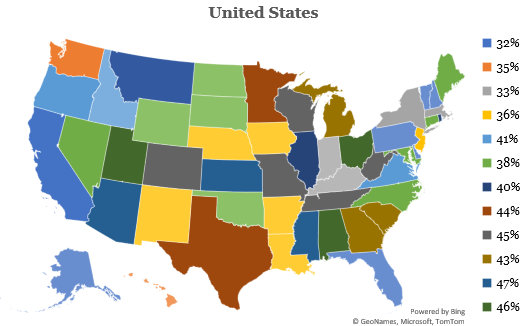
Source: Google Trends, January 1-28, 2025

While US companies continue to hold significant sway, Deepseek’s ascent challenges the status quo, prompting questions about the future of competition, collaboration, and governance in the AI landscape. As the world watches this unfolding story, one thing is clear: the emergence of players like Deepseek is reshaping not just the market but also the very fabric of how we think about technology and its role in society. The journey ahead will require stakeholders across geographies to embrace both competition and collaboration, ensuring that the benefits of innovation are felt far and wide.


These 5 Altcoins Could Define the Next Market Boom – Don’t Miss Out

0

Many coins are starting to show huge gains in this year of 2025, which is already signalling a bullish run. For this reason, investors who are continually scanning the market for the next possible high-performance crypto assets have identified several tokens. Experts of token value predict that such tokens have been having remarkable success for the last couple of weeks, and that’s why people are positive they will surge even higher.

Out of these cryptocurrencies, five of them have been designated as projects that have the potential to define the next market boom. Well, there are FXGuys ($FXG), Cardano (ADA), Ripple (XRP), Solana (SOL), and Polkadot (DOT). These crypto trading projects are unique in their functions and uses, but the focus has been on FXGuys.

Let’s explore these five cryptos that are set to define the next market boom.

>>>JOIN FXGUYS HERE<<<

Polkadot (DOT): Showing A bullish Trend After A Breakout

Polkadot has attracted market attention due to the latest price surge after a descending channel breakout. The first downtrend resistance at $11.77 is still important, and any breakdown would create a new path to the $24 level. Some of the key levels for Polkadot showed that the bulls maintained control, and other technical analyses drew a positive outlook in the analysis area.

Such a crossover of the weekly MA between the 9-day ($7.74) and 21-day ($5.78) moving average also pointed to a confirmed bullish trend. The social Dominance chart shows that Polkadot gained the community and investors’ attention: its rating increased from 0.432% to 0.551%. A similarly steep incline in market interest is tied to improved price action, with the increased number of participants operating in the ecosystem.

Ripple (XRP): Set For Higher Price Movement

Ripple has risen by 44.40% over the last 7 days, and it hit the $3.40 mark, a 7-year high and an astronomical market cap of $191.77 billion. The price action is once again dictated by the buyers, and the next big level on the chart is $3.6. If they keep $XRP above $3.3, then $XRP goes into price discovery.

Moving forward, XRP has only recently entered this list of altcoins which could reach their prior record prices in this cycle, as it joins BNB and SOL, which set a new record in late 2024. That said, sellers could return at this historic price if the rally is getting started or merely pausing for rest. If the token continues this kind of trajectory it has lately, Ripple has the ability to overtake Ethereum and become the second biggest digital currency.

Solana (SOL): Analysts Predict Potential Price Target

Solana breaks $100 billion in market capitalization as the cryptocurrency presses on its rally in 2025. It has also greatly resisted and grown, with the token having recorded a 13% increase within the past week. A price target of $250 has been widely anticipated, and some bullish scenarios point to $500 by Summer 2025.

Looking at the token from the moment when its price dropped after the FTX collapsed at the end of 2022, the token transformation to its current outcome can be called meteoric. Since then, SOL has really bounced and has gained 130% over the last year. Several main elements have driven this recovery, including Expanded ecosystem activity, especially in projects such as Pump, fun and Raydium.

Cardano (ADA): Ready For Grand Bull Run

After shedding off the lower ground in December, Cardano set $0.8 as the local low and used the rebound to rally by over 34% in the last couple of weeks. Perversely, the $0.8 is the March 2024 high, and so far, the altcoin has held it for the possibility of a test higher. Responding to the news, trader and analyst Peter Brandt took to Twitter to state that ADA was in for a ‘grand bull run’ provided that he noted the high of March as the bottom.

The consolidation above a previous price peak normally results in a very large upside breakout, most of the time. More to the point, if the likely rally follows the bull flag pattern, then the bullish target would be $1.9, just below $2—a 72% potential upside. There are two whale wallets, distributed within 100M-1B ADA (yellow) and 1M-10M ADA (red), and these whales have actively been staking since the start of the week.

FXGuys ($FXG): Disrupting DeFi Sector With The Trader Funding Program

FXGuys is one of the trending altcoins that has transformed the DeFi sector with its trading approach. The project’s goal is to unite TradeFi and DeFi systems, which is why it has topped the list as the best crypto to buy. The project has a Trader Funding Program that has caught the eyes of investors.

Through this program, traders have access to a funded account of up to $500,000. But, this capital is given after you have passed some tests and evaluations on the platform. The program also has a profit-sharing system, making it one of the best-trending altcoins in the market.

In the profit-sharing system, traders are given 80% of the profit, while FXGuys takes 20%. Through its Trade2Earn program, traders are also rewarded for participating, which is why it is the best crypto to buy. This means that when you trade on the platform, you are rewarded with $FXG tokens, even if your trade is profitable or not.

>>>JOIN FXGUYS HERE<<<

Conclusion

According to experts, FX Guys is the crypto project set to define the next market boom. FXGuys Trade2Earn platform is the best crypto trading platform ever, and it is unique and appealing, which is why investors are rushing to trade with the platform. While the presale is still on, you can join through the purchase of the tokens on the website of the firm.


To find out more about FXGuys follow the links below:

Presale | Website | Whitepaper | Socials | Audit

Big Money Investors Move Into Rexas Finance (RXS), XRP, and Dogecoin (DOGE) as 2025 Looks Promising

0

The cryptocurrency market is abuzz as big money investors gravitate towards Rexas Finance (RXS), Ripple (XRP), and Dogecoin (DOGE) in anticipation of a bullish 2025. With these projects displaying significant growth potential, savvy investors are moving to secure their positions early. Among these, Rexas Finance is a revolutionary platform poised to redefine asset ownership and blockchain integration.

Rexas Finance (RXS): A Game-Changer in Asset Tokenization

As of writing, RXS is priced at $0.175, rising 485% from its initial stage 1 price of $0.030. Rexas Finance is in stage 11 of its presale. Early investors have already seen a 6x return on investment from this outstanding rise. Rexas Finance has established itself as a top project in 2024, with 414,199,759 RXS tokens sold and $39,110,358 raised thus far. The project is expected to surge 14,300% for investors seeking long-term gains, hitting $25.05, presenting a fantastic chance.

The Certik audit of Rexas Finance strengthens its reputation by guaranteeing its platform’s security and dependability. Unlike many initiatives that depend on venture capital, Rexas Finance has adopted a community-driven approach, including people investors, to transform asset tokenizing. This approach builds confidence and helps the platform’s objectives match the user base.

Rexas Finance started a $1 million RXS giveaway to further involve its community. With 889,672 entries thus far, twenty lucky winners will receive RXS valued at $50,000 each. By finishing chores on the Rexas Finance website, individuals can increase their chances of winning and joining this innovative trip.

Listed on CoinMarketCap and CoinGecko, Rexas Finance offers investors real-time tracking and thorough insights. Overall, one billion RXS tokens guarantee a strong market presence. The platform is flexible and easily available for many usage situations since it supports several token standards, such as ERC-20, ERC-721, and ERC-1155. Rexas Finance’s emphasis on actual asset tokenization will help it to take a sizable portion of the multi-trillion-dollar market.

Ripple (XRP): Riding the Momentum

Mostly active in the cryptocurrency sector with a price of $2.50 at the time of writing and a 24-hour trading volume of $5,830,983,266, XRP has surged 362.62% over the past 90 days, driven by increasing acceptance and market confidence. Experts believe XRP might hit $8 in 2025, confirming its ranking as a major competitor in the crypto scene. Institutional investors love XRP since it is a bridge currency for international trade. For world banking, its capacity to process transactions in seconds at a fraction of conventional costs changes everything. XRP’s chances for general acceptance become more obvious as regulatory clarity improves.

Dogecoin (DOGE): The Meme Coin with Real Potential

With a 24-hour trading volume of $1,478,247, DOGE, currently trading at $0.333419 as of writing, has experienced a 191.76% rise in the last 90 days. Analysts project that DOGE could reach $3.2 in 2025, rewarding loyal holders with substantial returns. Dogecoin’s appeal lies in its vibrant community and growing utility. From tipping content creators to facilitating microtransactions, DOGE has carved out a niche. Its integration into major payment platforms and ongoing developer support ensure its relevance in the evolving crypto landscape.

Why 2025 Looks Promising for RXS, XRP, and DOGE

Projects like Rexas Finance, Ripple, and Dogecoin have a rich foundation for flourishing as blockchain technology and cryptocurrencies are adopted worldwide. Leading in the next wave of blockchain uses, Rexas Finance distinguishes itself with its unique approach to asset tokenization—cross-border payments using XRP and the community-driven development of Dogecoin appeal as investments for 2025.

Conclusion: Seize the Opportunity

Rexas Finance’s presale momentum sets significant gains in 2025, XRP’s outstanding market performance, and Dogecoin’s increasing popularity. With its price of $0.175, Rexas Finance presents a special starting place for those wishing to profit from its expected 14,300% increase. Investors can join a groundbreaking effort changing real-world asset ownership by helping in the presale and $1 million prize. Take advantage of the opportunity to invest in some really interesting cryptocurrencies. Rexas Finance, Ripple, and Dogecoin are paving the way for a rich future in the crypto industry. Get in a position right now and ride the wave of expansion toward 2025.


For more information about Rexas Finance (RXS) visit the links below:

Website: https://rexas.com

Win $1 Million Giveaway: https://bit.ly/Rexas1M

Whitepaper: https://rexas.com/rexas-whitepaper.pdf

Twitter/X: https://x.com/rexasfinance

Telegram: https://t.me/rexasfinance

Justice Department Fires Prosecutors Who Investigated Trump, Citing Lack of Trust

0

In a controversial move Monday, the Justice Department announced the termination of over a dozen prosecutors who had worked on criminal investigations involving President Donald Trump.

The firings, first reported by Fox News, described as abrupt and unprecedented, mark a significant shift in the department’s operations under the new administration, sending a clear message about its priorities and signaling an aggressive stance in reshaping its ranks.

The terminations primarily targeted career officials involved in the high-profile investigations led by former special counsel Jack Smith. These probes had scrutinized Trump’s attempts to overturn the 2020 election results and his alleged mishandling of classified documents at his Mar-a-Lago estate. Despite longstanding norms protecting rank-and-file prosecutors from political retribution, the Justice Department justified the dismissals as a step toward restoring trust and advancing the president’s agenda.

“Today, Acting Attorney General James McHenry terminated the employment of a number of DOJ officials who played a significant role in prosecuting President Trump,” a Justice Department spokesperson stated. “In light of their actions, the Acting Attorney General does not trust these officials to assist in faithfully implementing the president’s agenda. This action is consistent with the mission of ending the weaponization of government.”

The decision to remove career prosecutors from their posts breaks sharply with tradition, where transitions between administrations have typically avoided interference in the Justice Department’s nonpartisan work. The firings, effective immediately, are already sparking concerns about the erosion of civil service protections designed to shield federal employees from political retaliation.

A Climate of Retribution

The move is part of a broader pattern of upheaval within the Justice Department following Trump’s return to the presidency. Since taking office last week, Trump has moved swiftly to consolidate power, reassigning senior officials across divisions and signaling his intent to hold accountable those he perceives as adversaries.

This latest action follows Trump’s controversial decision on his first day in office to issue clemency to over 1,500 individuals charged in connection with the January 6 Capitol riot. The pardons included convicted leaders of far-right extremist groups and individuals found guilty of violent assaults on law enforcement.

Trump’s actions reflect his longstanding desire to transform the Justice Department, which he has often characterized as a bastion of bias against him. During his first term and beyond, Trump repeatedly criticized the department’s investigations into his actions as politically motivated, accusing officials of weaponizing government institutions against him.

“President Trump has made it clear that loyalty to his vision of governance is a non-negotiable requirement,” said a senior administration official familiar with the terminations. “He expects his team to prioritize his agenda over any legacy bureaucracy or entrenched opposition.”

Implications for Civil Service Protections

The firings raise significant legal and ethical questions, particularly regarding the civil service protections afforded to career federal employees. These protections are designed to ensure that government officials can perform their duties without fear of political reprisal.

It remains unclear how many of the dismissed prosecutors intend to challenge their terminations. Legal experts suggest the terminations could face scrutiny in court if affected officials argue that the Justice Department bypassed established procedures.

“These firings set a dangerous precedent,” said Marybeth Walker, a professor of constitutional law at Georgetown University. “The independence of the Justice Department is crucial to upholding the rule of law. If prosecutors can be dismissed simply for investigating powerful figures, it undermines the public’s trust in impartial justice.”

The lack of transparency about which officials were dismissed adds another layer of concern. Observers note that the terminations appear aimed at dismantling the remnants of the prosecutorial teams involved in sensitive investigations against Trump.

Jack Smith and the Investigations That Ended

The Justice Department’s actions come on the heels of the resignation of Jack Smith, the former special counsel who led twin investigations into Trump’s efforts to overturn the 2020 election and his retention of classified documents. Smith, who submitted a detailed two-volume report earlier this month, stepped down following Trump’s electoral victory in November.

The investigations were subsequently withdrawn, aligning with the department’s longstanding policy of avoiding politically sensitive prosecutions during a change in administration.

Smith’s departure was soon followed by the retirement of Jay Bratt, a key prosecutor in the classified documents case. The loss of these senior officials, coupled with Monday’s firings, marks a stark turning point for the Justice Department.

“Both cases were grounded in substantial evidence,” said a former Justice Department official familiar with the investigations. “The decision to terminate these prosecutors signals a troubling willingness to \prioritize political loyalty over accountability.”

Loyalty Over Law

The shakeup extends beyond individual prosecutions, reflecting Trump’s broader efforts to assert control over federal law enforcement. Trump has already replaced key figures, including former FBI Director Christopher Wray, with loyalists like Kash Patel. Additionally, Pam Bondi, Trump’s new attorney general, has vowed to maintain impartiality but has not ruled out investigations into Trump’s political adversaries.

Bondi’s confirmation hearing earlier this month was marked by pointed questions about her willingness to shield Trump from further investigations. While she pledged not to play politics, her evasiveness on certain questions has raised concerns about the department’s future direction.

“Trump has always demanded loyalty from his appointees, and the Justice Department is no exception,” said Richard Kline, a political analyst. “With allies in key positions, he’s ensuring that the department serves his personal and political interests.”

A Broader Reckoning for Justice

The terminations are expected to weigh heavily on, not just for the Justice Department but for the broader perception of impartiality in the U.S. legal system. Many believe that targeting prosecutors for their involvement in politically sensitive cases undermines the principle of equal justice under the law.

“By removing those who dared to hold him accountable, Trump is effectively rewriting the rules of governance,” said Walker. “This isn’t just about the Justice Department—it’s about the integrity of the institutions that safeguard democracy.”

As the dust settles, questions remain about how the department’s internal dynamics will evolve under this new era of political dominance. While Trump’s supporters argue that the firings are necessary to eliminate bias, detractors warn that such actions erode public trust in one of the country’s most vital institutions.

Nigeria’s 2025 Economic Outlook: PwC Predicts 3.3% GDP Growth, Additional 13m People to Fall Into Poverty

0

In its latest report, Nigeria’s 2025 Budget and Economic Outlook: Key Issues, Opportunities, Risks, and Strategic Imperatives for Businesses and Economic Growth, PricewaterhouseCoopers (PwC) has provided a thorough examination of the country’s economic trajectory, highlighting significant hurdles and opportunities for growth.

The report, an expansive analysis of fiscal, monetary, and structural challenges, explores how Nigeria can leverage reforms to achieve sustainable economic stability. It underscores six major themes that encapsulate Nigeria’s economic condition and forecasts for the coming year: revenue generation, debt sustainability, inflation control, fiscal reforms, foreign exchange stability, and the need for comprehensive social protection programs.

Revenue Generation: Revenue generation remains a pivotal challenge for Nigeria, even as reforms have yielded notable progress in recent years. According to PwC, by August 2024, the Nigerian government had achieved 73.8% of its pro-rata revenue target for the year. This performance indicates some positive momentum but also exposes the significant hurdles that need to be overcome to meet the ambitious N36.35 trillion revenue target for 2025.

A key driver of Nigeria’s revenue challenges is its dependence on oil revenue, a sector susceptible to fluctuating global prices and production shortfalls. Compounding the issue is the country’s low tax base, with a tax-to-GDP ratio of 6.1%, one of the lowest in the world.

“Government revenue is expected to grow in 2025 on the back of government reforms, however, achieving the ambitious target of N36.35 trillion will require significant effort,” the report says.

Efforts to enhance tax collection efficiency have shown promise, but the PwC report warns that these gains may fall short unless accompanied by aggressive policies aimed at formalizing the informal economy and addressing leakages in tax administration.

Debt Sustainability: The report raises alarms about Nigeria’s growing debt burden. By October 2024, the debt-to-GDP ratio stood at 50.7%, well above the 40% ceiling set in the nation’s debt management framework. Additionally, the 2025 budget deficit is projected to reach N13.8 trillion, or 3.87% of GDP, exceeding the 3% limit established under the Fiscal Responsibility Act of 2007.

The rise in the debt-to-GDP ratio, coupled with an increasing cost of debt servicing, highlights the unsustainable trajectory of Nigeria’s public finances. According to a PwC, “The 2025 budget adds N7.4 trillion in debt, with oversubscribed Eurobond issuance reflecting investor confidence. However, rising debt risks may reduce access to credit for private investment.”

The report also suggests that prioritizing concessional loans, increasing non-debt revenue, and implementing prudent fiscal policies will be essential to managing debt more sustainably.

Fiscal strategy and budgets: In an effort to mitigate the deficit and drive economic growth, the Nigerian government has adopted privatization and asset sales as key pillars of its 2025 fiscal strategy. By selling off underperforming assets and privatizing sectors that are ripe for efficiency gains, the government hopes to reduce its fiscal burden and enhance productivity in critical industries.

PwC acknowledges the potential benefits of these measures but warns of execution risks, particularly around transparency and governance.

“Privatization and asset sales are central to reducing deficits and boosting non-debt revenue in 2025. The strategy aims to address fiscal imbalances but hinges on effective implementation to sustain economic stability,” it says.

It also stresses the importance of aligning privatization efforts with broader fiscal and economic objectives to avoid merely plugging budgetary holes at the expense of long-term value creation.

“Fiscal consolidation, along with privatization and sell-downs of underperforming assets, is expected to evolve as key strategies in Nigeria’s revenue generation plan in 2025,” it says. “This could reduce fiscal deficits and increase non-debt revenue, thereby enhancing economic stability and growth in 2025.”

Inflation: Inflation, a persistent thorn in Nigeria’s economic side, reached 34.8% in December 2024, driven largely by supply-side pressures such as high transportation costs, insecurity in food-producing regions, and global commodity price fluctuations. However, PwC projects inflation to ease to 26% by the end of 2025, aided by tighter monetary policy and agricultural reforms.

“Inflation is expected to remain elevated but decelerate marginally over the next 3 to 6 months driven by high energy prices, increase in transportation cost, and exchange rate pressures, among others,” it says.

The Central Bank of Nigeria (CBN) has maintained its monetary policy rate (MPR) at 27.5%, one of the highest globally, to combat inflation. While this approach has had a moderating effect, it has also constrained credit availability for businesses and households.

The PwC further notes that the Nigerian government’s planned expenditure increase to N49.7 trillion in 2025, along with the new minimum wage, is expected to fuel inflation. Consequently, the CBN may sustain a tight monetary policy to manage these inflationary pressures.

The report also highlights the impact of structural inefficiencies, particularly in agriculture, where weak supply chains and inadequate storage facilities continue to exacerbate food inflation.

“Structural issues in food production and supply chains, such as inefficiencies, disruptions, or lack of infrastructure, can significantly drive up food prices. This increase in food prices can contribute to overall inflation, affecting the cost of living and economic stability,” the report says.

Foreign Exchange Reforms: The naira faced substantial depreciation in 2024, losing 39.8% of its value in the official market. This depreciation, though painful, was a necessary outcome of reforms aimed at liberalizing the forex market. Nigeria’s external reserves stood at $38.67 billion by the end of 2024, providing a buffer against further exchange rate volatility.

PwC highlights five critical factors that will shape foreign exchange stability in 2025: market transparency, price discovery, liquidity, demand-supply dynamics, and investor confidence. The report notes that ongoing CBN reforms are expected to improve forex liquidity and attract foreign investment, although challenges remain.

Diaspora Remittances and Capital Inflows: Diaspora remittances, a crucial source of foreign exchange, surged to $4.22 billion between January and October 2024, nearly doubling the $2.62 billion recorded during the same period in 2023. This uptick reflects the positive impact of CBN reforms and improved economic conditions in key diaspora markets.

“This increase is projected to continue into 2025, driven by improved economic conditions in advanced economies,” PwC says.

Capital inflows also saw a mixed performance. While foreign portfolio investments (FPIs) increased by 152% to $2.6 billion in 2024, foreign direct investment (FDI) plummeted by 65%, underscoring the structural challenges facing Nigeria’s investment climate.

The report says: “The outlook for 2025 is cautiously optimistic for FDI, while FPIs are expected to continue growing, supported by favorable market conditions and ongoing economic reforms.”

The Rising Cost of Living and Poverty Levels

One of the most sobering aspects of PwC’s report is its assessment of poverty and income erosion. With inflation continuing to erode purchasing power, an additional 13 million Nigerians are projected to fall below the poverty line in 2025, pushing poverty levels to unprecedented heights.

The report criticizes the government’s social safety net programs for their limited impact, pointing out that the new minimum wage, while a step in the right direction, covers just 4.1% of the population.

“33.1 million Nigerians may become food insecure in 2025 due to economic hardship, high inflation and violence in Northern food producing regions,” the report says.

Economic Growth Prospects: PwC projects Nigeria’s GDP to grow by 3.3% in 2025, driven by reforms in non-oil sectors and improvements in macroeconomic stability. However, high inflation, fiscal deficits, and structural bottlenecks remain significant headwinds.

The report emphasizes the importance of translating economic reforms into tangible benefits for households and businesses. It also highlights the role of public-private partnerships in driving infrastructure development and job creation.

PwC’s report offers a nuanced view of Nigeria’s 2025 economic outlook, acknowledging the challenges ahead. While ongoing reforms present opportunities for growth, the report notes the need for bold and decisive actions to address fiscal imbalances, enhance revenue generation, and foster an inclusive economy.