DD
MM
YYYY

PAGES

DD
MM
YYYY

spot_img

PAGES

Home Blog Page 234

IBM Launches “Digital Asset Haven” Platform

0

IBM officially announced the launch of IBM Digital Asset Haven. This new platform is designed to provide secure, scalable infrastructure for managing digital assets like cryptocurrencies, stablecoins, and tokenized assets, specifically tailored for highly regulated entities such as banks, governments, and large enterprises.

It’s a timely move amid surging institutional interest in blockchain, with crypto market activity rebounding and tokenized assets gaining traction in traditional finance.

IBM Digital Asset Haven acts as a “full-stack” operational backbone, integrating custody, transactions, settlement, and compliance tools into a single platform.

Multi-Chain Support; Operates across 40+ public and private blockchains like Ethereum, Bitcoin, Solana. Enables seamless asset management without siloed systems, reducing fragmentation.

Secure Custody and Wallets; Combines IBM’s hardware-level security via IBM Z mainframes with programmable wallets, multi-party approvals, and cold storage options. Meets bank-grade standards for sovereignty, encryption, and access controls, minimizing risks like hacks.

Built-in AML/KYC, policy-driven workflows, and regulatory reporting aligned with global standards (e.g., ISO 20022). Helps institutions avoid penalties while scaling from pilots to production.

Lifecycle Management; Automates routing, monitoring, settlement, and integration with third-party services via DeFi yields, payments. Streamlines operations from asset storage to real-time transactions, supporting tokenized RWAs and stablecoins.

Deployment Flexibility; SaaS/Hybrid SaaS available now; on-premises in Q2 2026. Allows customization for cloud, on-prem, or hybrid setups to fit enterprise needs. The platform was developed in partnership with Dfns, a Coinbase-backed digital wallet provider, leveraging Dfns’ custody tech with IBM’s renowned reliability in mission-critical systems.

As Tom McPherson, GM of IBM Z and LinuxONE, stated: “With IBM Digital Asset Haven, our clients have the opportunity to enter and expand into the digital asset space backed by IBM’s level of security and reliability.”

This launch comes as institutions ramp up crypto involvement. Banks are eyeing tokenized assets and stablecoins for efficiency in payments and capital markets, with platforms like this addressing integration barriers.

It positions IBM against rivals like Oracle’s Blockchain Platform, Microsoft’s Azure Web3, and Amazon’s Managed Blockchain, especially after recent AWS outages highlighted reliability needs.

Broader trends aligns with moves like Citi-Coinbase partnerships for digital payments and France’s proposed 420K BTC strategic reserve.

Analysts noted it as IBM’s “most ambitious crypto infrastructure push for U.S. businesses and governments.” This could accelerate mainstream crypto use—thoughts on how it might impact tokenized real-world assets?

IBM-Dfns Partnership: This collaboration combines IBM’s enterprise-grade security and infrastructure expertise with Dfns’ specialized custody and wallet management capabilities to create a full-stack solution for regulated entities handling digital assets like cryptocurrencies, stablecoins, and tokenized real-world assets (RWAs).

The partnership aims to bridge traditional finance with blockchain, enabling seamless operations from pilot projects to production-scale deployment. The partnership builds on an existing relationship between IBM and Dfns, including a prior integration of Dfns’ wallet technology with IBM’s Hyper Protect Virtual Servers for hardware-backed security in institutional wallets.

Announced alongside the platform launch, it was formalized to address the growing institutional demand for compliant, scalable digital asset tools amid surging crypto activity with Bitcoin surpassing $115,000 and stablecoin supply exceeding $300 billion.

Dfns specializes in wallet-as-a-service (WaaS) solutions and has created over 15 million wallets for more than 250 clients, including fintechs and enterprises. It raised $16 million in a Series A round in January 2025, led by Further Ventures, emphasizing compliance-heavy environments.

IBM, with over a decade in blockchain via Hyperledger, sought Dfns’ expertise to handle the “last mile” of digital asset operations—custody and programmable wallets—while layering on its mainframe reliability.

This integration was highlighted in Dfns’ recent announcement of OSO support, directly tying into the platform’s cold storage features. Lowers barriers to entry by providing a single, integration-ready platform that evolves tokenized assets from experiments to core services.

It supports scalability for high-throughput sectors like finance and healthcare while navigating global regulations. Positions IBM against competitors like AWS via Cronos partnership and aligns with trends like Ripple’s Absa Bank custody deal in Africa.

Clarisse Hagège, CEO of Dfns: “For digital assets to be integrated into core banking and capital markets systems, the underlying infrastructure must meet the same standards as traditional financial rails. Together with IBM, we’ve built a platform that goes beyond custody to orchestrate the full digital asset ecosystem, paving the way for digital assets to move from pilot programs to production at a global scale.”


Nigerian Lawmakers Advance Bill to Establish Fintech Regulatory Commission

0

The House of Representatives has taken a significant step toward strengthening Nigeria’s financial technology ecosystem, as lawmakers passed the Bill for an Act to Establish the Nigerian Fintech Regulatory Commission through its second reading during Tuesday’s plenary session.

Sponsored by Hon. Fuad Kayode Laguda, member representing Surulere I Federal Constituency, the proposed legislation seeks to create a comprehensive regulatory framework for the nation’s rapidly expanding fintech sector. The bill’s primary objective is to establish a Regulatory Commission responsible for licensing, supervising, and regulating fintech companies and their business activities across Nigeria.

The bill establishes two main categories of operating permission: individual licences and class licences. The Commission will maintain registers of every licence issued, suspended, revoked, surrendered, or amended. Also, it will have a governing board consisting of a chairman, a Director-General, executive and non-executive commissioners, and other members appointed by the President, subject to confirmation by the National Assembly.

Notably, it will have offices in all geopolitical zones and develop its own staff structure, conditions of service, and administrative systems. Funding will be through appropriations by the National Assembly and other sources, such as fees, charges, fines, and gifts.

Some Nigerians have expressed skepticism about the proposed Fintech Regulatory Commission Bill, questioning the need to establish a new agency. They argue that the creation of another regulatory body could lead to duplication of roles and bureaucratic inefficiency, given that the Central Bank of Nigeria (CBN) already oversees many aspects of the fintech industry.

One concerned user on X, remarked that lawmakers seem “too eager to create new agencies instead of strengthening existing ones,” adding that the CBN has been “doing a commendable job regulating fintech operations.” This sentiment reflects a broader concern among stakeholders that the bill, rather than streamlining regulation, might complicate Nigeria’s fintech regulatory landscape with overlapping mandates and increased administrative costs.

Currently, Nigeria lacks a single, unified regulatory body overseeing the practices and operations of fintech operators and service providers, despite their growing role in national development and digital transformation. The country’s fintech space is regulated by multiple agencies, such as the Central Bank of Nigeria (CBN), the Securities and Exchange Commission (SEC), and NITDA each overseeing specific aspects.

According to the bill’s sponsor, the establishment of the commission will foster public trust and industry growth by enhancing consumer protection, improving financial stability, encouraging innovation, increasing competition, and promoting collaboration among stakeholders. The creation of a central Fintech Regulatory Commission would unify oversight, reducing regulatory overlap, confusion, and compliance burdens for fintech operators.

The fintech industry has been instrumental in reaching unbanked and underbanked populations. With stronger regulation, the Commission can coordinate efforts between fintechs, banks, and regulators to deepen financial inclusion initiatives, especially in rural and underserved areas.

With more fintech products entering the market, incidents of fraud, misuse of personal data, and service failures have become growing concerns. The Commission would likely introduce standards for transparency, dispute resolution, and data privacy, protecting consumers from unethical practices and improving trust in digital financial services

By working alongside existing institutions such as the CBN, SEC, and NCC, the Commission could facilitate inter-agency coordination to create a more coherent and forward-looking regulatory ecosystem that reflects Nigeria’s growing digital economy

The bill has been referred to the House Committees on Banking Regulations, Digital & Electronic Banking, Science & Technology, and Communications for further legislative consideration and refinement.

Top 3 Breakout Tokens to Watch Before the Bull Run Peaks

0

Crypto bull markets don’t just reward those who buy strong assets—they reward those who identify breakout tokens before the peak hits. As momentum builds heading into the next explosive phase, smart investors are watching key assets that combine strong narratives, technical strength, and early-stage potential.

Pepe, Ethereum, and Ozak AI are three tokens currently drawing significant attention from both retail traders and whales. Each comes from a different segment of the market—meme coins, mounted potential, and early-level innovation—but all present the potential to supply breakout gains earlier than the bull run peaks.

Pepe

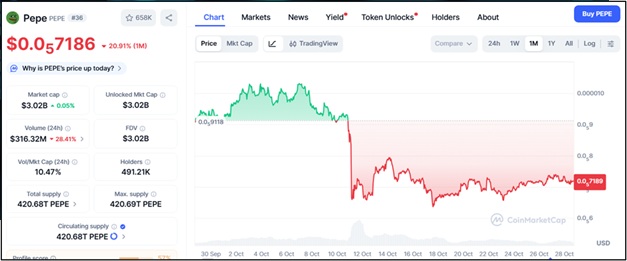
Pepe has been step by step hiking, presently trading around $0.000007186. Key resistance levels sit at $0.000007950, $0.000008600, and $0.000009500, while robust assist holds at $0.000006500, $0.000005800, and $0.000005200.

Pepe has speedily grown to be one of the most dominant meme coins available on the market, with an energetic network and high liquidity. Its simple, viral nature makes it a magnet for retail traders looking for rapid-transferring possibilities. As meme narratives warm up in the later tiers of bull cycles, Pepe is properly positioned to ride the retail wave and doubtlessly deliver big short-term profits.

Ethereum (ETH)

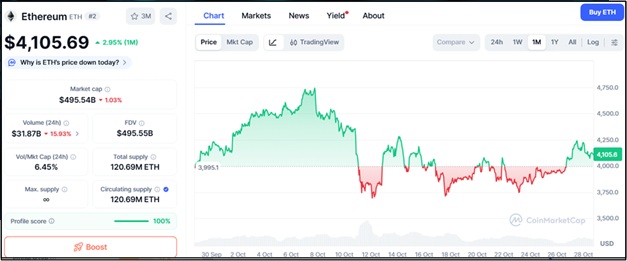
Ethereum remains one of the strongest large-cap properties in the market, trading close to $4,100. Resistance tiers are positioned at $4,450, $4,780, and $5,000, while support lies at $3,950, $3,720, and $3,500. Ethereum’s dominance in DeFi, NFTs, and Layer-2 solutions gives it both fundamental energy and long-term growth capability.

Institutional demand continues to grow, and as capital rotates from Bitcoin to top altcoins, ETH is often the first to benefit. Many analysts expect Ethereum to set new all-time highs before the bull run peaks, making it a core asset for both conservative and aggressive investors.

Ozak AI Emerges as a High-Upside Project

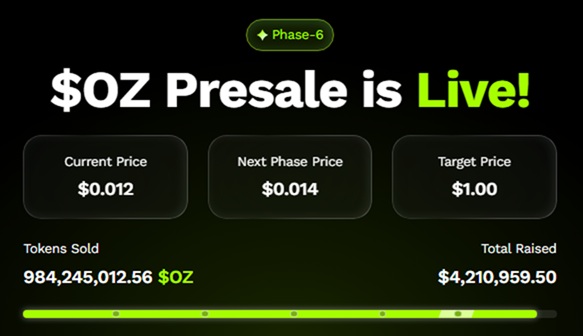
While Pepe and Ethereum bring strong narratives from opposite ends of the market, Ozak AI is turning heads as an early-stage project with explosive upside potential. Currently in its 6th OZ presale stage at $0.012, Ozak AI has raised over $4.2 million and sold more than 980 million tokens—a sign of growing investor confidence.

Unlike meme tokens, Ozak AI’s foundation lies in its AI-powered prediction agents that deliver real-time trading signals, intelligent market insights, and automation tools. This combination of AI and blockchain is one of the most powerful narratives heading into the next bull run.

A key reason Ozak AI stands out is its strategic partnerships with Perceptron Network, HIVE, and SINT. These collaborations enhance its technological capabilities, predictive accuracy, and integration into broader blockchain ecosystems. For whales and early investors, this isn’t just another presale hype—it’s a project with utility, vision, and momentum.

Pepe, Ethereum, and Ozak AI: Three Projects, One Goal—Breakout Gains

As the bull run accelerates, Pepe could ride the meme coin wave, Ethereum may solidify its blue-chip dominance, and Ozak AI could become the standout early-stage rocket.

Together, these three tokens cover retail frenzy, institutional trust, and innovation—all key narratives that tend to thrive before a cycle peaks. Investors positioning early in breakout assets like these could be the ones who capture some of the largest returns before the next market top.

About Ozak AI

Ozak AI is a blockchain-based crypto project that offers a technology platform that specializes in predictive AI and advanced facts analytics for financial markets. Through machine learning algorithms and decentralized community technology, Ozak AI enables real-time, accurate, and actionable insights to help crypto enthusiasts and businesses make the precise decisions.


For more, visit:

Website: https://ozak.ai/

Telegram: https://t.me/OzakAGI

Twitter: https://x.com/ozakagi

$10K in BTC Might Double—Ozak AI Could 100x the Same Amount

0

Crypto traders realize that bull markets create exceptional opportunities—however, how capital is located could make all of the difference between precise returns and life-changing ones. Bitcoin stays the most relied on and dominant asset within the market, able to deliver consistent and dependable profits as institutional demand grows.

But even as BTC can double in value all through a robust cycle, early-stage projects often supply the most important multipliers. That’s why many investors and whales are looking to allocate a slice of their Bitcoin profits into Ozak AI, a rising AI-pushed project with 100x ability.

Bitcoin (BTC)

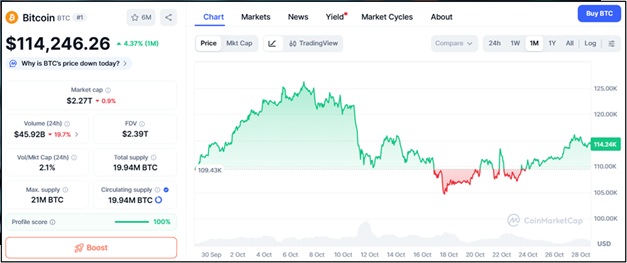
Bitcoin is presently trading around $114,246 and displaying robust bullish momentum. Key resistance levels sit down at $120,000, $132,500, and $150,000, even as solid support holds at $107,000, $101,800, and $96,000.

This price structure reflects a healthy and growing market, fueled by way of institutional inflows, ETF demand, and increasing macro confidence in BTC as a store of price. Many analysts trust Bitcoin ought to realistically double in the next bull leg, probably accomplishing or surpassing the $125K–$150K variety. For buyers searching for stability and dependable returns, Bitcoin remains a cornerstone asset.

Why Investors Look Beyond Bitcoin for Bigger Gains

While Bitcoin is powerful, it’s rarely the top-performing asset during a bull run. Historically, once BTC rallies, profits often rotate into altcoins with higher upside. This happened with Ethereum, Solana, and even Shiba Inu in previous cycles.

Investors who positioned early in such assets saw returns many multiples higher than those who stayed solely in BTC. That’s why smart money is now scanning for early-stage projects with explosive potential—and Ozak AI is increasingly at the center of that conversation.

Ozak AI’s Presale Creates Rare Early Presale Entry

Ozak AI is currently in its 6th OZ presale stage at $0.012, having already raised over $4.2 million and sold more than 980 million tokens. What’s driving this momentum isn’t just hype but a powerful AI + crypto narrative with real utility.

Ozak AI’s AI-powered prediction agents are designed to deliver real-time trading signals, intelligent market insights, and automated strategies, giving traders a competitive edge. Early-stage pricing means that even modest allocations can turn into massive upside if the project performs as expected.

Ozak AI’s growing credibility is backed by its partnerships with Perceptron Network, HIVE, and SINT. These alliances enhance its predictive infrastructure, expand data processing power, and ensure deeper integration into blockchain ecosystems. This isn’t just a speculative token—it’s a project with a technological foundation and a clear growth vision that appeals to both retail investors and whales.

$10K in BTC vs. $10K in Ozak AI

A $10,000 investment in Bitcoin could reasonably double to $20,000 if BTC reaches the upper end of its next target range. That’s a solid return for a blue-chip crypto. But the same $10,000 allocated to Ozak AI at its early presale price carries the potential to 100x, turning it into $1 million if the project performs as forecasted. This asymmetric risk-reward profile is why whales are quietly rotating a portion of their BTC gains into early-stage altcoins like Ozak AI.

As the 2025 bull run approaches, the smartest investors aren’t abandoning Bitcoin—they’re leveraging it as a base while positioning themselves into high-upside projects. Ozak AI is fast becoming one of the most promising plays in that category, offering both narrative strength and technological substance to back its explosive growth potential.

About Ozak AI

Ozak AI is a blockchain-based crypto project that offers a technology platform that specializes in predictive AI and advanced facts analytics for financial markets. Through machine learning algorithms and decentralized community technology, Ozak AI enables real-time, accurate, and actionable insights to help crypto enthusiasts and businesses make the precise decisions.


For more, visit:

Website: https://ozak.ai/

Telegram: https://t.me/OzakAGI

Twitter: https://x.com/ozakagi

How to Sell Cryptocurrency Without Rushing Into Mistakes

0

In the world of digital assets, speed is often seen as an advantage. Markets move quickly, and prices can change within seconds. This constant motion convinces many traders that selling fast is always the right choice. Yet rushing can lead to serious mistakes. Understanding how to sell cryptocurrency properly means learning when to act and when to wait, recognizing that patience often protects profits better than impulsive decisions.

Why Rushing Feels Tempting
Volatility creates urgency. A sudden price drop sparks panic, while a rapid surge triggers fear of missing out. Sellers rush into trades believing that hesitation will cost them everything. This emotional pressure is powerful, especially for beginners. But mastering how to sell cryptocurrency requires resisting these impulses and remembering that not every movement demands immediate action.

The Real Costs of Acting Too Quickly
Selling without preparation often results in disappointing outcomes. Hidden fees reduce profits, withdrawal charges eat into returns, and poor timing can mean exiting just before the market rebounds. Many traders who rush later regret their decisions, realizing that a few extra hours of analysis would have saved them money. Anyone asking how to sell cryptocurrency responsibly must calculate costs and assess conditions before confirming a transaction.

The Value of Strategic Planning
Patience allows for planning, and planning transforms selling into a deliberate act. Setting clear price targets, identifying acceptable risks, and deciding in advance when to exit eliminates the chaos of rushed decisions. With a strategy in place, the question of how to sell cryptocurrency becomes less stressful. Sellers can act confidently, knowing that their choices align with long-term goals rather than short-term emotions.

Tools That Support Patience
Modern platforms offer features that help traders avoid rushing. Stop-loss orders trigger automatic sales if prices fall too far, while limit orders execute only at predetermined levels. These tools reduce emotional pressure by handling decisions mechanically. For those exploring how to sell crypto, using automation is a way to stay disciplined even when markets become unpredictable.

When Waiting Brings Better Results
Sometimes the wisest decision is to wait. Prices often fluctuate before settling, and selling too early can mean missing out on stronger gains. Experienced investors understand that patience can turn small profits into significant returns. The ability to step back and observe rather than act immediately is one of the most valuable skills in learning how to sell crypto.

Turning Patience Into Confidence
The real benefit of slowing down is not just better timing but greater confidence. Sellers who plan, wait, and execute carefully feel more in control of their financial journey. Instead of regretting rushed sales, they build habits that strengthen every future transaction. They learn that how to sell cryptocurrency effectively is not about speed but about discipline, perspective, and balance.

Selling too quickly is one of the most common errors in the digital market. By slowing down, planning carefully, and using the tools available, traders transform selling from a reaction into a strategy. In a world where markets move faster than ever, patience is not a weakness — it is a decisive advantage.