DD
MM
YYYY

PAGES

DD
MM
YYYY

spot_img

PAGES

Home Blog Page 248

Post-Liquidation Market Outlook: What’s in Store for Little Pepe (LILPEPE) and Ripple (XRP) Price by the End of 2025

0

A brutal liquidation massacre has wiped billions off the cryptocurrency market, forcing traders to rethink their strategies. However, liquidation events can often present good opportunities within the market. Large liquidations have previously marked the end of speculative periods, which are usually followed by consolidation before the return of the bull run, as excess speculation is cleared. The market becomes increasingly focused on projects with good fundamentals and growing ecosystems during these periods. Ripple (XRP) and Little Pepe (LILPEPE) are two of the top tokens expected to make a comeback as the market reveals signs of recovery from the downturn.

Ripple’s Push for Utility and Adoption

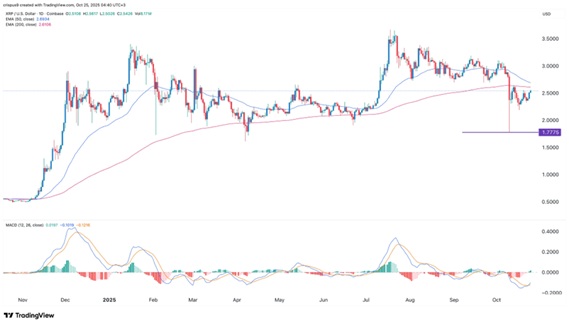
The XRP price held steady in the past few weeks, moving from a low of $1.7775 in October to $2.53 today. One potential catalyst for the ongoing rally is that Ripple Labs completed the Hidden Road buyout. Hidden Road, which offers prime brokerage services, will now be called Ripple Prime. This is a major platform that handles over $10 billion in transactions a day. Following the acquisition, Ripple hopes to incorporate its XRP Ledger into the network. It also hopes to introduce the RLUSD stablecoin on the platform, which may help boost its assets.
Source: Tradingview

Ripple price is about to avoid the risky death cross pattern, which happens when the 50-day and 200-day moving averages cross each other. Avoiding this pattern will be bullish for the token, and may see it jump to the key psychological level at $3. A drop below the head section at $2.2 will invalidate the bullish XRP price forecast.

Little Pepe (LILPEPE): The Meme Coin That’s Redefining the Narrative

While XRP builds on institutional trust, Little Pepe (LILPEPE) is capturing the imagination of retail investors. Once viewed simply as a playful meme token, LILPEPE has steadily grown into one of the most ambitious community driven projects in the market. Already listed on CoinMarketCap and fully audited by CertiK, the project has demonstrated credibility and transparency, two traits that most meme coins lack. Its concept goes beyond humor and hype. LILPEPE is building a dedicated Layer 2 chain explicitly designed for meme coins, with a focus on fast transactions, resistance to sniper bots, and affordable gas fees. This positions it as the launchpad for new meme projects, effectively creating an entire ecosystem for creativity and collaboration in the meme economy. The project is currently in stage 13 of its presale, priced at $0.0022, and it has already raised over $27.2 million while selling more than 16.5 billion tokens. Those numbers aren’t just impressive, they signal an enormous wave of community backing and investor confidence that’s rarely seen at this stage. Add to that the team’s $777,000 giveaway, designed to reward early supporters, and it’s no wonder that the community surrounding LILPEPE is growing faster than most established meme projects did at this stage.

Why Investors Are Turning Back to These Two Tokens

Both XRP and LILPEPE represent distinct ends of the crypto spectrum, one focused on institutional adoption and the other on cultural virality. Yet, they share resilience. Ripple has endured years of regulatory uncertainty and remains strong, while Little Pepe has managed to maintain hype and momentum, even as other meme coins have faded. In a recovering market, investors are increasingly looking for assets that combine innovation with real potential for exponential returns. XRP offers steady growth potential through adoption and partnerships, while LILPEPE provides the allure of high-risk, high-reward upside. Some analysts predict LILPEPE could deliver returns exceeding 10,000% if it captures even a fraction of the attention and trading volume that fueled PEPE, DOGE, or SHIB during previous meme coin surges.

Conclusion

As the dust settles from the liquidation phase, the crypto market appears poised for its next leg upward. Bitcoin’s dominance may ease, giving altcoins more room to shine, and that’s where projects like Ripple and Little Pepe could lead the charge. Ripple’s continued push into global finance could solidify its position as the digital bridge for cross-border payments, potentially sending XRP closer to its previous peak levels. Meanwhile, Little Pepe’s growing ecosystem, community strength, and technical innovation suggest it could be the next breakout meme coin to dominate headlines as sentiment flips bullish once again. In a market that often rewards patience and conviction, both XRP and LILPEPE appear poised to capitalize on a major turnaround, each poised to capture a different wave of the upcoming crypto recovery.


For more information about Little Pepe (LILPEPE) visit the links below:

Website: https://littlepepe.com

Whitepaper: https://littlepepe.com/whitepaper.pdf

Telegram: https://t.me/littlepepetoken

Twitter/X: https://x.com/littlepepetoken

$777k Giveaway: https://littlepepe.com/777k-giveaway/

Polkadot’s $25 Outlook Is Solid, but Ozak AI Could Deliver Explosive Returns

0

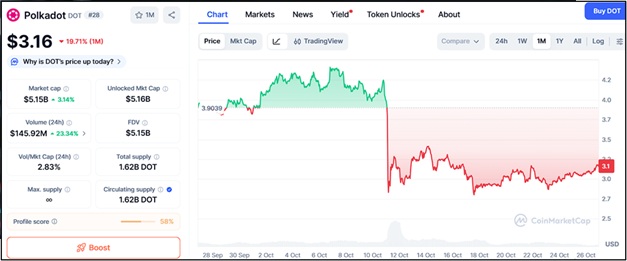
Polkadot is beginning to show renewed strength as investor sentiment turns bullish, and analysts eye a potential long-term rally toward the $25 mark. Currently trading in an accumulation zone, Polkadot is supported via strong surroundings, strong developer interest, and its well-established role in multi-chain interoperability.

Resistance is forming at $3.85, $4.40, and $5.10, at the same time as help stays close around $2.80, $2.40, and $2.05, signaling a strong technical shape that would fuel a regular climb as capital flows again into altcoins. However, even as Polkadot gives stability and credibility as a top-tier Layer-0 project, it is now not able to supply the same explosive upside as early-stage possibilities like Ozak AI.

Why Polkadot Remains a Strong Player

Polkadot’s interoperability framework has been one of its defining strengths. Its parachain structure lets a couple of blockchains speak and share information securely, giving it a unique facet in the multi-chain destiny. Institutional players and developers view Polkadot as a dependable environment that can help real-world applications and integrations.

If the market continues to rally and breaks via key resistance ranges, Polkadot has a clean path to reclaiming higher valuations. Yet, as a mature asset with an already huge market cap, its boom trajectory may be more measured compared to smaller, early-stage tokens, which have greater room to extend.

Ozak AI: The Early-Stage Asymmetry Play

While Polkadot offers a stable long-term outlook, Ozak AI presents a rare high-upside opportunity that thrives on early positioning. Ozak AI is currently in the OZ presale phase, attracting significant investor interest due to its unique approach of combining predictive AI intelligence with blockchain infrastructure.

Unlike many speculative early-stage projects, Ozak AI is built on real utility and strong technical partnerships. Its collaboration with Perceptron Network—with over 700,000 active nodes—enables the platform to deliver high-speed, real-time intelligence and data-sharing capabilities, while its partnership with SINT brings in AI agents, SDK toolkits, and voice-driven interfaces, solidifying its position as a serious AI-crypto player.

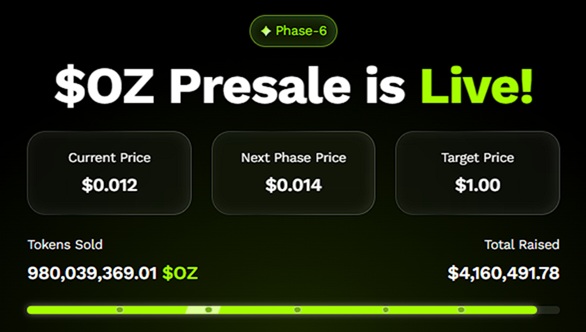
Moreover, Ozak AI has rapidly gained momentum in its presale, raising over $4.1 million and selling more than 980 million tokens in total—an impressive milestone that reflects growing investor confidence.

Explosive Potential Through Early Entry

One of the most powerful investment strategies in crypto bull markets is capturing early entries in projects with strong narratives and utility. While established tokens like Polkadot may deliver 3× or 5× gains in a healthy market, early-stage projects can generate exponential returns—sometimes 50× or more—if adoption accelerates.

Ozak AI fits this mold perfectly. Its early presale pricing gives investors the chance to secure a low entry point before wider exposure and exchange listings. As liquidity grows and the AI narrative continues to dominate market cycles, Ozak AI could experience rapid price discovery.

Polkadot Offers Stability, Ozak AI Offers Asymmetry

Polkadot remains a foundational pillar of the multi-chain ecosystem, making it a solid choice for investors seeking reliability and gradual appreciation. Ozak AI, by contrast, is the kind of early-stage, narrative-driven play that can generate explosive upside.

For those looking to balance stability with aggressive growth potential, a hybrid strategy that includes both assets may prove effective in this bull run. Polkadot can provide strength and stability, while Ozak AI offers the kind of asymmetrical opportunity that turns early entries into life-changing gains. In short, Polkadot’s $25 outlook is solid—but Ozak AI’s upside story could be even bigger.


About Ozak AI

Ozak AI is a blockchain-based crypto project that provides a technology platform that specializes in predictive AI and advanced data analytics for financial markets. Through machine learning algorithms and decentralized network technologies, Ozak AI enables real-time, accurate, and actionable insights to help crypto enthusiasts and businesses make the correct decisions.


For more, visit:

Website: https://ozak.ai/

Telegram: https://t.me/OzakAGI

Twitter: https://x.com/ozakagi

Multiply Your Portfolio Profits 3,000%: Why Ozak AI at $0.012 is Key to Massive Profit Increase

0

The Ozak AI presale presents a unique opportunity for early investors to multiply their portfolio profits by up to 3,000%. With the initial token price set at $0.012, the project is on track to experience significant growth as it progresses through its phases. Already raising $3.8 million and selling over 954 million $OZ tokens, the presale continues to gain momentum. As the next phase will see the token price increase to $0.014, early investors are encouraged to act quickly to secure their position before the price rise. Ozak AI’s long-term target price of $1.00 represents a promising potential for substantial returns as the presale unfolds.

Key Partnerships Drive Ozak AI’s Growth

The recent strategic partnerships have also contributed to the success of Ozak AI since they strengthen the capabilities of the platform and increase its reach. Among the major partnerships is the incorporation of real-time financial data feeds of the Pyth Network. This collaboration makes the predictive signals and market analysis of Ozak AI rely on the correct and prompt information, which provides an investor with a competitive advantage. Through data infrastructure that is decentralized by the Pyth Network, Ozak AI can offer valuable information that is up-to-date and reliable and can be necessary to make informed financial decisions.

Also, Ozak AI has partnered with Dex3, an entity that creates better liquidity solutions and trading experiences on the platform. Such cooperation enhances the general user experience, which allows smoother transactions and a higher level of market access. These collaborations play a crucial role in supporting the emergence of the platform as a primary tool of market forecasting, which is decentralized and AI-driven as the Ozak AI grows and develops its utility and services.

Future-level AI and Rewards Systems.

The core of the offering of Ozak AI is represented by the set of innovative features that aims at making users maximize their returns. The predictive AI agents of the platform are based on machine-learning models, including the ARIMA, linear regression, and neural networks. These agents give live information and projections of cryptocurrencies, stocks, and foreign exchange markets. Moreover, the combination of Ozak AI and SINT can allow one-click improvement of AI, which allows the platform to be flexible to market changes.

Also, the Ozak AI Rewards Hub proposes the implementation of a reward and staking system where users can receive passive income by owning tokens of the token section of $OZ. The hub also offers governance functions, in which the token holders will be able to vote on major decisions within the platform. Ozak AI provides an incentive to earn money by selling their insights and predictions, and hence creating a new source of revenue for those who make a habit of using the tool.

Advanced analytics features are also available in Ozak AI, thereby enabling easier, smarter financial decision-making by the user. The system is programmed to be user-friendly and easily accessible through no-code integration tools and a decentralized infrastructure that is run by Weblume. With these new features, the investors will be equipped with the necessary tools to be successful in the dynamic world of finance.

Presale Information and Investment Prospectus.

Ozak AI presale is actively selling tokens at $0.012, and the subsequent step will be to price them at a higher point of $0.014. The presale has already collected more than $3.8 million, and more than 953 million tokens of the $OZ have already been sold. The more the presale is ongoing, the more the return potential may be tremendous, and the target price will be 1.00 per token. The presale will allow a large number of investors to buy tokens with Ethereum, USDT, or USDC, which makes this presale available to everyone.

The project will be successful with the rising community of Ozak AI, a good partnership, and new technology. With the next stage of the presale, it is the time to buy tokens at a lower price than they are going to cost after the value gains. The combination of predictive AI, decentralized infrastructure, and market forecasting offered by Ozak AI makes it an asset in the financial sector with high growth potential among the initial investors.


For more information about Ozak AI, visit the links below:

Website: https://ozak.ai/

Twitter/X: https://x.com/OzakAGI

Telegram: https://t.me/OzakAGI


Dangote Refinery to Expand Capacity to 1.4mbpd, Poised to Become the World’s Largest

0

Nigeria’s Dangote Refinery is set to more than double its output to 1.4 million barrels per day (bpd), in a landmark expansion that will make it the largest oil refinery in the world, surpassing India’s Jamnagar Refinery.

Speaking at a press conference in Lagos on Sunday, Dangote Group President Aliko Dangote said the planned expansion underscores the company’s long-term confidence in Nigeria’s economy and its energy future.

“We are more than doubling the barrels… to 1.4 million from 650,000,” Dangote announced. “This will make it the largest refinery in the world, surpassing India’s Jamnagar Refinery.”

He added that the expansion reflects confidence in Nigeria, in Africa, and in our capacity to shape our own energy future.

Dangote praised the Federal Government for creating an enabling environment that has encouraged private investment in the downstream oil sector. He cited specific policy measures — including the Nigeria First Policy, the Naira-for-Crude Policy, and the One-Stop Shop Initiative — as instrumental in boosting investor confidence and removing bureaucratic bottlenecks in the industry.

He also lauded government efforts in mediating and resolving disruptions at the refinery caused by union disputes and alleged sabotage.

“The intervention was decisive and confidence-restoring,” Dangote said, noting that such stability is crucial for sustaining the refinery’s operations and expansion drive.

The refinery’s expansion project is expected to generate about 65,000 jobs during the construction phase alone, Dangote said, adding that local industries will benefit from new supply chain opportunities.

Beyond crude refining, the expansion will significantly enhance the country’s capacity in petrochemical production. The plant’s polypropylene output will increase from 900,000 metric tonnes to 2.4 million metric tonnes per annum, while new facilities will produce base oils and linear alkylbenzene, a key ingredient in detergent manufacturing.

According to the company, these additions will help establish Nigeria as a competitive player in the global chemicals and materials market, attracting investment and driving industrial growth.

With the year-end festive season approaching, Dangote assured Nigerians that there would be no fuel shortages or disruptions, despite recent fluctuations in global oil prices.

“For the first time in many years, Nigerians can look forward to a festive season free of fuel anxiety,” he said. “We are fully prepared to maintain consistent product flow and stable prices throughout the ember months.”

The refinery, which began phased production earlier in the year, is already refining diesel, aviation fuel, and kerosene, while petrol production for the domestic market is set to ramp up in the coming weeks.

Transformational Impact on Nigeria’s Economy

The planned expansion marks a major turning point in Nigeria’s decades-long struggle with fuel dependency. For years, Africa’s largest crude producer has relied on imported refined petroleum products due to the collapse of its state-owned refineries.

Once the expansion is completed, the 1.4 million bpd output could not only meet Nigeria’s domestic demand but also position the country as a net exporter of refined fuels, supplying West African markets and beyond.

Analysts say the refinery’s growth could save Nigeria billions of dollars in annual foreign exchange, ease pressure on the naira, and improve the country’s trade balance. It also aligns with the government’s push to localize energy processing and reduce the fiscal burden of fuel imports.

“When I said petroleum refining is not just about PMS, diesel and jet fuel, this is what I mean. As soon as the refinery adds a vacuum distillation unit, the RFOs (heavy distillates) will be processed into base oil, and the 300m liters of base oil imported into Nigeria yearly, for use in producing lubricants, will be a thing of the past,” energy expert, Kelvin Emmanuel, said.

The refinery’s expanded petrochemical capacity could become a key driver for Nigeria’s non-oil industrial base. Increased availability of polypropylene and base oils will support the domestic production of plastics, packaging materials, lubricants, and consumer goods, potentially reducing import dependence in these sectors.

Furthermore, the integration of linear alkylbenzene production is expected to boost Nigeria’s household goods manufacturing, strengthening industries such as detergents and cleaning products that rely heavily on imported inputs.

If the 1.4 million bpd target is achieved, Dangote’s facility will surpass India’s Jamnagar Refinery, owned by Reliance Industries, which has a refining capacity of around 1.24 million bpd. This would firmly place Nigeria on the global energy map as home to the largest single-site refinery complex.

The project also arrives at a time when several global refiners are cutting back on fossil fuel investments amid the energy transition. With the expansion, Nigeria now stands at the threshold of reshaping its energy narrative — from an oil exporter that imports fuel, to a refining and petrochemical powerhouse capable of supplying Africa and beyond.

Nigeria Records $50 Billion Crypto Transactions in One Year, SEC Calls For Capital Market Reforms

0

Nigeria has emerged as one of Africa’s most active hubs for cryptocurrency activities, recording over $50 billion in crypto transactions between July 2023 and June 2024, according to data from the Securities and Exchange Commission (SEC).

The staggering figure highlights the increasing adoption of digital assets in the country and the growing risk appetite of Nigerian investors outside the traditional capital market.

The SEC’s Director General, Dr. Emomotimi Agama, stated that despite the high level of digital asset investment in the country, it contrasts sharply with Nigeria’s traditional capital market, where fewer than 4% of adults are active investors.

Presenting a paper titled “Evaluating the Nigerian Capital Market Masterplan 2015-2025, at the annual conference of the Chartered Institute of Stockbrokers, he expressed concern over the minimal engagement of Nigerians in the formal capital market. He described it as a major obstacle to capital formation and economic growth, noting that while fewer than three million Nigerians invest in securities, over 60 million participate in gambling, spending roughly $5.5 million every day.

“This paradox is revealing,” he said. “An appetite for risk clearly exists, but not the trust or access to channel that energy into productive investment,” Agama warned that the dominance of speculative activities over structured investment reflects a deeper erosion of confidence in Nigeria’s financial ecosystem.

Reflecting on the Capital Market Master Plan (CMMP) 2015–2025, the SEC DG described it as an ambitious 10-year roadmap aimed at positioning Nigeria’s capital market as a key driver of long-term economic growth through infrastructure and enterprise financing. However, as the plan nears its conclusion, he urged for reflection over celebration, stressing the need to evaluate achievements and shortcomings.

“Today, our task is not ceremonial; it is reflective and diagnostic. We must ask what we achieve, where we fall short, and what lessons must anchor our next decade of reforms?”

According to Agama, less than half of the 108 initiatives outlined in the CMMP were fully implemented, hindered by weak policy alignment, inadequate monitoring, and limited stakeholder ownership.

He acknowledged progress in specific areas, including Green Bonds, Sukuk, fintech integration, and non-interest finance, but noted that market liquidity remains heavily concentrated in a few blue-chip equities such as Airtel Africa, Dangote Cement, and MTN Nigeria. This concentration, he said, limits market depth, discourages retail participation, and leaves vast sectors undercapitalized.

Dr. Agama emphasized the need for a reinvigorated and inclusive capital market to strengthen Nigeria’s economic base. He pointed out that the market capitalization-to-GDP ratio, currently at 30 percent, is significantly lower than South Africa’s 320 percent, Malaysia’s 123 percent, and India’s 92 percent. This disparity, he argued, underscores the urgency of mobilizing domestic capital and deepening financial inclusion to bridge Nigeria’s estimated $150 billion annual infrastructure deficit.

Nigerians preference to invest in digital assets like Bitcoin and Ethereum, unlike stocks, reflects deeper economic, social, and technological realities shaping the financial behavior of the country’s young and vibrant population.

One major driver behind this shift is economic instability and the persistent devaluation of the naira. As inflation continues to erode the value of local savings, many Nigerians view cryptocurrencies as a hedge against currency depreciation. Unlike traditional investments in the Nigerian stock market, which are tied to the local economy, crypto assets provide exposure to global markets and are often priced in stable foreign currencies like the U.S. dollar.

Also, the recognition of Cryptocurrencies as Securities in April this year under the newly enacted Investments and Securities Act (ISA) 2024 has rekindled individuals’ and stakeholders’ confidence, providing diversification opportunities beyond traditional equities and fixed income. Nigeria’s youthful population further fuels this momentum. With over 60 percent of citizens under 30, there’s a strong appetite for technology-driven solutions and new forms of income generation.

Notably, the SEC has reaffirmed its commitment to rebuilding investors’ confidence in Nigeria’s traditional capital market and creating a robust financial ecosystem capable of channeling the country’s growing risk appetite into productive, long-term investments that can drive sustainable economic transformation.