DD
MM
YYYY

PAGES

DD
MM
YYYY

spot_img

PAGES

Home Blog Page 2489

Enugu Launches ENGIS to Digitalize Land Administration, But 1978 Land Use Act Remains A Hurdle

0

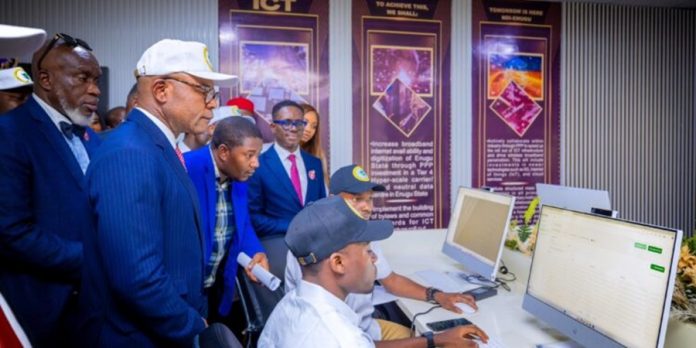
The Enugu State Government has taken a significant step in modernizing land administration by launching the Enugu State Geographic Information System (ENGIS).

The digital platform promises to simplify land title applications, offering a seamless process that can be completed entirely online within 48 hours.

Governor Peter Mbah, in a statement shared on his official X account, described ENGIS as a landmark achievement. The governor noted that the platform would eliminate long-standing issues such as land grabbing, double allocations, unauthorized constructions, and revenue diversion.

He emphasized that the initiative would restore public trust in land management processes while promoting ease of doing business.

“With ENGIS, we are putting an end to the era of land grabbing, double allocations, unauthorized constructions, and revenue diversion. This is not just a win for government – it is a major victory for Ndi Enugu, as trust and transparency now define our land processes,” Mbah stated.

He further highlighted the platform’s convenience, explaining that it allows residents to process land titles, conduct searches, and access results entirely from their homes.

The governor also pointed to ENGIS as a tool to attract investors, enhance efficiency, and drive economic growth. The platform is expected to significantly boost Enugu’s revenue base while aligning with broader federal initiatives like the National Land Digital System (NLDS), by digitizing decades-old land records.

The NLDS seeks to unlock $300 billion in economic potential by improving land registration and formalizing land transactions. Housing Minister Arc. Musa Dangiwa recently noted that efforts to modernize land administration could significantly boost investor confidence, reduce fraud, and enhance clarity in land ownership nationwide.

1978 Land Use Act, A Bigger Issue

While the ENGIS initiative has been lauded for its potential to enhance transparency and efficiency, experts contend that Nigeria’s real estate sector faces deeper structural challenges rooted in the 1978 Land Use Act.

It has been argued that digitalization alone cannot address the systemic issues hindering Nigeria’s real estate sector. The 1978 Land Use Act, which centralizes land ownership under state governors, is said to be the most significant impediment to growth in the sector.

The Land Use Act was enacted to regulate land use and ownership across Nigeria, vesting all land in a state, except those vested in the Federal Government or its agencies, under the control of its governor. While the Act sought to streamline land administration, it has introduced bureaucratic bottlenecks and inefficiencies that continue to stifle real estate development.

One of the primary issues is the centralization of land ownership. Under the Act, landowners receive certificates of occupancy (C of O) rather than outright ownership, leaving them with leasehold rights that create insecurity and discourage long-term investment. Additionally, the requirement for the governor’s consent for all land transactions significantly increases the time and cost of acquiring land titles.

Experts also point to the discretionary powers granted to governors as a source of corruption and inefficiency. Land allocations often lack transparency, making the process uncertain and unappealing to investors. This situation is compounded by high transaction costs, which deter small and medium-scale developers from pursuing real estate projects.

The implications of the Land Use Act extend beyond bureaucratic inefficiencies. It has stymied efforts to address Nigeria’s housing deficit by driving up costs and delaying developments. Foreign direct investment (FDI) in the real estate sector has also been limited, as investors remain wary of uncertainties surrounding land rights.

The ENGIS Solution

While ENGIS cannot solve the structural challenges posed by the Land Use Act, it offers a promising solution to some of the inefficiencies in land administration. Its introduction is expected to improve transparency and enhance investor confidence in Enugu’s real estate sector.

However, experts maintain that meaningful progress in Nigeria’s real estate sector requires a repeal or significant amendment of the 1978 Land Use Act. They argue that decentralizing land management, granting full ownership rights to individuals and businesses, and simplifying transaction processes are essential steps to unlocking the sector’s potential.

Although Mbah’s commitment to modernizing land administration is commendable, the journey toward a fully functional and equitable land management system in Nigeria is said to depend on bold policy decisions at the federal level.

OpenAI Expands ChatGPT Search to All Users, Challenging Google’s Search Dominance

0

OpenAI has expanded its ChatGPT search feature to all users, including those using the free version, positioning it as a direct competitor to search engines like Google.

Users can search the web faster and in a better way both on their mobile and desktop apps. ChatGPT also includes links to its information sources, so users can verify. This move democratizes access to real-time, web-integrated information through ChatGPT, enhancing user experience with up-to-date answers and accurate content.

OpenAI users can now set ChatGPT Search as their default search engine, further integrating Al-driven search capabilities into daily browsing. Users can access this feature by clicking the “Search the Web” icon in the prompt bar. To power the search feature, OpenAI has partnered with top news and data providers, enabling widgets for stocks, sports scores, weather updates, and many more.

This development signifies a significant shift in the search engine landscape, with OpenAl directly challenging established players by offering an Al-powered alternative that combines conversational interfaces with real-time web information. In addition to text-based information, ChatGPT search delivers rich content, including embedded photos and YouTube videos, offering a more comprehensive user experience.

OpenAI has also integrated this feature with its advanced Voice Mode, enabling users to receive real-time answers in a conversational tone. This integration is particularly useful for tasks such as checking weather forecasts or obtaining current stock prices. The artificial intelligence company has also added maps to ChatGPT in its mobile apps, so users can search for and chat about local restaurants and businesses with up-to-date information.

OpenAl’s decision to make its ChatGPT Search feature available to all users, including those on the free tier, significantly enhances its position in the Al and search engine markets.

This move introduces several key advantages:

1. Real-Time Information Access:

By integrating live web search capabilities, ChatGPT can provide up-to-date information, addressing a common limitation of Al models that rely solely on pre-existing data. This ensures users receive current and relevant responses.

2. Enhanced User Experience

The combination of conversational Al with search functionality offers a seamless and intuitive user experience. Users can obtain direct answers without sifting through multiple links, streamlining the information retrieval process.

3. Competitive Edge

By offering a search feature that combines Al-generated responses with real-time data, OpenAl positions ChatGPT as a formidable competitor to established search engines like Google. This integration challenges traditional search paradigms and introduces innovative methods for information access.

4. Increased Accessibility

Making this feature available to all users democratizes access to advanced Al tools, potentially expanding OpenAl’s user base and fostering greater adoption of Al-driven search solutions.

These strategic enhancements not only differentiate OpenAl in the competitive landscape but also contribute to the evolution of search engine technology, emphasizing the growing importance of Al in everyday applications.

The Entrepreneurs on the Platforms of Nations

1

Comment: “It’s time for African entrepreneurs to start to figure things out and to stop sitting on the fence waiting for the government to provide solutions. Governments can support later but the momentum and direction must first come from African entrepreneurs.”

My Response:  I will respond by classifying entrepreneurs into two categories – typical entrepreneurs and pioneering entrepreneurs. Typical entrepreneurs are entrepreneurs  we meet daily, and they are common, and run in thousands in economies. Pioneering entrepreneurs are generation-shaping entrepreneurs who transform economies and nations.

Africa has many typical entrepreneurs and those entrepreneurs need platforms to operate. Economic platforms are built by governments and entrepreneurs build companies on them. The platforms include road, clean water, security, postal systems, and amenities which enable companies to grow and thrive. Some countries invest to build those platforms, even at losses, providing ecosystems for their typical entrepreneurs to do their things. 

For example, the US postal service has not recorded profit in two decades, and the US Amtrak rail system has not made a profit since 1971, and America has not shut them down. What is happening is that the postal service and other platforms are foundational platforms which enable businesses to thrive in America. 

But there are also moments when the governments cannot build platforms by themselves. What they then do, is to transfer their rights as governments to pioneering entrepreneurs. When America promulgated the eminent domain ordinance, it helped  railway tycoons like Vanderbilt to build a platform for commerce. In other words, those pioneering entrepreneurs receive special benefits to solve platform-level problems in societies.

When you read about Mellon, Carnegie, Rockefeller, and other men who built America, you will notice that the government assisted in many ways because those men were building platforms. When Bezos started Amazon, a pioneering ecommerce platform, America did not require Amazon to collect sales tax, thereby making Amazon products cheaper than the ones sold in physical stores. Without those benefits, Amazon will not be where it is today.

So, the comment has it both ways: Africa needs pioneering entrepreneurs even as the typical entrepreneurs need platforms to operate.  And someone must build those platforms because they must exist before the typical entrepreneurs can create companies on top of them.

Note this: Across human histories, from the UK to America, companies rise before nations can build strong institutions. In other words, if you expect Nigeria to have the best public institutions before great companies, you would keep waiting. Typically, what happens is that nations have great companies, and then use the taxes paid by those companies to build better public institutions. My thesis is that Nigeria cannot have solid public institutions, from great schools to good public institutions, until Nigeria has created category-leading private companies that would provide resources to build those institutions.”

You can then ask: why must it be that way? It is what it is. What the US Congress did for Amazon would be seen as cronyism in Nigeria, but sometimes, those things are done to seed new platforms.

My summary: it is either your government builds those platforms or it gives goodies to the pioneers to build the platforms, because the platforms must be built for any nation to experience development and prosperity.

Mali, Burkina Faso, and Niger (AES) To Exit ECOWAS in Jan 2025, Offer Free Movement for the Region’s Citizens

0

Mali, Burkina Faso, and Niger are on the verge of finalizing their exit from the Economic Community of West African States (ECOWAS), a bloc they helped establish nearly five decades ago.

This decision, culminating in the formation of the Alliance of Sahel States (AES), represents a significant challenge to the vision of a unified and cooperative West Africa. The departure, scheduled for January 2025, comes after the countries rejected Ecowas’s demands to restore democratic governance.

The AES however, has offered an olive branch to ECOWAS members, allowing its citizens the rights to live and work across AES states, while goods circulate freely under the bloc’s agreements.

While the leaders of the bloc have provided a six-month grace period for the Sahel nations to reconsider their exit, the announcement marks a significant blow to ECOWAS, one of Africa’s most integrated regional organizations.

The departure of these three founding members of ECOWAS, established in 1975 to foster economic and political integration, underlines a major shift in West Africa’s regional politics. Together, Mali, Burkina Faso, and Niger account for over half of ECOWAS’s geographical land area and 76 million of its 446 million citizens.

While AES leaders frame their exit as a necessary pivot to sovereignty and regional security, many view it as a step backward for West Africa’s collective goals of economic unity and political stability.

However, to allay fears that their exit will harm political and economic growth of the region, the leaders of the three Sahel nations have sought to reassure the bloc of continued goodwill. AES Chairman and Mali’s military ruler, Assimi Goïta, emphasized that visa-free travel, residency rights, and the right of entry for ECOWAS citizens would remain intact within the AES.

The three nations, heavily reliant on neighboring ECOWAS coastal states for trade, risk significant isolation. Most migrants from these Sahel countries move to richer coastal economies, highlighting their dependence on the economic engine of ECOWAS.

The Back story: The Rise of Military Rule

The seeds of discord were sown with a series of military coups that toppled democratic governments across the Sahel. In 2020, a coup in Mali ousted President Ibrahim Boubacar Keïta, citing corruption and the government’s failure to address a growing jihadist insurgency.

Two years later, Burkina Faso followed suit, with the military overthrowing President Roch Marc Christian Kaboré under similar pretenses. The coup wave reached Niger in 2023, with soldiers seizing power and deposing President Mohamed Bazoum.

In each case, Ecowas swiftly condemned the takeovers, suspended the countries’ memberships, and imposed sanctions in an attempt to restore civilian rule. However, the juntas, buoyed by public support and regional solidarity, resisted. For the new military leaders, the sanctions became a rallying cry against what they perceived as undue interference and a reflection of ECOWAS’s alleged allegiance to Western powers, particularly France and the United States.

The Sahel leaders have accused ECOWAS of aligning too closely with Western powers, particularly France and the United States. This growing rift denotes broader geopolitical competition in the region, as Russia positions itself as an alternative ally for African states seeking to counter jihadist insurgencies.

Russia’s involvement, through private military contractors like the Wagner Group, has deepened, with some Sahel nations attributing military gains against jihadists to Russian support.

In Mali, the military junta expelled French forces and welcomed Russian military contractors, including the Wagner Group, to combat jihadist insurgents. Burkina Faso and Niger soon followed suit, citing the need for more effective security partnerships.

The Birth of the Alliance of Sahel States

In the aftermath of the Niger standoff with ECOWAS, the three nations announced the creation of the Alliance of Sahel States (AES) in early 2024. The new bloc was founded on principles of security cooperation, political solidarity, and economic integration.

AES leaders framed the alliance as a necessity in the face of what they described as ECOWAS’s failures. Mali’s leader, Assimi Goïta, declared that the new bloc would “chart its own path” to regional stability and development. Burkina Faso’s junta leader, Ibrahim Traoré, echoed this sentiment, emphasizing the need for a Sahel-centric approach to the region’s challenges.

ECOWAS Leaders Extend Olive Branch

Despite the Sahel states’ assertion that their exit is “irreversible,” ECOWAS leaders are working to maintain dialogue. Senegal’s President Bassirou Diomaye Faye and Togo’s Faure Gnassingbé have been tasked with leading ongoing negotiations.

During the ECOWAS summit in Nigeria, Commission President Omar Touray expressed disappointment at the impending departures but commended mediation efforts. “This is disheartening,” he said, noting the bloc’s commitment to preserving unity.

The January to July 2025 transitional period has been opened by the bloc so that the Sahel nations can rejoin ECOWAS should they reconsider.

Exploring the Messari’s 2025 Crypto Thesis, and 2024 As Turning Point for Crypto Policy Development

0

The Trump administration, supported by a Republican-controlled Congress, is set to prioritize reshaping crypto regulations. A key move will be appointing a new SEC Chair and commissioners who are more open to innovation and industry engagement.

However, lasting regulatory clarity is expected to come from Congress rather than the SEC. With majorities in both chambers, Republicans are motivated to fulfill campaign promises by advancing legislation that establishes clear and supportive guidelines for the digital asset ecosystem.

Expect a modified version of FIT-21, incorporating elements of the Lummis-Gillibrand Responsible Financial Innovation Act and addressing Senate concerns regarding illicit finance, to be a top legislative priority. Passage of such legislation would establish a much-needed framework for digital asset issuers and intermediaries, clarifying jurisdictional lines between the SEC and CFTC, streamlining registration processes, and establishing tailored disclosure requirements.

The shift from regulatory uncertainty to a clear legal framework would also likely encourage institutional adoption and further integrate digital assets into the traditional financial system.

Stablecoin Legislation Gets Signed into Law

The stars are aligned for stablecoin legislation in 2025. With bipartisan support in Congress and a Trump Administration eager to promote financial innovation, a comprehensive stablecoin bill is highly likely to be enacted.

The final legislation will likely draw heavily from Chair McHenry’s Clarity for Payment Stablecoins Act, incorporating a strengthened federal floor for state-qualified issuers and provisions addressing AML/CFT concerns to appease Senate Democrats. Expect a robust state pathway for issuers, fostering competition and innovation in the stablecoin market.

Establishing a federal stablecoin framework would bring crucial regulatory clarity, encouraging mainstream adoption, integration into payment systems, and strengthening the U.S. dollar’s position in global finance. With BRICS developing an alternative financial system—a move Trump has opposed, threatening 100% tariffs on adopters—the Administration may view U.S. dollar-backed stablecoins as a strategic tool to counter BRICS’ influence.

The future of decentralized stablecoins like DAI remains uncertain. While a regulatory framework for centralized stablecoins could accelerate their adoption, it may also place decentralized alternatives at a disadvantage due to challenges in meeting regulatory requirements. This shift could further strengthen the dominance of centralized stablecoins like USDC and USDT.

The ability of decentralized stablecoins to retain market share will hinge on their adaptability to the new regulatory environment and their capacity to demonstrate unique value in a more regulated ecosystem. However, innovation in decentralized stablecoins may stall, potentially delaying the realization of a fully decentralized financial system.

CBDC Development Continues, but Retail is Off the Table

Under a Trump Administration and a Republican-controlled Congress, a retail CBDC is highly unlikely. However, research and development of wholesale CBDCs will continue at the Federal Reserve. The Fed will explore potential use cases for wholesale CBDCs in cross-border payments and settlements, working with industry stakeholders to address privacy and security concerns.

Legislation will likely be enacted to explicitly prohibit the Fed from issuing a retail CBDC without clear Congressional authorization, further solidifying the Republican Party’s stance on protecting financial privacy.

This focus on wholesale CBDCs, while less impactful for individual consumers, could still have significant implications for the financial system, potentially improving efficiency and reducing costs for cross-border transactions. It could also create new opportunities for private sector innovation in developing and implementing CBDC-related technologies and services.

Self-Custody is Protected, but Privacy Remains a Battleground

With a Republican majority in Congress and a Trump Administration committed to protecting individual liberties, the right to self-custody will likely be codified through legislation. This would safeguard individuals’ ability to hold and control their own digital assets, a core tenet of the crypto community.

However, the debate over privacy-enhancing technologies, like mixers, will persist. Expect targeted legislation aimed at addressing the illicit use of mixers, while also seeking to preserve privacy for lawful transactions.

Policymakers face the challenge of balancing privacy rights, national security, and efforts to combat illicit finance. The outcome of this debate will significantly impact the future of financial privacy, shaping the adoption of privacy-preserving technologies in both crypto and traditional finance. Striking the right balance is essential to foster innovation while addressing legitimate law enforcement needs.

2024 Was a Turning Point for Crypto Policy Development – Messari

2024 was a turning point for crypto policy, setting the stage for transformative developments in 2025. If there ever were a year to embody “climbing a wall of worry,” 2024 might be it. After surviving the onslaught of inflation in 2022 and 2023, investors were still glancing over their shoulders in fear of its return.
When it became clearer that inflation had moderated, the focus shifted to a weakening labor market, begging the question: did the Fed overtighten or wait too long?
The first half of the year saw an intense struggle over the industry’s direction, with the SEC asserting its authority through aggressive enforcement actions. In response, the crypto sector, supported by allies in Congress, pushed back by advocating for clear, tailored legislation and pursuing judicial interventions to limit regulatory overreach.
In the latter half of the year, the political landscape shifted drastically as the Trump Campaign adopted a pro-crypto stance. With Trump’s eventual victory, expectations for a more favorable regulatory environment surged, establishing 2024 as a defining year for the evolution of crypto policy.
The SEC’s Enforcement Blitz:
The SEC, led by Chair Gary Gensler, intensified its “regulation by enforcement” approach in 2024, targeting major players across the crypto industry. High-profile cases rolling over from 2023 against Coinbase and Binance accused them of operating as unregistered securities exchanges, brokers, and clearing agencies, reflecting the SEC’s broad interpretation of existing securities laws.
The agency also set its sights on DeFi protocols like Uniswap, alleging unregistered securities offerings, and extended its reach into the creator economy by pursuing NFT projects for similar violations. While these actions led to some settlements and fines, they drew widespread criticism for stifling innovation and pushing crypto businesses to relocate offshore.
The SEC’s refusal to engage in rulemaking, despite repeated calls from industry and some members of Congress, further fueled frustration and calls for legislative intervention.
The SEC’s arguments in court, particularly its assertion that secondary market sales of crypto assets constitute investment contracts, were met with mixed results, highlighting the legal uncertainty surrounding the application of the Howey test to digital assets. The Debt Box case, where the SEC was sanctioned for making misleading statements to the court, further damaged the agency’s credibility and fueled calls for greater oversight.
Congressional Push for Regulatory Clarity:
In response to the SEC’s aggressive enforcement and the growing regulatory uncertainty, the House, under Republican leadership, made significant strides in advancing crypto-specific legislation. FIT-21, a comprehensive market structure bill, passed the House with a surprising level of bipartisan support, signaling a growing recognition that tailored rules for digital assets are necessary.
The Clarity for Payment Stablecoins Act also advanced in the House, demonstrating bipartisan interest in establishing a regulatory framework for stablecoins. However, these bills faced an uphill battle in the Democrat-controlled Senate, where the focus remained on addressing illicit finance concerns through proposals like DAAMLA and CANSEE, which the industry viewed as overly broad and potentially harmful to innovation.
Despite the Senate roadblocks, bipartisan efforts to address tax reporting requirements for digital asset brokers and promote blockchain innovation in non-financial sectors gained traction, suggesting potential areas for compromise in the future. The House also passed a resolution to repeal SAB-121, an SEC accounting rule that deterred banks from custodying digital assets, though President Biden ultimately vetoed the resolution.