DD
MM
YYYY

PAGES

DD
MM
YYYY

spot_img

PAGES

Home Blog Page 250

First Bank Integrates PAPSS Into Its Digital Banking App, to Boost Cross-border Payments

0

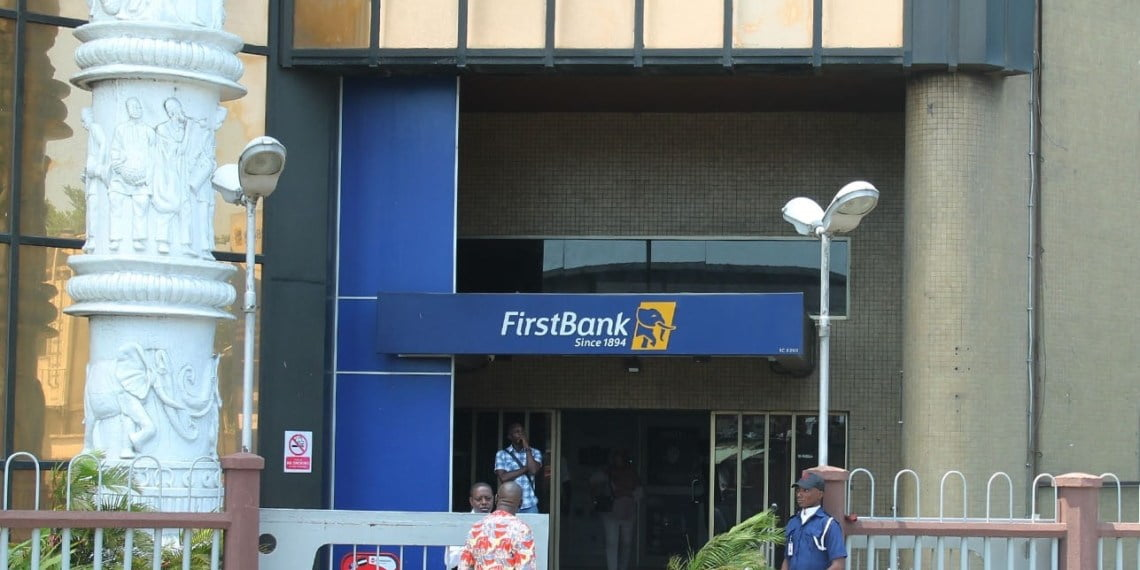
First Bank, Nigeria’s premier bank, has integrated Pan-African Payment and Settlement System (PAPSS) into its flagship digital banking platform, the LIT App.

This integration enables customers to make instant, secure, and local currency-based cross-border payments across Africa. Also, it will enable FirstBank customers to send and receive payments across participating African countries directly from the LIT app, using their local currency. This advancement eliminates the need to route transactions through intermediary banks outside Africa, thereby reducing transaction costs and settlement times.

Launched in January 2022, PAPSS, a centralized financial market infrastructure, facilitates secure and efficient cross-border payment transactions across Africa. It aims to minimize risks and enhance financial integration among African countries, enabling the flow of money in local currencies.

Speaking on the Integration into the LIT app, Chuma Ezirim, Group Executive, e-Business and Retail Products at Firstbank, described it as a major step forward in the bank’s innovation journey.

He said,

“The integration of PAPSS into the LIT app is a testament to FirstBank’s commitment to delivering innovative, customer-centric solutions that simplify and enhance financial transactions. This milestone aligns with the Bank’s strategic goal of deepening digital capabilities and expanding access to seamless cross-border payment services across Africa.”

Also commenting on this collaboration, Mike Ogbalu, CEO of PAPSS, said,

Every time an individual, an SME, or a Company sends money instantly within Africa in their own currency, we are not just moving funds, we are connecting ambitions, supporting livelihoods, and bridging dreams across borders. This collaboration with FirstBank and their LIT app brings us a step closer to making African borders invisible to the movement of money, so that the continent’s entrepreneurs and families can focus on what matters most: building their future, not battling payment barriers.”

The LIT app is First Bank’s proprietary mobile banking application designed to provide customers with easy access to their banking needs. The app was launched to revolutionize the culture and experience of mobile banking in Nigeria.

The state-of-the-art banking app exposes customers to a wealth of opportunities to promote safety and convenience whilst ensuring they are at an edge in today’s digital banking world.

Key features include;

  • Instant virtual card generation and loan applications.
  • User-friendly interface that allows customers to manage their accounts conveniently.
  • Access to various banking services such as bill payments and account management.

With the addition of PAPSS on the LIT app, it expands its capabilities to support cross-border commerce, especially for individuals and SMEs engaged in pan-African business.

Nonetheless, the integration of PAPSS into FirstBank’s LIT app represents a transformative milestone for Africa’s financial ecosystem. It lays the groundwork for a more connected, inclusive, and efficient payment infrastructure, one that supports the continent’s broader goals of economic integration and sustainable development.

FirstBank has taken a bold step toward realizing the vision of a borderless African payment system by embedding PAPSS into its digital platform. The move not only enhances convenience for customers but also strengthens the foundation for intra-African trade and financial inclusion.

As more African banks follow suit, PAPSS could very well become the cornerstone of Africa’s next financial revolution, one powered by technology, collaboration, and a shared vision for continental prosperity.
Access Holdings’ H1 2025 Profit Dips 8% to N320.57bn Despite Strong Revenue Growth and Subsidiary Expansion

0

Access Holdings Plc, one of Nigeria’s largest financial services groups, has released its audited half-year financial results for the period ended June 30, 2025, reporting a pre-tax profit of N320.57 billion — an 8.12% year-on-year decline from N348.92 billion recorded in the corresponding period of 2024.

Post-tax profit also fell by 23.25% to N215.92 billion, compared to N281.33 billion in H1 2024.

Despite the earnings drop, top-line performance remained solid. Gross earnings rose by 13.81% to N2.50 trillion, reflecting the Group’s robust revenue base and diversified operations.

“The financial results for the half year ended June 30, 2025, reflect the resilience of our business model, the diversification of our revenue streams, and the steady progress in executing our five-year strategic plan,” Access Holdings said in its report.

Banking Subsidiary Dominates Performance

The Group’s performance in H1 2025 was largely anchored by its banking subsidiary, which contributed the bulk of profitability, posting a pre-tax profit of N303 billion and a post-tax profit of N199.3 billion.

Interest income remained the key driver of growth, rising by 38.87% year-on-year to N2.04 trillion, representing over 58% of the full-year 2024 total. This growth was underpinned by stronger lending activities and higher yields on investment securities amid Nigeria’s elevated interest rate environment.

Interest income from loans and advances to customers grew by 36% to N944 billion, while earnings from investment securities jumped 46% to N956.56 billion, jointly accounting for over 93% of total interest income. This sharp rise in core earnings highlights the Group’s strategy of leveraging higher rates to maximize returns from its loan book and investments.

Interest Expenses and Impairments Pressure Bottom Line

Interest expenses grew at a slower pace than income, rising 10.53% to N1.10 trillion. Most of this came from customer deposits, which accounted for over 85% of the total. Deposits from customers increased marginally by 1.69% to N22.9 trillion, while deposits from financial institutions fell sharply by 47% to N4.94 trillion, reflecting reduced reliance on short-term institutional funding.

The resulting wide spread between income and expenses drove a 92% surge in net interest income to N984.63 billion. However, the Group faced heavier impairment charges, which rose 87% year-on-year to N230 billion. Loan loss provisions alone soared 240% to N209 billion, reflecting the impact of credit risk adjustments amid a challenging macroeconomic environment marked by inflationary pressures and currency volatility.

Even after accounting for impairments, net interest income after provisions stood at N754.56 billion — almost double last year’s level — reinforcing the Group’s strong core performance despite market headwinds.

Non-Interest Income and Subsidiary Growth

Access Holdings’ non-interest income also remained a bright spot. Fee and commission income grew significantly, driven by robust activity in digital channels and credit-related services. Credit-related fees rose 24% to N114 billion, while channels and e-business income surged 38% to N102 billion, reflecting growing digital adoption among customers.

Beyond the core banking business, the Group’s diversified non-bank subsidiaries delivered standout performances.

Access ARM Pensions recorded a 65.1% rise in pre-tax profit to N13.1 billion. At the same time, Hydrogen Payments — its financial technology arm — reported a 273% increase in pre-tax profit and processed N41.1 trillion in transactions, up 211% year-on-year. Access Insurance Brokers posted a 161% jump in pre-tax profit, with gross written premiums up 125%, while Oxygen X, the Group’s digital lending platform, generated N5.4 billion in revenue and N2.2 billion in profit.

Operating Costs and Market Factors

Despite strong revenue performance, higher operating expenses and a steep decline in fair value and foreign exchange gains weighed on profitability. Fair value and FX gains fell by 89% to N45.94 billion, from N407 billion in H1 2024, reflecting a tougher currency environment and lower revaluation gains.

Total assets rose 2.29% year-on-year to N42.45 trillion, supported by solid liquidity and a growing deposit base. Gross loans and advances to customers stood at N11.15 trillion, a slight 2.9% decline, as the Group adopted a cautious lending stance to preserve asset quality. Cash and cash equivalents rose by 10.09% to N5.75 trillion, highlighting improved liquidity buffers.

  • Key Highlights (H1 2025 vs. H1 2024):
  • Gross earnings: N2.499 trillion (+13.81% YoY)
  • Interest income: N2.044 trillion (+38.87% YoY)
  • Interest expenses: N1.060 trillion (+10.53% YoY)
  • Net interest income: N983.63 billion (+91.79% YoY)
  • EPS: N3.71 (-51.12% YoY)
  • Loans and advances: N11.154 trillion (-2.90% YoY)
  • Cash and cash equivalents: N5.748 trillion (+10.09% YoY)
  • Total assets: N42.447 trillion (+2.29% YoY)
  • Customer deposits: N22.905 trillion (+1.69% YoY)

Market Standing and Capital Strength

Access Holdings’ shares closed at N25 per share on Friday, October 24, 2025, representing a modest year-to-date gain of 4.82%. The Group remains one of the most capitalized financial institutions in Nigeria, having met and surpassed the Central Bank’s new recapitalization requirement. Its combined share capital and premium of N594.90 billion comfortably exceed the N500 billion threshold.

While profit dipped due to impairments and weaker FX gains, the strong revenue growth across banking and non-banking operations signals that the Group’s diversification strategy is taking root.

Analysts expect the Group’s continued expansion into payments, insurance, and pensions to buffer against future earnings volatility. The Group’s robust capital position also places it on a strong footing to sustain growth and absorb potential credit shocks in the second half of 2025.

EU Finds Meta and TikTok Breached Data Access Requirements Under Digital Services Act

0

The European Commission said on Friday that Meta Platforms and TikTok breached their obligations under the European Union’s landmark Digital Services Act (DSA) by failing to grant researchers adequate access to public data, and by making content flagging unnecessarily difficult for users.

In its preliminary findings, the EU executive said that Meta’s Facebook and Instagram, along with TikTok, had “burdensome procedures and tools” for researchers requesting access to public data — a requirement seen as central to ensuring transparency and accountability for large online platforms.

“Allowing researchers access to platforms’ data is an essential transparency obligation under the DSA, as it provides public scrutiny into the potential impact of platforms on our physical and mental health,” the Commission said.

The DSA, which came into full effect last year, represents the EU’s most comprehensive effort to regulate Big Tech platforms. It mandates that major digital services take responsibility for moderating illegal and harmful content, reduce systemic risks such as disinformation and addiction, and ensure researchers can independently study the societal impact of their platforms.

The Commission added that Meta failed to provide “a user-friendly and easily accessible mechanism” for flagging illegal content — including child sexual abuse material and terrorist propaganda — on Facebook and Instagram. It said Meta’s content reporting tools were overly complex and contained “deceptive interface designs” that could confuse users or dissuade them from reporting harmful content.

“Such practices can be confusing and dissuading. Meta’s mechanisms to flag and remove illegal content may therefore be ineffective,” the EU executive said.

Meta, in response, pushed back against the Commission’s preliminary assessment.

“We disagree with the suggestion that we breached the DSA,” a Meta spokesperson told Reuters. “We have introduced changes to our content reporting options, appeals process, and data access tools since the DSA came into force and are confident that these solutions match what is required under the law in the EU.”

TikTok also said it was reviewing the findings and reaffirmed its commitment to transparency but raised concerns about conflicting legal obligations under different EU regulations.

“Requirements to ease data safeguards place the DSA and GDPR in direct tension,” a TikTok spokesperson said, referring to the EU’s General Data Protection Regulation (GDPR). “If it is not possible to fully comply with both, we urge regulators to provide clarity on how these obligations should be reconciled.”

The Commission’s report noted that both companies now have the opportunity to examine the findings and take remedial measures to avoid sanctions. The preliminary results do not prejudge the final outcome of the investigation, which remains ongoing.

If confirmed, the breaches could expose Meta and TikTok to fines of up to 6% of their global annual revenue — a penalty that, for Meta, could run into billions of euros.

The DSA’s enforcement powers have placed Big Tech under unprecedented scrutiny in Europe. Regulators have already opened multiple investigations into companies like X (formerly Twitter), Amazon, and Apple over alleged failures to meet transparency and safety standards.

The move signals that the EU is tightening the reins on digital platforms’ control over user data and research access, with regulators viewing transparency as critical in curbing the spread of misinformation, political manipulation, and mental health risks tied to algorithmic content.

Both Meta and TikTok are expected to engage in negotiations with the European Commission in the coming weeks to avoid formal sanctions.

FATF Removes Nigeria from Grey List, Boosting Investor Confidence and Marking a Major Financial Reform Milestone

0

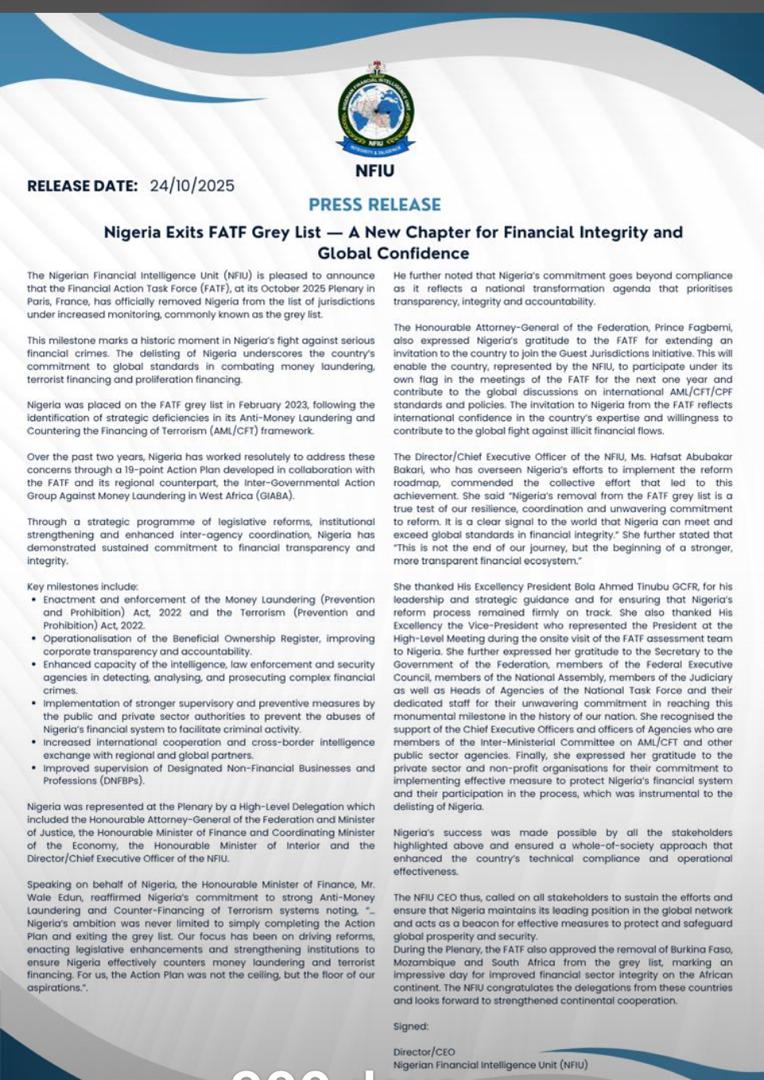
The Financial Action Task Force (FATF), the global body responsible for combating money laundering and terrorist financing, announced on Friday that it has removed Nigeria from its grey list after nearly three years, signaling renewed confidence in Africa’s 4th-largest economy and its financial system.

Nigeria was delisted alongside South Africa, Burkina Faso, and Mozambique, following what FATF described as “significant progress” by the countries in strengthening anti-money laundering (AML) and counter-terrorism financing (CFT) systems. Nigeria and South Africa were added to the grey list in February 2023, Mozambique in October 2022, and Burkina Faso in February 2021.

The decision comes after an on-site assessment confirmed that Nigeria had implemented substantial reforms to address strategic deficiencies identified by the FATF in previous reviews. The global watchdog praised the country’s “sustained political commitment and measurable progress” in improving transparency, monitoring illicit financial flows, and enforcing compliance within its banking and non-banking sectors.

A Turning Point for Nigeria’s Financial System

Nigeria’s removal from the grey list is widely viewed as a crucial step toward restoring investor confidence, reducing transaction costs, and improving the ease of doing business across borders.

Being on the list had complicated Nigeria’s international transactions, as foreign banks and financial institutions imposed heightened due diligence measures, increasing compliance costs for businesses and individuals. The development had also hindered capital inflows, restricted correspondent banking relationships, and slowed foreign direct investment (FDI).

With Friday’s announcement, Nigeria can expect smoother cross-border transactions, faster processing of remittances, and lower compliance costs for international businesses. The country receives around $20 billion in remittances annually, and reducing compliance barriers could boost inflows through formal channels.

Finance Minister Wale Edun welcomed the news, describing it as “a vote of confidence in Nigeria’s reform trajectory.”

“This development reinforces confidence in our economy and the integrity of our monetary and financial systems, signaling to investors and global partners that Nigeria’s institutions are strong, transparent, and internationally trusted,” Edun said in a statement.

“It will ease cross-border transactions, improve capital flows, including foreign direct investment, and strengthen the foundations for rapid and sustainable economic growth and job creation,” he added.

A Long Road to Reform

Nigeria’s removal from the FATF grey list follows a sustained campaign led by the Nigerian Financial Intelligence Unit (NFIU), the Central Bank of Nigeria (CBN), and other regulatory agencies to overhaul compliance and enforcement mechanisms.

Earlier this year, NFIU Chief Executive Officer Hafsat Bakari had projected that Nigeria could exit the list by late 2025, following the approval of the country’s fifth progress report by the FATF. The report, she said, reflected “Nigeria’s concrete and measurable progress in strengthening its AML/CFT framework.”

Bakari emphasized that the approval of the fifth progress report was “a substantial achievement that demonstrates Nigeria’s adherence to international standards and commitment to a more transparent financial environment.”

Over the past two years, Nigerian authorities have tightened oversight of banks, fintechs, and designated non-financial businesses such as real estate agents and casinos. The country has also expanded cooperation between the NFIU, the Economic and Financial Crimes Commission (EFCC), and international partners to track illicit capital flows.

The FATF decision is expected to improve Nigeria’s global financial standing, potentially lowering the country’s risk profile among lenders and boosting the naira through renewed capital inflows. Economists say it could also strengthen the Tinubu administration’s ongoing fiscal and monetary reforms aimed at stabilizing the economy and attracting foreign investment.

Nigeria’s improved compliance rating may particularly benefit sectors that have struggled to attract foreign capital due to reputational concerns, including energy, manufacturing, and financial technology.

Since 2023, the Nigerian government has been working to rebuild confidence in the economy through structural reforms. These include efforts to unify the exchange rate, remove fuel subsidies, and modernize the tax and customs systems.

Analysts believe the FATF delisting could provide a psychological lift for investors and development partners who have been waiting for signs of policy stability and stronger governance.

For Nigeria, the exit from the grey list not only marks the end of a challenging chapter but also a renewed opportunity to position itself as a credible financial hub in Africa.

Crypto Giants Back Trump’s White House Expansion Donations to the $300M Ballroom Project

0

Major cryptocurrency companies including Coinbase, Ripple, and Gemini via its co-founders are confirmed as donors to President Donald Trump’s ambitious $300 million White House ballroom project, announced in July 2025 and now under construction.

This privately funded initiative—adding a 90,000-square-foot event space to the East Wing—has drawn contributions from tech, finance, and energy sectors, but the crypto industry’s involvement stands out as a sign of deepening alignment between digital asset firms and the administration’s pro-crypto stance.

Demolition of parts of the East Wing began in mid-October 2025, with completion targeted well before Trump’s term ends in 2029. The ballroom, described by the White House as a “modern addition” to host large state events seating up to 650, is entirely financed through private donations routed via the Trust for the National Mall, a nonprofit tied to the National Park Service.

No taxpayer funds are involved, countering criticisms amid an ongoing federal government funding impasse.

Coinbase: The largest U.S. crypto exchange attended a White House donor dinner on October 15, 2025, and is listed as a major contributor. CEO Brian Armstrong previously donated $1 million to Trump’s inauguration and has lobbied for bills like the GENIUS Act for stablecoin regulation.

Ripple: Executives from the payments firm, including CEO Brad Garlinghouse, joined the donor event. Ripple has run pro-crypto ads in D.C. and participated in White House summits, aligning with its focus on cross-border payments via XRP.

Gemini: Co-founders Cameron and Tyler Winklevoss are explicitly named donors. They’ve been vocal Trump allies, pledging $2 million in Bitcoin during his 2024 campaign, attending stablecoin bill signings, and contributing $21 million to pro-Trump PACs ahead of 2026 midterms.

Other Notable Donors: The full list, released by the White House on October 23, 2025, includes tech heavyweights from Amazon, Apple, Google, Meta, Microsoft, defense firms like Lockheed Martin, Palantir, and others like Tether. Additional pledges include $22 million from a YouTube settlement and $10 million in stock from construction CEO Paolo Tiramani.

This funding push follows a White House gala on October 16, 2025, where Trump hosted 128 elite guests, thanking them for “tremendous” pledges that he said have “fully covered” costs. The event underscores crypto’s shift toward mainstream political influence, especially after Trump’s post-inauguration signing of crypto-friendly laws like stablecoin frameworks.

Critics, including Sen. Elizabeth Warren, have raised alarms about potential quid pro quo, questioning if donations buy policy favors in a lightly regulated sector. Heritage advocates decry the East Wing alterations as a threat to historic preservation. The White House dismissed backlash as “manufactured outrage” from “unhinged leftists,” emphasizing the project’s private nature.

Pro-crypto users hailed it as a “win for innovation,” while skeptics mocked it as “crypto bros buying access.” Market-wise, shares of Coinbase ($COIN) ticked up 2% post-announcement, and XRP saw brief volatility.

The involvement of Coinbase, Ripple, and Gemini in funding President Trump’s East Wing ballroom expansion—now estimated at $300 million and fully privately financed—carries significant ripple effects across politics, regulation, economics, and culture.

This isn’t just a construction story; it’s a marker of how the crypto industry is cementing its role in U.S. power structures, leveraging donations for influence amid a pro-crypto administration.

Once viewed as regulatory pariahs (e.g., Ripple’s SEC battles, dropped under Trump), these firms are now “insiders” funding White House infrastructure. This builds on 2024 election cycles where crypto PACs like Fairshake raised $200M+ for pro-industry candidates, signaling a shift from defense to offense in policymaking.

Analysts call it a “turning point,” with crypto no longer peripheral but actively shaping federal discourse. The October 15 donor gala, attended by execs from these firms, exemplifies elite networking.

Critics like former White House ethics lawyer Richard Painter label it “payment for access” to Trump, potentially yielding perks like engraved donor plaques in the ballroom. Joined by Big Tech Amazon, Google, Meta, this fosters a unified “innovation lobby,” contrasting Trump’s first-term tensions with Silicon Valley.

Donations align with Trump’s crypto-friendly moves, like pardoning Binance’s CZ and proposing a U.S. strategic crypto reserve including XRP. Expect faster progress on the GENIUS Act for stablecoins and a crypto market structure bill, where Coinbase has lobbied heavily.

Tether’s involvement, amid stablecoin scrutiny, could soften rules for USDT, boosting adoption. While empowering, it invites “quid pro quo” probes. Sen. Elizabeth Warren and ethics watchdogs warn of blurred lines between donations and policy favors, potentially triggering congressional hearings or calls for donation transparency.

Symbolizing legitimacy, this could drive institutional inflows. Post-announcement, Coinbase stock rose ~2%, with XRP volatility signaling trader optimism. Winklevoss twins’ prior $2M BTC pledge to Trump amplified bullish sentiment; expect similar for midterms via $21M PACs.

Lawsuits from groups like the National Trust for Historic Preservation challenge East Wing demolition, framing the ballroom as a “gaudy” Trump vanity project over heritage. Completion by 2029 could redefine the White House as a “Mar-a-Lago North,” blending opulence with policy schmoozing.

These donations propel crypto from fringe to fixture, potentially unlocking billions in growth but at the cost of heightened ethical scrutiny. Watch for mid-2026: If regs ease, it’s a win; if scandals erupt, a setback. This fusion of blockchain and Beltway could redefine American capitalism—or expose its fault lines.