DD
MM
YYYY

PAGES

DD
MM
YYYY

spot_img

PAGES

Home Blog Page 2533

Unlocking Nigeria’s AI Potential Through Private Investment and Research

0

Artificial Intelligence (AI) is not just a technological revolution; it is a defining feature of the global economy, reshaping industries and redefining human progress. Nigeria, Africa’s most populous nation and one of its leading economies holds immense potential to become a key player in the AI landscape. Yet, as we analyze the data on private investment and academic output in AI from 2016 to 2023, a critical narrative emerges- one of missed opportunities, untapped potential, and the urgent need to align investment with research.

A Tale of Two Trends: Investments and Publications

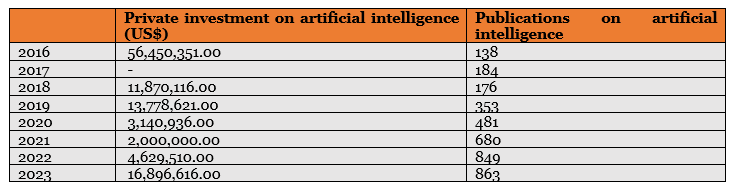
Between 2016 and 2023, Nigeria witnessed significant fluctuations in private investment in AI. In 2016, investments peaked at $56.45 million, marking an auspicious start for AI development in the country. However, this enthusiasm quickly dissipated, with investments plummeting to zero in 2017. From 2018 to 2020, modest recovery efforts were observed, but these were far from the levels recorded in 2016. The resurgence in 2023, when investments reached $16.89 million, indicates renewed interest, possibly influenced by global trends and the increasing relevance of AI across sectors.

Conversely, scholarly publications on AI in Nigeria have shown a steady upward trajectory. From 138 publications in 2016 to 863 in 2023, this growth underscores the growing academic interest in AI, as well as the efforts of researchers to establish Nigeria as a hub of intellectual contribution in the field. Notable surges in 2019 and 2021 onward suggest enhanced research funding, international collaborations, or institutional emphasis on AI as a critical domain.

Private Investment Trends
  • 2016: The highest private investment ($56,450,351) was observed in 2016, which might indicate an early surge of interest or a significant project initiative during that year.
  • 2017: A sharp decline to $0 indicates either a lack of documented investments or withdrawal of funding, which could reflect uncertainty or low confidence in AI prospects during that year.
  • 2018-2020: Gradual recovery is observed, with investments fluctuating between $1,187,0116 (2018) and $3,140,936 (2020). This could reflect growing awareness or initial attempts to rebuild confidence in AI as a field.
  • 2021: A significant drop to $2,000,000 may signify reduced private sector enthusiasm or focus on other priorities such as recovery from the COVID-19 pandemic.
  • 2022-2023: A rebound is seen, culminating in $16,896,616 in 2023, possibly indicating renewed interest and confidence, likely spurred by global trends in AI and its increasing integration into industries.
    Scholarly Publications Trends
    • 2016-2023: Scholarly publications on AI show a consistent increase year-over-year, growing from 138 in 2016 to 863 in 2023. This steady rise signifies growing academic interest and capacity building in the AI domain.
    • 2019-2023: Notable surges are seen in 2019 (353 publications) and 2021-2023 (849-863 publications). This could be attributed to increased research funding, the availability of digital platforms, or global trends emphasizing AI as a critical field.

The Disconnect: Why Investment and Research Are Out of Sync

Despite the growth in academic output, the relationship between private investment and research appears tenuous at best. For instance, the high investment in 2016 coincided with relatively low academic output (138 publications), while periods of low investment, such as 2017 and 2021, witnessed substantial growth in publications. This disconnect raises critical questions: Why hasn’t Nigeria’s burgeoning academic research in AI translated into consistent private-sector interest? And what does this mean for the future of AI in the country?

Possible explanations could be limited commercialisation of research, unpredictable funding patterns, global competition and local challenges. Despite these challenges, Nigeria’s AI ecosystem holds immense promise. The steady rise in scholarly output indicates a strong foundation of talent and intellectual capacity. To unlock this potential, Nigeria must bridge the gap between investment and research, creating an environment where innovation can thrive.

Exhibit 1: Private investment versus publications on artificial intelligence 2016-2023
Source: Our World in Data, 2024; Infoprations Analysis, 2024

The Future of AI in Nigeria

The year 2023 marks a turning point for Nigeria’s AI ecosystem. With private investment rebounding and academic output at an all-time high, the country stands at the cusp of a major transformation. However, to sustain this momentum, Nigeria must address the gaps in its AI landscape.

Nigeria will be able to create a thriving AI ecosystem that drives innovation, creates jobs, and positions the country as a leader in AI on the African continent and beyond when private investment with academic research, fostering collaboration, and implementing supportive policies are more prioritised.

Our analyst notes that Nigeria’s journey in AI is a story of resilience, ambition, and potential. But the road ahead requires deliberate action. Policymakers, academics, and industry leaders must come together to build an ecosystem where innovation is not just encouraged but also rewarded. With the right strategies, Nigeria can not only bridge the gap between investment and research but also establish itself as a global leader in AI, shaping the future of technology and society.


Artificial Intelligence Predicted to Drive 94.1% of Global Ad Revenue by 2029 – Report

0

According to report, Artificial Intelligence is poised to reshape the global advertising industry with a remarkable prediction that AI-driven content will influence 94.1% of global ad revenue by 2029.

Recent forecasts by GroupM, one of the world’s leading media investment companies, revealed that global advertising will surpass $1 trillion in revenue in 2025, and about 69.5% of ad revenue will be informed by AI.

The high proportion reflects how much Ad revenue goes to companies such as Google,  Meta, and Bytedance, which are heavy users of AI tools. There is a growing role of artificial intelligence and the potential for machine-generated content in advertising.

AI-driven content is transforming how advertisements are created and delivered, enabling greater efficiency and personalization. This innovation plays a pivotal role in driving the transition to a more technology-oriented advertising ecosystem.

In the past three years, a huge percentage of marketers reportedly started integrating AI into their processes, 60.4% just in the last 12 months. Roughly half of marketing leaders reported using AI for content personalization and content creation. In content creation, more than 50% used AI for blogs, website content, social media, and email content. Overall, marketers reported a positive impact of AI technologies on sales and customer satisfaction.

It is interesting to note that AI’s transformative power extends beyond advertising, with significant contributions anticipated in various sectors. A report by Public First, commissioned by Google, estimates that AI could contribute over $30 billion to Africa’s economy in the next decade.

AI is revolutionizing the advertising industry, driving the dominance of digital platforms and creating new opportunities for targeted, data-driven strategies. Beyond advertising, its transformative potential is fueling economic growth across diverse sectors, paving the way for a technology-driven future full of possibilities.

Notably, AI advertising is reshaping how brands do business. Forward-thinking brands are using the technology today to increase advertising productivity and performance. The advanced technology predictive capabilities unlock a number of superpowers. Using AI trained on vast amounts of proprietary ad data, businesses can begin to predict how effective the ads will be before they even launch.

Al-powered predictive analytics can forecast future consumer trends, allowing brands to anticipate demand, adjust their marketing strategies accordingly, and stay ahead of the competition. With AI, these brands can highly personalize their advertisements based on what motivates consumers.

It is interesting to note that there are AI solutions that exist today that can understand the language and content that motivates different types of people, and then automatically adjust your ad content to reflect those motivations. By embracing Al, brands can unlock new opportunities to connect with customers on a deeper level, drive engagement and achieve sustainable growth in today’s competitive marketplace.

Homepage Design: Lessons for Business Media from Harvard Business Review

0

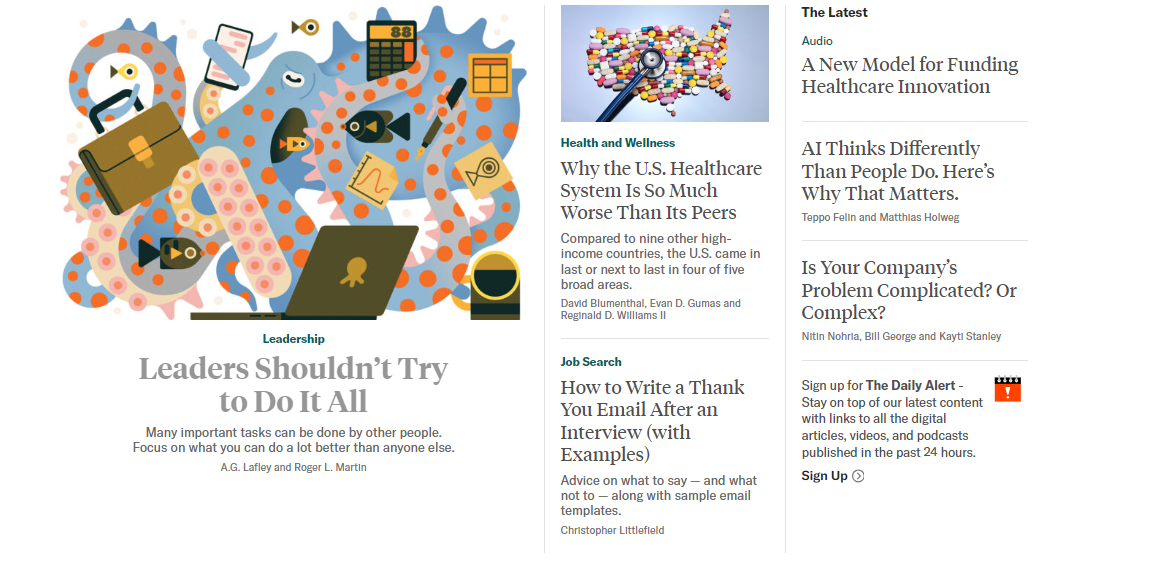
Because it directly affects user engagement and the efficacy of information transmission, visual communication is essential to web design, especially for home pages. Visual components including layout, colour, font, and images are all integrated to give users an easy-to-use and visually appealing experience. In this piece, our analyst examines the Harvard Business Review (HBR) homepage, as seen in its December 11, 2024, iteration, which exemplifies a masterclass in leveraging design to highlight content while guiding users seamlessly through a wealth of information. This analysis identifies best practices that other business review-focused media platforms can adopt to improve their audience engagement and content delivery.

Power of Intentional Design

The Harvard Business Review (HBR) homepage exemplifies the power of intentional design and visual communication in business media. Its layout immediately captures attention with a bold and central feature article, “Leaders Shouldn’t Try to Do It All,” accompanied by an illustrative graphic that reflects creativity and intellectual depth. This focus on prioritization signals to readers what is most essential while leaving space for additional curated content in a well-balanced, modular structure. Other media platforms can replicate this approach by establishing a visual hierarchy through font sizes, bold colours, or images, using whitespace effectively to separate primary features from supporting content and highlighting flagship articles or insights with distinct visuals or banners.

HBR’s design blends imagery and text with precision. Each section is crafted with a distinct theme: leadership insights, wellness commentary, career advice, and forward-looking analyses. Graphics complement the headlines, giving life to abstract topics like healthcare and artificial intelligence. These visuals are more than decorative—they are purposeful, drawing in readers and subtly conveying themes. This symbiotic relationship between text and imagery is a hallmark of effective communication design, encouraging thoughtful engagement rather than overwhelming the user. Other platforms can enhance user engagement by investing in bespoke or thematic visuals for content headers, ensuring images are not merely decorative but convey a story or theme and pairing visuals with clear, concise text that complements the image.

hbr.org

Giving Readers the Right Pathways

The navigation experience is intuitive, guiding readers seamlessly across categories without clutter. The page’s organization reflects an understanding of audience segmentation: leadership content appeals to executives, wellness articles resonate with professionals seeking balance, and career-focused insights cater to job seekers. By categorizing content this way, HBR serves its diverse readership while maintaining coherence in presentation.

Subtle call-to-actions (CTAs), like the prompt to subscribe to The Daily Alert, are seamlessly integrated into the design without feeling intrusive. Positioned alongside valuable content, this CTA invites engagement, offering readers a way to stay informed while maintaining their trust through non-aggressive prompts.

The platform’s design choices also stress the importance of consistency. Its clean typography and muted colour palette reflect HBR’s authority and professionalism, aligning perfectly with its brand identity. This cohesive branding reinforces trust and builds long-term loyalty among readers.

Balancing Intellectual with Practical Content

What stands out most is the balance of intellectual and practical content. Articles like “AI Thinks Differently Than People Do” stimulate forward-thinking, while practical pieces like “How to Write a Thank You Email After an Interview” provide actionable advice. This variety ensures the homepage caters to curiosity and immediate needs, embodying a nuanced understanding of its audience.

Foresight

For other business media, HBR offers valuable lessons. A clear content hierarchy, purposeful imagery, and responsive design are essential for engaging readers. Intuitive navigation and strategic CTAs demonstrate how to invite participation without compromising user experience. Finally, a mix of thought leadership and practical advice ensures broad appeal without diluting brand identity. Other platforms can elevate their visual communication and audience engagement by emulating these principles to match HBR’s benchmark-setting design.

Is Bitcoin just one part of a battle in a new evolution of Global Economic War?

0

So Donald Trump has come out unequivocally in support of Bitcoin, with less than 40 days to go until his Presidency accedes.

Big question – Is this just about Bitcoin?

Maybe it is something he considers much bigger.  A new version of MAGA – ‘Make America Great Again’. There is a not too old saying, that the REAL wars of today are not fought with guns and planes and tanks. These things are only occasional symptoms of the bigger war.

The biggest war is in global economics.

Every day, war or none, another symptom of this big global economic war is afoot. This is in the size and trade nature of ports.

China has 8 of the top 15 global ports by capacity. That’s even if considering Hong Kong separately. Shanghai is the biggest at 49.16 million TEU (2023 figures). No other nation has more than one.

Others in the top 15 are Singapore (Rank 2), South Korea (Rank 6), Hong Kong (8), Netherlands (10), UAE (11), Malaysia (12), and Belgium (14).

The United States doesn’t even have one.

Over the years, many nations have retained global leadership in the ‘Economic Balance’, by creating a wealth dynamic away from low value to volume ratio extraction goods, increasingly ramping up the value to volume ratio in what they offer the world, while importing low value from other nations.

We had the advent of computers and the rise of ‘Silicon Valley’

As nations began to exhaust their own natural resources, they looked for novel ways to stay on top of the economic pyramid.

Then ‘Revenue Machines’ which required no raw material at all arose – Global accountancy firms, (EY, Deloitte, PwC, and KPMG); and the traditional strategy consulting firms (McKinsey, BCG, and Bain).

As sovereign agitation began in oil rich countries globally, big oil extractors pivoted away from extraction towards consultant and engineering services.

Scotland was once the hub of Northern Hemisphere O&G outside of Texas, but long after North Sea Oil and Gas dried up, Aberdeen had become the O&G recruitment capital of the world – 1990 – 2010 about.


Extractive industry nations that do not keep value in house and fail to export only finished goods become impoverished.  With the advent of EV, the baton for the demise of some oil producers of the past, has been passed to the Lithium producers of the present – case in point, Democratic Republic of Congo.

But the models of Aberdeen, Extractive Consultancy by Oil Majors, the EYs’ KPMGs’ and McKinseys’ of this world have an impediment to the logical scaling of business to retain the apex of the value pyramid.

They still require a significant number of people.

We’ve had our affair with AI for a while, but with the ascension of Donald Trump to The White House, the marriage with cryptocurrency is reasserting its influence.

A new top of the value pyramid is in town which scales like a mathematical curve with the ratio of value/volume heading towards infinity. Bitcoin is only the top of an iceberg with a whole ecosystem of different types of virtually tokenized goods and services.

Donald Trump and Bitcoin are just the start of a journey which is absolutely nowhere near its end.

The question is, how are other nations going to respond and outflank this shift of value centre?

The ‘Space Race’ expired with the last millennium and a new race has begun. The EU seems to have decided to be doomed before beginning, with overburdening regulation, and a belligerent pursuit of the dedicated enemy of the whole web3 and cryptospectrum – a CBDC in the form of the Digital Euro.

The Global South has particular challenges, with no complete local/regional circular economies of the sector. Capacity is in excess in some aspects of the ‘circle’ and absent in many.

This forces available individuals to seek inroads to local/regional circular economies elsewhere in the world, but, who will offer opportunities to those in their own circular economy first.

This is normal for the trajectory of any new sector with only a few years to grow rather than many decades or even centuries. The US based blockchain/web3 circular economy is more likely to behave more insular than any other under Trump, and this one is the biggest and most robust by far.

BRICS seems to be travelling more down a CBDC type structure rather than embracing this virtual ecosystem.

Will China bring their own separate response? Much will begin on 20 January 2025.

9ja Cosmos is here…

.9jacom Domains

.det0x Domains

Preview our Sino Amazon/Sinosignia releases (Ente)

Visit 9ja Cosmos LinkedIn Page

Visit 9ja Cosmos Website

The Importance of Genetic Testing in Modern Cannabis Seed Banks

0

Modern cannabis seed banks play a pivotal role in the cultivation and distribution of cannabis. With the rise in demand for specific strains catering to medicinal and recreational needs, genetic testing has emerged as a game-changer in the cannabis industry. But what exactly is genetic testing, and why is it important?

Genetic testing involves analyzing the DNA of cannabis plants to determine their traits, such as potency, flavor, aroma, resistance to pests, and growth patterns. By understanding these traits at a genetic level, seed banks can ensure better quality and consistency in their offerings.

The Role of Genetics in Cannabis Cultivation

Ensuring Strain Consistency

Cannabis consumers often look for specific strains with particular effects, such as relaxation, energy, or pain relief. Genetic testing helps seed banks maintain consistency in these strains by verifying their genetic makeup. This ensures that consumers get the same experience every time they purchase a strain.

Improving Plant Health and Resistance

Genetic testing allows seed banks to identify plants with natural resistance to pests and diseases. By cultivating these resilient strains, growers can reduce the need for chemical pesticides and fertilizers, making the cultivation process more sustainable.

Why Genetic Testing is Crucial for Cannabis Seed Banks

Precision in Breeding

One of the most significant advantages of genetic testing is the precision it offers in breeding programs. Seed banks can crossbreed plants with desirable traits, such as high THC or CBD content, faster flowering times, or unique terpene profiles. This precision leads to the creation of new, high-quality strains.

Identifying Genetic Mutations

Occasionally, genetic mutations can occur in cannabis plants, leading to undesirable traits such as low yield or susceptibility to diseases. Genetic testing helps identify these mutations early, allowing the best seed banks to remove faulty plants from their breeding programs and maintain high-quality standards.

Supporting Legal Compliance

Many regions have strict regulations regarding cannabis strains, especially concerning THC and CBD levels. Genetic testing ensures that seed banks comply with these regulations by accurately determining the chemical profiles of their strains.

Benefits of Genetic Testing for Consumers

Access to Tailored Strains

Genetic testing empowers seed banks to develop strains tailored to specific needs, such as pain relief, anxiety reduction, or enhanced creativity. This customization ensures that consumers have access to the right strain for their requirements.

Improved Safety and Transparency

Consumers deserve to know what they are purchasing. Genetic testing provides detailed information about a strain’s potency, cannabinoid content, and effects, improving transparency and safety.

Better Overall Experience

Strains with consistent genetics lead to predictable effects, ensuring that consumers have a reliable experience every time they use a product.

How Genetic Testing Supports Cannabis Research

Advancing Medical Cannabis

Medical cannabis relies heavily on strains with specific cannabinoid and terpene profiles. Genetic testing facilitates the development of these strains, contributing to advancements in medical cannabis research and treatments.

Exploring Terpene and Cannabinoid Interactions

Terpenes and cannabinoids work together to create the “entourage effect,” which enhances the therapeutic potential of cannabis. Genetic testing helps researchers understand these interactions, leading to the development of more effective medicinal strains.

Challenges in Implementing Genetic Testing

High Costs

One of the barriers to widespread adoption of genetic testing is its cost. Advanced equipment and skilled professionals are required, which can be expensive for smaller seed banks.

Complexity of Cannabis Genetics

Cannabis has a highly complex genetic structure, making testing and analysis a challenging process. Despite advancements, there is still much to learn about cannabis genetics.

The Future of Cannabis Seed Banks with Genetic Testing

As technology evolves, genetic testing is becoming more accessible and cost-effective. In the future, it is likely to become a standard practice in all cannabis seed banks. This will lead to:

  • Enhanced Strain Diversity: With better understanding and control over genetics, seed banks can produce a wider variety of strains catering to diverse consumer needs.
  • Sustainable Cultivation: Genetic testing will promote environmentally friendly farming practices by enabling the cultivation of resilient, high-yield plants.
  • Global Standards: As genetic testing becomes universal, it will help establish global standards for cannabis strains, improving quality and safety for consumers worldwide.

Conclusion

Genetic testing is revolutionizing the cannabis industry, particularly in the operations of modern seed banks. By ensuring strain consistency, improving plant health, and supporting legal compliance, genetic testing enhances the quality and reliability of cannabis products. For consumers, it offers tailored strains, improved safety, and a better overall experience. While challenges such as cost and complexity remain, the future of genetic testing in cannabis seed banks looks promising. It not only benefits the industry but also paves the way for groundbreaking research and sustainable cultivation practices.