DD
MM
YYYY

PAGES

DD
MM
YYYY

spot_img

PAGES

Home Blog Page 2598

Nigeria’s Public Debt Stock Hit N134.30tn in Q2 2024 – Debt Management Office (DMO)

0

Nigeria’s public debt stock surged to an alarming N134.30 trillion in the second quarter of 2024, marking a sharp 10.38% increase from N121.67 trillion in the first quarter, according to the latest data from the Debt Management Office (DMO) published by the Nigerian Bureau of Statistics (NBS).

This rapid growth in debt reflects the mounting fiscal challenges facing the country amid dwindling oil revenues, rising global interest rates, and a depreciating naira.

The report highlighted that Nigeria’s external debt reached N63.07 trillion in Q2 2024, while domestic debt rose to N71.22 trillion. Domestic debt accounted for 53.04% of the total public debt, while external debt comprised 46.96%.

Lagos State topped the chart as the most indebted state domestically, with a staggering N885.99 billion, followed by Rivers State at N389.20 billion. At the other end of the spectrum, Jigawa and Ondo States recorded the lowest domestic debts of N1.82 billion and N15.10 billion, respectively.

On the external front, Lagos State again led with $1.20 billion, followed by Kaduna State at $640.99 million. Meanwhile, Yobe and the Federal Capital Territory (FCT) recorded the least external debts, with $20.49 million and $20.85 million, respectively.

Raising the Cost of Debt Servicing

The rising debt has significantly strained Nigeria’s finances. By August 2024, the cost of servicing external debt skyrocketed to N3.8 trillion, exceeding the budgeted N1.83 trillion for the entire year by an alarming N1.97 trillion. This dramatic overshoot reflects a 107.7% increase, largely driven by unfavorable exchange rates, rising global interest rates, and increased borrowing to meet fiscal shortfalls.

The total budget for debt servicing in 2024, including domestic and foreign debts, was set at N7.41 trillion. However, actual payments by August had already reached N5.51 trillion, accounting for 34.4% of the total budget. Domestic debt servicing costs also slightly surpassed the budgeted amount of N3.53 trillion, climbing to N3.6 trillion, an increase of N71 billion.

Declining Oil Revenues Fuel Borrowing

One of the major drivers of Nigeria’s rising debt profile is the shortfall in oil revenue. Oil and gas revenue for 2024 was projected at N20 trillion, but only N9.83 trillion was realized by August—a realization rate of 72.1%. After statutory deductions, net inflows to the Federation Account amounted to N8.5 trillion, falling short of prorated targets by 25.3%.

The underperformance in oil revenue is attributable to persistent challenges such as crude oil theft, production constraints, and global price volatility. These issues have undermined the government’s ability to capitalize on Nigeria’s natural resource wealth, forcing it to increasingly rely on borrowing to fund expenditures.

President Bola Tinubu’s administration is seeking additional loans to bridge the fiscal gap, including a $2.2 billion loan from the World Bank, recently approved by the Senate. While such borrowing may provide short-term relief, experts have warned that it would further compound the long-term challenge of debt sustainability.

The Lagos Chamber of Commerce and Industry (LCCI) said on Friday, that the growing debt profile, currently exceeding 50% of GDP, poses significant risks to economic stability.

“A critical perspective of further borrowing is the risk of losing steam on infrastructure financing as debt servicing alone may rise above what is set aside for capital expenditure in the 2025 federal budget.

“Another concern is the exposure to the external currency shocks that may result from the depreciation of the naira against the dollar in the course of servicing these accumulated debts,” Director-General of LCCI, Chinyere Almona, said in a statement.

Analysts have warned that with a significant portion of government revenue going towards debt repayment, critical investments in infrastructure, healthcare, and education are being sidelined. They note that the rising debt and the associated cost of servicing it pose significant risks to Nigeria’s economic stability.

It is also noted that the reliance on external borrowing exposes Nigeria to exchange rate risks. The naira’s depreciation against major currencies has amplified the cost of servicing foreign debt, further tightening fiscal space.

Experts have called for urgent reforms to reduce the debt burden. Measures include diversifying the economy to reduce dependence on oil revenues, improving tax collection, and curbing wasteful government expenditures.

Tekedia Capital Welcomes Felafax

0

Tekedia Capital welcomes Felafax (felafax.ai) which is building AI infra for non-NVIDIA GPUs. Simply, Nvidia’s near monopoly will not last forever, and with Felafax’s new AI stack that is 2x more cost-efficient and performant without needing Nvidia’s CUDA, a new era awaits. Felafax aspires to make it possible for more people to get into the upstream production phase of AI development by commoditizing the hardware element.

Tekedia Capital (capital.tekedia.com) is investing in the companies of the future.

$1,000 Bet in the Dogecoin Price Turned into $300,000 in 2021; Analyst Spots the Next Altcoin to Achieve It

0

Early investors saw enormous gains in 2021 when the Dogecoin price surged. By May, a $1000 investment made at the beginning of the year had grown to an incredible $300,000.

Dogecoin’s unprecedented growth was fueled by viral campaigns, community support and celebrity endorsements, which turned the memecoin into a crypto phenomenon.

Analysts have identified an altcoin with similar explosive potential to DOGE: RCO Finance. This altcoin’s innovative features and real-world utility make it a high-growth asset, positioning it as the next altcoin to achieve Dogecoin-like returns.

2021’s Dogecoin Price Surge: What Made Dogecoin the 2021 Star

The 2021 Dogecoin price surge can be attributed to its unique meme appeal, high-profile endorsements, and community-driven support. These factors helped create an environment ripe for speculation and investment, pushing DOGE to new heights.

Dogecoin started as a meme that grew into a cultural phenomenon. Its Shiba Inu mascot resonated with the masses, making it relatable and engaging. This meme status attracted attention and helped foster a sense of community.

Social media also played a pivotal role in increasing Dogecoin’s visibility and helping attract investors. These viral campaigns and discussions spurred interest, driving engagement and speculation which helped the Dogecoin price rise.

Dogecoin has built a dedicated community of supporters known as the DOGE Army. They have been pivotal in driving awareness and adoption. Coupled with endorsements from high-profile figures like Elon Musk, these efforts helped transform Dogecoin into more than a meme attracting attention and investor interest. This led to an increase in demand, pushing the Dogecoin price even higher.

As the Dogecoin price rose, FOMO set in, fueling further growth. Witnessing its impressive growth, investors rushed to buy DOGE, creating a self-reinforcing growth cycle. As the Dogecoin price increased, it attracted more buyers, leading to higher prices.

RCOF: The Altcoin Analysts Say Could Deliver 2021-Dogecoin-Like Returns

Dogecoin’s 2021 bull run was remarkable, and now the market is watching to see the next altcoin that could deliver similar results. RCO Finance is emerging as a strong contender that could deliver Dogecoin-like returns. However, unlike the memecoin, RCOF offers utility combined with advanced features that appeal to a broader audience.

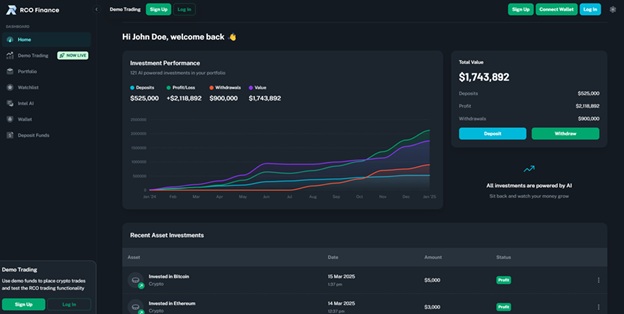
This altcoin integrates AI and machine learning, providing users with real-time insights, automated trading support, and personalized trading guidance. The robo-advisor serves as your trading assistant. It’s like having a financial guru at your beck and call. This AI tool analyzes market conditions to create customized investment strategies based on your preferences.

It helps you make smarter investments with actionable insights, educational resources, pattern alerts, automated portfolio management and real-time market analysis.

With the robo-advisor, you don’t need extensive crypto trading knowledge to get started. It provides educational materials to help you understand crypto trading and how financial markets work. These resources empower beginners but also help experts improve their strategies.

Its pattern recognition feature helps identify potential investment opportunities and market anomalies. You can easily capitalize on emerging trends while avoiding potential pitfalls.

RCO Finance allows users to lend and borrow without selling their assets, giving them access to liquidity. Its cross-chain compatibility makes it easy to interact with different blockchains, increasing user flexibility.

RCOF is designed to democratize access to advanced investment tools, making wealth-building opportunities available to a broader audience. It offers access to more than 120,000 tradable digital and real-world assets.

Tokenizing real-world assets means users can directly buy them using cryptocurrency, increasing their accessibility to more users. It also opens more investment opportunities, allowing users to diversify their portfolios.

As a fully autonomous platform, security is a top priority. RCOF has undergone a thorough audit by SolidProof, ensuring transparency, security, and reliability for all users.

Don’t Miss the Next Dogecoin: Join the RCOF Presale

The meteoric rise of the Dogecoin price in 2021 turned early investors into millionaires, proving the value of investing in a high-growth altcoin. Now, analysts have identified RCO Finance as an altcoin offering a similar growth opportunity. With its innovative features, RCOF could easily deliver 2021 Dogecoin-like returns.

Any savvy investor knows timing and opportunity are key to capturing these massive returns. RCOF’s presale is underway, and it’s the perfect opportunity to get in early and secure tokens at a discounted price.

Currently, in stage 3, tokens are going for $0.055 and selling out fast. Buy now before the price jumps to $0.077 in the next stage, reducing your overall returns.

Don’t wait. Invest now and make 2021 Dogecoin-like gains.

For more information about the RCO Finance (RCOF) Presale:

Visit RCO Finance Presale

Join The RCO Finance Community

Analyzing the Bitcoin Market’s Trends and MicroStrategy 55,500 BTC Buy

0

The cryptocurrency market experienced a tumultuous weekend, with over $500 million worth of crypto assets being liquidated as Bitcoin’s value took a sharp dive to $96,000. This volatility is not uncommon in the crypto sphere, but the scale of this event has caught the attention of investors and analysts alike.

Bitcoin’s Sudden Drop

Bitcoin, the leading cryptocurrency, saw a significant drop from its recent high, falling to $96,000 over the weekend. This decline led to widespread liquidations, predominantly affecting smaller altcoins and midcap futures. The market’s sensitivity to Bitcoin’s fluctuations remains a critical factor in the stability of the entire cryptocurrency ecosystem.

MicroStrategy’s 55,500 Bitcoin Bold Move

Amidst the market’s downturn, MicroStrategy, a major player in the corporate adoption of Bitcoin, made a substantial purchase of 55,500 BTC for $5.4 billion. This move has solidified MicroStrategy’s position as one of the largest corporate holders of Bitcoin, with a total holding of 386,700 BTC. The company’s aggressive investment strategy in Bitcoin reflects a strong belief in the long-term value of the cryptocurrency.

MicroStrategy, under the leadership of CEO Michael Saylor, has been a pioneer in incorporating Bitcoin into its treasury strategy. The company’s aggressive investment in Bitcoin began in 2020 and has since been a topic of much discussion in financial circles. With this latest purchase, MicroStrategy’s total holdings amount to 386,700 BTC, valued at nearly $38 billion. The average purchase price of the newly acquired Bitcoins stands at $97,862 per coin, showcasing the company’s commitment to its long-term vision for Bitcoin’s role in its financial strategy.

The impact of this acquisition extends beyond MicroStrategy’s balance sheet. The company’s stock price has seen an 80% surge, aligning with Bitcoin’s 150% rise in 2023. This correlation highlights the increasing interconnection between traditional financial markets and the cryptocurrency ecosystem. Furthermore, MicroStrategy’s bold strategy has propelled it into the top 100 U.S. publicly traded companies by market capitalization, briefly surpassing a $100 billion valuation.

The market’s reaction to these events has been mixed. On one hand, the price drop triggered a sell-off that led to significant liquidations. On the other hand, some investors and ‘whales’ have viewed the dip as a buying opportunity, accumulating more Bitcoin as the price dropped. This behavior indicates that there is still a strong conviction among certain segments of the market regarding the future potential of Bitcoin.

The recent events have sparked discussions about the future of Bitcoin and the broader cryptocurrency market. While some analysts remain bullish, citing institutional demand and whale accumulation during dips, others urge caution as Bitcoin approaches the $100,000 milestone. The market’s volatility underscores the need for investors to remain informed and cautious.

MicroStrategy’s move could potentially signal a shift in how companies manage their reserves, with cryptocurrency becoming a more accepted component of corporate investment portfolios. This acquisition not only reinforces the legitimacy of digital assets but also demonstrates the potential for substantial returns on investment within the volatile cryptocurrency market.

The cryptocurrency market continues to be a dynamic and unpredictable space. The recent price drop and subsequent liquidations serve as a reminder of the inherent risks involved in crypto investing. However, the actions of companies like MicroStrategy also highlight the ongoing interest and confidence in the potential of cryptocurrencies. As the market recovers from this latest shake-up, all eyes will be on Bitcoin’s next moves and the implications for the wider crypto landscape.

Implications of Gary Gensler’s Departure from US SEC for the Blockchain Industry

0
WASHINGTON, DC - OCTOBER 03: Securities and Exchange Commission (SEC) Chair Gary Gensler listens during a meeting with the Treasury Department's Financial Stability Oversight Council at the U.S. Treasury Department on October 03, 2022 in Washington, DC. The council held the meeting to discuss a range of topics including climate-related financial risk and the recent Treasury report on the adoption of cloud services in the financial sector. (Photo by Anna Moneymaker/Getty Images)

The recent announcement of Gary Genslers departure from the U.S. Securities and Exchange Commission (SEC) has sent ripples through the blockchain industry. Gensler, who served as the SEC Chair, was known for his stringent approach to regulating the crypto market. His tenure saw the implementation of robust rulemaking to enhance the efficiency, resiliency, and integrity of the U.S. capital markets, as well as high-impact enforcement cases to hold wrongdoers accountable.

Gensler’s exit marks a significant turning point for the blockchain industry, which has long been under the scrutiny of the SEC. Under his leadership, the SEC pursued an aggressive enforcement strategy that led to numerous lawsuits and significant costs for crypto companies. This approach, while aimed at protecting investors and ensuring market integrity, has been viewed by many in the crypto space as a hindrance to innovation and growth.

Gensler’s approach to regulation was often seen as aggressive, especially by those within the crypto industry. He emphasized investor protection and was vocal about the risks associated with the burgeoning market. Under his watch, the SEC took action against several key players in the crypto space for various violations.

However, Gensler’s strict regulatory stance also coincided with significant milestones for the industry. For instance, the approval of exchange-traded funds (ETFs) tracking the spot price of Bitcoin was a notable achievement, providing investors with easier access to the cryptocurrency.

The reaction to Gensler’s resignation has been mixed. Some view it as a loss of a regulatory figure who prioritized investor protection, while others see it as an opportunity for a more lenient regulatory environment. The market’s response was immediate, with cryptocurrencies like XRP and Bitcoin experiencing notable price surges following the announcement.

The blockchain industry is now at a crossroads, with Gensler’s departure signaling a potential shift in regulatory stance. The next chair will face the challenge of balancing the need for investor protection with the industry’s call for a more conducive regulatory environment that fosters innovation. The crypto community has expressed hope that the new leadership will bring a fresh perspective to digital asset regulation and engage in meaningful dialogue with market participants.

The impact of this leadership change on the blockchain industry cannot be overstated. A more collaborative approach between regulators and the crypto sector could lead to the development of a regulatory framework that not only protects consumers but also supports the advancement of blockchain technology. Such a framework could position the United States as a global leader in the digital asset space, attracting investment and fostering innovation.

As the industry awaits the appointment of a new SEC Chair, there is a sense of cautious optimism. The blockchain community hopes for a regulatory environment that is clear, fair, and conducive to growth. The coming months will be crucial in determining the direction of U.S. crypto policy and its implications for the global blockchain ecosystem.

Gary Gensler’s resignation from the SEC opens up a new chapter for the blockchain industry. It presents an opportunity for a reset in the relationship between regulators and the crypto market. The industry looks forward to a regulatory approach that encourages innovation while upholding the integrity of the markets. The legacy of Gensler’s tenure will continue to influence the SEC’s policies, but the future now holds the promise of a fresh start for the blockchain industry.