DD
MM
YYYY

PAGES

DD
MM
YYYY

spot_img

PAGES

Home Blog Page 2631

Intel Secures $7.865 Billion in CHIPS Act Funding as US Ramps Up Semiconductor Production

0

The Biden administration has awarded Intel $7.865 billion under the CHIPS and Science Act, marking the largest allocation to date from the $39 billion set aside to bolster domestic semiconductor manufacturing.

While slightly less than the $8.5 billion initially earmarked for Intel earlier this year, the funding underscores the White House’s commitment to reshoring critical supply chains and fostering job creation across the United States.

“Today’s award marks another key step in implementing President Biden’s CHIPS and Science Act and the Investing in America agenda to reshore manufacturing, create thousands of good-paying jobs, and strengthen our economy,” said White House Deputy Chief of Staff Natalie Quillian in a statement announcing the grant.

Intel plans to use the funds to expand its semiconductor fabrication facilities in Arizona, New Mexico, Ohio, and Oregon. These projects are expected to create up to 30,000 jobs across all four states, including direct employment at the facilities and indirect roles in construction and supply chain services.

The funding also comes with conditions aimed at ensuring Intel prioritizes innovation and manufacturing over shareholder payouts. The company has pledged to avoid stock buybacks for five years—a measure likely intended to align with the CHIPS Act’s goal of strengthening the US semiconductor ecosystem.

Intel’s final funding amount was reduced due to a mix of factors, including delays in some of its project timelines and a separate $3 billion contract awarded in September to develop semiconductors for national security and military applications. Additionally, some of Intel’s expanded plans now extend beyond the CHIPS Act’s 2030 project deadline, prompting adjustments in the allocated amount.

Intel Scales Back Ambitions Amid Financial Struggles

The funding arrives at a challenging time for Intel, which has faced significant setbacks over the past year. The company recently reported a staggering $16.6 billion quarterly loss—its largest since its founding in 1968—and laid off over 15,000 employees.

Intel has also revised its growth strategy to reflect its financial realities. The company has reduced its planned US manufacturing investments from $100 billion over the next five years to $90 billion by 2030. Its expansion in Ohio, initially estimated to create 10,000 jobs, has been scaled back to 6,500 roles.

Despite these struggles, Intel remains a critical player in the US semiconductor industry. Its efforts to advance 18A process technology—considered vital for next-generation chip manufacturing—are seen as essential to maintaining the country’s technological edge.

CHIPS Act Funding Disbursement Accelerates Amid Looming Deadline

Intel’s award is part of the Commerce Department’s efforts to distribute $19 billion of the total $39 billion in CHIPS Act funding before the Trump administration takes office in January. The incoming administration has expressed plans to scale back the program, potentially reducing the scope of future investments in domestic semiconductor production.

With the Intel deal finalized, the Commerce Department has now reached agreements with six companies under the CHIPS Act, allocating nearly half of the available funding. More announcements are expected in the coming weeks as time runs short to obligate the remaining funds.

Challenges and Opportunities for Intel

The CHIPS Act funding provides a lifeline for Intel as it navigates a turbulent period marked by declining revenues, competitive pressures, and operational challenges. However, the company’s ability to meet its ambitious goals will depend on how effectively it utilizes the funds to regain technological leadership and improve its financial stability.

Reports that Qualcomm considered acquiring Intel further highlight the uncertainty surrounding the chipmaker’s future. While Qualcomm’s interest has reportedly cooled, Intel’s struggles have raised concerns about its long-term competitiveness in a rapidly evolving global semiconductor market.

Reshoring Semiconductor Manufacturing

The Biden administration’s push to reshore semiconductor manufacturing comes amid heightened concerns about US reliance on foreign suppliers, particularly in Taiwan and South Korea. The CHIPS Act is part of a broader strategy to secure critical supply chains and reduce vulnerabilities in the event of geopolitical disruptions.

Intel’s expanded facilities are expected to play a pivotal role in this effort as the US works to strengthen its position in the global semiconductor race.


Bitcoin Retreats Below $100,000 as Investors Lock in Gains

0

The price of Bitcoin has retreated from the highly anticipated $100,000 milestone as investors secure profits following the crypto asset’s strong rally after the US presidential election.

In a push to hit the $100,000 price, Bitcoin traded at $99,665 before dropping more than 4% to $90,999.30, according to Coin Metrics. Also, crypto-related equities felt the pressure, with Coinbase shares falling 6% and Microstrategy dropping 12%.

As Bitcoin approaches a $2 trillion market cap, large investors, such as pension funds and central banks, are starting to pay attention. Several analysts reveal that there is a lot of liquidity around the $100,000 mark, which may lead to more consolidation before any breakout. This according to them could cause a short squeeze if Bitcoin breaks above this level, potentially pushing prices higher.

Matt Mena, a crypto research strategist at 21Shares, explained that the $100,000 level serves as a psychological selling point for investors who have held onto Bitcoin since its last bull run. He told Business Insider that token holders likely anticipated declines around the price point and chose to sell some holdings to lock in gains. The same behavior can be traced back to previous highs in bitcoin’s price, he said.

With Bitcoin’s recent record-breaking performance, reports reveal that it has prompted long-term holders to increasingly sell their assets in large amounts. The selling pressure has been offset to some extent by institutional inflows, including purchases by MicroStrategy and bitcoin exchange-traded funds (ETFs). However, ETFs experienced $438 million in outflows on Monday, ending a five-day streak of inflows.

Traders have been cashing in for a second conseçutive day following bitcoin’s post-election surge, fueled by optimism about President-elect Donald Trump’s pro-crypto policies.

While Bitcoin has lately been experiencing some form of pullback, currently trading at 93,965 at the time of writing this report, several analysts suggest that the price of BTC will hit the $100,000 price.

“Bitcoin has been on a tear since Election Day with very few pullbacks, but the $100,000 mark remains a formidable psychological barrier. While breaking through now would be a major bullish signal, a brief pullback may be needed to gather momentum before the next attempt”, Mati Greenspan, founder, and CEO of Quantum Economics, told CNBC by email.

Brett Reeves from BitGo explained that new all-time highs often lead to consolidation periods before the next price rally. “With new institutional money entering the space and rising retail activity via ETFs and exchanges, coupled with positive macroeconomic and regulatory developments, we may see a rapid recovery in price activity,” Reeves told CNBC.

Despite the recent pullback, bitcoin remains up over 30% since the U.S. election and has gained an impressive 114% year-to-date, signaling strong long-term momentum in the cryptocurrency market.

OpenAI Begins The Minting of Millionaires as SoftBank Arrives with Big Chequebook

0

Mostly in America: you start work, they give you shares of the company. They tell you that if you work hard and this thing works, everyone can have a great Christmas, Diwala, Salah, etc depending on your call. And just like that, the game begins. Those shares at $10 could jump to $40, and they buy them back from you – and as that happens, there will be money everywhere. People, it is always a big rain, and when it happens at scale, financial liberation comes.

OpenAI employees are experiencing a major rain as Softbank comes with a truckload of cash to buy them out: “In a significant development for employees and investors, OpenAI is offering a new tender opportunity for current and former employees to sell approximately $1.5 billion worth of shares to SoftBank”.

Most of those shares will be employee stock options which Softbank can convert, via OpenAI, to common full shares even as some with common shares (a super minority in this case) exit. In other words, SoftBank is creating liquidity to enable OpenAI to exit some shareholders and also put cash in the pockets of workers.

This tender offer comes after SoftBank’s $500 million investment in OpenAI during its last funding round. It highlights the persistence of Masayoshi Son, SoftBank’s billionaire founder, in securing a larger slice of the AI market. Known for his investments in transformative technology, Son has signaled his commitment to artificial intelligence, recently stating he is reserving “tens of billions of dollars” for AI ventures.

SoftBank’s interest in OpenAI complements its broader AI strategy, following investments in startups such as Glean, Perplexity, and Poolside through its Vision Fund 2. With assets exceeding $160 billion, SoftBank has made AI a cornerstone of its investment philosophy.

Say it another way: many $millionaires will be minted when this deal closes. And many of them will retire or leave the company for their passions. And that is the risk for OpenAI there: if people become rich that money is no more a motivator, many bad things happen as those cubicles could become empty.  But for all humans, it is a good problem for society because abundance will be scaled.

OpenAI will allow its staff to sell $1.5 billion in stock in a new tender offer to Japan’s SoftBank, CNBC reports, citing anonymous sources. The financing would allow the tech conglomerate to get a bigger share of the ChatGPT maker. It will also let current and former OpenAI employees cash out on their restricted stock units. The unit price will be $210, after OpenAI was valued at around $157 billion in October. Meanwhile, the company just suspended access to its unreleased video generation tool Sora following a protest of its treatment of creatives. (Linked News)

Revisiting U.S. Inflation: The Key Data Points Investors Can’t Ignore

0

The latest U.S. inflation figures are not as positive as they seem at first glance, and the markets have promptly caught on.

As expected, following Donald Trump’s victory in the November 5 Election Day, markets affected by the new President’s political agenda have shown a burst of euphoria. However, a few weeks later, as the final appointments to key government positions are awaited, the spotlight has shifted back to economic fundamentals, with inflation stealing the show.

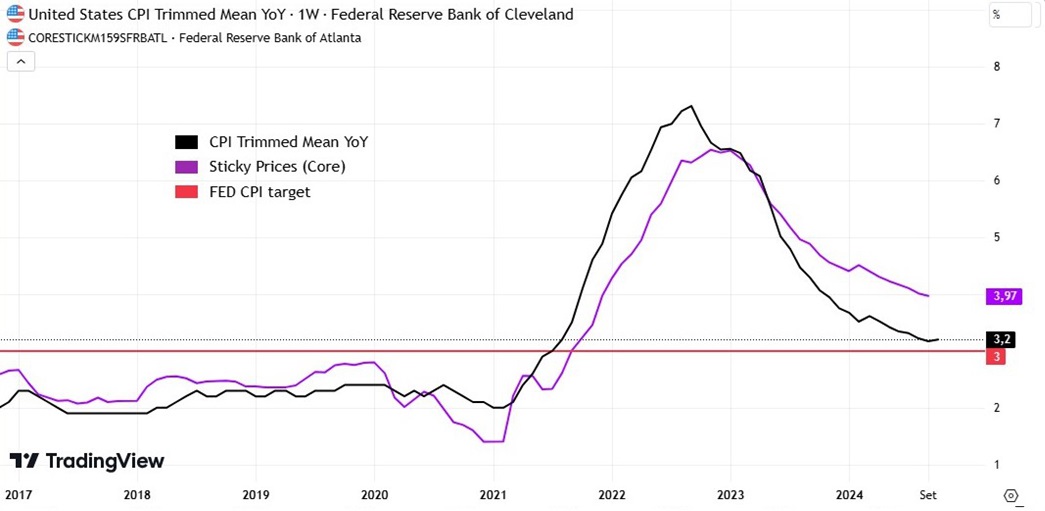
Although October reports have been generally positive, a deeper analysis reveals potential clouds on the horizon. The annual U.S. inflation rate still remains under the Federal Reserve’s target 3% ceiling, a benchmark for stability.

The pace of decline seems to have stalled for now, with October data showing a smaller decrease than analysts’ forecasts, remaining consistent with previous months. Meanwhile, essential categories like housing and services—things that directly affect daily life—are still running hot, stubbornly and alarmingly above the 3% mark.

Using specialized metrics developed by Federal Reserve economists — such as the Cleveland Fed’s trimmed mean (which filters out extreme outliers), or Atlanta Fed’s “Sticky Prices” (focusing on slower-moving costs), it becomes evident that inflation isn’t under control yet.

Inflation remains a highly political issue, and the choice of President Trump’s new economic team will be a pivotal moment. The country could face significant shifts in macroeconomic policies, especially as they juggle tightening trade policies and inflation control. These goals may clash, increasing the risk of market turbulence, primarily affecting the U.S. dollar index and currency pairs like EURUSD or USDJPY.

With unemployment rising to 4.1%, a further drop in inflation seems unlikely. The CME Fed Watch tool, shows just over a 50% chance of a small 25-basis-point rate cut at the upcoming FOMC meeting on December 18. Beyond that, additional cuts are expected to be on hold until the new administration gets settled. Markets appear to have already adjusted to this outlook. Stock indices hit new highs, signs point to a potentially rocky start to 2025.

To better understand these dynamics, free market replay tools can be invaluable. This tool allows you to review historical market data, helping analyze how past events influenced market behavior. By replaying key moments, you can identify patterns and make more informed decisions in the present.

California Plans To Revive EV Rebates, Could Exclude Tesla, As Musk and Trump Challenge Federal Credits

0

California Governor Gavin Newsom has vowed to revive the state’s Clean Vehicle Rebate Program (CVRP) if President-elect Donald Trump’s incoming administration dismantles federal tax credits for electric vehicles (EVs).

The announcement underscores a clash between California’s climate action priorities and the potential policy shifts of Trump’s second term.

“We will intervene if the Trump Administration eliminates the federal tax credit, doubling down on our commitment to clean air and green jobs in California,” Newsom stated. “We’re not turning back on a clean transportation future — we’re going to make it more affordable for people to drive vehicles that don’t pollute.”

The CVRP, which had provided financial incentives for over 590,000 vehicles before being phased out in late 2023, will be reinstated to cushion California residents from potential changes to the federal electric vehicle tax credits.

These credits, introduced under President Joe Biden’s Inflation Reduction Act (IRA) in 2022, allow buyers of qualifying EVs to receive up to $7,500 in tax rebates. The program catalyzed EV adoption nationwide, benefiting automakers like Ford, General Motors, Rivian, and Tesla.

However, with Trump set to assume office, his administration, in coordination with Congress, could significantly alter or remove these rebates. Speculated changes include lowering the rebate amounts, introducing stricter eligibility criteria, or implementing market-share limitations, which could exclude dominant players like Tesla from benefitting.

Tesla’s Market Dominance And The Rebate

Tesla’s dominance in the EV market, particularly in California, has placed it at the center of the rebate debate. The company accounted for nearly 55% of new EV registrations in California during the first three quarters of 2024, according to the California New Car Dealers Association. While Tesla’s overall sales grew, its market share declined from 64% in 2023 to 55% in 2024, as competitors like Hyundai and BMW made modest gains.

Newsom’s office suggested that California’s revamped rebate program may include a market-share cap to promote competition and prevent one company from monopolizing state incentives. Such a cap could exclude Tesla and other major players from receiving rebates, redirecting funds toward newer or smaller EV makers.

Elon Musk, Tesla’s CEO, quickly criticized the potential exclusion on X (formerly Twitter), calling it “insane.” Musk’s reaction has sparked accusations of hypocrisy, as he has publicly supported the end of federal tax credits, arguing that Tesla’s strong market position renders the company less dependent on government incentives.

“I think it would be devastating for our competitors and for Tesla slightly,” Musk said during a July earnings call. “But long term probably actually helps Tesla, would be my guess.”

Musk’s comments highlight a paradox: while he advocates for eliminating federal subsidies to disadvantage competitors, he opposes California’s exclusion of Tesla from state rebates, a move designed to achieve a similar competitive balance. Many have suggested Musk wants to “eat his cake and have it.”

The potential rollback of federal credits and California’s response come at a critical time for the EV industry. Governor Newsom’s decision to revive the CVRP aligns with California’s broader climate goals and reflects the state’s resistance to Trump-era policies that could undermine clean energy progress.

This isn’t the first time California has clashed with Trump on environmental issues. During his first term, the state sued the administration over 100 times, challenging policies on greenhouse gas emissions, health care, and immigration.

Dan Ives, an analyst at Wedbush Securities, warned that the evolving rebate policies could lead to a “Game of Thrones-style battle” between Newsom and Musk. Such tensions may prompt Tesla to accelerate its exit strategy from California, a process that began when Musk relocated Tesla’s headquarters to Texas in 2021.

California remains the largest EV market in the United States and a global leader in clean transportation. Despite Tesla’s dominance, the state has seen increasing competition, with Hyundai and BMW capturing 5.6% and 5% of the EV market, respectively, in 2024.

Reinstating the CVRP could mitigate the impact of federal policy changes and make EVs more accessible to Californians. However, the introduction of market-share limitations may deter Tesla’s participation, potentially impacting the state’s EV adoption rates and overall competitiveness.

Musk’s apparent alignment with Trump on ending federal tax credits raises questions about Tesla’s long-term strategy. Musk is set to co-lead Trump’s Department of Government Efficiency (DOGE), an advisory commission tasked with reducing federal spending. Analysts speculate that Musk’s support for ending subsidies is aimed at solidifying Tesla’s dominance by slowing the growth of competitors reliant on such incentives.