In a significant policy shift, the Federal Government has announced the lifting of the long-standing restriction on the posting of members of the National Youth Service Corps (NYSC) to the private sector.
The directive, effective with the commencement of the 2024 Batch ‘C’ Orientation exercise, was outlined in a memo dated November 18, 2024, by Minister for Youth Development Ayodele Olawande.
The policy change permits corps members to be posted to private sector organizations, including banks and oil and gas companies, marking a departure from the previous framework which confined NYSC postings to the public sector, focusing on education, agriculture, health, and infrastructure.
The previous restriction, implemented during the tenure of former Youth and Sports Development Minister Bolaji Abdullahi, was aimed at preventing private companies from exploiting cheap labor while promoting public sector capacity building. The directive limited corps members’ service opportunities to sectors deemed critical for national development.
The newly introduced policy, according to Olawande, aligns with President Bola Tinubu’s strategy to combat youth unemployment and provide young Nigerians with relevant work experience.
“There is an urgent need to review this policy to expand the opportunity and access for corps members to serve in places that are relevant to their areas of study,” Olawande noted in the memo.
New Opportunities in the Private Sector
Under the new directive, corps members will now be posted to select private-sector organizations, starting with Lagos and Abuja. The postings will prioritize aligning assignments with the corps members’ fields of study to better prepare them for the labor market.
“This directive will allow corps members to gain valuable experience in their chosen fields of study,” the memo stated. “The now revoked policy has greatly hampered experience gathering that would effectively prepare them for the job market.”
A Step Towards Addressing Youth Unemployment
The policy reversal is being touted as part of President Tinubu’s broader plan to address the alarming rates of youth unemployment in Nigeria. According to the Minister, the move will enhance job preparedness by integrating young graduates into sectors where their skills are in demand.
However, the implementation is set to start in a phased manner, with Lagos and Abuja serving as pilot locations before the directive is extended nationwide.
While the government sees the policy as a means of tackling youth unemployment, concerns remain over how private companies will handle the influx of NYSC members. During Bolaji Abdullahi’s tenure, critics argued that private-sector employers often exploited corps members as a source of inexpensive labor.
Observers will also be watching to see if the government ensures compliance with labor laws and provides oversight to prevent the exploitation of corps members in the private sector.
Stakeholders React
The announcement has sparked mixed reactions. While many youth groups and private sector organizations have welcomed the move as a step in the right direction, critics have questioned whether this policy can truly address the systemic challenges facing the NYSC scheme.
Some have described the decision as long overdue, noting that it’s an opportunity for NYSC members to gain real-world experience and improve their employability.
However, some public sector advocates have expressed reservations. They note that the NYSC was designed to build capacity in underserved sectors, particularly rural areas. This move, they added, could dilute that purpose.
As the 2024 Batch ‘C’ corps members prepare for orientation, all eyes will be on how the new policy is implemented. Will this initiative fulfill its promise of creating meaningful opportunities for Nigeria’s youth, or will it spark new challenges?
From Condia newsletter: “Nigeria’s telecom industry continues facing tough times. The average revenue per user (ARPU) for major telcos like MTN and Airtel has plummeted by over 40% in the past year. MTN Nigeria, once the MTN Group’s top-performing market with a $5.03 ARPU in Q1 2023, has seen its user revenue fall with an ARPU of $2.09 by Q3 2024. Similarly, Airtel Nigeria, which was the second-highest-earning market across Airtel Africa’s 14-country operations with a $3 ARPU, has fallen to $1.60 ARPU.”
ARPU is a gold standard metric in telecoms just like cost-to-income ratio is for banking. When ARPU begins to crash, most times, investments stall. In other words, why waste money on customers who may not even afford the services? That is partly the reason why banks do not expand to most rural areas in Nigeria as making money from the “poor” is tough (using poor with respect there). The ARPU numbers from Nigeria will affect how MTN and Airtel will operate in Africa.
First, they will increasingly go the fintech model (like mobile money, insurance, etc) where the margins remain strong. And over time, they will try to use the space, through partnership with satellite providers, as most may not have the resources to expand via a terrestrial model: “MTN, Africa’s largest telecom operator, is exploring partnerships with Low-Earth-Orbit (LEO) satellite providers to expand its internet reach…”
Simply, if ARPU is crashing and they are losing money, do not expect telcos to deploy more investment dollars. But through partnerships with satellite providers, they can hang on there even though over time, they will have real challenges from some of those providers like SpaceX Starlink.
Good People, what are you doing as your customers become poorer in Nigeria? Are you changing your business model? Are you striking partnerships to reduce your fixed costs and improve your marginal cost to keep serving them? Put on your thinking cap and learn how MTN and others are evolving
For Tekedia Mini-MBA learners, we have posted the written materials from Dr Abel Osuji from Afreximbank on how SMEs can make changes and thrive even though a period of economic perturbation. The course video of yesterday is already posted in the course board. Take time and study his suggestions and plot new strategic paths to thrive. Good luck.
In recent months, MultiChoice Nigeria has faced an unprecedented challenge. The company announced a loss of 243,000 subscribers from its DStv and GOtv services within six months, sparking widespread reactions from its customer base. These responses, drawn from a variety of socioeconomic and service-related grievances, reveal deep frustrations and a shifting dynamic in consumer preferences. With the rise of alternative platforms and increasing economic pressures, the question arises: should MultiChoice reinvent its business model in Nigeria? In this piece, our analyst examines this question using thematic analysis of user feedback, with critical implications for MultiChoice and the broader pay-TV industry.
Themes from Public Reactions
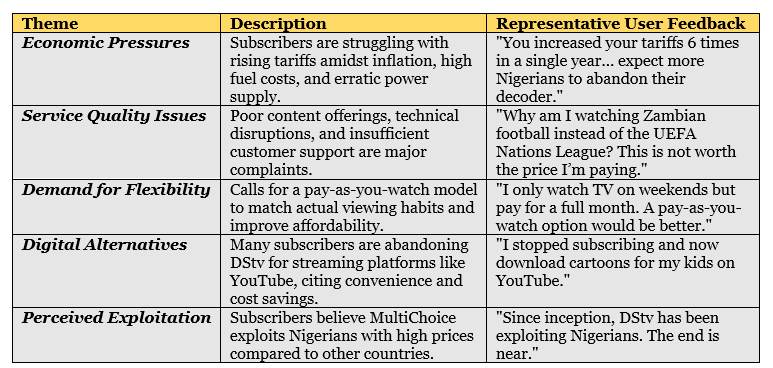
Nigerians’ reactions to MultiChoice’s announcement span across economic concerns, dissatisfaction with service quality, and demands for innovative pricing models. Below is a thematic summary of key insights:
Source: Multiple posts from Facebook, 2024; Infoprations Analysis, 2024
Source: Multiple posts from Facebook, 2024; Infoprations Analysis, 2024
Economic Pressures: The Breaking Point
The high cost of living in Nigeria has left many subscribers questioning the affordability of MultiChoice’s services. One user lamented, “Fuel is expensive, electricity is unreliable, and now you want us to pay through the nose for subscription fees? It’s not possible.” This sentiment echoes across numerous reactions, as the company’s repeated tariff hikes—six times in one year—are seen as tone-deaf to the economic realities of its customers. In response to this, MultiChoice faces a tough balancing act: maintaining profitability while ensuring its services remain accessible to an audience grappling with inflation.
Service Quality and Customer Experience
Several subscribers pointed to a decline in service quality as another critical issue. One user asked, “What am I supposed to do with Zambian football? Why did you remove Africa Magic Urban without replacement?” Others criticized prolonged service disruptions due to maintenance exercises, which they argued were poorly managed and left subscribers without compensation.
The erosion of trust between MultiChoice and its customer base highlights the urgent need to improve content offerings, technical reliability, and customer service. Customers are increasingly unwilling to tolerate disruptions or diminished value in exchange for higher prices.
The Flexibility Revolution: Pay-As-You-Watch
One of the most persistent demands is for greater flexibility in subscription plans. Subscribers are calling for a pay-as-you-watch model that aligns with their viewing habits. A frustrated parent remarked, “Imagine paying for 30 days and only utilizing eight days because my kids only watch TV on weekends.”
This demand reveals a broader trend toward personalization in media consumption. Competitors such as Netflix and YouTube offer on-demand access, setting a benchmark that traditional pay-TV providers like MultiChoice must meet to remain competitive.
The Shift to Digital Alternatives
The rise of digital platforms is accelerating MultiChoice’s subscriber losses. Many users noted that they had switched to YouTube or downloaded content to USB drives to avoid paying for DStv. As one subscriber put it, “YouTube to the rescue. After spending so much, I stopped and started streaming every weekend.”
This trend reflects the growing preference for affordable, on-demand viewing experiences. MultiChoice’s challenge lies in integrating digital offerings with its traditional model to stay relevant in this rapidly evolving landscape.
Perceived Exploitation: A Persistent Criticism
Since its inception, MultiChoice has faced accusations of exploiting Nigerian subscribers with pricing models that differ from those in South Africa. One user argued, “MultiChoice assumes Nigerians cannot seek alternatives, but this exploitative approach will soon lead to their downfall.”
This perception of exploitation damages the company’s brand reputation and erodes customer loyalty. Transparent communication about pricing, combined with reforms that reflect local economic realities, could help rebuild trust.
To navigate this turbulence, MultiChoice must apply business model reinvention principles to transform its value proposition, customer engagement strategies, and operational efficiency.
MultiChoice: Reinvention Is the Way Forward
MultiChoice’s challenges in Nigeria reflect broader trends reshaping the global pay-TV industry. By applying business model reinvention principles—redefining value, innovating revenue streams, reimagining customer engagement, leveraging digital transformation, and building operational agility—the company can regain its footing and thrive in an increasingly competitive landscape.
The path forward requires bold decisions and a willingness to disrupt traditional norms. For MultiChoice, the stakes couldn’t be higher. Reinvention is not just an option; it is a necessity to secure its place in the future of entertainment in Nigeria.
Principle 1: Redefine the Value Proposition
The Challenge: MultiChoice’s value proposition, traditionally centred on premium content and exclusivity, is no longer sufficient. Nigerian consumers, burdened by inflation and rising living costs, are questioning the relevance of paying for full-month subscriptions when they only watch a fraction of the content.
The Recommendation:
Adopt Flexible Pricing Models: Introducing pay-as-you-watch or pay-per-view options can better align with consumer viewing habits. For example, one user shared, “I only watch TV on weekends but pay for a full month. A pay-as-you-watch option would be better.” This model acknowledges the diverse needs of subscribers and provides value without imposing unnecessary costs.
Enhance Content Personalization: MultiChoice must curate content that resonates with local audiences, such as Nigerian-focused entertainment, sports, and educational programs. By investing in localized offerings, the company can differentiate itself from global streaming giants like Netflix.
Reinvention Insight: A redefined value proposition must focus on affordability, relevance, and personalization, ensuring that every subscriber feels the service is tailored to their unique preferences and budget.
Principle 2: Innovate Revenue Models
The Challenge: MultiChoice’s current subscription-based revenue model is rigid and misaligned with the flexibility offered by digital competitors. The recurring criticism of frequent tariff hikes—“You increased your tariffs six times in a single year”—underscores the unsustainability of this approach.
The Recommendation:
Introduce Tiered and On-Demand Options: Beyond traditional subscription tiers, MultiChoice could develop micro-payment models, such as daily or weekly access to select content. This approach caters to low-income households and casual viewers, expanding the addressable market.
Incorporate Advertising Revenue Streams: By offering a free or low-cost tier supported by advertisements, MultiChoice can attract price-sensitive consumers while diversifying its revenue base.
Reinvention Insight: Diversifying revenue models will allow MultiChoice to adapt to economic pressures while maintaining profitability, creating a win-win situation for the company and its customers.
Principle 3: Reimagine Customer Engagement
The Challenge: Service disruptions, poor customer support, and uninspired content offerings have alienated many subscribers. One frustrated user remarked, “We have faced terrible challenges due to so-called maintenance, and yet no compensation was offered.”
The Recommendation:
Invest in Customer Experience: MultiChoice must prioritize service reliability, faster resolution of complaints, and proactive communication. Offering tangible compensation, such as free viewing days during service outages, can help restore trust.
Enhance Content Offerings: Addressing customer grievances about declining content quality—such as the removal of channels like Africa Magic Urban—should be a priority. Collaborating with local creators to develop exclusive, high-quality shows can reinvigorate the platform.
Reinvention Insight: Modern customer engagement is built on trust and emotional connection. MultiChoice must demonstrate that it values subscribers’ loyalty by actively addressing their concerns and exceeding expectations.
Principle 4: Leverage Digital Transformation
The Challenge: The rise of YouTube, Netflix, and other digital platforms has disrupted traditional pay-TV models. As one subscriber noted, “I stopped subscribing and started streaming on YouTube every weekend.”
The Recommendation:
Integrate Digital Platforms: MultiChoice should develop a hybrid model that combines traditional pay-TV with on-demand streaming. By offering a seamless, cross-platform experience, the company can compete with digital-first players while retaining its core audience.
Develop a Multi-Screen Strategy: Enabling subscribers to access content on mobile devices and smart TVs ensures flexibility and convenience. This strategy aligns with the growing demand for portable and on-the-go entertainment.
Reinvention Insight: Embracing digital transformation will allow MultiChoice to future-proof its operations and cater to tech-savvy audiences seeking flexibility and convenience.
Principle 5: Build Operational Agility
The Challenge: MultiChoice’s perceived rigidity in responding to consumer demands, such as calls for a pay-per-view system, has fueled dissatisfaction. One user bluntly stated, “MultiChoice assumes Nigerians cannot seek alternatives, but this exploitative approach will lead to their downfall.”
The Recommendation:
Adapt to Market Realities: MultiChoice must adopt a responsive, data-driven approach to pricing, content curation, and customer service. Regular surveys and feedback loops can provide actionable insights into consumer needs.
Optimize Cost Structures: Reducing operational inefficiencies, such as reliance on outdated technologies, can free up resources to invest in innovation and customer-centric initiatives.
Reinvention Insight: Operational agility will ensure that MultiChoice remains nimble in the face of economic, technological, and competitive pressures.
President-elect Donald Trump’s nominee to lead the Federal Communications Commission (FCC), Brendan Carr, is poised to bring significant changes to the regulatory landscape governing Big Tech.
Carr, a long-time critic of large social media platforms, has set his sights on Section 230 of the Communications Decency Act, a legal provision that underpins the modern internet by shielding platforms from liability for third-party content.
Carr’s perspective, outlined in the conservative think tank Heritage Foundation’s Project 2025, aligns with a broader push by both Trump and his predecessor, Joe Biden, to reform or eliminate Section 230. Many see this as a necessary correction to Big Tech’s outsized influence, while others argue it could stifle free expression and disrupt the internet as we know it.
Section 230 grants social media platforms immunity from legal consequences for user-generated content. This allows platforms like Meta, X (formerly Twitter), and YouTube to host millions of posts without the risk of being held liable for harmful or defamatory content. For example, if a user libels someone on X, the individual is accountable, but the platform is protected.
Exceptions to Section 230 exist for copyright violations, facilitating illegal activity, or failing to honor moderation promises. However, these carve-outs are narrow, and critics like Carr argue that courts have expanded the law far beyond its original intent.
In Project 2025, Carr lambasts this expansive interpretation: “Courts have construed Section 230 broadly to confer on some of the world’s largest companies a sweeping immunity that is found nowhere in the text of the statute,” he said.
Carr’s Vision for Reform
Carr proposes a dramatic reinterpretation of Section 230 through FCC directives, aiming to strip Big Tech of legal immunities he deems “non-textual.” His rhetoric reflects a growing consensus in Washington that Big Tech wields too much power without accountability.
“It is hard to imagine another industry in which a greater gap exists between power and accountability,” Carr wrote.
He also emphasizes limiting platforms’ ability to remove content without user notification, a practice Republicans argue disproportionately targets conservative voices.
Both Trump and Biden have called for Section 230’s repeal, albeit for different reasons.
Democrats, led by Biden, criticize Big Tech for enabling the unchecked spread of misinformation, harmful content, and opaque algorithms.
Republicans, including Trump, accuse platforms of censoring conservative voices under the guise of content moderation.
Biden’s position was encapsulated in a 2023 Wall Street Journal op-ed, where he wrote: “We need Big Tech companies to take responsibility for the content they spread and the algorithms they use… We must fundamentally reform Section 230.”
Trump, meanwhile, has been vocal about perceived biases, tweeting in 2020: “Twitter is doing nothing about all of the lies & propaganda being put out by China or the Radical Left Democrat Party… Section 230 should be revoked by Congress.”
The Stakes of Repealing Section 230
Eliminating Section 230 could fundamentally alter the digital industry. Without immunity, platforms would likely impose stricter content moderation, potentially limiting user-generated content. A precedent can be found in Craigslist’s removal of its “personals” section after a 2018 law introduced liability for platforms facilitating sex work.
Big Tech platforms might become more risk-averse, prioritizing vetted content over the open forums that define today’s internet. Critics warn this could stifle free speech, while proponents see it as a necessary step to curb misinformation and abuse.
Legislative Impasse
Despite bipartisan agreement on the need for reform, legislative progress has been slow. In 2023, Senator Josh Hawley (R-Mo.) admitted the blame was bipartisan: “Republicans are just as much to blame, if not more,” he said.
A potential breakthrough looms with a House Energy and Commerce Committee bill proposing to phase out Section 230 over 18 months. However, that is still uncertain, as disagreements over the scope and implementation of reforms persist.
The Trump-Carr Agenda: An FCC with Teeth
Carr’s ascension to FCC leadership signals an intent to use the agency’s regulatory powers to rein in Big Tech. While Trump distanced himself from Project 2025 during his campaign, Carr’s nomination underscores an alignment with its principles.
As Carr assumes his role, the FCC may become a battleground for one of the most contentious issues in tech regulation. Whether this translates into meaningful reform—or exacerbates political divisions—remains to be seen.
Brendan Carr’s Fight Against Section 230, A Clash with Elon Musk’s Free Speech Vision
Elon Musk’s acquisition of X in 2022 was framed as a crusade for free speech. Musk pledged to transform the platform into a digital town square where all voices—regardless of political or social leanings—could freely engage.
“Free speech is the bedrock of a functioning democracy,” he said.
Under Musk’s leadership, X made sweeping changes that included the following:
Content Moderation Rollbacks: Musk eliminated policies that restricted hate speech and misinformation, citing his belief in minimal intervention.
Amnesty for Banned Accounts: Musk reinstated accounts previously banned for violating platform rules, including those belonging to controversial figures like former President Trump.
Algorithmic Transparency: The platform introduced measures to give users more control over content visibility and engagement.
While these changes were meant to bolster free speech, they came at a significant cost. Major advertisers, including Coca-Cola and General Motors, pulled their campaigns, citing concerns over brand safety. Additionally, X faced a mass exodus of users who criticized the platform’s tolerance for hate speech and disinformation.
Musk’s Role in Trump’s Campaign
However, Musk’s X became a vital tool for Trump’s political ambitions. During the 2024 election campaign, Trump leveraged the platform to rally supporters, promote his policies, and counter criticism. Musk himself endorsed Trump’s re-election bid, emphasizing his belief in Trump’s leadership and the need for “bold decisions” to steer America forward.
X’s alignment with Trump’s campaign made it a critical component of his communication strategy, with Musk positioning the platform as a counterweight to mainstream media.
A Potential Rift?
Many believe that Carr’s push to reinterpret Section 230 could undermine Musk’s vision for a free speech-centric X. Without the legal protections of Section 230, X would face heightened liability for user-generated content, potentially forcing Musk to reinstate stricter moderation policies. This would directly conflict with Musk’s libertarian ethos and the changes he has implemented.
Given Musk’s significant contribution to Trump’s re-election efforts, there is growing skepticism about whether Trump will allow Carr to pursue his aggressive stance on Section 230. Many argue that Trump’s own reliance on Musk’s platform highlights the inherent contradiction in Carr’s agenda.
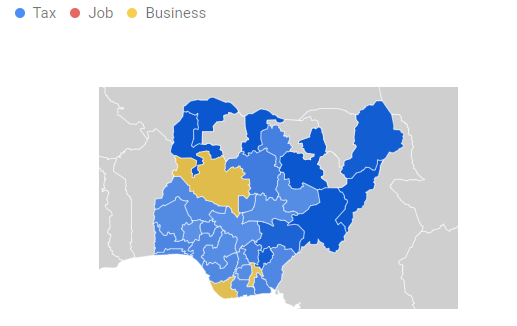
As Nigeria navigates significant reforms across sectors, a look at the nation’s search trends reveals a telling narrative of public priorities. A heatmap of Nigerians’ search interests over the last 90 days highlights three critical themes: tax, jobs, and business. Dominated by tax (blue), punctuated by business (yellow) in select southern regions, and barely touched by jobs (red), this map reflects the anxieties, aspirations, and regional disparities shaping the lives of millions. These insights hold powerful implications as Nigeria transitions into 2025.
Exhibit 1: Public search interests in 90 days Source: Google Trends, 2024
The Tax Dominance: Widespread Anxiety or Increased Engagement?
The dominance of tax-related searches across Nigeria signals a collective reckoning with the government’s drive to expand its revenue base through taxation. With the gradual decline of oil revenues, the federal government has ramped up tax reforms, introducing measures to expand the tax net and enforce compliance. While this strategy may secure much-needed revenue for development, it also places significant pressure on citizens and businesses, especially in a struggling economy.
For individuals, the surge in tax-related searches likely stems from confusion or apprehension about new policies and compliance requirements. Many Nigerians, particularly in the informal sector, are unfamiliar with digital tax systems or are wary of their implications. For businesses, especially small and medium-sized enterprises (SMEs), these concerns are magnified. Compliance costs, fears of punitive measures, and uncertainty about how taxation will impact profitability are driving the heightened interest.
Implications for 2025
The government must prioritize large-scale awareness campaigns to demystify taxation processes. Simplifying compliance and addressing public concerns will foster trust and voluntary participation. Citizens are more likely to embrace taxation if they see tangible benefits from their contributions. The government must transparently demonstrate how tax revenues are being utilized for the public good. Policies must carefully balance revenue generation with economic stimulation. Overburdening businesses or individuals risks stifling entrepreneurship and productivity.
The regions highlighted for business-related searches—predominantly in southern Nigeria—reflect the country’s commercial nerve centers. Lagos, the epicenter of economic activity, and its surrounding states have long been hubs for entrepreneurship and innovation. Despite inflation, currency devaluation, and other macroeconomic challenges, Nigerians remain committed to building businesses as a means of self-reliance and wealth creation.
This focus on business also emphasises regional disparities. The absence of significant interest in northern and interior states highlights unequal economic opportunities. Structural challenges, including poor infrastructure, insecurity, and limited access to capital, continue to stifle entrepreneurial growth in these regions.
Implications for 2025
The government must address regional imbalances by promoting economic activities in underdeveloped areas. Incentives for investors and improved infrastructure can help bridge the gap. Providing affordable access to credit, reducing bureaucratic hurdles, and offering mentorship programs can further bolster entrepreneurial success, particularly in high-potential regions. As Nigeria’s economy increasingly digitalizes, investing in technology for business growth—such as e-commerce platforms, digital payment systems, and training—can unlock opportunities for a broader population.
Jobs: The Quiet Crisis
The near-absence of job-related searches on the map is a striking observation, considering Nigeria’s persistently high unemployment rates. This silence could mean two things: either Nigerians are disillusioned with formal employment opportunities, or they have shifted focus toward entrepreneurship and informal work as alternative pathways to survival.
Nigeria’s youth, who represent a significant portion of the unemployed population, face particular challenges. The disconnect between the skills they possess and the demands of the job market continues to widen. While government programs aimed at reskilling and job creation exist, they have yet to yield visible results at scale.
Implications for 2025
Targeted programs to equip young Nigerians with market-relevant skills will be critical. Apprenticeships, vocational training, and partnerships with private sectors can create pathways for employment. Beyond traditional roles, government and private sectors must invest in emerging industries like technology, renewable energy, and creative arts to absorb Nigeria’s growing labour force. Policies must reduce barriers to employment, such as restrictive labour laws, and incentivize companies to hire locally.
A Pathway to Shared Prosperity
The interplay between these three themes—tax, business, and jobs—reveals the complexity of Nigeria’s socio-economic landscape. It also presents an opportunity for the government and stakeholders to align reforms with the aspirations of the people. As Nigeria enters 2025, these are the key takeaways for policymakers:
Nigerians are increasingly engaged with policies affecting their lives. Transparent governance, equitable resource distribution, and consistent communication will build the trust needed for successful reforms. Economic policies must consider the diverse realities across regions. By addressing structural barriers and providing tailored support, the government can ensure no region or group is left behind.
With the informal economy dominating Nigeria’s labour force, supporting this sector is crucial. Formalizing businesses, offering tax incentives, and providing access to markets can yield significant economic benefits. Education, skills development, and healthcare are foundational to sustained growth. Strategic investments in these areas will prepare Nigerians for a competitive global economy.
Charting the Course for 2025
The heatmap of search interests is more than just a snapshot of curiosity—it is a mirror of Nigeria’s present struggles and future potential. As the nation moves forward, political leaders must recognize that taxation, entrepreneurship, and employment are not isolated issues but interconnected threads of a larger narrative. Addressing these priorities holistically, with a focus on equity and inclusion, will not only stabilize the country in the short term but also set it on a path to prosperity.
The road to 2025 is both challenging and promising. By listening to the voices behind the data, Nigeria can craft policies that resonate with its citizens’ needs and aspirations, building a future where opportunity is accessible to all.