
DD
MM
YYYY

PAGES

DD
MM
YYYY

spot_img

PAGES

Home Blog Page 27

Pharma’s Pricing Storm Fails to Shake Healthcare’s Rally

0

The pharmaceutical industry has spent much of the year navigating an increasingly complicated political landscape, but investors appear to have decided that the latest threat is less dangerous than feared.

President Donald Trump’s latest Medicaid pricing agreements have expanded to include nine additional drugmakers, bringing the total number of participating companies to 26 and covering roughly 90% of the U.S. pharmaceutical market.

The newest group includes Alcon, Astellas and Teva, companies that have agreed to participate in a broader effort to reduce Medicaid drug prices while directing billions of dollars toward domestic manufacturing.

Collectively, the nine companies have pledged about $19.6 billion in U.S. manufacturing investment alongside commitments to offer discounted prices through Medicaid.

On paper, the agreements represent another significant intervention in the economics of American healthcare. Drug pricing has become one of Washington’s most politically sensitive issues.

With pharmaceutical companies facing pressure to lower costs while simultaneously maintaining research budgets, manufacturing capacity and shareholder returns. Yet Wall Street’s response has been remarkably calm.

Rather than interpreting the latest agreements as a major blow to pharmaceutical profitability, investors appear to view them as manageable. That reaction is particularly notable because healthcare stocks have just experienced their strongest quarter on record.

Suggesting that investors are looking beyond the immediate political headlines and focusing instead on earnings, innovation and the durability of demand. Biotechnology has been an especially striking part of that story.

The XBI biotech ETF has climbed approximately 80% over the past 12 months, transforming what was once a cautious corner of the market into one of its more powerful areas of momentum.

The rally reflects renewed enthusiasm for drug development, particularly in fields such as oncology, where advances in precision medicine and targeted therapies continue to reshape expectations.

UBS analyst Michael Yee believes the latest pricing agreements may actually remove some uncertainty from the sector. According to Yee, the deals were softer than investors had feared, reducing the possibility of a more severe policy shock hanging over pharmaceutical valuations.

That distinction matters. Markets often react as much to uncertainty as they do to bad news. A harsh policy outcome can force investors to price in years of lower margins, weaker cash flows and increased regulatory pressure.

But when the final agreement turns out to be less damaging than anticipated, some of that risk premium can disappear almost immediately. For Yee, the investment case is also being strengthened by developments in cancer treatment.

August brought a series of positive cancer-drug developments that reinforced his preference for companies such as Merck and Revolution Medicines. Their prospects highlight a central reality of the pharmaceutical market.

Political pressure can influence pricing, but it cannot easily erase the value created by successful innovation. Merck represents the scale and commercial power of an established pharmaceutical giant.

While Revolution Medicines embodies the potential of biotechnology to develop highly targeted treatments for difficult diseases. Their stories illustrate two sides of the same investment equation—financial strength on one side and scientific breakthroughs on the other.

The market appears to be drawing a line between political risk and fundamental risk. Trump’s pricing push remains important, particularly for an industry dependent on government programs and complex reimbursement systems.

But so far, investors do not appear convinced that it will derail the sector’s broader momentum. Healthcare’s record quarter and biotech’s extraordinary 12-month advance suggest that capital is still willing to bet on innovation.

If pricing agreements remain less punitive than feared and cancer-drug pipelines continue producing meaningful wins, the pharmaceutical rally may have more room to breathe.

For now, Washington may be rewriting the rules of the drug market, but Wall Street is listening closely to another language: earnings, innovation and growth.
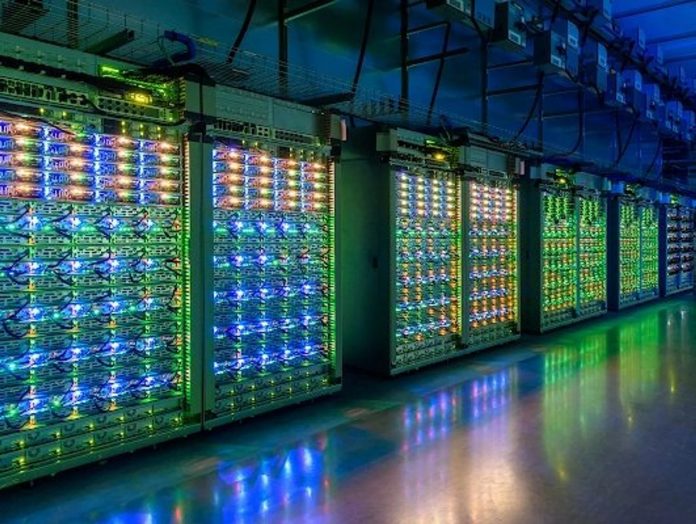

Trump, Sanders and the Political Fight Over America’s AI Data Centers

0

The data-center boom was supposed to be one of the great economic stories of the artificial-intelligence age. Billions of dollars would pour into towns, construction crews would find work.

Tax bases would expand, and communities would become part of the infrastructure powering a technological revolution. Yet beneath the promise of silicon and servers, a political fault line is widening.

Donald Trump has now stepped directly into that fight, urging American communities to stop resisting data-center projects. Writing on Truth Social on Monday, Trump described the buildout as a “Golden Goose” and warned that towns rejecting facilities risk becoming “backwards and poor.”

He also invoked China, arguing that Beijing could not be happier to see Americans turn against the infrastructure needed to compete in artificial intelligence. The message is unmistakable.

America cannot afford to slow the construction of the machines that will underpin the next generation of computing. But for many communities, the argument is not about rejecting technology. It is about asking who pays for it.

By late July, more than 500 counties and municipalities were restricting or blocking new data-center developments. The resistance stretches across political boundaries, making it increasingly difficult to dismiss as a fringe environmental movement or an anti-technology campaign.

Residents in different parts of the country have raised similar concerns: electricity costs, water consumption, grid capacity, noise and the transformation of local landscapes.

The economic equation becomes complicated when a community is told that a facility will bring prosperity while residents fear their utility bills could rise to accommodate enormous new loads on the power grid.

A data center may create construction jobs and generate tax revenue, but its electricity demand can also reshape local infrastructure decisions for decades.

Pennsylvania, Texas and New York have all seen efforts to pause, freeze or otherwise scrutinize projects. The geography matters because these are not states traditionally defined by opposition to industrial development.

Instead, they illustrate how the AI boom is colliding with an older reality: infrastructure has physical consequences. Bernie Sanders seized on that tension in his response to Trump, arguing that the reported 75% opposition does not represent Americans choosing poverty.

Rather, he said, people want a decent future for their communities. That distinction may define the political battle ahead. Trump sees data centers through the lens of global competition. In his framing, every delayed project potentially strengthens China.

While every new facility adds another brick to America’s technological fortress. Sanders and local opponents see the issue from the ground up, asking whether national ambitions should override local concerns about resources, affordability and quality of life.

Even Trump’s political allies appear to recognize the danger. A leaked National Republican Senatorial Committee memo reportedly warned that opposition to data centers could become a “sleeper” issue throughout the election cycle, beginning in Ohio.

That warning is significant because the politics of AI infrastructure are still being written. The same technology that promises economic transformation can become unpopular when its costs are visible at the household level.

America’s AI race therefore faces an uncomfortable question: how fast can the country build without leaving communities feeling that the future has been imposed upon them?

The Golden Goose may indeed be valuable. But communities want to know who owns the nest, who feeds the bird, and who gets stuck cleaning up after it.

Bitcoin Enters September at a Crossroads as Capital Rotates Toward Altcoins

0

Crypto markets are entering September with the unmistakable scent of risk appetite in the air, but beneath the green screens lies a more complicated story.

The broader market remains optimistic, yet the buying is no longer spread evenly across digital assets. Capital appears to be becoming more selective, with money flowing away from Bitcoin exchange-traded funds while Ethereum, XRP and Solana continue to attract inflows.

The rotation suggests that investors may be willing to take greater risks, but they are increasingly searching beyond Bitcoin for the next leg of returns.

That shift comes at an important moment for Bitcoin. August delivered one of its strongest performances for the month since 2015, yet the achievement carries an unusual contradiction.

Bitcoin can post a powerful August rally and still remain in negative territory for the year. The market therefore enters September with momentum on one side and unfinished business on the other.

Historically, September has often been an uncomfortable month for Bitcoin and broader risk assets. Seasonal weakness, profit-taking and uncertainty surrounding monetary policy can create a difficult environment.

This year, however, the backdrop is different. Institutional participation has grown, crypto markets have matured, and digital assets are increasingly connected to the wider financial system. These developments could soften traditional seasonal patterns, although they cannot eliminate them.

The most revealing development may be the changing composition of investment flows. Bitcoin has long been the primary institutional gateway into crypto, particularly through spot ETFs.

When those flows weaken while alternative assets continue attracting capital, it can signal a change in investor preference. Rather than abandoning crypto altogether, investors may simply be moving further along the risk curve.

Ethereum, XRP and Solana represent three different expressions of that appetite. Ethereum continues to benefit from institutional interest in its ecosystem and investment products. XRP has developed a powerful narrative around payments and institutional adoption.

While Solana remains closely associated with high-growth activity across decentralized finance, trading and consumer-facing crypto applications. Their continued inflows suggest that the market’s appetite is not disappearing; it is being redistributed.

For Bitcoin, September could therefore become a test of whether its August strength represented the beginning of a broader recovery or merely another burst of momentum. If Bitcoin can absorb ETF outflows, defend important support levels and regain institutional demand.

The negative year-to-date performance could begin to look increasingly temporary. A renewed surge in ETF inflows could also restore Bitcoin’s leadership and pull capital back from the altcoin complex. But the opposite scenario deserves equal attention.

If Bitcoin continues losing ETF demand while capital concentrates in higher-beta assets, its dominance could weaken further. That would not necessarily mean a collapse. Instead, it could mark a deeper rotation within the crypto market, where investors seek greater returns from assets with stronger narratives and more aggressive price momentum.

September, then, is unlikely to be simply a question of whether Bitcoin rises or falls. The more important question is where the market chooses to place its conviction. August demonstrated that Bitcoin still possesses considerable strength.

The opening of September is now asking whether that strength can translate into sustained leadership. For Bitcoin, the road ahead is therefore neither guaranteed nor hopeless. It is a contest between institutional flows, macroeconomic conditions, market psychology and seasonal history.

The risk-on mood remains alive. But as capital becomes more selective, Bitcoin must prove once again that it deserves to remain at the center of the crypto universe.

The Yield Storm Meets the AI Money Machine

0

The global economy is entering an unusual moment: borrowing is becoming more expensive, government debt is expanding, yet equity markets continue to march higher.

Across major economies, hawkish central banks and relentless government borrowing have pushed bond yields toward levels not seen in decades. Japan, long associated with ultra-low interest rates, has become one of the clearest symbols of this transformation.

With its 10-year government bond yield reaching 3% for the first time since 1996. Normally, rising yields would be expected to cast a shadow over stocks. Higher government borrowing costs raise the price of capital.

Increase financing expenses for companies and make relatively safe bonds more attractive compared with equities. But markets have so far refused to follow the traditional script. Stocks remain green, even as the foundations beneath them become more expensive.

Part of the explanation lies in the extraordinary concentration of the current rally.

Fewer companies are carrying the broader market, with investors increasingly clustering around businesses perceived to have durable earnings power and exposure to structural technological trends. At the center of that enthusiasm is artificial intelligence.

The AI boom has developed into something larger than a technology story. It has become an industrial spending cycle involving semiconductors, cloud computing, electricity, networking equipment and enormous data centers.

Every new model requires more computing power, and every leap in capability appears to create another appetite for infrastructure. Anthropic illustrates the scale of this spending frenzy.

The company has reportedly committed to enormous amounts of computing capacity, including a reported $35 billion cloud agreement with Nvidia-backed Lambda for a massive new data center in Texas.

That comes only days after Anthropic reportedly committed another $45 billion to Nscale for compute infrastructure in West Virginia. These numbers are staggering because they reveal the new economics of artificial intelligence.

The race is no longer simply about who can build the smartest model. It is about who can secure enough chips, power, cooling, data-center capacity and computing resources to operate those models at extraordinary scale.

The irony is difficult to miss. On one side of the global economy, governments are borrowing aggressively, pushing bond markets to demand greater compensation for holding public debt.

On the other, technology companies are committing tens of billions of dollars to an infrastructure race whose future returns remain difficult to measure. Yet investors continue to believe that AI could generate enough productivity, revenue and economic value to justify the spending.

That optimism has become a powerful counterweight to rising yields. Still, the market’s resilience should not be confused with immunity. If yields continue climbing, valuation pressures could eventually become harder to ignore.

Expensive capital can change corporate behavior, reduce investment outside the strongest sectors and expose companies whose business models depend heavily on cheap financing. For now, the financial world appears caught between two machines.

The first is the government borrowing machine, steadily issuing debt into a market demanding higher yields. The second is the AI investment machine, consuming capital at breathtaking speed in pursuit of the next technological frontier.

And both machines are humming. The question is not whether the money is moving. It clearly is. The deeper question is whether the productivity and profits eventually arrive quickly enough to justify the extraordinary capital being deployed today.

For now, the market’s answer is simple: keep spending, keep building and keep betting on AI. Brrr goes the money machine.

ChipMango Raises $1.9 Million to Expand Semiconductor Talent And Accelerate Edge-AI Innovation

0

ChipMango, an AI-native semiconductor technology company has raised $1.9 million in funding to expand semiconductor talent, strengthen chip-design capabilities and accelerate innovation across the United States, Africa and Europe.

The funding round was led by Atlantica Ventures VC Fund, with participation from DFS, Kaleo Ventures, Madica Ventures, Trilinear Technologies, Malta Ventures and other strategic investors.

The new capital will support the expansion of ChipMango’s AI-native workforce platform, commercial hardware engineering services and edge-AI development, as the company seeks to address growing demand for skilled semiconductor engineers and intelligent hardware.

Commenting on the funding round, ChipMango founder and CEO Ola Fadiran said,

The next era of AI will not be defined by software alone. It will depend on who can design the chips, systems and intelligent hardware that power it. Chipmango is expanding access to those capabilities so more regions can help build the technologies.”

Also commenting, Founding partner at Atlantica Ventures Anikó Szigetvári said,

“The semiconductor industry’s binding constraint is no longer capital it is people. Chipmango converts Africa’s deep engineering talent into world-class chip design capability, already proven through production-grade work for global customers. We believe it can become foundational infrastructure for the next generation of smart devices and semiconductor IP”.

Currently, the semiconductor industry is facing a significant talent shortage as artificial intelligence drives demand for advanced chips and computing infrastructure.

Deloitte estimates that the industry will need to add approximately one million skilled workers by 2030, requiring more than 100,000 new workers annually as global semiconductor revenue approaches $1 trillion.

ChipMango is tackling the talent and capacity gap through what it describes as a connected talent-to-technology model. The company develops engineers through industry-aligned curricula and professional tools, deploys them on commercial semiconductor projects, and uses the resulting expertise to drive innovation in edge AI, intelligent hardware and semiconductor intellectual property.

Through the latest funding, ChipMango aims to scale this model across multiple markets while contributing to the development of a broader and more globally distributed semiconductor engineering workforce.

Founded in 2022 by Ola Fadiran and Jovan Andjelich, Chipmango addresses one of the industry’s most urgent constraints: talent. The AI-semiconductor technology company connects industry-aligned training and hands-on engineering  development directly to commercial semiconductor design, verification, edge-AI and intelligent hardware programs.

This helps customers expand technical capacity while bringing more regions into the global semiconductor economy. ChipMango has taken steps toward building a broader semiconductor ecosystem in Nigeria.

In 2025, it partnered with NITDA to introduce the NITDA–ChipMango Microchip Design Framework, designed around capacity building, semiconductor outsourcing and policy development.

One of its recent milestones has been the expansion of its university training programmes. In Uganda, ChipMango partnered with Lwera Electronics and Semiconductors on a three-month chip-design programme involving 50 university students. In Nigeria, it partnered with AI UniPod UNILAG to launch fully sponsored Chip Design and Edge AI programmes, with an inaugural cohort of 40 trainees.

The company plans to establish a European Design center in Malta with Malta Ventures and advance ecosystem-building initiatives in Kigali, Rwanda focused on semiconductor capability, workforce development and AI infrastructure.

Looking ahead, ChipMango is positioned to deepen its role in the global semiconductor and AI hardware ecosystem as demand for advanced computing continues to rise.

As AI adoption accelerates across industries, demand for specialized chips, edge-AI systems and intelligent hardware is likely to remain strong.

ChipMango’s model of combining talent development, commercial engineering and semiconductor innovation could therefore position the company to capture opportunities across multiple stages of the AI hardware value chain.