DD
MM
YYYY

PAGES

DD
MM
YYYY

spot_img

PAGES

Home Blog Page 27

How Delta Exchange Helps You Trade Crypto Derivatives With Low Fees

0

Trading fees don’t look like a big deal at first, but they quietly shape your overall returns in the crypto derivatives market. If you’re a regular trader or adjust positions in fast-moving markets, you’ve probably felt how charges stack up over time.

Many traders lose a chunk of their gains without realising that frequent order placements, multi-leg setups, and hedges all trigger extra costs. This is where a cost-friendly platform like Delta Exchange makes a real difference.

In this post, we’ll discuss how this leading Indian crypto exchange helps you trade with confidence, whether you’re just starting out or already active in crypto F&O trading.

Market Insights and Delta Exchange’s Ecosystem

India already leads the global crypto population, and the growth ahead is set to be even stronger. The AltIndex report projects that the country’s crypto user base will grow by 21% to reach almost 330 million by 2028. The report also states that by 2028, every third crypto user worldwide will likely be from India.

With such a huge audience stepping into trading, access and affordability matter a lot. Many traders here want a smooth entry into crypto derivatives, and what better way than to rely on an Indian crypto exchange that keeps things simple.

Delta Exchange – One of the leading Indian crypto exchange

Delta Exchange fits well into this shift by offering crypto F&O and trackers with low trading fees, clean tools, and an app experience that suits all levels of users. It brings a practical setup that helps you trade without feeling weighed down by costs or complexity.

Why Worry So Much About Crypto F&O Trading Fees

High trading fees quietly eat into your profits. You notice it the most when you’re an active trader and rely on quick entries and exits. Even small cuts on every order add up over time.

Here’s where it matters:

  • Scalping multiple times a day, where each trade can cut your gains.
  • Multi-leg options setups that need several orders to build and adjust.
  • Regular hedging on platforms without low trading fees.
  • Active users on the Delta Exchange app who want flexibility without expensive trades.

When your fee outflow grows faster than your profit inflow, your crypto trading strategy stops feeling worth the effort. Delta Exchange solves this issue with a structure that supports frequent crypto F&O trading without draining your pockets.

Delta Exchange’s Transparent and Low Trading Fee Structure

Delta Exchange’s transparent fee structure helps you make apt trading decisions. Here are all the details you need to know about the crypto derivatives trading fees:

1. Maker and taker fees

  • Futures:05% taker and 0.02% maker fees.
  • Options:015% maker and taker fees – capped at 5% of option premium.
  • Trackers:05% maker and taker fees.

2. Liquidation fees

  • For futures: BTC 0.05%, ETH 0.10%.

Other altcoin liquidation fees range from 0.10% (100x leverage) to 1% (10x leverage).

  • For options:

When an options position on Delta Exchange gets liquidated, the platform charges a fee proportional to the notional size:

  • BTC: 20% of the premium and 0.05% of the notional size
  • ETH: 20% of the premium and 0.10% of the notional size.

A GST of 18% is also applicable to these liquidation fees on the platform.

3. Small lot sizes

  • BTC contracts start at ~?5000.
  • ETH contracts are available from ~?2500.

4. No hidden charges

You benefit from low trading fees if you scalp, adjust options often, or test strategies on the Delta Exchange app. The structure makes active trading on an Indian crypto exchange feel smoother and more cost-efficient without surprise deductions.

5. Deposit and withdrawal fees

Another benefit of Delta Exchange is that you don’t have to pay any deposit or withdrawal fees on the platform.

Extra Features That Support Efficient Crypto Derivatives Trading

Apart from the low trading fees on an Indian crypto exchange, you want tools that help you avoid errors, place cleaner trades, and test ideas without stress.
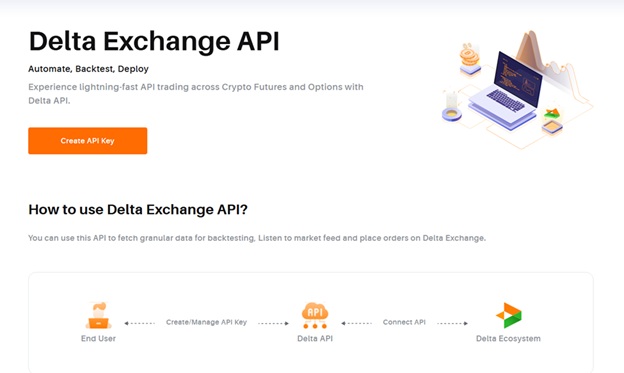

Delta Exchange’s API integration

The Delta Exchange app keeps your entire process smooth with features like:

  • INR deposits and withdrawals: You can move funds in and out in INR without currency conversions and keep your crypto F&O flow stable.
  • Demo account: If you want to try a new setup or learn crypto derivatives trading with zero pressure, the demo account gives you space to test freely.
  • Strategy builder and payoff charts: These tools show you how a multi-leg setup may behave. With payoff charts, you can readjust trades and enter the market more confidently.
  • Automated and API-based trading: You get tools to automate trades through the Delta API, run backtests, and deploy algo trading bots – reducing manual effort.
  • Mobile trading through the Delta Exchange app: You can download the mobile app for quick order placement and position checks to trade from anywhere, any time.

Final Thoughts: Should You Trade on Delta Exchange?

If you’ve ever felt your profits shrinking because of charges applied across trades, you’re not alone. To stand out, Delta Exchange has kept its fee structure transparent and lower than most competitors.

The low trading fees give you more breathing space, especially if you adjust positions often or run multi-leg ideas in crypto derivatives. With small lot sizes, INR access, and the Delta Exchange app, your bitcoin trading experience becomes smoother without extra effort.

Disclaimer: Cryptocurrency markets are subject to high risks and volatility. Kindly do your own research before investing.


FUTUROMiNing offers XRP, BTC, and SOL holders the opportunity to earn $1,000 per day.

0

As the global cryptocurrency market continues to fluctuate, more and more XRP, BTC, and SOL holders are seeking a way to expand their digital asset portfolios that is “unaffected by market fluctuations and sustainably appreciates in value.”

Among numerous cloud mining platforms, FUTUROMiNing has rapidly risen to become one of the fastest-growing cloud mining platforms globally, thanks to its stable income model, highly available data centers, and transparent operating mechanisms.

Now, FUTUROMiNing’s new mining system allows cryptocurrency holders to easily earn $1000 in passive income daily, attracting a surge of users worldwide.

Why are global investors flocking to FUTUROMiNing?

For many investors, the crypto market is fraught with uncertainty:

  • High price volatility
  • Long investment cycles
  • High technical barriers
  • Expensive equipment costs

Cloud mining offers a completely new solution to this problem.

On FUTUROMiNing, users don’t need to purchase mining rigs, have server rooms, or possess specialized technical skills. Simply select a contract to start automatic mining, with daily earnings automatically settled by the system, eliminating the risk of market fluctuations.

Get started in just 3 steps: Register ? Select Contract ? Automatic Mining

About FUTUROMiNing

FUTUROMiNing is one of the world’s leading cloud mining platforms, providing secure, efficient, and environmentally friendly cryptocurrency computing power services to over 2 million users from 100+ countries.

The platform is renowned for its high standards of transparency and strong compliance, and has become a trusted passive income tool for global investors.

FUTUROMiNing’s Core Advantages

  1. Compliance & Security & High Transparency

Headquartered in a compliant regulatory environment, adhering to global financial and data security standards, ensuring the safety of every user’s assets.

  1. Zero Equipment Cost, No Technical Skills Required

Users can start mining without mining rigs or technical knowledge, truly achieving zero barriers to entry.

  1. Automated Profit Distribution

Daily profits are automatically settled and distributed to user accounts by the system, and can be withdrawn at any time.

  1. Green and Environmentally Friendly Computing Power Services

Global data centers use clean energy for power, achieving environmentally friendly, efficient, and low-cost green mining computing power.

How to Get Started? Only 1 Minute

  • Visit the Official Website:  https://futuromining.com/
  • Create an Account
  • Register with your email address – simple and secure.
  • Get a $18 Free Reward

New users receive $18 upon registration, which can be used directly to start a free mining contract.

  • Choose a Mining Contract

Choose a suitable plan based on your budget and timeframe.

  • Activate the Contract

Supports deposits of mainstream assets such as BTC, ETH, XRP, and DOGE.

  • Automated Mining

Stable daily profit distribution.

  • Withdraw Anytime

Withdrawals are available to your personal wallet once your account reaches $100.

Contract Name Investment Duration Total Return (Principal + Interest)
Free Mining Experience $18 1 day $18.72
New User Experience $100 2 days $106
WhatsMiner M66S $500 7 days $547.25
WhatsMiner M60 $1,200 14 days $1,443.6
Bitcoin Miner S21 $2,600 20 days $3,380
Bitcoin Miner S21 XP Immersion $5,700 24 days $7,820.4
ALPH Miner AL1 $9,800 28 days $14,190.4


For more details, please visit the official website: https://futuromining.com/

Conclusion: Why is now the best time to join FUTUROMiNing?

In today’s uncertain global cryptocurrency market, stable-yield mining models are becoming a new trend for global investors.

FUTUROMiNing, with its:

  • Zero-risk equipment investment
  • Stable daily returns
  • Automated mining
  • High compliance and high security
  • Trust and support from global users

is the best choice for XRP, BTC, SOL, and other cryptocurrency holders to enhance asset value.

Register now to receive a $18 bonus and start your daily passive income for free!

Official website: https://futuromining.com/

Contact us: info@futuromining.com

Bitcoin “After Dark” ETF Filing Reveals Potential Strategy for Alpha, as Leveraged ETFs Hit Record $239 Billion in AUM

0

A new exchange-traded fund (ETF) proposal has emerged targeting Bitcoin’s (BTC) price movements outside U.S. trading hours, where historical data shows much of the cryptocurrency’s gains occur.

On December 9, 2025, Tidal Trust II filed a Form N-1A registration statement with the U.S. Securities and Exchange Commission (SEC) for the Nicholas Bitcoin and Treasuries After Dark ETF. This fund would adopt a unique timing strategy.

The ETF would acquire Bitcoin exposure via futures, options, or other U.S.-listed Bitcoin ETPs/ETFs around 4:00 p.m. ET when U.S. markets close, holding positions through the night. Positions would be unwound by 9:30 a.m. ET when markets reopen, with assets rotating into short-term U.S. Treasuries to minimize daytime volatility.

The rationale stems from analysis showing that a significant portion of Bitcoin’s 2024 price appreciation happened post-U.S. close, potentially allowing this ETF to outperform traditional spot Bitcoin funds by capturing “overnight returns” while sidestepping intraday dips often linked to U.S. equity market flows.

Bloomberg ETF analyst Eric Balchunas noted this could yield “better returns,” though it introduces timing risks and execution costs. This filing reflects the maturing Bitcoin ETF market, which has amassed over $118 billion in assets despite recent outflows like $3.48 billion in November 2025.

If approved, it would join a lineup of specialized products, signaling innovation amid BTC’s push toward $94,000 as of December 9. Currently, BTC trades around $92,000, up from recent lows but facing volatility amid Fed rate speculation.

Spot BTC ETFs saw $4 billion in outflows in November 2025 but rebounded with $287 million inflows on December 9. With $118 billion in BTC ETF assets under management, this filing reflects maturation in the space. Issuers are innovating beyond plain-vanilla spot/futures products to target niches like time-based strategies.

If approved, it could inspire similar “microstructure-engineered” ETFs, enhancing options for risk-averse investors. However, approval isn’t guaranteed—SEC scrutiny on crypto products remains high, especially post-2024 election shifts.

Next StepsThe SEC will review the filing, with a decision timeline potentially spanning 75 days. Investors should watch for updates on tidaletfs.com or SEC filings. This proposal underscores Bitcoin’s 24/7 nature clashing with traditional finance’s 9-to-5 model, potentially offering a “sleep-easy” way to bet on overnight edges.

Vivek Ramaswamy’s Strive Raises $500M for Bitcoin Expansion

In parallel, Strive Asset Management—co-founded by entrepreneur and former presidential candidate Vivek Ramaswamy—announced a $500 million “at-the-market” (ATM) preferred stock offering to bolster its Bitcoin treasury strategy.

The proceeds from selling Series A Perpetual Preferred Stock will primarily fund Bitcoin acquisitions. Purchasing additional BTC and related products, building on Strive’s current holdings of 7,525 BTC valued at ~$694–695 million, ranking it as the 14th-largest corporate holder.

Working capital, debt repayment, share buybacks, and investments in income-generating assets. This move emulates MicroStrategy’s (MSTR) playbook under Michael Saylor, using equity raises to amass BTC without dilution or heavy debt reliance.

Strive pivoted to a full Bitcoin treasury model in May 2025 via a reverse merger with Asset Entities and further expanded in September through acquiring Semler Scientific, a medical device firm with substantial BTC reserves.

CEO Matt Cole recently advocated for index providers like MSCI to include Bitcoin-holding firms in passive funds. The announcement drove Strive’s common stock up over 3% to $1.02, reflecting investor enthusiasm despite an 18% unrealized loss on its BTC stash.

If fully deployed at current prices ~$92,000/BTC, the raise could add ~5,400 BTC, potentially elevating Strive into the top 13 corporate holders. These developments underscore surging institutional Bitcoin adoption in late 2025, with ETFs innovating for niche strategies and corporates treating BTC as a balance-sheet staple.

Amid BTC’s volatility testing $92K–$94K, they signal confidence in long-term upside, though regulatory hurdles and market risks remain.

Leveraged ETFs Hit Record $239 Billion in AUM

Assets under management (AUM) in U.S. leveraged ETFs reached a new all-time high of $239 billion as of the end of Q3 2025.

This marks a significant surge, reflecting heightened investor appetite for amplified market exposure amid ongoing bull market momentum, AI-driven growth in tech sectors, and expectations of further Fed rate cuts.

The figure represents roughly 0.2% of the total U.S. stock market capitalization ~$125 trillion, but it underscores a broader trend of risk-on behavior. Leveraged ETFs, which use derivatives and debt to deliver 2x or 3x the daily performance of underlying indices like the S&P 500, Nasdaq-100, or sectors like semiconductors, have benefited from 2025’s equity rebound.

The S&P 500 and Nasdaq hit fresh highs in Q3, fueled by tech and defense stocks. For instance, gold miners and aerospace/defense leveraged funds like Direxion Daily Aerospace & Defense Bull 3X (DFEN) posted triple-digit gains earlier in the year.

Net inflows into leveraged products accelerated in H2 2025, with investors rotating from low-yield money market funds which crossed $8 trillion AUM in November. This aligns with broader ETF trends: Vanguard’s S&P 500 ETF (VOO) saw $20.8 billion in November inflows alone, the second-highest monthly figure in four years.

Top leveraged ETFs by AUM as of late 2025 include: ProShares UltraPro QQQ (TQQQ): ~$27 billion (3x Nasdaq-100). Direxion Daily Semiconductor Bull 3X (SOXL): ~$9.7 billion (3x semiconductors). Direxion Daily TSLA Bull 2X (TSLL): ~$6.5 billion (2x Tesla stock). ProShares Ultra QQQ (QLD): ~$7.7 billion (2x Nasdaq-100).

These funds saw strong trading volumes like TQQQ averages 95 million shares daily and performance, with SOXL up 19% in early 2025. This ATH signals peak optimism but also elevates risks. Leveraged ETFs amplify volatility: a 1% index drop can mean 2-3% losses or more due to daily resets and compounding.

In downturns, forced liquidations can exacerbate selloffs—similar to the October 2024 crypto flash crash that wiped $19 billion in leveraged positions. Analysts like those at Goldman Sachs note parallels to pre-dot-com bubble levels in AI valuations, with the top 10 S&P 500 stocks now comprising 40% of the index.

Leveraged ETFs are short-term tools; daily resets cause “volatility decay,” eroding long-term returns in choppy markets. At 0.2% of the $125 trillion U.S. stock market cap, they’re small but amplify sentiment—liquidations during corrections like October’s crypto flash crash wiped $19 billion can exacerbate downturns.

Combined with high valuations S&P 500 P/E ~28x and concentration top 10 stocks = 40% of index, this setup echoes pre-dot-com vibes. If the bull run continues, AUM could push $300 billion by mid-2026. But a 5% pullback—overdue after 159 days—might trigger forced selling, turning a dip into a rout.

Leveraged ETFs suit tactical traders, not buy-and-hold investors. Volatility decay is the hidden performance drag that causes leveraged (and inverse) ETFs to lose value over time — even when the underlying index ends exactly where it started — whenever the market is volatile.

It is the single most important concept to understand before ever touching a 2× or 3× ETF for more than a few days. Daily Reset + Compounding AsymmetryA 3× leveraged ETF does NOT deliver 3× the return of the index over weeks or months.

It delivers exactly 3× the daily return, every single day, and then compounds those daily returns. This daily re-leveraging creates the decay because percentage gains and losses are asymmetric.

Central banks’ gold buying 634 tonnes in 9 months and $324 trillion global debt add to the macro caution. If you’re trading these, stick to short-term horizons— they’re tools for tactical bets, not buy-and-hold. For broader exposure, consider unleveraged ETFs like VOO amid the inflows.

Implications of Amazon’s $35 Billion Investment Commitment in India

0

Amazon ($AMZN) has officially announced plans to invest more than $35 billion across its businesses in India through 2030. This commitment was revealed on December 10, 2025, at the sixth edition of the Amazon Smbhav Summit in New Delhi.

The investment builds on the company’s existing nearly $40 billion poured into the country since 2010, positioning Amazon as India’s largest foreign direct investor in e-commerce and a major job creator.

The funds will prioritize three strategic pillars aligned with India’s national priorities. Expanding AI capabilities, including cloud infrastructure via AWS, to benefit 15 million small businesses and hundreds of millions of consumers. This includes democratizing AI access and providing AI literacy programs for 4 million government school students by 2030.

Quadrupling cumulative e-commerce exports enabled by Amazon from $20 billion as of 2024 to $80 billion by 2030, supporting “Made-in-India” products going global. Generating an additional 1 million direct, indirect, induced, and seasonal jobs by 2030.

This builds on Amazon’s current support for about 2.8 million jobs in 2024 across technology, operations, logistics, retail, and creative services. According to an Economic Impact Report by Keystone Strategy, released at the summit, the investments will enhance logistics infrastructure, digitize over 12 million small businesses, and accelerate India’s digital transformation toward an “Atmanirbhar” and “Viksit” economy.

Amit Agarwal, Amazon’s Senior Vice President for Emerging Markets, emphasized the company’s long-term vision: “We have invested at scale in growing the physical and digital infrastructure for small businesses in India, creating millions of jobs, and taking Made-in-India global.

Looking ahead, we’re excited to continue being a catalyst for India’s growth, as we democratize access to AI for millions of Indians, create 1 million job opportunities, and quadruple cumulative ecommerce exports enabled to $80 billion by 2030.”

This pledge comes amid a wave of tech investments in India, including Microsoft’s $17.5 billion commitment for AI and cloud infrastructure announced December 9, 2025 and Google’s $15 billion for AI data centers over five years.

It underscores Amazon’s bet on India’s booming digital economy, which is projected to be one of the fastest-growing AI markets globally. As of December 10, 2025, $AMZN shares showed modest gains in pre-market trading, up about 0.5-1% following the announcement, reflecting investor optimism about emerging market expansion amid U.S. slowdown concerns.

This could diversify Amazon’s revenue streams, with India contributing significantly to AWS growth already a key driver. Analysts view it as a positive signal for sustained international revenue, potentially boosting EPS through cost efficiencies in logistics and AI scaling.

Amazon aims to democratize AI access for millions, including tools for 15 million small businesses, enhanced shopping experiences for hundreds of millions of customers, and education programs reaching 4 million government school students through curriculum support, teacher training, and hands-on learning.

The company plans to quadruple cumulative e-commerce exports enabled from India to $80 billion by 2030, up from $20 billion to date, via a new “Accelerate Exports” program. This will support an additional 1 million direct, indirect, induced, and seasonal jobs by 2030, bringing the total to 3.8 million, building on 2.8 million jobs supported in 2024.

Infrastructure investments will include expansions in fulfillment centers, transportation networks, data centers particularly for Amazon Web Services, and digital payments, with a heavy emphasis on cloud and AI capabilities.

This pledge surpasses recent commitments from competitors like Microsoft’s $17.5 billion for AI and cloud infrastructure by 2029 and Google’s $15 billion for AI data centers over five years. It also exceeds Amazon’s own 2023 announcement of $26 billion by 2030, reflecting accelerated growth in India’s digital economy—now boasting over a billion internet users and rapid e-commerce expansion.

Amazon’s efforts have already digitized 12 million small businesses in India. However, execution risks include regulatory hurdles in India’s e-commerce sector and competition from local players like Flipkart. If you’re considering investing based on this, note that past performance isn’t indicative of future results—consult a financial advisor.

China’s Anti-Stealth Radar Capabilities is a Growing Challenge to U.S. Air Superiority

0

China has made significant strides in radar technology designed to counter the stealth features of U.S. fifth-generation fighters like the F-22 Raptor and F-35 Lightning II.

These aircraft rely on radar-absorbent materials, angular shaping, and internal weapon bays to minimize their radar cross-section (RCS), often reducing it to the size of a golf ball or smaller against high-frequency (e.g., X-band) radars.

However, emerging Chinese systems—particularly quantum-based radars and long-wave VHF/UHF radars—exploit different physical principles to potentially detect and track these low-observable targets.

While Chinese state media and defense firms tout these as operational breakthroughs, Western analysts emphasize that real-world effectiveness remains unproven, with challenges in accuracy, range, and integration into combat networks.

Quantum radar represents a theoretical leap from classical systems, using entangled photons pairs of light particles linked by quantum mechanics instead of radio waves. When one photon interacts with a target, it disrupts the entanglement, allowing the receiver to detect the disturbance—even from faint reflections off stealth coatings.

This could theoretically bypass traditional stealth designs optimized for microwave frequencies. In October 2025, China announced mass production of a “photon catcher”—a four-channel single-photon detector developed by the Quantum Information Engineering Technology Research Centre in Anhui province.

This ultra-low-noise device detects individual photons with 35% efficiency up from 25% in prior models and operates at temperatures as low as -120°C, enabling multi-wavelength scanning for improved imaging. Chinese state media claims this enables quantum radars to track F-22 and F-35 signatures at ranges exceeding 100 km, rendering their RCS “obsolete” by analyzing quantum noise that classical radars ignore.

Unlike radio-wave radars, quantum systems are harder to jam or spoof, as stealth aircraft can’t mimic entangled photon signatures. Prototypes reportedly succeeded in simulated tests against stealth targets.

Integration into the People’s Liberation Army (PLA) Air Force’s early-warning networks is underway, potentially neutralizing U.S. advantages in scenarios like a Taiwan Strait conflict. Experts like MIT’s Jeffrey Shapiro argue quantum radar faces insurmountable hurdles, including atmospheric interference, low signal-to-noise ratios, and scalability issues—making it more “speculative” than deployable.

U.S. countermeasures, such as infrared search-and-track (IRST) systems on F-22s, could mitigate this without relying on radar. No independent verification exists, and claims echo unfulfilled 2016-2021 prototypes.

Stealth works best against shorter-wavelength radars like X-band, 3 cm, but VHF 30-300 MHz, 1-10 m wavelengths and UHF 300-3,000 MHz, 0.1-1 m systems use longer waves that interact differently with aircraft geometry, potentially yielding detectable returns despite absorbent materials.

JY-27V unveiled at the 2025 World Radar Expo, this truck-mounted VHF radar from China Electronics Technology Group Corporation (CETC) uses active electronically scanned array (AESA) antennas for 3D tracking. It claims detection of F-22/F-35 at up to 500 km, with high-power apertures and AI-driven signal processing to filter clutter.

An upgrade from the 2016 JY-27A, it’s designed for early warning in contested airspace. YLC-8E: A UHF counterpart, also mobile and fully digital, marketed as an “anti-stealth” system. It pairs with JY-27V for layered coverage, detecting RCS as low as a “metal marble” and guiding precision strikes.

Venezuela reportedly used a similar CETC system (JY-27) to track U.S. F-35s near its borders in 2025. These radars provide broad-area surveillance, cueing higher-frequency systems for fire control. China’s networked approach integrates them with S-400-like missiles and J-20 fighters.

Reports from 2024-2025 suggest PLA radars have tracked F-22s during U.S.-South Korea exercises. Low resolution hampers precise targeting—VHF detections yield “blobs,” not locks for missiles. Stealth still reduces effective range, and jamming or low-altitude flight evades them. Russian analogs like Nebo-M face similar issues.

These advancements signal China’s $10B+ investment in quantum and anti-stealth tech, aiming to erode U.S. air dominance in the Indo-Pacific. If integrated, they could force F-22/F-35 pilots to rely more on standoff weapons or electronic warfare.

However, as one X post notes, quantum claims may be “90% propaganda,” with VHF/UHF better suited for cueing than solo kills. The U.S. is responding with next-gen jammers, hypersonics, and allied networks like AUKUS.

China’s radars can detect stealth aircraft under ideal conditions, but turning detection into a decisive edge requires overcoming technical and tactical hurdles. This arms race underscores that no technology is invincible—stealth’s era may evolve, not end.