
DD
MM
YYYY

PAGES

DD
MM
YYYY

spot_img

PAGES

Home Blog Page 279

Gold Price Drops Below $4100 Shredding $1.7T Worth of MarketCap

0

Gold has plummeted, erasing a massive chunk of its total market capitalization calculated as above-ground gold stocks multiplied by the spot price. Gold is trading at approximately $4,050 per troy ounce, down about 1.8–2.2% from yesterday’s close.

This puts it firmly below $4,100 marking a sharp pullback from recent all-time highs around $4,381 earlier this week. The drop equates to roughly $75–$85 per ounce from yesterday, the largest single-day fall since August 2020.

Over the past few days, gold has shed over 5% from its peak. Estimated at $27.8–$28.1 trillion today, based on ~216,265 metric tons 6.95 billion troy ounces of above-ground gold stocks. This is down from ~$29 trillion at the peak last week.

The plunge has erased $1.7–$1.75 trillion in market cap over the last 24–48 hours, confirming your figure. For context, earlier in the month, a single-day drop wiped out over $1 trillion alone.

Calculations based on 6.95B oz supply; minor variances from source estimates.Why the Drop?Profit-Taking: After a blistering rally up 48% year-over-year, investors are locking in gains ahead of Diwali and key U.S. inflation data this week.

A rebounding dollar and de-escalating U.S.-China trade frictions are pressuring non-yielding assets like gold. Capital is shifting to stocks, Bitcoin, or Treasuries as Q4 optimism builds.

Gold broke key support near $4,100, accelerating the sell-off; forecasts suggest potential tests of $4,045 if momentum persists. Short-term bearish, with downside risks to $4,000 if U.S. data surprises positively (e.g., cooler inflation).

But long-term bulls remain intact—analysts like Goldman Sachs eye $4,000+ by mid-2026, driven by central bank buying and scarcity. Gold’s “infinite market cap” slow supply growth keeps it a wealth benchmark, now rivaling entire stock indices in scale.

As of October 21, 2025, spot gold prices are hovering around $4,371–$4,393 per troy ounce, with intraday peaks touching $4,393.60 earlier. This marks a staggering ~60% surge year-to-date from ~$2,722 at the start of 2025, and it’s up over 19% in the past month alone.

Prices fluctuate rapidly; these are mid-morning ET figures. Gold briefly dipped after Monday’s record close above $4,380, but the uptrend remains intact. This isn’t just hype—gold’s ATH run is fueled by a perfect storm of global jitters.

Escalating U.S.-China trade tensions think tariffs and rare earth mineral disputes are pushing investors toward gold as a hedge against uncertainty. Expectations of further interest rate reductions make non-yielding assets like gold more appealing, especially with inflation lingering.

Ongoing U.S. sanctions, the Russia-Ukraine fallout, and diversification by central banks (e.g., China loading up) are supercharging buys. A softer USD and record inflows into gold ETFs are amplifying the rally.

Analysts like those at Goldman Sachs have bumped their 2026 forecast to $4,900/oz, citing sustained central bank hoarding. On the flip side, some warn of overbought conditions—Bank of America advises caution as prices stretch valuations thin.

From $850 to $4,400?Gold’s inflation-adjusted ATH was ~$850/oz in January 1980 nominal ~$2,000 in today’s dollars, but the nominal record was ~$2,000 in 2011. Fast-forward to 2025: It first cracked $4,000 on October 7 amid Fed bets and a U.S. government shutdown scare, then powered past $4,300 last week.

At ~$4,400, it’s obliterating those marks—up 50%+ YTD—and some bulls eye $5,000 or even $10,000 if chaos persists. One chart-watcher eyes a “sick move” to $4,400 after dipping below $4,196: “GC1! taking out PWL < 4196 then back up to 4400 for a new ATH would be a sick move .”

Peter Schiff’s “gold eating Bitcoin’s lunch” jab is still echoing—BTC’s down 32% in gold terms since August. If you’re eyeing exposure ETFs, futures, or physical, consider diversification over FOMO—experts stress a long horizon over chasing peaks. What’s your take: Buy the dip or wait for $4,400?
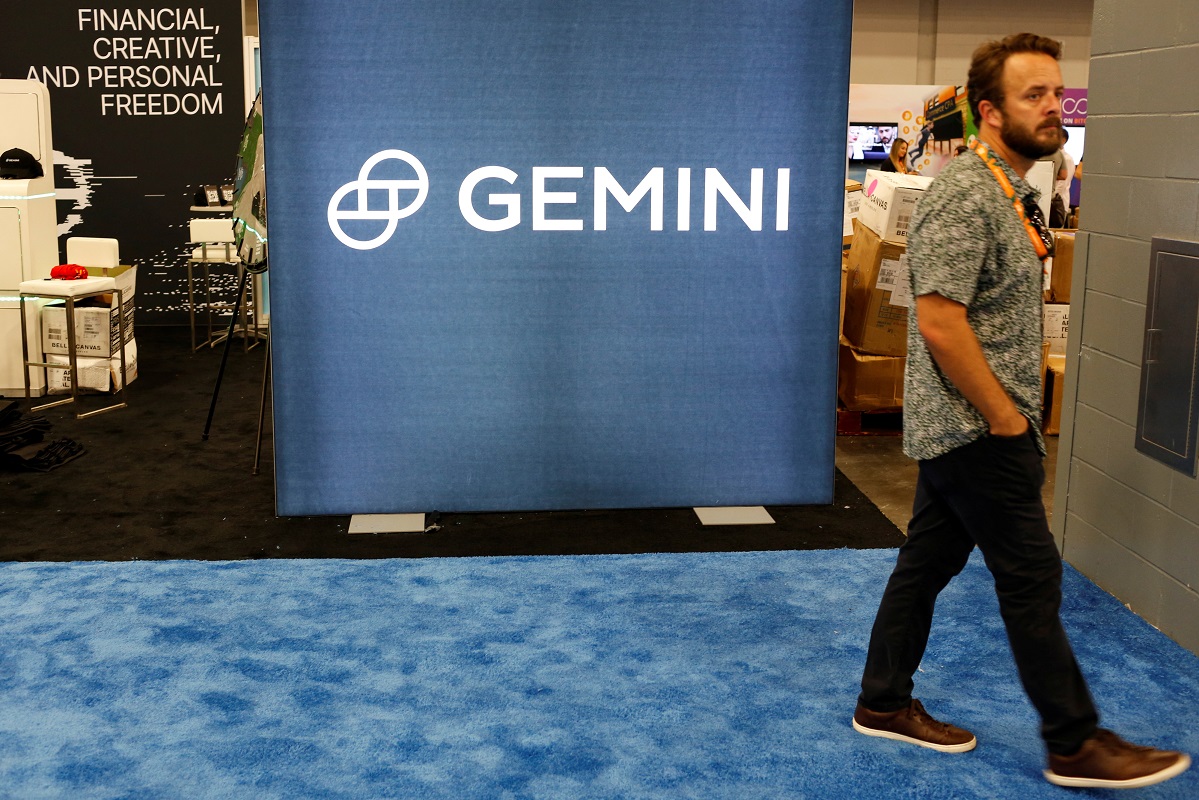
Gemini Launches Solana-Themed Credit Card with Auto-Staking Rewards

0
A man walks past the logo of Gemini Trust, a digital currency exchange and custodian, during the Bitcoin Conference 2022 in Miami Beach, Florida, U.S. April 6, 2022. REUTERS/Marco Bello/Files

Cryptocurrency exchange Gemini officially unveiled the “Solana Edition” of its Gemini Credit Card, marking its first blockchain-specific card design and introducing an innovative auto-staking feature for rewards.

This move deepens Gemini’s integration with the Solana ecosystem, allowing users to earn Solana (SOL) tokens on everyday spending while optionally staking those rewards directly for additional yield.

Earn up to 4% back in SOL on eligible purchases, with boosted rates of up to 10% at select partner merchants (e.g., for gas, EV charging, and rideshare spending). Rewards are flexible and can be redeemed in various cryptocurrencies.

For the first time, cardholders can enable automatic staking of SOL rewards on Gemini’s platform, earning up to 6.77% APY while supporting Solana’s network security through transaction validation. Users can unstake at any time, though processing may take hours to days.

The limited-edition physical card features a 16-gram matte metal build with Solana’s signature gradient design. It includes no annual or foreign transaction fees, plus Mastercard World Elite benefits like travel insurance and concierge services. Issued by WebBank.

Gemini highlighted that SOL rewards held for at least one year have appreciated by nearly 300%, making it one of the top-performing assets in their rewards program. This launch follows Gemini’s recent expansions in Solana support, including USDC and USDT transfers on the network and institutional staking services earlier in 2025.

The exchange cited Solana’s high throughput, low fees, and vibrant developer community as key reasons for the partnership.Market ReactionThe announcement contributed to a modest uptick in SOL’s price, with gains of around 2-3% in the following trading session.

Gemini’s stock (GEMI) also rose about 5% to $20.67. On X (formerly Twitter), the news generated buzz, including an official promo from Solana’s account emphasizing the card’s seamless fiat-to-SOL earning potential.How to Get StartedU.S. residents can apply via the Gemini app or website.

New users opt in during signup; existing cardholders can select SOL rewards and enable auto-staking in their settings. Availability is limited for the physical Solana-themed card.

This product positions Gemini as a leader in blending traditional finance with crypto, potentially accelerating Solana’s mainstream adoption by turning routine purchases into yield-generating opportunities.

Solana staking is the process of locking up SOL tokens to support the network’s operations, specifically its Proof-of-Stake (PoS) consensus mechanism, in exchange for rewards.

Proof of Stake (PoS)Solana uses a Proof-of-Stake model combined with Proof-of-History (PoH) to achieve high transaction throughput and low latency. Validators (nodes) process transactions and secure the network. Staking involves delegating SOL to validators, who use these tokens to participate in consensus and earn rewards.

PoH ensures efficient ordering of transactions, reducing the computational burden and enabling Solana’s high-speed blockchain. Users lock SOL in a stake account and delegate it to a validator of their choice. You don’t run a validator yourself; you entrust your SOL to one.

These are distinct from your main wallet. You create a stake account to hold the SOL you want to stake, which is then assigned to a validator. Once delegated, your stake enters an “activating” phase typically one epoch, ~2-3 days. After activation, it contributes to the validator’s voting power and starts earning rewards.

Rewards are distributed at the end of each epoch, based on the validator’s performance and the total staked SOL on the network. Annualized returns typically range from 5-8% APY (e.g., ~6.77% as noted in recent data), though this varies with network conditions.

To stop staking, you deactivate your stake, which enters a “deactivating” phase another epoch before the SOL becomes liquid again. This cooldown prevents immediate withdrawal. These are nodes that validate transactions and produce blocks.

The more SOL staked to a validator, the higher its chance of being selected to propose blocks. Choose validators with good uptime and reasonable fees typically 0-10% of your rewards.

Solana operates in epochs ~2-3 days, ~432,000 slots. Rewards are calculated and distributed per epoch based on the validator’s performance and the network’s inflation rate. Solana’s inflation currently ~4-6% annually funds staking rewards. The total reward depends on the global stake rate higher staked percentage reduces individual APYs and validator commission.

Unlike some blockchains, Solana currently has no slashing penalties for validator misbehavior, so your staked SOL is safe from loss due to validator errors, though you should still pick reliable validators to maximize rewards.

Staking with top validators can concentrate power. Supporting smaller, reliable validators helps network decentralization. With Gemini’s Solana Credit Card, rewards earned in SOL can be automatically staked via their platform.

This simplifies the process: Gemini handles delegation to a validator, and rewards compound at the network’s APY (e.g., ~6.77%). Users can opt out and unstake, subject to Solana’s standard epoch-based cooldown.

Solana’s scalability 65,000+ TPS makes it attractive for validators and stakers. Transaction costs are minimal, preserving rewards. Staking offers a way to earn yield on SOL holdings while supporting network security.

Jupiter DEX Launches Beta Prediction Markets Powered by Kalshi

0

Jupiter, the leading decentralized exchange (DEX) aggregator on Solana, officially launched its first native prediction market in beta form.

This new feature allows users to trade on real-world event outcomes directly within the Jupiter platform, with liquidity and data powered by Kalshi, a U.S.-regulated event contract exchange overseen by the Commodity Futures Trading Commission (CFTC).

The integration bridges traditional finance’s regulatory-compliant prediction trading with Solana’s high-speed, low-cost DeFi ecosystem, aiming to enhance liquidity, transparency, and accessibility for retail traders.

The beta kicks off with a focus on sports betting, specifically the winner of the Formula 1 Mexico Grand Prix scheduled for October 26, 2025. Users can speculate on drivers like Max Verstappen current favorite at 47.61% odds, Lando Norris (27.3%), Oscar Piastri, or George Russell.

How It Works: Traders buy and sell “Yes” or “No” shares for specific outcomes (e.g., “Yes” on Verstappen winning). Share prices fluctuate between $0.01 and $0.99 based on market sentiment and supply/demand.

Positions can be exited anytime before resolution. At event end, correct “Yes/No” shares pay out $1 each; incorrect ones expire worthless. Settlement is on-chain via Solana for speed and auditability.

Trading Limits (Beta Safeguards): To maintain stability, the global cap is 100,000 contracts, with a per-user limit of 1,000 contracts. Available now via the Jupiter app at jup.ag/prediction. No bridging is required for Solana users, and it’s designed for seamless integration with existing wallets.

This launch positions Jupiter as a frontrunner in on-chain prediction markets, competing with platforms like Polymarket while leveraging Kalshi’s established liquidity Kalshi has handled significant volumes in sports and non-political events.

Prediction markets overall have grown rapidly, with total value locked (TVL) across platforms hitting $241.9 million recently. By combining Kalshi’s compliance and depth with Solana’s efficiency, Jupiter could attract traditional finance users wary of unregulated DeFi, while enabling new use cases like hedging real-world risks (e.g., economic data or geopolitics) in future expansions.

Kalshi’s role is pivotal: As a CFTC-regulated entity since 2021, it provides event resolution data and liquidity without Jupiter acting as a broker. Early community buzz on X highlights the “solid combo” for better pricing and liquidity.

X users are optimistic, with comments like “Moon that” from Kalshi’s crypto lead and calls for more Solana-DeFi integrations. This follows similar moves, like Polymarket’s Solana integration and World App’s Polymarket tie-up, signaling a broader trend of prediction markets entering mainstream crypto.

Kalshi is a U.S.-based prediction market platform regulated by the Commodity Futures Trading Commission (CFTC), a federal agency overseeing derivatives markets. Since receiving approval in November 2020, Kalshi operates as a Designated Contract Market (DCM) under the CFTC, making it the first regulated exchange for event contracts in the U.S.

This status subjects Kalshi to strict compliance with the Commodity Exchange Act (CEA) and CFTC regulations. Kalshi offers trading on “event contracts,” which are binary (yes/no) markets based on real-world outcomes, such as sports results, economic indicators, or weather events.

These contracts are treated as commodity derivatives, requiring CFTC approval for each market type to ensure they serve a legitimate economic purpose (e.g., hedging or price discovery) and avoid sensitive topics like political elections in some cases.

Kalshi must adhere to CFTC rules on market integrity, including anti-manipulation measures, transparent pricing, and regular reporting of trading activity. Funds are held in segregated accounts, and Kalshi enforces know-your-customer (KYC) and anti-money-laundering (AML) checks to verify user identities and prevent illicit activity.

The CFTC imposes caps on contract sizes (e.g., $25,000 per contract for certain markets) and restricts retail participation in some high-risk markets to protect consumers.

Kalshi uses predefined, objective data sources for settling contracts (e.g., official sports outcomes or government economic reports), ensuring fairness and reducing disputes.

Significance for Jupiter’s Integration

By partnering with Kalshi, Jupiter leverages a regulated liquidity pool and event resolution data, allowing its Solana-based prediction markets to operate with compliance in the U.S.

This contrasts with unregulated platforms like Polymarket, giving Kalshi-powered markets like Jupiter’s a legal edge for U.S. users. Kalshi’s CFTC regulation restricts certain markets like political betting was only recently allowed under specific conditions and limits participation based on U.S. state laws, which may affect Jupiter’s market accessibility.

Syndicate and EigenCloud Simplify Decentralized Sequencers for Ethereum Rollups

0

Syndicate, the infrastructure layer for developing and scaling purpose-built chains, has teamed up with EigenCloud, the world’s first verifiable cloud platform, built on EigenLayer, to launch AVS Sequencer Networks, a new solution that makes it simple for Ethereum rollups to decentralize their sequencers without rebuilding their infrastructure.

Until now, rollups that wanted to decentralize faced a tough choice: rewrite large parts of their systems or stay reliant on a single, centralized sequencer.

AVS Sequencer Network removes that trade-off by letting teams deploy decentralized, programmable sequencer networks secured by native token staking — all while remaining compatible with major rollup frameworks like Arbitrum Nitro and OP Stack.

Decentralised sequencers are key to scaling Ethereum and delivering a community-owned internet, said Will Papper, Co-Founder at Syndicate. “Our partnership with EigenCloud makes this transition seamless for rollup teams, laying the foundation for horizontal scalability across thousands of purpose-built chains.”

At its core, the system replaces centralized control with collective verification. Syndicate Network provides programmable sequencer smart contracts, while EigenCloud contributes the validation and data infrastructure through its Actively Validated Services (AVS) and EigenDA.

Together, they ensure that blocks are sequenced and verified cryptographically by multiple operators instead of being controlled by a single party, improving fairness, transparency, and network resilience.

This addresses one of Ethereum’s biggest scalability challenges and advances the vision of a community-owned internet. With AVS Sequencer Networks, rollup teams can decentralize in days, not months, unlocking a more open and verifiable web where thousands of independent purpose-built chains can thrive in parallel.

“This collaboration transforms how rollups achieve decentralization,” said Sreeram Kannan, Founder and CEO at Eigen Labs. “It’s a true showcase of what EigenCloud was designed to support, letting developers decentralize their sequencing logic while maintaining Ethereum-level security.

With minimal integration, teams can now use Syndicate’s tools and EigenCloud’s infrastructure to launch new sequencers that are compatible with most rollup frameworks.”

Syndicate is the blockchain infrastructure layer for horizontally scaling Ethereum through purpose-built chains, customized, programmable, decentralized networks and sequencers designed for specific applications and their communities.

With Syndicate, developers can control how their chain operates from governance and fees to how transactions are processed and value circulates within their economy.

Backed by leading investors including a16z, Coinbase, Circle, IDEO, Electric Capital, Variant Fund, and CoinFund, Syndicate is building the foundation for a community-owned internet: networks owned by the people who build and use them everyday.

About EigenCloud

EigenCloud is the world’s first verifiable cloud, enabling developers to build applications, AI products, and AI agents that are provably trustworthy. Built on top of the EigenLayer restaking protocol, EigenCloud extends Ethereum’s security across the digital and even physical world, allowing developers to verify any input, event, or computation using cryptoeconomic guarantees.

With primitives like EigenAI for verifiable inference, EigenCompute for secure offchain execution, and EigenDA for high-throughput data availability, EigenCloud introduces verifiability-as-a-service to launch a new era of cloud computing.

Its services are backed by over $19B in staked assets, with more than 190 Autonomous Verifiable Services (AVSs) in development and 40+ live on mainnet.

Syndicate and EigenCloud are also launching a Design Partner Program for rollup teams and infrastructure providers who want early access to the technology. Full technical specifications and first deployments will be released in the coming weeks.

FalconX Acquires 21Shares, a leading Crypto Exchange-Traded Products (ETPs) firm

1

Institutional crypto prime broker FalconX announced its acquisition of 21Shares, a leading issuer of cryptocurrency exchange-traded products (ETPs).

This deal, reported by outlets including the Wall Street Journal, CoinDesk, and Cointelegraph, marks FalconX’s third major transaction in 2025 and underscores accelerating consolidation in the digital asset space amid a more favorable U.S. regulatory environment, such as the recent GENIUS Act.

Terms are undisclosed but involve a mix of cash and FalconX shares. The merger combines 21Shares’ expertise in ETP design and distribution with FalconX’s $2 trillion+ trading infrastructure, serving over 2,000 institutional clients.

The combined entity plans to launch new regulated crypto investment products, focusing on derivatives and structured funds to bridge traditional finance and crypto. This expands FalconX beyond market-making into ETF/ETP issuance, enhancing global reach across the US, Europe, and Asia-Pacific.

Founded in 2018, the Zurich-based firm manages over $11 billion in assets across 55+ ETPs (e.g., Bitcoin, Ether, and token-specific products), primarily in Europe where such products predate U.S. approvals.

This follows a crypto M&A surge, including Coinbase’s $2.9B Deribit buy and Kraken’s $1.5B NinjaTrader deal, signaling mainstream institutional adoption.

FalconX CEO Raghu Yarlagadda emphasized the move as a “natural next step” for market efficiency, while 21Shares co-founder Hany Rashwan highlighted innovation in digital asset products.

Bealls Inc. Adds In-Store Crypto Payment Support

On October 20, 2025—coinciding with its 110th anniversary—U.S. retailer Bealls Inc. launched in-store cryptocurrency payments across all 660+ locations in 22 states, partnering with Flexa.

This makes Bealls the first national U.S. retailer to accept digital assets from any wallet across multiple blockchains, including majors (Bitcoin, Ethereum), stablecoins (USDC), and memecoins (Dogecoin, Shiba Inu).

Powered by Flexa Payments, the system integrates seamlessly with existing POS terminals, supporting 99+ cryptocurrencies from 300+ wallets. Transactions settle in sub-seconds with instant fiat/stablecoin payouts to merchants, minimizing volatility risks.

Applies to Bealls, Bealls Florida, and Home Centric brands for in-store purchases only online expansion TBD. No transaction fees for customers; security via blockchain confirmations.

With ~28% of U.S. adults 65M people holding crypto in early 2025, this taps growing demand for alternative payments. It follows similar moves by retailers like Overstock and Newegg, but stands out for scale and multi-chain support.

Bealls Chairman/CEO Matt Beall called it a step toward “reshaping global commerce,” while Flexa co-founder Trevor Filter praised Bealls’ legacy of innovation since 1915. This rollout highlights crypto’s shift from speculation to everyday utility, potentially boosting adoption as more chains integrate.

The merger strengthens FalconX’s ability to offer regulated crypto investment products like ETFs/ETPs, bridging traditional finance (TradFi) and crypto. This could attract institutional investors seeking exposure to crypto via familiar vehicles, especially in the U.S. where spot crypto ETFs have gained traction since 2024.

Combining FalconX’s trading infrastructure with 21Shares’ ETP expertise enables innovative offerings like crypto derivatives and structured funds. This could deepen liquidity and stabilize markets, appealing to risk-averse institutional players.

With 21Shares’ European and Asia-Pacific presence, FalconX gains a foothold in markets with mature ETP frameworks, potentially increasing its $2T+ trading volume and client base 2,000+ institutions.

The acquisition aligns with a favorable U.S. regulatory shift (e.g., GENIUS Act), easing crypto product approvals. This could accelerate launches of new ETFs, positioning FalconX-21Shares as a market leader in a less restrictive environment.

However, global regulatory fragmentation may complicate cross-border product standardization, requiring careful compliance navigation. The deal reflects a broader M&A wave signaling crypto’s maturation. Smaller players may struggle to compete, potentially leading to further consolidation or niche specialization.

Competitive pressure on rivals like Grayscale or BlackRock’s iShares could drive innovation but also margin compression in the ETF space. FalconX’s infrastructure could enhance price discovery and reduce volatility in ETPs by leveraging its market-making prowess.

However, integrating 21Shares’ $11B AUM into FalconX’s operations poses execution risks, such as operational scaling or client retention challenges. Overreliance on crypto market growth could expose the merged entity to downturns, especially if retail or institutional sentiment sours.

Implications of Bealls Inc. Adding In-Store Crypto Payments

Bealls’ move, as the first national U.S. retailer to accept crypto in-store across 660+ locations, normalizes digital assets for everyday purchases. With 28% of U.S. adults (~65M) holding crypto, this could drive spending, especially among younger, crypto-native consumers.

Supporting 99+ cryptocurrencies across multiple blockchains (via Flexa) sets a precedent, potentially pressuring competitors (e.g., Walmart, Target) to follow. This could accelerate crypto’s use as a payment rail, reducing reliance on traditional payment processors like Visa.

Flexa’s sub-second settlement and instant fiat/stablecoin payouts minimize volatility risks and transaction fees for Bealls, potentially lowering costs compared to card networks (2-3% fees). This could improve margins or allow competitive pricing.

Accepting memecoins (e.g., Dogecoin, Shiba Inu) alongside majors and stablecoins taps diverse crypto communities, potentially boosting foot traffic and brand loyalty among tech-savvy shoppers. Seamless POS integration via Flexa demonstrates blockchain’s practical utility, encouraging other retailers to adopt similar systems.

However, scaling to high transaction volumes across 660 stores tests blockchain network reliability (e.g., Bitcoin, Ethereum). Supporting multiple blockchains enhances accessibility but introduces complexity in wallet compatibility and user education, which could slow adoption if not user-friendly.

Bealls’ move reflects confidence in crypto’s staying power, potentially influencing investor sentiment and attracting more retail-focused blockchain development. Limited crypto wallet adoption and user unfamiliarity could hinder uptake, especially for in-store purchases requiring quick transactions.

Both developments reflect crypto’s shift from speculative asset to institutional and consumer utility, driven by infrastructure (FalconX-21Shares) and real-world adoption (Bealls). This could amplify market confidence and investment.

These moves signal crypto’s deepening integration into finance and commerce, but their success hinges on execution, regulatory clarity, and sustained market enthusiasm.