DD
MM
YYYY

PAGES

DD
MM
YYYY

spot_img

PAGES

Home Blog Page 2881

Circle moves Headquarters to NYC ahead of IPO

0

Circle Internet Financial, the issuer of the popular stablecoin USDC, has announced a significant shift in its operations as it prepares to transition its global headquarters to New York City. This move comes at a pivotal moment for the company as it gears up for an initial public offering (IPO).

The relocation to New York, a city often regarded as the financial capital of the world, is a strategic one for Circle. By positioning itself in the heart of Wall Street, Circle is signaling its readiness to play a central role in the evolving landscape of finance, where traditional systems and digital innovations converge.

Circle’s choice of the iconic One World Trade Center as its new base underscores the company’s commitment to security, trust, and stability—values that are paramount in the financial sector, especially within the rapidly growing realm of cryptocurrency. The symbolism of this location cannot be overstated; it represents resilience and progress, qualities that Circle aims to embody as it forges a path forward in the digital economy.

The timing of Circle’s move is noteworthy, aligning with a broader trend of cryptocurrency firms seeking to establish a more prominent presence within mainstream financial ecosystems. Circle’s USDC is the world’s second-largest stablecoin, backed by cash and cash equivalents, including short-term Treasury bonds. Despite fluctuations in the crypto market, the demand for stablecoins like USDC remains robust, reflecting their critical role in providing stability and facilitating transactions within the volatile cryptocurrency markets.

The recent move by Tether to mint an additional $1 billion USDT on the Ethereum blockchain has been a significant event in the cryptocurrency market. This action, described as an “inventory replenish,” is part of Tether’s ongoing efforts to manage liquidity and ensure smooth operations across different blockchains.

Tether’s CTO, Paolo Ardoino, clarified that this minting is an “authorized but not issued transaction,” meaning the new USDT will be used for future issuance requests and chain swaps. Chain swaps are a vital process that allows traders to transfer digital assets from one blockchain to another, facilitating the use of cryptocurrencies like USDT on multiple platforms.

This development comes at a time when the stablecoin market is under close scrutiny, with Tether’s USDT maintaining a significant market dominance despite challenges faced by other stablecoin issuers. The minting of USDT is a routine part of Tether’s operations and is not expected to impact the overall market cap of USDT immediately.

The move also precedes a forecasted Bitcoin price rally, potentially signaling a positive outlook for the cryptocurrency market. As the market responds to these developments, Tether’s actions highlight the dynamic and interconnected nature of blockchain technologies and the importance of maintaining liquidity in the ever-evolving digital asset landscape.

Circle’s upcoming IPO is a testament to the company’s growth and the increasing interest in cryptocurrencies as a legitimate and integral part of the financial landscape. The move to New York and the planned IPO is expected to bolster Circle’s position, potentially setting the stage for stablecoins to become a mainstream fixture in the global financial system.

As Circle embarks on this new chapter, the eyes of the financial world will be watching closely. The company’s success or failure could have far-reaching implications for the acceptance and integration of cryptocurrencies within traditional finance. With its new headquarters set to open in early 2025, Circle is poised to make a significant impact on the future of finance, blending the innovation of Web3 with the established practices of Wall Street.

The Fastest Proxy Servers to Use in 2024

0

In an increasingly interconnected world, privacy and security are paramount. The internet offers countless benefits, yet it also poses significant risks. This is where proxy servers come into play. A proxy server, acting as an intermediary between users and the web, ensures data security, anonymity, and unrestricted access to global content. In this article, we explore what proxy servers are, why they’re indispensable in 2024, and the best proxy providers currently available.

What is a proxy server?

A proxy server is a tool that routes internet traffic through an intermediary server, masking the user’s IP address. By doing so, it provides an extra layer of privacy and security. When browsing online, users are often vulnerable to tracking, data breaches, and restricted access based on geographic location. Proxy servers, by assigning a new IP address, can bypass these issues, making them essential for businesses, individuals, and researchers who prioritize security and anonymity.

What does a proxy server do?

Proxy servers serve a crucial role in internet navigation. Beyond masking IP addresses, they filter requests, enhance privacy, and provide access to region-locked content. Businesses use proxies to ensure that sensitive data is protected from cyber-attacks, while individuals rely on them to maintain anonymity in an era of constant online tracking. Proxies can also speed up web browsing by caching frequently accessed sites. With AI technologies increasingly shaping how data is gathered online, Oxylabs explains what is AI scraping and how it’s redefining scalable, automated web data extraction for businesses and researchers alike.

Best 5 Proxy Providers in 2024

Choosing the right proxy provider in 2024 can make all the difference. Here are the top five providers that have garnered attention for their reliability, security features, and diverse options. Proxy services offer numerous advantages. First, they provide enhanced security by acting as a buffer between the user and the internet, reducing the risk of hacking attempts. Additionally, proxies enable access to restricted content by circumventing geographical blocks. For businesses, they offer load balancing, ensuring smoother and faster operations. For everyday users, proxies mean anonymous browsing, protecting them from unwanted surveillance. SmartProxy is also worth considering alongside these options for users who prioritise easy onboarding, stable performance and flexible proxy types for common workflows such as web data collection, ad verification and multi-location testing.

1. Proxycompass.com

Proxycompass.com is renowned for its speed and versatility. Offering both residential and data center proxies, it caters to a broad spectrum of users, from casual internet surfers to enterprise-level businesses. The platform guarantees 99.9% uptime, ensuring uninterrupted connectivity. Their global proxy pool spans over 80 countries, making it ideal for businesses requiring extensive reach.

Key Features

  • High-speed connections with global server coverage.
  • Support for both HTTP and SOCKS proxies.
  • 99.9% uptime guarantee.

Pros

  • Wide variety of server locations.
  • Advanced encryption features for added security.

Cons

  • Slightly more expensive than competitors.

Pricing

  • Starter Plan: $40 a month for 40 proxy servers.
  • Advanced Plan: 150 proxies for $60 a month.
  • Professional Plan: 350 proxies for $120 a month.

2. Proxy5.net

Proxy5.net has solidified its reputation for reliability and security. Focused on delivering top-notch privacy, it offers a variety of proxy types, including shared, dedicated, and rotating proxies. One standout feature is their robust anti-bot protection, which ensures smooth and secure scraping operations without the risk of being blocked.

Key Features

  • Affordable plans tailored for small-scale users.
  • Reliable service with dedicated IP addresses.
  • Easy-to-use interface.

Pros

  • Competitive pricing.
  • Excellent customer service with 24/7 support.

Cons

  • Limited server locations compared to larger providers.

Pricing

  • Datacenter Proxy: 100 proxies for $15 a month.
  • Private Proxy: 1 proxy costs $3 a month.
  • Professional Plan: For $45 a month, you get 2 mill proxies.

3. Oneproxy.pro

Oneproxy.pro emphasizes customization. This platform allows users to tailor their proxy configurations based on their needs, ensuring maximum control. Offering SOCKS5 and HTTP/HTTPS proxies, Oneproxy.pro provides exceptional security, particularly for users who value encrypted connections. Their servers are strategically located, delivering fast and stable performance.

Key Features

  • Dynamic IP switching for enhanced anonymity.
  • Customizable packages based on user needs.

Pros

  • Flexible pricing plans.
  • Fast connection speeds, ideal for streaming and browsing.

Cons

  • Not suitable for high-traffic business use.

Pricing

  • Basic Plan: 30 proxies for $15 a month.
  • Standard Plan: 120 proxies for $50 a month.
  • Plan Premium: $120 a month for 300 proxies.

4. Proxyelite.info

Known for its elite residential proxies, Proxyelite.info offers users access to millions of IP addresses worldwide. This platform is a favorite among marketers and researchers who need reliable proxies for web scraping, data mining, and bypassing geographical restrictions. Proxyelite.info also boasts a robust dashboard, making it easy to manage and rotate proxies.

Key Features

  • Specializes in secure, encrypted connections.
  • Offers both shared and dedicated proxies.

Pros

  • Strong emphasis on privacy with advanced encryption.
  • Scalable plans for growing businesses.

Cons

  • Interface can be complex for new users.

Pricing

  • Bronze Plan: 50 proxies for $25 a month.
  • Silver Plan: 200 proxies for $75 a month.
  • Gold Plan: 500 proxies for $150 a month.

5. Fineproxy.org

Fineproxy.org is a well-rounded proxy provider, offering affordable and fast proxies for both businesses and individuals. With an impressive 1,000,000 IP addresses in its arsenal, users have access to IPs from every corner of the globe. Fineproxy.org prides itself on providing top-tier anonymity, perfect for users concerned about their privacy.

Key Features

  • Proxies for residential, datacenter, and mobile use are available.
  • Global reach with over 150 server locations.

Pros

  • Excellent for businesses needing large-scale operations.
  • Top-tier security features and customer support.

Cons

  • Higher cost for premium features.

Pricing

  • Shared proxies cost $50 for 1000 proxies.
  • Private Proxy Servers: $5 each.

NodeMaven

NodeMaven is known for its focus on IP quality and stable performance. Offering residential, mobile, and ISP proxies, it supports a wide range of use cases from automation and scraping to multi-account management. The platform provides access to over 30 million residential IPs and 295 thousand mobile IPs across 190+ countries, with precise geo-targeting and flexible session control.

Key Features
Clean IPs with IP Quality Filter for stable connections
Support for residential, mobile, and ISP proxies
Sticky sessions up to 7 days and flexible rotation options
Precise geo-targeting down to city, ZIP, and ISP level
Quality guarantee and cashback model for cost efficiency

Pros
High-quality IPs with low-fraud scores
Long session stability for account-based workflows
Flexible pricing models for different use cases

Cons
No built-in browser extension
Requires setup for advanced configurations

Pricing
Residential and Mobile: From $2.00/GB
ISP Proxies: From $2.99/IP

Vision

The vision is to create an internet where security is the norm, not the exception. Proxy services aim to be the trusted shield behind every online transaction, search, and interaction. By pushing the boundaries of anonymity, these providers envision a world where users can surf freely without fear of data breaches or surveillance.

Wrap Up

Proxy servers are not just a tool for tech-savvy individuals. They are essential for anyone seeking security and privacy in the digital age. As we move further into 2024, the demand for reliable proxy services is on the rise. The top five providers—Proxycompass.com, Proxy5.net, Oneproxy.pro, Proxyelite.info, and Fineproxy.org. They have proven themselves leaders in the field. Each offering unique features, strengths, and pricing options tailored to diverse needs. These servers offer unparalleled performance and ensuring you stay connected no matter where you are. They are tailored to meet both personal and business needs. They offering flexible plans, advanced encryption, and 24/7 support.

UN Announces $6 Million in Humanitarian Assistance to Borno, Nigerian Flood Victims

0

Mohammed Fall, the UN Humanitarian Coordinator in Nigeria, has announced that $6 million from the Nigeria Humanitarian Fund would be allocated to support flood victims in Borno State, as the humanitarian situation takes a critical turn.

The devastating flood was caused by the collapse of the Alau Dam, located just over 10 miles south of Maiduguri, the capital of Borno. The dam collapsed on September 10, 2024, killing at least 30 people and displacing nearly one million people, exacerbating the existing challenges faced by the region.

UN spokesperson Stephane Dujarric, in a press conference held on Monday in New York, shared details about the unfolding crisis and the joint mission to Maiduguri led by UN agencies, NGOs, and the Nigeria Red Cross Society. The mission was aimed at assessing the damage and coordinating relief efforts.

“We and our partners are providing them with hot meals, we are facilitating air drops of food in hard-to-reach areas cut off by floodwaters, and we are also trucking in water,” Dujarric said. “We are also providing water and sanitation hygiene services and water purification tablets to stem disease outbreaks. This is in addition to supplying hygiene and dignity kits to women and girls, as well as emergency health and shelter services.”

Dujarric further added that the UN Office of the Coordination of Humanitarian Affairs (OCHA) is working closely with donors to secure additional funding to ensure the continuous provision of aid.

The collapse of the dam and the resulting flood have had far-reaching consequences. More than 125,000 hectares of farmland have been damaged across Nigeria, and this happened just before the harvest season, at a time when 32 million people in the country are already facing severe food insecurity.

Emmanuel Bigenimana, head of the World Food Programme (WFP) office in Maiduguri, shared his firsthand experience, having conducted a rapid assessment of the damage.

“What I have seen is really heartbreaking,” he stated, describing submerged homes, schools, hospitals, and other essential infrastructure.

He highlighted that over 200,000 to 300,000 displaced people are overcrowded in several Internally Displaced Persons (IDP) camps and even on the streets.

The WFP confirmed that the dam collapse resulted in river water overrunning 50% of Maiduguri. In response, state authorities issued evacuation orders to residents in affected areas and appealed for international humanitarian support.

Bigenimana noted that WFP, in collaboration with local authorities and other partners, had managed to establish soup kitchens in three IDP camps: Teachers’ Village, Asheikh, and Yerwa. These kitchens aim to provide hot, nutritious meals to around 50,000 of the most affected children, women, and men who have lost their homes.

However, he stressed that the situation requires further assistance, noting, “This is really an additional burden to already existing crises. This region has been facing conflict for a decade.”

Borno state has been one of the regions most severely impacted by the Boko Haram insurgency. Although the conflict has been somewhat controlled, the recent flooding compounds pre-existing challenges. Bigenimana further elaborated on the difficulties the region faces, particularly in terms of rising food inflation and the skyrocketing prices that have worsened the food insecurity for millions in the region.

The WFP revealed that as of September 2024, some 800,000 people in 29 states across Nigeria have been affected by floods, while over 550,000 hectares of cropland have been inundated. Given that as of March 2024, 32 million Nigerians were already facing acute hunger, the current flooding presents an even greater challenge to the country’s food security.

The UN’s food agency estimates that $147.9 million is needed to support food-insecure people in Nigeria’s northeast over the coming six months. As for the flood-affected populations in Maiduguri, Bigenimana said, “recovery will take long.”

He concluded with a pressing call for more resources: “We need more resources to save lives and to put together efforts to respond to the crises – and also think of longer-term recovery and solutions.”

Heeding the call for help to boost the relief efforts, other players have also stepped in. The United Arab Emirates contributed five tonnes of food. Closer to home, business magnates Aliko Dangote and Abdulsamad Rabiu Dantata each pledged N1.5 billion in aid, while Senator Bala Mohammed donated N250 million. Former Vice President Atiku Abubakar and former Anambra State Governor Peter Obi also made contributions, with Atiku giving N100 million and Obi donating N50 million.

However, as the donations pour in, there are murmurs of doubt about whether the funds will reach the intended beneficiaries. In a country where corruption is systemic, the fear is that a significant portion of these donations will be siphoned off by unscrupulous middlemen, leaving those in desperate need with little to nothing. For the displaced in Maiduguri, who have already lost their homes and livelihoods, such theft would be another cruel blow.

Sui (SUI) Crosses $1; Kaspa (KAS) Launches KRC-20 Tokens – This New Hybrid Exchange Valued at $0.06 Captures Interest

0

Meta Description: Sui (SUI) targets $1.5 next, while Kaspa (KAS) launched KRC-20 tokens. DTX Exchange (DTX), a new hybrid exchange protocol, is priced at just $0.06.

The crypto market ended the week on a high note post-CPI, boosting sentiment and confidence. Sui (SUI), one of the top altcoins, crossed $1 amid a burst of momentum. In other news, Kaspa (KAS) rolled out its KRC-20 tokens, proving to be a bullish catalyst.

Also at the heart of the current market buzz is DTX Exchange (DTX), one of the latest new ICOs. The novel hybrid exchange protocol captures investors’ interest by combining the best elements of centralized and decentralized exchanges. By standing at the crossroads between TradFi and DeFi, it has been hailed as one of the best new cryptos to invest in.

DTX Exchange (DTX): A New Altcoin on Investors’ Radars

DTX Exchange (DTX), a new hybrid exchange protocol, stands out for several reasons. The crypto market has been buzzing given its blend of CEX and DEX—a shift from the norms. As it takes a different approach to trading and prepares to reshape the $10 billion global trading market, it is a new DeFi protocol to watch out for.

In just the third round of the ICO, over $2.6 million has been raised. Besides, it is heavily discounted and teeming with potential at its early stages, making it an investor favorite. A token costs only $0.06 and is tipped for a 55x jump after its debut. On its way to becoming one of this year’s breakout stars, investors have been betting on DTX ahead of Sui (SUI) and Kaspa (KAS).

Among its unique offerings, one distinguishing feature is its one-stop platform for all trading needs. Users can trade thousands of assets across TrardFi and Web3, including forex, stocks, equities and cryptocurrencies. By providing the best of both worlds, it is set for massive adoption.

Kaspa (KAS): KRC-20 Tokens Go Live

Kaspa (KAS), a proof-of-work (PoW) cryptocurrency that implements the GHOSTDAG protocol, is among the top crypto coins—a top 25. It plays a key role in the Layer-1 ecosystem, contributing to its rising demand and ascent. Talking about growth, KAS has been one of the year’s biggest highlights.

The Kaspa price increased over 200% on the yearly charts, making it one of the year’s best investments, outperforming the wider crypto market. Shorter time frames aren’t any different; there has been a 10% uptick in the past seven days in the Kaspa coin price.

Besides the overall market rally, the launch of KRC-20 tokens on the Kaspa protocol, which introduces smart contract functionality, can be linked to its upswing. In a viral post on X  by GHOSTDAG co-author, reposted by Kaspa, the KRC-20 launch on $KAS works great so far: “no reports of crashing nodes or anything like that.”

Sui (SUI): Eyes $1.5 Next

Sui (SUI), one of the top altcoins, also plays a key role in crypto. As a Layer-1 blockchain designed to be secure, powerful and scalable, it is among the most favorite destinations for developers and projects. Its performance in the past few weeks has been among the most explosive.

Reflecting bullish sentiment, the Sui token price surged over 15% on the weekly charts. This upswing extends to longer timeframes, up over 30% in the past month. The Sui (SUI) price trades over $1, with $1.5 the next key price level to watch out for.

With the new week starting strong, optimism can be barely contained. A weekly close above $1.3 is on the cards, as noted by top analysts. This will push it closer to its all-time high of $2.18, placing the Sui coin on the list of altcoins to watch out for.

Conclusion

As Sui (SUI) crosses $1 and targets the next resistance and Kaspa (KAS) launches KRC-20 tokens, DTX Exchange has become the latest DeFi protocol. Its combination of CEX and DEX, while offering the best of the worlds of DeFi and TradFi, makes it primed for massive adoption. To become an early adopter or investor, we suggest checking out the presale.

Learn more:

Buy Presale

Visit DTX Website

Join The DTX Community


African Analysis Gaps – Starlink (and phones).

0

Starlink (and phones)

I’ve seen a lot of articles hailing Starlink as a panacea for all Africa based communication links, and drama about it disrupting the business of companies like MTN. Here is why they are often wrong, or at least an incomplete perspective.

Starlink, as the name suggests, is a satellite service. Satellite services support long distance transfer of data of many different types, such as audio and video streams, phone calls, Enterprise CRM and ERP systems, interbank data, internet services, and App platform services.

Satellite is not the only solution for data transfer. Initially, it happened over old copper networks only used for phone calls. Modern networks include Fibre, and Terrestrial Microwave Radio.

Traditional satellites are high orbit. The journey from the ground to the satellite takes about 550 milliseconds (ms). This is a round trip of 1100 ms (up and back down again). This time is called the ‘latency’ (sometimes ‘ping time’).

Much content we access online are different even though they may appear to have similarities.

Remote Procedure Calls (RPCs)

RPCs are used by a device like a laptop or phone, to ask for remote content. If a streaming service is a single stream, the device asks once, and the stream is initiated. The ‘latency’ of the connection is hardly noticed.

Modern Websites and Social Media however, are not single content entities. What may appear as one block has many sections in it, and each must receive a request separately. Many RPCs must happen to call up what may appear to be one single piece of content. While 1100 ms may not seem like a lot of time, when the use of RPCs scale to call up complex content, the type of content matters. Using transport media with lower latency matters hugely with complex content.

Tier 1 providers (aka internet ‘mirrors’) and ‘silos’.

Tier 1 providers (aka internet ‘mirrors’) are at the top of the food chain for sourcing internet content. They are all over the world, with the U.S. having more of them than any other country. They maintain copies of the internet in real time.

They have a peer arrangement between each other.

  • They don’t pay to have their traffic delivered between them as they constantly update.
  • Their peering relationship provides internet downstream through other providers and eventually to individual users.
  • They peer on multiple continents. An RPC initiated by a device will pick the shortest route their providers service plan can offer.
  • There is no Tier 1 on the continent of Africa.

Examples: AT&T, Arelion, NTT, Verizon, Tata, Telestra, Colt, Deutsche Telekom, CenturyLink, GTT, Orange Open Transit and Zayo.

‘Silos’ are separate datacentre content reservoirs owned by large social media or other operators that have closed systems with a lot of content relative to their services. They include Meta, Amazon, Google, Apple, Microsoft, and X (fka Twitter).

An RPC initiated by a device will pick content held by a ‘silo’ at a regional location if it is the shortest route to getting it. There is some silo content at various locations on the African continent.

Connectivity types and what Starlink is:

Traditional Geostationary Satellites have a roundtrip latency of 1100 ms as said. Fibre is much faster, and from an ‘average’ African location will complete roundtrip service with the nearest Tier 1 in about 300 ms. Microwave Radios are often used for extension across terrain where fibre is not workable for a variety of reasons. It’s also often used as a last mile solution. Microwave Radio will add an extra 20-40 ms roundtrip to the solution.

Starlink is a LEO (Low Earth Orbit) satellite.

Starlink’s satellites orbit about 550km above Earth. With much less distance to cover when sending and receiving signals, the latency is drastically reduced.

Negative considerations of LEO:

One geostationary satellite can cover up to 1/3rd of the earths surface. This depends on the band frequency. Examples are Ku band, Ka band, C band and L band. LEO low height means the footprint is tiny, and many satellites are needed for global coverage. As of August 2024, there are 6,350 Starlink satellites in orbit, of which 6,290 are working. LEO satellites are ‘point to multipoint’ in a ‘mesh’ network. This means information packets can travel from a satellite to closest available one(s), in addition to travel across connections with the ground. Starlink calls these ‘Inter-Satellite Link’ (ISL).

With none of the Tier 1’s (think Internet Mirrors) in Africa, the latency would be still better than geostationary satellite doing multiple ISL hops, but nowhere near fibre. Starlinks ideal environment to scale adoption,  is where vast open spaces with no fibre exist, Tier 1’s are regionally available, and disposable income of citizenry is above global averages.
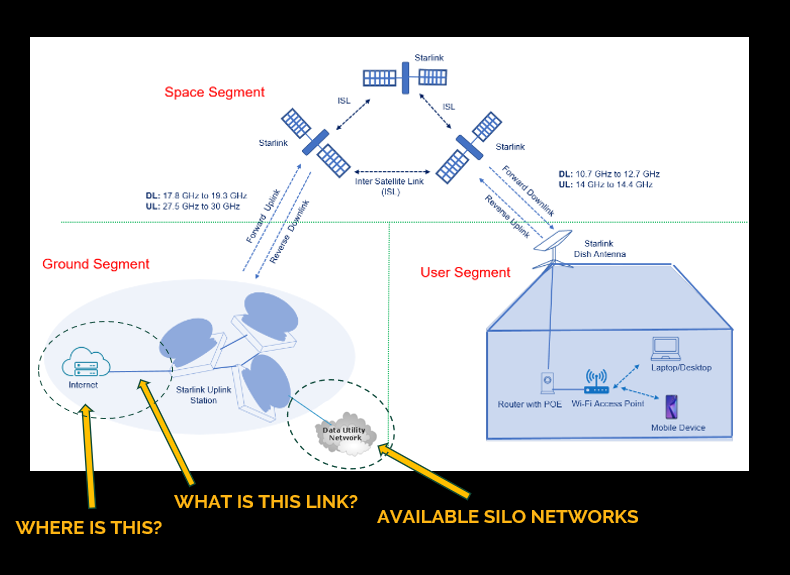
Generic Starlink Architecture – Segment Links

Securing BACKHAUL services from other data transport infrastructure owners.

In the generic architecture above, the Ground Segment is misleading. We have no idea what the link to the ‘internet’ is, and what is represented by the ‘internet’ cloud. In an African country, with no regional Tier 1, and variable access to ‘Silo Networks’ it’s unclear if performance will be anything like those broadly bantered about.

It’s quite possible in some climbs, the backhaul includes the same submarine cable services chosen by regional customer-end networks, and Telcos, and layering Starlink on top. When you examine that model, it can’t pay for Starlink.

Pricing seems to be focused on growth and market capture rather than profit.

Facing competition from Hughesnet and Viasat in one geography Starlink recently temporarily lowered its equipment prices from a steep $599 to $299. That’s lower than equipment costs from Hughesnet ($400 to $550) and essentially the same costs as equipment from Viasat ($300).

Equipment is proprietary.

I previously ‘owned’ a small project to refit an earth station at AUN (American University of Nigeria) in Yola. The project also needed to reposition the earth station, and provision it with a different (geostationary) satellite service provider. Starlink equipment will only work with Starlink. If the provider is changed the hardware is worthless. This would also be true of a phone service.

High Provision and maintenance cost.

While Starlink sattelites are relatively cheap, there are a lot of them there, and they cost a lot to launch. Being lower, they are subject to stratospheric and atmospheric elements. Having a very finite footprint, with thousands spread globally,  they can’t all be launched from a single ‘best balance’ launch point and moved into position.

Community Gateways 

Community Gateways are for large shared groups but they are a product alternative at the user segment end, and don’t mitigate where the other segments bring challenges for some climbs.

Starlink Community Gateway

Future Starlink Phones

Phones represent an alternative device solution at the User Segment end. They do not impact on the nature of the Space Segment or the Ground Segment in how they impact on both performance and cost of sales in different Geos.

If the service was in Lagos, it will either achieve ISL multi-hops or backhaul over submarine fibre – nearest Tier 1 for peering – Portugal. If the service was in Nairobi, it would either achieve ISL multi-hops or backhaul first over regional fibre backbone to Mombasa, and then over submarine fibre – nearest Tier 1 for peering – India.

Availability of Silo Networks may be different at both locations.

While the performance and cost of sales would be different, they are unlikely to offer users something better, unless again, they are focused on growth and market capture rather than profit.

Again if the provider is changed the phone is worthless. It cannot work as the way a handset using MTN can also be used for Airtel or Globacom.

A user in the US, Europe, Canada, Australia or India for example would have higher performance, and lower cost of sales, because a Tier 1 internet mirror would be located locally or regionally, within fibre backbone reach.

Other articles and posts about Starlink.  

Many third party articles appear from time to time brining their own technical opinion fused with those of technojournalists, and the Starlink site. Most of them fail to expose granular data on the Ground Segment, which can have a huge impact on performance, and cost of sales, and can massively vary from one location to another, most especially across different African geos.

This situation would work equally for phones as it would for premises services.

It’s important to understand any market prices kept artificially uniform by Starlink, cannot do so indefinitely and at some point will have to become a function of cost of sales.

No nitty gritty geo contrasts on ‘cost of sales’ appear in articles.

Parallels with Bouquet Content Services (example Multichoice DSTv) in Africa and Netflix

As an aside, articles comparing these similar services for the market, frequently focus only on the relationship between the cost of content to providers and the charge to users.

This is also an incomplete comparison. Why?

The cost of internet is metred in Africa and shows high variances. Though there are some exceptions there is a general trend for East Africa to be cheaper to source internet than the West.

A user with Netflix will additionally have to pay for internet, and may even have such poor bandwidth it severely impacts the user experience. Services like DSTv however have their own carrier media bundled in the subscription price. This is rarely highlighted in comparisons, and on the rare occasions it is, it lacks sufficient detail for the comparison to be valid.

Conclusion

Dig very deep on costs and comparisons. Ask for a trial if possible. Seek price continuity information on Starlink, and explore hardware buy-back options you may be able to persuade a vendor to undertake. Ensure you get full contractual terms agreed in writing.