DD
MM
YYYY

PAGES

DD
MM
YYYY

spot_img

PAGES

Home Blog Page 2993

The Political Economy of Data in the Age of Platformization

0

In today’s digital age, data has become a powerful currency that shapes societal norms, influences policies, and drives economic decisions. As Mutiu Iyanda and Gbolahan Salahudeen, during Infoprations’ Personalised Mentorship Programme, delve into the nuances of data ownership, distribution, and ethical use, they highlight the relationship between data and power dynamics, especially in regions like Nigeria.

Data Ownership, Distribution, and Misuse

The discourse begins by examining the political economy of data, emphasizing critical concerns about ownership, control, and the lack of transparency. Mutiu highlights how data collected from individuals is often owned and monetized by large corporations, raising ethical concerns around data misuse and surveillance capitalism. He introduces concepts like data colonialism, where the extraction and exploitation of data resemble historical colonial practices, shifting control from citizens to powerful entities.

Digital Media’s Influence on Data Dynamics

With the proliferation of digital media and platforms, society has undergone a transformative shift. Mutiu underscores how governments and corporations utilize data to frame narratives and justify policies. In Nigeria, connectivity challenges compound these issues, where limited access to accurate information can skew public perception and electoral integrity. The discussion points to the need for robust digital literacy to navigate these complex media landscapes.

Data Science, Ethics, and Exploitation

Mutiu explores the growing field of data science, emphasizing its role in understanding distribution patterns and the implications for citizens. The ethical use of data, including avoiding bias in datasets, becomes paramount as data increasingly dictates socio-economic decisions. Mutiu advocates for transparency and accountability in data handling, particularly in political contexts where misinformation can be weaponized.

Do-It-Yourself

  1. Understand Data Ownership and Distribution
  • Recognize that data you generate is often controlled by corporations. To protect your data rights, be mindful of terms of service and advocate for transparency.
  1. Address Data Misuse Concerns
  • Be aware of how data is used, especially for advertising and surveillance capitalism. Push for policies that require explicit consent and responsible data use.
  1. Leverage Data Science and Ethics
  • Use data science responsibly to analyze patterns, ensuring you address biases and promote transparency in data handling.
  1. Enhance Data Literacy
  • Build skills in data cleaning, analysis, and visualization to make informed decisions. Promote data literacy within organizations to improve transparency.
  1. Be Aware of Digital Media’s Impact
  • Recognize how data and digital narratives shape public opinion and policy. Critical evaluation of information sources is essential.
  1. Apply Predictive Analytics Ethically
  • Use data analytics, like traffic predictions, responsibly, balancing efficiency with privacy considerations.
  1. Promote Data Ethics in Decision-Making
  • Integrate data ethics in organizational processes, balancing quantitative and qualitative insights for fair and informed decisions.

Datafication and Predictive Analytics

Salahudeen contributes to the discussion by examining datafication—the transformation of various aspects of life into data. He highlights practical applications, such as using data to predict traffic patterns or train algorithms to optimize public services. However, these advancements also present risks of data exploitation, where privacy is often compromised for perceived efficiency gains.

Building Data Literacy for Decision-Making

The conversation culminates in the critical need for data literacy. Mutiu argues that understanding how data is collected, interpreted, and used is essential for informed decision-making. He identifies key skills like data cleaning, analysis, and visualization as vital for organizations to leverage data ethically. By embedding data ethics into the fabric of decision-making processes, organizations can foster a culture of transparency and accountability.

The political economy of data in the age of platformization presents both opportunities and challenges. As the discourse by Mutiu and Salahudeen illustrates, the control and use of data have profound implications for society, governance, and individual autonomy. Navigating this landscape requires a keen understanding of the ethical, political, and economic dimensions of data, calling for a collective effort to prioritize data rights, transparency, and responsible usage in a rapidly evolving digital world.
Nigerian Banks Terminate 49 Employees Over Fraud Involvement in Q2 2024, as Losses Soar

0

Nigerian banks have reportedly terminated the employment of 49 employees between April and June 2024, over involvement in fraudulent activities, according to the Financial Institutions Training Centre (FITC).

This was revealed in the FITC recently released second quarter (Q2) 2024 fraud and forgeries report. The report highlights a 40% increase in employee dismissals, compared to the 35 terminations in Q1 2024.

In Q2 2024, banks witnessed a dramatic increase in fraud-related losses, with the total amount lost skyrocketing by 9004.82% compared to the first quarter. This highlights significant shifts in fraud activity and staff involvement. In Q1 2024, banks reported a total of 11,472 fraud cases involving N2.99 billion, with actual losses amounting to N468.4 million.

However, by Q2 2024, the total number of fraud cases rose slightly to 11,532, but the total amount involved surged by 1784.64%, reaching N56.32 billion. The total amount lost to fraud in Q2 climbed to an alarming N42.65 billion, a sharp contrast to Q1 losses. In terms of outsider involvement, the number of external participants increased marginally by 5.20%, from 10,397 cases in Q1 to 10,938 cases in Q2 2024. Meanwhile, insider involvement-specifically bank staff, rose by 23.40%, with 58 employees implicated in Q2 compared to 47 in Q1.

According to FITC, miscellaneous and other fraud types accounted for 96.46% of the total losses, amounting to N41.14 billion. Fraudulent withdrawals and computer/web fraud were responsible for N781.2 million and N400.7 million, respectively. The financial impact of these fraud cases is significant, with the total amount involved in the cases reaching N1,253,394,990.66.

This includes the following breakdown:

Tellering Fraud: N177,009,908.54 (0.31%)

Forged Cheques with Forged Signatures: N326,673,410.00 (0.58%)

Computer/Web Fraud: N1,253,394,990.66 (2.23%)

The actual and expected losses from the reported cases are also detailed:

Tellering Fraud resulted in an actual loss of N23,538,942.15. Computer/Web Fraud had the highest expected loss of N400,784,701.93, representing 32% of the total amount involved.

In response to these alarming figures, FITC recommended that banks enhance their use of technology to curb fraudulent activities. They advised strengthening access controls by limiting access to sensitive files to a small group of vetted personnel with proper clearance and regular security training.

Additionally, multi-factor authentication (MFA) and role-based access controls (RBAC) were suggested to mitigate the risk of unauthorized changes to settlement files. FITC also emphasized the importance of comprehensive fraud prevention training for all employees, particularly in emerging areas like card-related and web-based fraud.

Notably, with Artificial Intelligence playing a crucial role in the financial sector, deposit money institutions are advised to leverage Al and machine learning algorithms to identify patterns indicative of fraudulent activity, allowing for early detection and proactive prevention. Implementing advanced encryption and tokenization strategies is also essential to protect sensitive data, particularly during transactions on POS systems and web platforms.

The FITC report underscores the growing need for banks to intensify fraud prevention efforts, leveraging technology and enhancing internal controls to curb the rising tide of financial fraud.

Breaking: These 3 Crypto Coins Are Set to Dominate the Upcoming Bull Run

0

There is a lot of excitement in the crypto market right now as the Fed cuts rates by half a percentage point, the first in the past four years. Thus, many traders are looking at crypto currencies with much growth potential. Analysts think that DTX Exchange (DTX), Solana (SOL) and Ethereum (ETH) fit that description.

Recently, DTX Exchange (DTX) revealed it will open up 50% of its token supply to the public while Solana (SOL) made a new announcement for a handheld Web3 gaming device. Moreover, crypto analyst Wolf sees a bullish pattern for Ethereum (ETH).

DTX Exchange (DTX): A Potential Good Crypto To Buy

DTX Exchange (DTX) is making a name for itself in the crypto space. Its ongoing presale has grown amazingly, reaching Stage 3 in a few months. Plus, DTX Exchange has already raised over $2.6M and may hit $3M before the end of next week. Big-time crypto influencers like Crypto League think of DTX Exchange as the next big thing in the crypto market.

DTX Exchange aims to bring something new to online trading. It will launch a hybrid trading platform that combines the best CEX and DEX features. Thus, people can buy over 120K asset classes like crypto currencies, gold, and CFDs in one place at 1000x leverage. No sign-up KYC checks will also give millions of traders more privacy—a big advantage over its peers.

Recently, DTX Exchange announced it will unlock 50% of its token supply to the public. Therefore, people can buy the DTX utility token and get smaller trading fees or governance voting rights. DTX is now worth $0.06 in Stage 3 – a 200% rise from its starting price. But, this price will rise to $0.08 after Stage 4 starts. Experts predict a 20x growth after a Tier-1 CEX lists DTX soon.

Solana (SOL): Play Solana Gen1 Announcement

Solana (SOL) is one of the best cryptos and some noteworthy news has been reported. For instance, Play Solana announced the Play Solana Gen1 (PSG1) device. This will be the first handheld Web3 gaming device built entirely on Solana (SOL). Those who hold the Player 1 NFT will get priority and discounted access to preorders for this device.

Hardware launches like these may also trigger an increase in demand for the Solana crypto. The Solana (SOL) value has jumped over 10% in the past week alone. Additionally, the Solana coin is hovering above its 50-day EMAs and has an RSI of 61.90, which is neutral. Due to all this bullish Solana news, experts remain confident. They predict a potential value of $160 for this crypto currency in October.

Ethereum (ETH): A Strong Bullish Move

Ethereum (ETH) is a top 5 cryptocurrency with great success. CoinMarketCap shows that the price of Ethereum (ETH) grew nearly 10% on the weekly chart. Crypto analyst Wolf says this has been a hard retest of the upper boundary from the 18-month ascending triangle accumulation. He also predicts a solid bullish move that could see Ethereum (ETH) hit $8.392.

There was also some noteworthy news for the Ethereum crypto. For instance, devs will split the upcoming Pectra upgrade into two batches. This decision will help bring key features to the first batch while giving room to introduce the second batch without any mistakes. As a result, market analysts have made a bullish Ethereum price prediction—reaching $2,600 before October ends.

DTX Exchange (DTX) vs. Solana (SOL) vs. Ethereum (ETH) – Which Crypto May Skyrocket First?

While Solana (SOL) and Ethereum (ETH) are still the top crypto coins, DTX Exchange (DTX) could become one faster than them. This rookie has a smaller market cap that could result in faster growth with less new money. Plus, DTX Exchange taps into the growing $17T gold market, which will give it stability and amazing long-term growth potential. Therefore, DTX may be the best new crypto to invest in.

Learn more:

Buy Presale

Visit DTX Website

Join The DTX Community

NCC Set to Leverage 6GHz Spectrum For Faster And More Reliable Internet in Nigeria

0

The Nigerian Communications Commission (NCC) has announced that it has initiated steps to tap into the 6GHz spectrum to boost the internet speed across the country.

This announcement was made during a stakeholders Consultative Forum on Emerging Technologies in Lagos, by the Executive Vice Chairman, Dr. Aminu Maida, represented by the Executive Commissioner of Technical Services, Abraham Oshadami.

Maida explained that the 6GHz band offers much faster data rates and transmission speeds, making it a key resource for Nigeria’s rapidly expanding digital infrastructure. He emphasized that this shift to a higher spectrum is crucial as existing bands, such as 5GHz and 2.4GHz, are facing capacity limitations due to increasing data demand.

In his words,

“The 6GHz band, spanning from 5925 MHz to 7125 MHz, offers a substantial increase in available spectrum, which is crucial for supporting the growing demand for high-speed internet and advanced applications. Wi-Fi plays a crucial role in the distribution of fixed broadband connectivity in homes, offices, and various other environments.

“The vast majority of home internet traffic is connected to the end-user through Wi-Fi. In enterprise settings, Wi-Fi is essential for handling large amounts of data and simultaneously connecting large numbers of devices with improved reliability, higher data throughout, and lower latencies”.

Also speaking, the Head of Spectrum Administration, Atiku Lawal added that the overcrowded 2.4GHz and 5GHz bands are currently restricting Wi-Fi’s potential. He disclosed that the introduction of the 6GHz spectrum is expected to increase the available spectrum two to three times over current levels.

This additional capacity accordig to him, will allow for the implementation of 80MHz and 160MHz channels, which are crucial for the new Wi-Fi 6 standard. This technology will support emerging use cases such as high-definition video streaming and X Reality (XR) applications, driving digital transformation in Nigeria.

In his words,

The commission’s decision to open the 6GHz frequency and for unlicensed WHA use is poised to revolutionize broadband connectivity in Nigeria. This move will significantly enhance internet services, providing faster and more reliable connections. With the advent of Wi-Fi 6, users can expect higher data rates and increased capacity, making it ideal for high-demand environments such as airports, and offices.”

He added that by offloading devices from cellular networks to Wi-Fi 6, the NCC aims to improve overall quality of service, alleviating capacity constraints and boosting broadband penetration in Nigeria.

The NCC’s decision to open the 6GHz band for unlicensed Wi-Fi use is expected to revolutionize broadband connectivity in the country, providing faster and more reliable internet services. The adoption of Wi-Fi 6 will be particularly beneficial in high-demand environments.

Innovation Transduction: From Business Ideas to Business Revenue | Mini-MBA

0

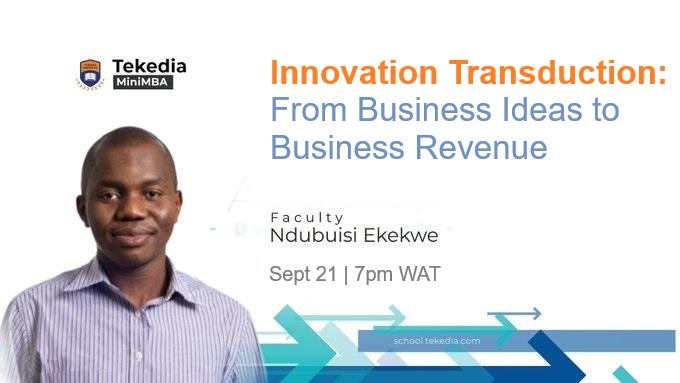
Join me in 30 minutes at Tekedia Mini-MBA for a lecture on Innovation Transduction. Yet, what can we learn from physics on energy transduction, on converting from one state of energy to another, on the grand transduction in business, which is converting from IDEA to PRODUCT states.

Sat, Sept 21 | 7pm-8.30pm WAT | Innovation Transduction: From Business Ideas to Business Revenue – Ndubuisi Ekekwe | Zoom here