DD
MM
YYYY

PAGES

DD
MM
YYYY

spot_img

PAGES

Home Blog Page 2994

The Role of Digital Wallets in Africa’s Expanding Gambling Market

0

The gambling market in Africa is experiencing rapid growth, and digital wallets play a significant role in this development. Especially in regions with limited banking access, these mobile payment solutions make it easier for users to engage in online betting and gaming. Digital wallets provide a secure method for transactions and enable wider participation among the unbanked population, thereby expanding the potential customer base for gambling operators.

With the rise of fintech innovations, many African countries are witnessing a shift towards cashless transactions. The gambling sector has embraced this trend, which is increasingly adapting to modern payment methods. By integrating digital wallets, gambling operators can enhance user experience and streamline their services, making it more appealing for new players to join the market.

Understanding the interplay between digital wallets and gambling in Africa becomes crucial as the landscape evolves. JeffBet.net, a leading UK casino operator, provided expert analysis on how emerging financial tools are reshaping the gambling landscape and influencing the industry’s future across the continent.

Evolution of Digital Wallets in Africa

Digital wallets have transformed the financial landscape in Africa, integrating seamlessly into the everyday lives of millions. Their evolution has been driven by the rise of mobile money platforms, innovations in fintech, and efforts to enhance financial inclusion across the continent.

Rise of Mobile Money Platforms

Mobile money platforms have played a crucial role in developing African digital wallets. M-Pesa, launched in Kenya, is the most prominent example. Since its inception, M-Pesa has grown to serve millions, facilitating peer-to-peer transfers, utility payments, and more.

By late 2022, approximately 763 million mobile money accounts had been opened in Sub-Saharan Africa. These platforms enable transactions without the need for a traditional bank account. Countries like Nigeria and South Africa have also seen significant growth in mobile money usage, driving this digital evolution.

The increasing number of registered accounts signifies a shift towards cashless transactions. The convenience offered by mobile wallets aligns with the needs of many Africans who prefer quick and accessible financial services.

Influence of Fintech Innovations

Fintech innovations have significantly impacted the development of digital wallets. New technologies, such as blockchain and AI, enhance security and streamline transactions, contributing to the rapid adoption of digital payment methods across the continent.

Startups in various African nations are creating tailored solutions to meet local demands. For instance, digital wallets allow seamless payments for goods, services, and gambling activities. This increased convenience is vital for attracting younger generations who favour mobile transactions.

In addition, regulatory changes foster a more supportive environment for fintech innovations. Adapting regulations can help eliminate barriers, encourage growth in the digital wallet sector, and further advance the gambling market.

Contribution to Financial Inclusion

Digital wallets significantly contribute to financial inclusion in Africa. They provide access to financial services for millions excluded from the traditional banking system, including populations in rural areas where brick-and-mortar banks are scarce.

The convenience and accessibility of digital wallets encourage usage among the unbanked, improving their economic participation. Digital wallets are essential in empowering individuals with financial tools in countries like Ethiopia, Zambia, and Malawi.

Initiatives by organisations like GSMA further amplify this impact. They advocate for policies that promote mobile money services, which are crucial for enhancing financial literacy and inclusion. This shift opens doors for economic growth and opportunities across the continent.

Regulatory and Security Aspects

Managing the regulatory and security environment is crucial for the success of digital wallets in Africa’s expanding gambling market. Key factors include the role of central banks, the importance of transparency and trust, and the effects of the COVID-19 pandemic on digital payment adoption.

Central Banks and Regulations

Central banks play a significant role in regulating digital wallets. In countries like Botswana, regulators establish and enforce guidelines to ensure secure transactions. The SARB NPS 2025 Vision aims to create a more robust payment system, which is essential in managing risks associated with digital wallets.

Mobile Money Guidelines are also pivotal in defining how digital payments should operate. Central banks must balance innovation with financial stability and consumer protection. Compliance with these regulations is necessary for businesses operating in the gambling sector to maintain credibility and customer trust.

Promoting Transparency and Trust

Transparency is essential for building trust in digital wallets. Consumers need clarity about fees, transaction processes, and security measures. Regulators often require companies to publish audits and reports to provide this information.

Trust can be fostered through strict enforcement of regulations that protect customer data and funds. Effective regulations help mitigate fraud and establish a secure environment for users. By promoting clear communication and accountability, operators enhance their reputation and attract more users.

COVID-19’s Impact on Digital Payment Adoption

The COVID-19 pandemic accelerated the adoption of digital payments across Africa. Lockdowns and social distancing measures pushed consumers towards contactless transactions. This change has led to an increase in the use of digital wallets for gambling activities.

The shift also brought regulatory focus to online gambling. Authorities are now more aware of the challenges posed by unregulated sites and the need for stricter oversight. The pandemic has demonstrated the importance of digital financial resilience. The demand for well-regulated and secure gambling platforms will likely grow as users become accustomed to digital transactions.

Integration and Interoperability in Payment Systems

Integrating digital wallets into Africa’s gambling market enhances payment systems. This section discusses the importance of ecosystem versatility and the need for building an inclusive financial environment that supports cross-border transactions.

Ecosystem Versatility and Cross-Border Interactions

Ecosystem versatility allows digital wallets to operate seamlessly across various financial platforms. This interoperability is essential for facilitating transactions in a diverse market.

In Africa, fintech companies like Mukuru are leading the way in mobile payment solutions. They enable users to conduct cross-border remittances easily. This capability is vital, as many individuals rely on international funds for gambling activities.

Universal QR codes have emerged as a standard that helps unify payment methods. They allow users to make payments across different platforms without limitations. With enhanced access to agent networks, users can conveniently deposit and withdraw funds, increasing their participation in the gambling market.

Building an Inclusive Financial Ecosystem

Creating an inclusive financial ecosystem is crucial for the widespread adoption of digital wallets in gambling. Many African countries need help with their banking infrastructure and high fees.

Digital wallets can mitigate these issues by providing affordable transaction options. They allow users to conduct financial activities without the need for traditional banking, which not only increases accessibility but also enhances user engagement in the gambling sector.

Efforts to integrate digital wallets must focus on increasing user education. Greater awareness of the benefits of digital payments will improve acceptance rates in both urban and rural communities. As more individuals embrace these technologies, the entire gambling market stands to benefit significantly.

Digital Wallet Usage and Market Dynamics

Digital wallets are rapidly transforming the gambling landscape in Africa by enhancing payment processes and expanding accessibility. The increasing adoption of digital payments influences transaction values and merchant activities across the continent.

Expansion of Merchant Networks

Expanding merchant networks is crucial for adopting digital wallets in Africa. Companies like Airtel Africa and Safaricom lead the charge by partnering with local businesses to integrate digital payment solutions.

This integration allows merchants to accept various transactions, from e-commerce and food delivery to bill payments. With a growing network, more businesses can benefit from reduced transaction fees and quicker payments.

The rise of digital wallets also facilitates safer and faster payments. This is particularly important in areas where physical cash transactions dominate. As merchants embrace these digital solutions, customers’ acceptance and trust in mobile payments increase.

Future of Digital Currencies in Africa

The future of digital currencies in Africa appears promising, driven by national digital currencies and cryptocurrencies. Governments are exploring incorporating digital currencies into their financial systems to enhance economic transparency and inclusion.

Cryptocurrency has gained traction among younger populations, with many using it for online gambling and investment. This growing interest can increase transaction values in both the gambling and e-commerce sectors.

As digital currencies gain legitimacy, businesses will likely adopt these technologies, enabling smoother transactions. The interplay between traditional digital wallets and emerging digital currencies will shape the landscape, offering various payment options to consumers. This shift could ultimately drive further growth in Africa’s expanding gambling market.

Japanese Prime Minister to Step Down in September Amid Financial Misconduct

0

In light of recent events, it has been reported that Japanese Prime Minister Fumio Kishida will step down from his position in September following allegations of financial misconduct and the impact of rising living costs on the population. This decision comes after a series of political scandals that have marred his term, including ties to the controversial Unification Church and unrecorded political donations at Liberal Democratic Party (LDP) fundraising parties.

Prime Minister Kishida’s tenure has been a complex one, marked by efforts to lead Japan out of the COVID-19 pandemic with significant stimulus spending. However, his administration has faced criticism over its economic policies, particularly as inflation began to take hold, contributing to stock market instability and a decrease in the value of the yen. The unexpected rise in interest rates by the Bank of Japan in July, a move away from the country’s longstanding radical monetary stimulus, has also been a point of contention.

The upcoming leadership change in Japan has sparked significant interest in the potential candidates who may succeed Prime Minister Fumio Kishida. Among the names being discussed, several stand out as prominent figures within the political landscape of Japan.

Shigeru Ishiba, a seasoned politician and a former defense minister, is considered a strong contender. Known for his previous bids for the party presidency and his popularity in public opinion polls, Ishiba’s stance on economic policies, especially regarding the normalization of monetary policy, could influence his support among Liberal Democratic Party (LDP) lawmakers.

Toshimitsu Motegi, the current secretary-general of the LDP, brings a wealth of experience from his various cabinet positions, including foreign, trade, and economy minister. His background as a tough negotiator and his international education may position him as a candidate with a global perspective.

Shinjiro Koizumi, another potential candidate, carries the legacy of his father, former Prime Minister Junichiro Koizumi. As a former environment minister and a young reformer, he represents a blend of tradition and modernity that could appeal to a broad spectrum of voters.

Sanae Takaichi, known for her conservative views and her role in economic security, is also in the running. Her previous candidacy against Kishida in the last party leadership race demonstrates her ambition and determination to lead.

Lastly, Taro Kono, a familiar face in Japanese politics who has served as foreign and defense minister, is seen as a likely candidate. His efforts as digital minister to modernize government technology and his fluency in English suggest a forward-thinking approach to governance.

As the LDP prepares for its leadership election, these candidates, among others, will be vying for the top position. The outcome of this election will not only shape the future of Japan’s domestic policies but also its role on the international stage. The world awaits the decision with keen interest, recognizing the impact it will have on global affairs.

The upcoming departure of Prime Minister Kishida signifies a period of transition for Japan as the nation grapples with internal political challenges and external geopolitical tensions. The successor to Kishida will need to navigate these complexities while addressing the concerns of the Japanese public, particularly regarding the cost of living and maintaining public trust in governance.

Ibrahim Traore of Burkina Faso Turns Down IMF Financial Assistance

0

In a move that has captured the attention of international observers and economists, Burkina Faso’s President Ibrahim Traore has made the decision to decline financial assistance from the International Monetary Fund (IMF). This decision marks a significant moment for the West African nation as it navigates its economic and political landscape.

The IMF, known for providing financial support to countries in need, had approved a substantial arrangement under the Extended Credit Facility for Burkina Faso, aimed at addressing the country’s balance of payments problems and supporting economic resilience and poverty reduction efforts. However, President Traore’s administration has opted to turn down this offer.

This decision could be seen as a statement of economic independence and a desire to pursue a different path towards financial stability and development. It reflects a broader trend of African leaders evaluating the terms and long-term implications of international financial aid. President Traore’s stance may resonate with a growing sentiment for self-sufficiency and a cautious approach to foreign debt.

One of the key reasons cited for rejecting the IMF’s assistance is the belief that such aid could perpetuate economic dependency and limit the country’s control over its financial decisions. There is also a sentiment that accepting the aid could keep the country ensnared in a cycle of debt. This perspective aligns with a broader trend among some African leaders who are re-evaluating the long-term implications of international financial aid and expressing a preference for policies that promote autonomy and self-determination.

Additionally, the decision reflects concerns about the potential for international financial institutions to influence domestic policy and priorities. By turning down the IMF assistance, Burkina Faso is asserting its financial sovereignty and demonstrating a commitment to prioritizing the well-being of its citizens above external pressures.

It’s important to note that Burkina Faso faces numerous challenges, including security issues and the impact of external shocks such as the COVID-19 pandemic and adverse weather conditions. Despite these difficulties, the government’s decision suggests a willingness to address these challenges independently, possibly looking towards other forms of partnership and support that align more closely with the nation’s goals and values.

Burkina Faso has faced numerous challenges, including security concerns, the impact of the COVID-19 pandemic, and adverse weather conditions, all of which have strained the nation’s economy. Despite these hurdles, the government seems committed to seeking alternative strategies for growth and development.

The move has sparked discussions on the sustainability of such a decision and its potential impact on Burkina Faso’s future. Some analysts argue that while this could foster a sense of national pride and control over the country’s resources, it also raises questions about the viability of self-funded development in the face of significant economic challenges.

As Burkina Faso charts its course, the international community will be watching closely to see how this decision unfolds and what it might mean for the future of financial assistance and economic sovereignty in Africa. The country’s leadership appears to be signaling a new era of autonomy and self-determination, setting a precedent that could influence the region’s economic policies for years to come.

What is DPoS? Delegated Proof of Stake Explained

0
Delegated Proof of Stake (DPoS)

Consensus mechanisms play an essential role in verifying the legitimacy of blockchain networks by fostering trust, security, and agreement among network participants. In this approach, all nodes in a decentralized network must agree on the state of a blockchain.

Blockchains traditionally incorporated Proof of Stake (POS) and Proof of Work (POW). To increase security, Bitcoin, for example, uses the POW mechanism to pay miners to solve computational puzzles. On the other hand, Ethereum compensates participants with native tokens based on their stake levels.

Nevertheless, Delegated Proof of Stake (DPoS) serves as a solution to address inefficiencies that previous methods could not adequately resolve. So, what exactly is DPoS? In this article, we’ll explore what DPoS is, how it works, and more.

What is Delegated Proof of Stake (DPoS)?

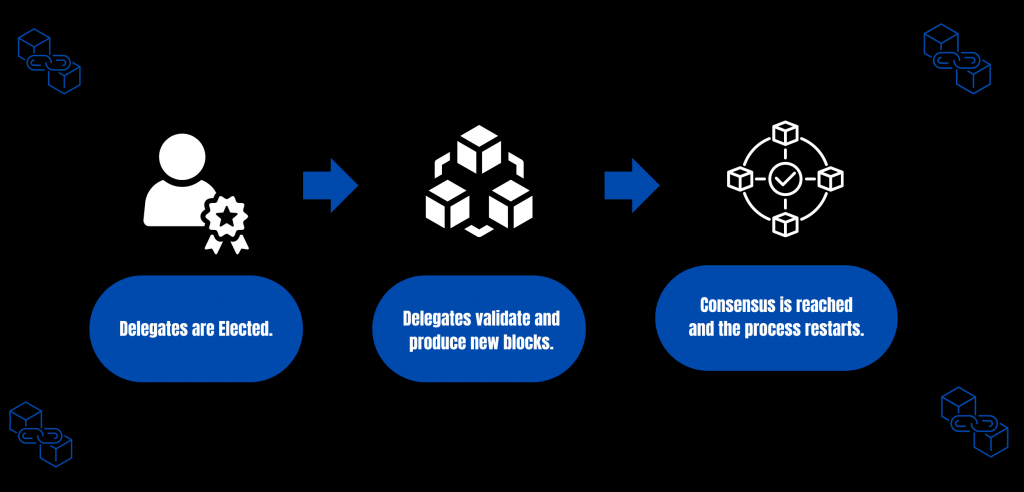
Delegated Proof of Stake (DPoS) offers an alternative to the POS consensus algorithm. In DPoS, network participants elect delegates or validators responsible for creating and validating blocks. Afterward, supporters or voters of these delegates can then receive rewards from them.

Background of DPoS

One of the first projects to employ Delegated Proof of Stake (DPoS) to increase blockchain performance was BitShares, a blockchain platform developed by Daniel Larimer in 2015. Due to its early success, DPoS proved to be a feasible solution for other blockchain projects by demonstrating its ability to manage large transaction volumes.

After BitShares, DPoS was used in several other projects. Notable projects include the well-known blockchain network, EOS, and the social media site, Steem. EOS attracted lots of interest for both its large-scale initial coin offering (ICO) and its application of DPoS. This revealed the potential utility of DPoS for extensive blockchain applications.

How Does Delegated Proof of Stake (DPoS) Work?

In DPoS, voting is combined with a simplified block-creation process. It allows token holders to elect a few delegates who are responsible for validating transactions and creating new blocks.

how delegated proof of stake works

In order to select these delegates, users pool their tokens into a staking pool, and the delegate with the most tokens may help to validate a block. However, the number of tokens a user has helps to determine their ability to vote. This means that the more tokens they own, the more power they have.

Moreover, voters and other delegates keep an eye on the elected delegates as they alternately propose and validate blocks. To guarantee its legitimacy, a block proposal needs to be approved by the majority of delegates. Unlike conventional consensus methods, this procedure improves the network’s scalability and efficiency.

In addition, delegates can be regularly replaced in DPoS elections according to their reputation and performance. This retains only reliable delegates in positions of authority. Occasionally, delegates and users who voted for them receive rewards such as transaction fees. This encourages delegates to perform better, while voters are motivated to select delegates who best represent their interests. 

Proof of Stake (PoS) vs Delegated Proof of Stake (DPoS)

Proof of Stake (PoS) vs Delegated Proof of Stake (DPoS)

Delegated Proof of Stake (DPoS) and Proof of Stake (PoS) are both consensus mechanisms designed to strengthen the efficiency and scalability of blockchain networks. However, they differ significantly in their approach and execution.

In PoS, all stakeholders with a stake in the network participate directly in the validation process. This model relies on the amount of cryptocurrency held by each participant to determine their influence. Although PoS offers advantages like computational power, lower energy consumption, and quicker transaction processing than Proof of Work (PoW), it can also lead to centralization, as those with larger stakes wield more control and accumulate block rewards disproportionately.

However, DPoS introduces a democratic process for block verification by allowing token holders to vote for a limited number of delegates responsible for transaction validation. This system addresses some PoS’s drawbacks by distributing the validation power more evenly among elected representatives or block producers, rather than concentrating it among wealthy stakeholders. Consequently, DPoS often results in higher transaction throughput and improved scalability. When the number of active validators is reduced, it makes the consensus process more apt and less prone to centralization issues in PoS.

Nominated Proof of Stake (NPoS) vs Delegated Proof of Stake (DPoS)

Nominated Proof of Stake (NPoS) vs Delegated Proof of Stake (DPoS)

While Proof of Stake (Pos) and Delegated Proof of Stake (DPoS) share some differences, DPoS and Nominated Proof of Stake (NPoS) have a minor overlap.

Delegated Proof of Stake (DPoS) and Nominated Proof of Stake (NPoS) both use voting for blockchain validation, but with key differences. In NPoS used by Polkadot and Kusama, both nominators and validators are fully involved in the staking system. Nominators vote for validators, and both parties must stake tokens. If either nominators or validators act maliciously, they can face penalties.

Conversely, DPoS allows users known as delegators to vote for validators or delegates who handle block creation and verification. These validators are held accountable for any issues, while delegators are not directly penalized.

Advantages of Delegated Proof of Stake (DPoS)

DPoS differs from other conventional consensus methods due to its unique framework and contributions to the blockchain. Below are some of the advantages of DPoS:

Guarantees Efficiency and Scalability

DPoS accelerates block confirmation times and supports higher transaction throughput by limiting the number of delegates responsible for validating transactions. This approach contrasts sharply with more energy-intensive consensus mechanisms like Proof of Work (PoW), thereby contributing to blockchain’s growth.

 Inclusivity and Decentralization

DPoS lowers entry barriers by allowing any token holder to participate in the voting process and potentially become a delegate. This fosters a more democratic governance model and encourages broader community involvement.

Ensure Rapid Network Upgrades

DPoS supports rapid network upgrades and adjustments without requiring disruptive hard forks. Its predictable block production and community-driven decision-making contribute to a better and adaptable blockchain ecosystem.

Disadvantages of Delegated Proof of Stake (DPoS)

While DPoS offers several benefits to blockchain, there are certain limitations. Below are some of the associated risks of DPoS:

Risk of Centralization

A primary concern is the risk of centralization, where a limited number of delegates might concentrate power, undermining the decentralized nature of the network. This can potentially lead to vulnerabilities such as collusion and reduced network security.

Dependence on Voter Participation

The system also relies heavily on active voter participation. If stakeholders are disengaged or uninformed, it can result in the election of ineffective or malicious delegates, compromising network integrity. Also, the need for constant user engagement in voting and awareness can be a significant barrier for some users.

Favoring Wealthier Token Holders

DPoS networks may inadvertently favor those with greater token holdings, giving them more influence in delegate elections and potentially skewing governance. This can marginalize smaller stakeholders and exacerbate inequalities.

Financial Barriers to Delegates

Becoming a delegate in a DPoS network often requires substantial financial resources and infrastructure, making it difficult for average users to participate. This financial barrier can limit the diversity of candidates and increase the cost of network participation.

FAQs

What is the Difference Between Stake and Delegate?

Staking is the process of locking cryptocurrency in a network to serve as transaction collateral, while delegation means entrusting the process to validators to ensure network security.

What is The Purpose of a Delegated Validator in a Proof of Stake Blockchain?

A delegated validator in a proof-of-stake blockchain helps to validate transactions and secure the network. They are selected by token holders who delegate their voting power or stake to them. This system helps ensure network security and efficiency while allowing token holders to participate in governance without directly validating transactions.

What Blockchains use Delegated Proof of Stake (DPoS)?

EOS and Steem are popular blockchains that have contributed to the growth of DPoS. Additionally, it is also implemented on other notable networks, which include: SUI, Tron (TRX), Hive, Elastos, Credits, and Ark.

Does Delegated Proof of Stake Work Like Leased Proof of Stake?

While network participants elect representatives, also known as delegates or witnesses, to stake their crypto in DPoS, Leased Proof of Stake allows these participants to lease their cryptocurrency to network nodes.

Conclusion

Delegated Proof of Stake (DPoS) offers an advanced blockchain consensus approach, improving the traditional Proof of Stake (PoS) method. DPoS boosts efficiency and scalability by using a system where token holders vote to elect delegates who validate transactions. This method speeds up transaction processing and lowers energy use, making it an environmentally friendly option compared to PoW. It also increases inclusivity and adaptability within the network.

However, DPoS has its challenges, such as centralization of power among a few delegates, dependence on active voter participation, potential bias towards wealthier holders, and even its financial barriers to becoming a delegate can limit participation diversity. Nevertheless, DPoS presents a promising solution for improving blockchain performance and addressing the drawbacks of earlier consensus models.

Talent and Human Capital Development – Bola Adesope, 7pm WAT Today

0

“We build PEOPLE before we build CARS” – Toyota.

“We are not in the coffee business. We are in the PEOPLE business serving coffees” – Howard Schultz, Founder of Starbucks.

“Talent is GOLD. Talent is the backbone of every organization’s success. The best investment any StartUp business or organization can make is the investment in its people” – Bola Adesope.

Join us today as Tekedia Institute Faculty Bola Adesope. ITIL, PMP, CBAP, CSM, PSM, CSPO, ICP-ACC, LPM, SAFe SPC, of  SixDots Canada, teaches on Talent and Human Capital Development. The SixDots Team will be spending time in Nigeria, to run workshops on how companies, including startups and large companies, can accelerate innovation and growth via talent development. The date and venue of this free workshop in Lagos will be communicated in class. If interested to attend, please email here for a free pass (write from your business email).

Tekedia Mini-MBA current learners, use the Zoom link in the classboard to attend today’s session; others who are interested should check this page for a webcast of the session.

Thur, Aug 15 | 7pm-8pm WAT | Talent and Human Capital Development– Bola Adesope, SixDots

Tekedia Faculty Bola Adesope is a multi-award winning Agile and Business Transformation leader. Ex-Accenture and ex-Deloitte, he developed Tekedia Institute’s Agile Methodology Framework which many startups across Africa have used to improve operations.