DD
MM
YYYY

PAGES

DD
MM
YYYY

spot_img

PAGES

Home Blog Page 3

Global Central Bankers Reject Stablecoin Threat, Say They Boost The U.S. Dollar

0

Global central banks and institutions like the Bank for International Settlements have stated that crypto stablecoins are primarily strengthening the US dollar rather than challenging fiat currencies as alternatives.

With roughly 98% of stablecoin value pegged to the USD, these digital assets have reportedly extended the reach of the dollar into blockchain-based transactions, offering 24/7 settlement and lower costs in cross-border payments, especially in emerging markets with limited traditional banking access.

This dynamic has turned what many once viewed as a potential disruptor into a powerful extension of existing financial hierarchies.

Recall that for years, stablecoins were viewed with skepticism by central banks and financial regulators, with many warning that the fast-growing digital assets could undermine sovereign currencies and weaken the global financial system.

The earlier concerns surrounding these digital assets, were rooted in their potential to operate as an alternative form of money outside the traditional banking system.

Policymakers feared that widespread adoption could encourage consumers and businesses to hold digital tokens instead of bank deposits, reducing banks’ funding base and limiting their capacity to extend credit.

Such a transition, experts warned, could weaken the effectiveness of central bank monetary policy.

Another major concern was that private companies issuing stablecoins could become powerful operators of a parallel financial system.

As stablecoins gained popularity for payments and cross-border transactions, critics argued that they might diminish governments’ control over money by allowing transactions to occur outside conventional banking networks.

Regulators also expressed fears that stablecoins could introduce new financial stability risks. If confidence in a major stablecoin issuer were to collapse, investors might rush to redeem their holdings, potentially forcing issuers to liquidate large amounts of U.S. Treasury securities and disrupting financial markets.

Those concerns intensified following the collapse of the algorithmic stablecoin TerraUSD in 2022, which erased billions of dollars in market value and prompted renewed calls for stricter regulation. Despite these risks, recent developments have led many central bankers to adopt a more nuanced view.

The Growth And Adoption of Stablecoins

Stablecoins have surged in market capitalization, with transactions exceeding $265 billion.

It is worth noting that Stablecoins received a real boost when U.S. President Donald Trump signed the GENIUS Act earlier this year, and now European banks are trying to get into the act by issuing stablecoins of their own.

Stablecoin issuers hold significant amounts of US Treasuries, increasing demand for dollar-denominated assets and supporting US government financing.

In regions facing high inflation or capital controls, users turn to dollar-pegged stablecoins for stability and convenience, a phenomenon described as digital or stealth dollarisation that enhances rather than erodes the dollar’s global dominance.

Christos Makridis, acting director of the Center for Data Analysis at The Heritage Foundation in an article last year, wrote that these digital dollars have numerous benefits. They can cut fees, shorten settlement cycles, counter local inflation and widen access to trade and finance.

He further noted that by championing stablecoins and the financial networks they run on, America can help unlock growth in emerging economies while buttressing its own economic might.

Outlook

The growth of stablecoins, now exceeding hundreds of billions in market capitalization, has been accelerated by regulatory clarity in the United States, including frameworks designed to maintain dollar leadership.

While this provides efficiency gains for payments and on-ramps to crypto ecosystems, it also raises concerns among some central banks about monetary sovereignty in developing economies.

Overall, the data shows stablecoins functioning more as bridges to dollar liquidity than as independent challengers to traditional money, reshaping global finance in ways that reinforce rather than replace the current system.

China’s Central Bank Introduces Overnight Reverse Repos, Signaling a Subtle but Significant Evolution in Its Monetary Toolkit

0

China’s central bank took a notable step toward modernizing its liquidity management on Monday by conducting its first overnight reverse repo operation, a move markets interpreted as deepening its control over short-term funding conditions and gradually aligning its policy framework more closely with practices seen at major global central banks.

The People’s Bank of China (PBOC) said it offered 300 billion yuan ($44.10 billion) through overnight reverse repos to financial institutions, according to an official statement. It also injected an additional 157.5 billion yuan through seven-day reverse repos at an unchanged rate of 1.4%.

The PBOC did not publicly disclose the borrowing cost for the overnight operation. Sources told Reuters the rate was set at 1.25%, 15 basis points below the seven-day tenor. The volume-weighted average rate for the benchmark overnight repo in the interbank market stood at 1.3533% on Monday, down about 2 basis points from the previous close.

The introduction of overnight reverse repos expands the PBOC’s toolkit at a time when China’s financial system is undergoing profound changes. With direct financing through bonds and equities now surpassing traditional bank lending as a key source of funding, and credit allocation shifting away from more capital-intensive sectors like property, the central bank is adapting its approach to better influence short-term rates and overall liquidity conditions.

“By omitting the overnight reverse repo rate, the PBOC does not want to dilute the signaling effect of the seven-day rate at this point,” said Lynn Song, chief economist for Greater China at ING. “Markets have been speculating on the overnight rate, and generally agree it will come in lower than the seven-day rate at around 1.30%-1.35%. It’s likely that the PBOC doesn’t want any confusion on rate cuts at this time as well before the actual easing is made.”

Xing Zhaopeng, senior China strategist at ANZ, noted that the central bank’s decision not to announce the overnight rate publicly suggested it had no intention of undermining the status of the seven-day reverse repo as the primary policy rate.

“The overnight rate was likely priced at a spread below the seven-day rate, with the gap varying over time,” he said.

The overnight reverse repo is expected to help the PBOC manage liquidity more effectively, particularly around month- and quarter-ends when money market rates often experience volatility. By strengthening its influence over short-term rates, the central bank aims to improve monetary policy transmission across the financial system.

This development aligns with comments made by PBOC Governor Pan Gongsheng at the annual Lujiazui Forum earlier this month, in which he indicated that the central bank would expand the variety of overnight reverse repo operations and work to narrow the range of short-term rates to reduce volatility in money markets.

The quarterly monetary policy implementation report published in May also emphasized the central bank’s intention to guide overnight rates closer to the policy rate level.

“Since the volume of overnight interbank lending by financial institutions far exceeds that of other tenors, by strengthening control over short-term interest rates, the central bank can enhance the effectiveness of monetary policy transmission throughout the financial system,” the PBOC-run publication Financial News said, citing industry experts.

Overnight repo transactions already dominate China’s interbank money market, accounting for more than 80% of repo turnover. Many major central banks, including the U.S. Federal Reserve, have long used overnight rates as their primary policy tool to anchor the broader yield curve. China’s move brings its framework closer to these global standards, though analysts expect a gradual transition.

“I think we’ll eventually still move in this direction where the overnight rate takes precedence just like in many developed market central banks,” ING’s Song said, noting the PBOC will ensure a smooth transition and that it will likely take some time.

Implications for China’s Evolving Financial Industry

The launch of overnight operations comes as China’s economy continues to navigate a complex environment of slowing credit growth in traditional sectors and rising importance of capital markets. With direct financing gaining ground, the central bank’s enhanced focus on short-term rates could help stabilize funding conditions and support broader economic objectives.

Markets appeared to welcome the development, with the overnight repo rate easing slightly. The move is also part of a broader effort to refine policy tools amid shifting economic priorities, including efforts to support emerging industries while managing risks in areas like real estate.

For now, the seven-day reverse repo remains the anchor of China’s policy rate system. But Monday’s operation hints at a future where overnight rates could play a more prominent role, potentially giving the PBOC finer control over liquidity and borrowing costs.

Analysts note that as China’s financial system becomes more market-oriented, tools like these overnight facilities could prove increasingly valuable in guiding economic activity without relying solely on longer-term rates or quantitative measures. The central bank’s careful communication around the new instrument is seen as an indication that it is mindful of maintaining clarity in its policy signaling while gradually expanding its operational flexibility.

This latest step fits into a pattern of incremental modernization at the PBOC, aimed at ensuring monetary policy remains effective in a rapidly changing economic landscape.

[Attend] Building Modern Property Admin Infrastructure in Nigeria – Unveiling Tekedia Fund

0

Tell your governors, commissioners, state investment corporations, and state legislators to attend this session or reach out to us directly at capital@tekedia.com.

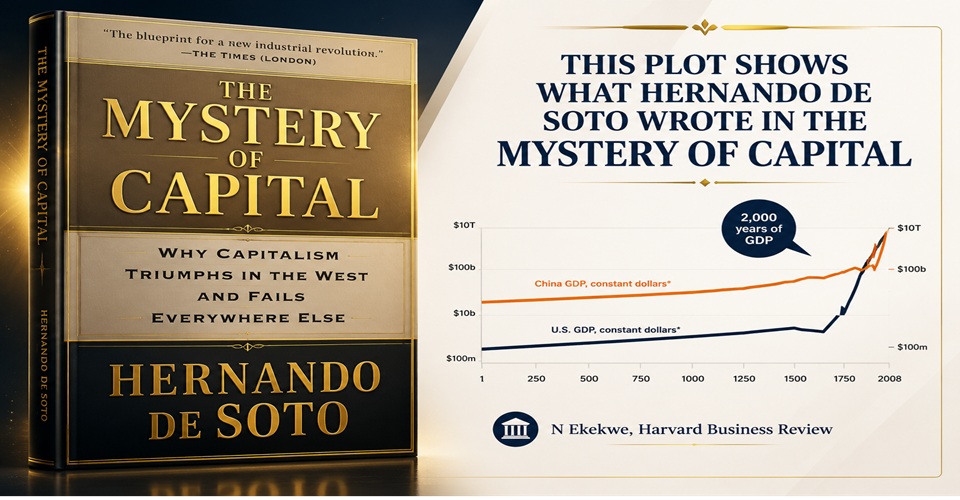
Economist Hernando de Soto has been clear, and history has validated his thesis: there is a powerful correlation between property rights and economic development. One of the fundamental differences between countries such as the United Kingdom and Nigeria is that, in developed economies, nearly every piece of land and real estate is formally recorded, searchable, and easily used as collateral, traded, or financed.

In Nigeria, however, a significant portion of our lands and properties exists outside formal records. They are not properly represented on the balance sheets of banks, nor are they fully captured in the general ledgers of local and state governments. As a result, enormous amounts of wealth remain trapped as dead capital.

Without addressing this challenge, it will be difficult to achieve broad-based economic development. More than two thousand years of economic history demonstrate a strong relationship between secure property rights and sustained economic growth.

Rather than merely discussing this problem, we want to become partners with state governments in implementing practical solutions. Tekedia Capital is prepared to invest up to $1 million per state to support the modernization of property administration systems across Nigeria. We bring world-class technology, regulatory expertise, and implementation capabilities.

Our destination is clear: Modernize property administration. Unlock prosperity for citizens.

To advance this conversation, we are organizing an open webinar:

Title: Building Modern Property Administration Infrastructure in Nigeria: Unveiling the $1 Million per State Real Estate Innovation Fund

Speaker: Prof. Ndubuisi Ekekwe
Chairman, Tekedia Capital

Date: Saturday, July 11, 2026

Time: 2:00 PM – 3:30 PM WAT

Venue: Zoom link here

Join us as we discuss how modern property infrastructure can unlock investment, deepen financial markets, increase internally generated revenue, and accelerate economic growth across Nigeria’s states.


Tekedia Capital Wants to Invest $1M In Nigerian States To Modernize State Real Estate Infrastructure


The Mystery of Capital and Nigeria’s Missing Opportunity and How To Fix it

Kraken Reportedly Eyes Aave Acquisition in $385M Deal

0

Kraken’s reported discussions to acquire Aave at a valuation of approximately $385 million have sparked renewed interest across the decentralized finance sector, highlighting the growing convergence between centralized cryptocurrency exchanges and decentralized financial protocols.

Although no agreement has been officially confirmed, the market has reacted positively to the speculation. AAVE, the governance token of the Aave protocol, has climbed more than 19% over the past week, while the protocol’s fully diluted valuation (FDV) has risen to roughly $1.4 billion.

The sharp price movement reflects investor optimism that such a deal could reshape the competitive landscape of digital finance. Kraken has been recognized as one of the cryptocurrency industry’s most established centralized exchanges, offering spot trading, derivatives, staking, and institutional services.

Aave has emerged as one of DeFi’s flagship lending protocols, enabling users to lend and borrow digital assets without relying on traditional financial intermediaries.

An acquisition would represent more than a simple corporate transaction—it would symbolize a strategic effort to merge the efficiency and regulatory infrastructure of centralized exchanges with the innovation and transparency of decentralized finance.

The reported $385 million valuation has attracted attention because it appears significantly lower than Aave’s current market metrics. With the protocol trading at an estimated fully diluted valuation of $1.4 billion.

Investors are questioning whether the acquisition price reflects only a portion of the ecosystem, such as the development company or intellectual property, rather than the decentralized protocol itself.

Since decentralized autonomous organizations (DAOs) govern protocols like Aave, acquiring the protocol outright is far more complex than purchasing a conventional software company.

The strategic rationale behind the discussions is compelling. Kraken has steadily expanded beyond simple cryptocurrency trading by investing in payments, custody, institutional infrastructure, and tokenized financial products.

Integrating Aave’s lending technology could enable Kraken to offer decentralized borrowing and lending services directly through its platform, creating a more comprehensive financial ecosystem for retail and institutional users alike. Such integration could also strengthen Kraken’s competitive position against rivals seeking to bridge centralized and decentralized financial services.

The market’s enthusiastic response demonstrates growing confidence in the future of DeFi despite ongoing regulatory uncertainty. Investors increasingly view decentralized lending as a critical component of the broader digital asset economy.

Aave has consistently maintained one of the largest total value locked (TVL) figures in decentralized finance, supporting multiple blockchain networks while continuously introducing new features such as GHO, its native decentralized stablecoin.

Beyond the immediate price appreciation, the acquisition talks may signal a broader trend across the cryptocurrency industry. As competition intensifies, centralized exchanges are seeking new revenue streams beyond transaction fees.

Owning or partnering with leading DeFi protocols offers access to lending markets, yield generation, tokenized assets, and programmable financial infrastructure that traditional exchange businesses cannot easily replicate.

Negotiations do not always result in completed transactions, and governance considerations could complicate any attempt to integrate a decentralized protocol into a centralized corporate structure. Regulatory approval, community sentiment, and technical integration would all play significant roles in determining whether such a deal ultimately succeeds.

Regardless of the final outcome, the reported discussions between Kraken and Aave have already reignited optimism throughout the DeFi sector. Investors appear to believe that closer collaboration between centralized exchanges and decentralized protocols represents the next phase of crypto’s evolution.

Whether through acquisition, partnership, or strategic investment, the blending of these two worlds could accelerate mainstream adoption, expand financial innovation, and reshape how digital asset services are delivered in the years ahead.

AI Bubble Alert: Central Bankers Warn of Impending Global Financial Crisis

0

Central bankers are raising concerns over the rapid expansion of artificial intelligence, prompting fresh warnings that the technology-driven investment boom could be fueling a dangerous market bubble.

This development comes as the AI sector continues to dominate headlines. Companies like NVIDIA and other semiconductor leaders have seen explosive growth, fueled by demand for GPUs and data center infrastructure. However, concerns about unsustainable valuations and the gap between promised capabilities and real-world deployment have persisted among analysts.

The Bank for International Settlements (BIS), often called the central bank for central banks, recently warned that excessive debt-fueled spending on AI infrastructure could trigger a broader financial crisis if the current enthusiasm fades.

BIS General Manager Pablo Hernández de Cos introducing Chapters I and II of the BIS Annual Economic Report 2026, which discusses the AI investment risks said,

Progress is seen in rapid advances in artificial intelligence (AI) and their potential to boost economic activity; and peril arises from heightened inflationary pressures, financial vulnerabilities including those related to AI exuberance and high public debt.

“One risk is that large-scale investment in AI infrastructure becomes excessive, as each firm tries to outcompete rivals and dominate market share. This could leave the sector more vulnerable if AI underdelivers, possibly bringing the current investment boom to an abrupt end, with large macroeconomic consequences”.

The BIS core concern centers on the massive capital expenditures by major technology companies, known as hyperscalers. These firms have poured trillions into data centers, chips, and related infrastructure to pursue AI dominance.

While this spending has driven innovation and boosted markets, the BIS highlights significant vulnerabilities. Much of the financing flows through opaque private credit channels that lack the transparency and regulation of traditional banking.

Should these companies slow their aggressive investments, suppliers and borrowers across the chain could face sudden revenue declines and struggle to service debt.

Many argue that this situation echoes past tech bubbles, particularly the dot-com era of the late 1990s. Rapid investment created overcapacity, inflated valuations, and eventual sharp corrections.

Today, AI-related stocks and valuations have reached extraordinary levels, supported by expectations of transformative productivity gains. However, questions remain about the speed of real-world returns. Power constraints, high infrastructure costs, intense competition, and uncertain monetization paths could undermine the optimistic forecasts.

Recall that earlier this month, Polymarket, the world’s largest prediction platform, disclosed that the probability that the artificial intelligence investment frenzy will burst by the end of 2026 climbed to 26%.

The odds have been rising rapidly, reflecting growing trader skepticism amid sky-high valuations in AI-related stocks and massive capital inflows into the sector.

Market participants have mixed reactions. Optimists argue that AI represents genuine technological progress unlike prior hype cycles, with applications already emerging in healthcare, software, and industrial efficiency.

Skeptics point to concentrated bets on a few large players and warn that disappointing progress on advanced models or energy bottlenecks could puncture confidence quickly.

Notably, Chinese hedge fund managers are warning that the global AI stock rally has entered unsustainable “super bubble” territory. Their investor letters, reported by Bloomberg, highlight growing concerns over sky-high valuations detached from near-term fundamentals.

Wealspring Asset and Shanghai Banxia Investment Management Center are leading the charge with blunt assessments.

Wealspring, founded by Yang Dong known in China for accurately calling the 2007 market top stated that global AI stocks have become a super bubble and that the collapse point may not be far away. The firm, which manages over $1.4 billion, urges caution as enthusiasm outpaces realistic expectations.

Shanghai Banxia went further, declaring that “the trigger for the AI bubble to burst has already appeared.” The manager pointed to mounting pressure on breakneck revenue growth at companies like Anthropic, where hyperscaler spending and infrastructure demands are creating visible strains.

Also, crypto enthusiast Michael Van Poppe gave his opinion. He wrote in a post on X,

“I’ve been using many tools over the past few months, and to be honest: they aren’t much better than the previous ones. One thing is clear: AI will change our lives. Massively. However, in the short-term, we’re living in a bubble and the marginal extra impact of any update on any LLM right now doesn’t yield the actual value. I think that we’ll see money flow out of the AI sector and that this liquidity will seek for other markets to invest in Bitcoin and crypto.”

Central bankers are not calling for an immediate end to AI development. Instead, they urge caution regarding leverage, greater transparency in financing, and preparedness for potential reversals.

Their warnings serve as a reminder that monetary policy and financial regulation must account for rapid technological shifts without stifling innovation.

Outlook

For investors, the message is one of balance. AI holds long-term promise, but current valuations and debt levels warrant scrutiny. Diversification, realistic assessment of timelines, and attention to underlying fundamentals remain essential.

A potential correction could be severe, with some forecasts suggesting 80%+ drawdowns for select high-flyers if sentiment shifts. Yet history shows bubbles can persist longer than expected before deflating.

As AI continues evolving, the coming months will test whether the boom delivers sustainable growth or faces the painful adjustment many central bankers now anticipate.