DD
MM
YYYY

PAGES

DD
MM
YYYY

spot_img

PAGES

Home Blog Page 3

“We Must Pace the Frontier:” Anthropic CEO Calls for Slower AI Development: Altman And Musk Back Him

0

Anthropic CEO Dario Amodei has called on artificial intelligence companies to slow the pace at which they improve increasingly capable models, warning that the industry needs more time to strengthen safety systems before AI reaches capabilities that could create serious real-world risks.

In an essay published Saturday, Amodei proposed a three-step framework for “pacing” AI development without sacrificing commercial competitiveness or the United States’ lead in the technology.

“But over the last few months, I have become convinced that fully addressing the risks requires even more prudence — not just investing in risk prevention, but pacing the rate of capabilities advancement so that risk prevention has time to keep up,” he said.

“We must slow the pace at which we improve the capabilities of AI models. Progress will still seem fast, and we must make wise use of the time we gain. Two things have convinced me.”

The proposal comes as AI companies race to build more capable systems and as concerns grow within the industry that advances in reasoning, autonomy and cyber capabilities may be outpacing the safeguards designed to control them.

“But like many technologies before it, AI brings risks, and because it is such a powerful technology, these risks are serious. I’ve written a lot about them too. They include the risk of losing control of AI systems, misuse of AI for cyberattacks and bioterrorism, and serious economic disruption. A race to the bottom, spurred by commercial incentives, can make these risks more acute,” he said.

Amodei stressed that pacing does not mean stopping AI research or halting model training.

“To be clear, pacing does not mean halting model training or technical progress,” he wrote.

Instead, he said companies should ensure they have adequate time to align and safeguard capable systems and allow independent evaluators to verify that those protections work.

Anthropic has already committed unilaterally to the first part of Amodei’s proposal. Under it, independent third-party evaluators would receive employee-level access to the company, allowing them to examine safety practices and report incidents.

The second step calls for leading AI companies in democratic countries to coordinate on common safety standards. The third would extend that coordination to democratic and authoritarian governments.

The proposal has gained wide interest because it seeks to address the competitive problem at the heart of AI safety. A unilateral slowdown could leave one company at a disadvantage if competitors continue developing more powerful systems. Amodei’s approach instead calls for companies and governments to establish shared standards that could make restraint less commercially costly.

AI Safety Concerns Are Becoming Harder To Dismiss

Amodei’s essay followed a public dispute over the risks posed by powerful AI systems.

Jacob Coxon, a researcher who recently left Anthropic and previously worked at OpenAI, said this week that he resigned because he believed the companies were taking unacceptable risks. Coxon said people developing AI “earnestly believe that it could kill us all by the end of the decade.”

Such warnings remain controversial, but concerns about catastrophic AI risks are not new. In 2023, Amodei, OpenAI CEO Sam Altman, and other prominent AI researchers and executives signed a statement arguing that reducing the risk of extinction from AI should be treated as a global priority alongside threats such as pandemics and nuclear war.

Amodei now believes that circumstances have changed since that earlier debate.

He said slowing or pausing development made little sense in 2023 because AI systems were not yet powerful enough to take meaningful action in the real world and lacked capabilities involving significant deception, manipulation, cheating or cyberattacks.

The implication of his latest argument is that the question is no longer simply whether AI could eventually become dangerous. It is whether the industry’s safety infrastructure is developing quickly enough alongside the models themselves.

“I continue to believe that AI can enormously improve the quality of human life,” Amodei wrote.

He added that those benefits depend on building the technology correctly and using additional time to improve safeguards.

His proposed approach therefore stops short of the broad moratoriums that have occasionally been advocated by AI safety campaigners. Instead, it seeks a temporary reduction in the speed of capability development to create more time for evaluation, monitoring and alignment.

Altman And Musk Endorse The Idea

Amodei’s proposal received support from two of the most prominent figures in the AI industry, OpenAI CEO Sam Altman and Elon Musk.

Altman said on X that he agreed the industry needs to pace the development of advanced AI capabilities, adding that the issue had become a “primary topic” of discussion at OpenAI in recent weeks.

“Committing to having independent evaluators with employee-like access is a great idea, and we will do the same,” Altman wrote. “We’ll have more to share soon.”

The endorsement is significant because OpenAI is one of Anthropic’s closest competitors in developing frontier AI systems. If other leading companies adopt similar independent evaluation arrangements, Amodei’s first proposed safeguard could become an emerging industry norm rather than an Anthropic-specific policy.

OpenAI’s chief scientist, Jakub Pachocki, had already raised similar concerns earlier this month. He warned that no AI company had “solved alignment and monitoring to a sufficient degree to continue responsibly scaling at maximum speed for much longer.”

Pachocki said he expected and hoped voluntary slowdowns would become commonplace until companies established shared safety thresholds.

Musk also endorsed Amodei’s proposal, writing simply: “Dario is right.”

The support is particularly striking given Musk’s previous criticism of Anthropic. He had accused the company of hostility toward Western civilization and suggested it was destined to become “misanthropic.” His stance softened after Anthropic announced a major computing deal with SpaceX in May.

Musk said at the time that the people he met at Anthropic were highly competent and appeared deeply concerned with doing the right thing.

Amodei’s proposal now puts the industry in a more complicated position. AI companies are competing aggressively over model capability, customers and computing resources, yet some of their leaders are simultaneously acknowledging that moving at maximum speed may no longer be compatible with responsible development.

Amodei believes even a relatively short delay could matter. If slowing development bought the industry another year or two before models reached what he called “critical levels of capability,” he argued, that time could be used to improve alignment and substantially reduce the probability of a serious failure.

That makes his proposal less a call to stop the AI race than an attempt to create a safety interval within it. However, there is concern about companies collectively accepting that interval without fearing that rivals will use the extra speed to gain an advantage.

Oracle Earnings Signal a Turning Point for Software Stocks as Dan Ives Backs Adobe, Palantir and Snowflake

0

Oracle’s latest earnings may signal more than a strong quarter for one enterprise software company. According to Wedbush analyst Dan Ives, the results could represent an early turning point for software stocks, a sector that has faced skepticism as investors reassess valuations, artificial intelligence disruption and the durability of corporate technology spending.

Speaking on CNBC’s Fast Money, Ives argued that institutional investors had underestimated the strength of the software market. Oracle’s performance, in his view, caught investors “offsides” and could force the market to reconsider its positioning toward companies whose growth prospects remain closely connected to cloud computing, enterprise digitization and artificial intelligence.

The significance of Oracle extends beyond its own stock. The company sits at the intersection of several powerful technology trends, including cloud infrastructure, databases and AI-related computing demand.

As businesses expand their use of AI, they require enormous amounts of computing capacity, data management and enterprise software. Oracle’s results therefore provide investors with another indication of whether corporate technology budgets are holding up despite broader economic uncertainty.

For software stocks, that distinction is important. The sector has spent much of the recent period balancing two competing narratives. On one side, artificial intelligence has created a new wave of investment and productivity opportunities.

On the other, investors have questioned whether AI could eventually disrupt traditional software business models, compress margins or make existing applications less valuable. Ives’ interpretation places greater emphasis on the first narrative.

If Oracle can demonstrate resilient demand and accelerating opportunities tied to cloud and AI infrastructure, investors may begin looking beyond concerns about software disruption and focus again on long-term growth.

That could benefit companies such as Adobe, Palantir and Snowflake, which operate in different segments but share exposure to enterprise technology spending and the broader AI transition. Adobe is navigating the transformation of creative and productivity tools through generative AI.

While Palantir has positioned its platforms around data, analytics and AI adoption. Snowflake, meanwhile, remains closely tied to the expanding importance of cloud-based data infrastructure.

The potential rotation into software would also have a broader market implication.

Institutional investors frequently influence sector momentum because large allocations can amplify price movements once a new investment thesis gains credibility. If major funds begin increasing exposure to software after previously remaining cautious.

The resulting demand could create a self-reinforcing cycle of stronger valuations, improved sentiment and renewed analyst expectations. However, Oracle’s results alone cannot guarantee a sustained software rally.

Investors still have to distinguish between companies benefiting from genuine structural demand and those whose valuations already reflect aggressive growth expectations. Interest rates, enterprise IT budgets, competition and the pace of AI monetization will remain critical variables.

Still, the message from Ives is significant: software may be moving from a defensive investment narrative back toward a growth narrative. Oracle’s earnings could therefore become a reference point for a wider reassessment of the sector.

If Adobe, Palantir, Snowflake and their peers continue demonstrating strong demand, investors may conclude that software was not left behind by the AI revolution—it is becoming one of its principal economic beneficiaries.

How Entertainment Districts Shape Modern Cities

0

Entertainment now moves easily between physical and digital spaces. People may spend part of their free time streaming, using mobile apps, joining online events, or exploring gaming options such as slotoro, then look for experiences that feel more social and immersive offline. That shift has made physical entertainment districts more focused on atmosphere, variety, and shared experiences, combining restaurants, live shows, nightlife, public spaces, and major attractions. Broadway, London’s West End, and the Las Vegas Strip show how cities continue to build distinctive leisure districts even as more entertainment moves online.

What Makes an Entertainment District Work

An entertainment district is usually a compact area where several leisure activities sit close together. A visitor might have dinner, attend a show, stop at a bar, and walk to another venue without crossing the city.

Density matters because each venue can support the others. A concert hall brings people into the area before and after a performance, restaurants benefit from those crowds, and late-night venues extend the visit. Hotels, taxis, public transport, and nearby shops can gain from the additional foot traffic.

Broadway is a clear example. Its theaters are surrounded by restaurants, hotels, transport links, and other attractions. The West End follows a similar pattern, combining theater, shopping, dining, and nightlife within a walkable central area.

The Economic Role of Urban Entertainment

Entertainment can become an important part of a city’s economy, especially when it attracts visitors who spend beyond the main venue. A concert ticket, for example, may also lead to spending on dinner, transport, accommodation, and shopping.

Entertainment districts can support jobs in hospitality, security, cleaning, transport, retail, events, and venue management. They may also encourage private investment when businesses expect reliable evening and weekend foot traffic.

Economic Factor Direct Effect Wider Urban Impact
Visitor spending Revenue for venues, restaurants, and shops Supports nearby hotels, transport, and retail
Employment Jobs in hospitality, events, security, and services Increases local household spending
Business investment New venues and commercial activity Can stimulate redevelopment of surrounding streets
Property demand Greater interest in central entertainment areas May raise rents and development pressure
Tax revenue Income from businesses and visitor activity Can support transport, public space, and local services

The benefits are not automatic. A successful district can increase demand for commercial space and nearby housing, but rising rents may also make it harder for independent venues and long-term residents to remain. Cities therefore have to balance several goals:

  • attracting visitors and investment;
  • supporting independent businesses;
  • keeping streets safe and accessible;
  • managing noise and late-night transport;
  • protecting housing and neighborhood character.

That balance is why entertainment districts are an urban-planning issue rather than simply a collection of leisure businesses.

Gaming and Nightlife as Urban Anchors

In destinations where casino gaming is a major part of tourism, large gaming venues can act as anchors for wider entertainment zones. The Las Vegas Strip is the clearest example because casinos are integrated with hotels, restaurants, theaters, clubs, shopping, and major events.

The casino itself is only one part of the attraction. Visitors may spend considerable time eating, watching shows, shopping, or attending concerts. This mixed-use model helps the district stay active across different parts of the day.

Gaming is not equally important everywhere, and regulation varies widely. In some cities, nightlife develops around music venues, theaters, sports arenas, or food districts instead. The common factor is the presence of attractions strong enough to draw people into the area and support surrounding businesses.

Online platforms add another layer by changing how people discover leisure brands, compare experiences, and decide where to spend their time. Physical districts still matter because digital entertainment cannot fully reproduce the social experience of a live venue, restaurant, or public event.

Designing Streets for Evening Activity

Good entertainment districts depend heavily on urban design. People are more likely to move between venues when streets feel comfortable, well lit, and easy to navigate.

Walkability is particularly important. Wide pavements, pedestrian crossings, clear signage, and short distances between venues encourage visitors to explore. Public transport also becomes essential late at night, when normal commuting patterns no longer apply. Successful districts often combine:

  • reliable public transport during evening hours;
  • lighting that improves visibility;
  • pedestrian routes connecting major venues;
  • clear taxi and ride-pickup areas;
  • public spaces where people can gather.

The timing of activity matters too. A district built only around late-night bars may remain quiet during the day, while cafés, shops, restaurants, theaters, and nightlife can attract different groups across a much longer period.

Culture Gives Districts Their Identity

The most memorable entertainment districts usually have something that cannot be copied easily. Local music, food, architecture, performance traditions, independent businesses, and public events can give an area a distinct personality.

That identity matters because purely commercial districts can become interchangeable. Independent theaters, local bars, street performers, markets, and festivals often provide the details people remember.

Success can also create pressure. Higher rents may push out the smaller businesses that helped establish a district’s reputation, so long-term planning needs to consider how to preserve variety while still attracting investment.

When Nightlife Creates Pressure

Entertainment districts can bring energy and economic activity, but they also create practical tensions. Noise, crowds, traffic, litter, and late-night behavior can affect nearby residents, while transport systems and public services may face greater demand.

Cities respond in different ways. Some introduce late-night transport, noise-management rules, pedestrian zones, designated entertainment areas, or licensing conditions for venues. Others use nightlife managers or similar officials to coordinate between businesses, residents, and local authorities.

The Future of Entertainment Districts

Entertainment districts show how leisure can influence the physical structure and reputation of a city. Their success depends on transport, walkability, cultural identity, housing pressures, venue diversity, and local regulation.

Technology will continue to influence how people find entertainment and interact with venues, but physical gathering places remain valuable because they offer something digital platforms cannot fully reproduce: shared atmosphere.

The cities that handle entertainment districts best are not simply those with the most venues. They are the ones that create places people want to return to while keeping those areas distinctive and livable for the communities around them.

Instagram Followers Viewer Without Account: Is It Actually Possible?

0

Short answer: yes, but not the way Instagram’s own app allows. The platform was built around the assumption that you’re logged in to see anything meaningful, which is exactly why the question keeps coming up. An Instagram followers viewer without account requirement sounds like it shouldn’t work, but it’s actually a solvable problem once you understand where the real obstacle sits, rather than assuming the whole idea is a scam by default. The confusion usually comes from mixing up two very different things: what Instagram’s own app allows, and what’s technically achievable through a separate system entirely.

Instagram Followers Viewer Without Account: The Short Answer

Getting this to work depends on where the data comes from, not on some trick inside the Instagram app itself. That distinction is the whole answer to whether this is possible at all.

What actually has to be true for it to work:

  • The tool retrieves data through its own system, not by logging into Instagram on your behalf
  • No personal Instagram credentials are ever entered anywhere in the process
  • The service works independently of whether you have an Instagram account at all
  • Results load into a separate dashboard, not inside the Instagram app itself

An Instagram followers viewer without account access is possible specifically because it never asks Instagram to treat you as a logged-in user in the first place. It sidesteps the requirement instead of trying to break it, which is why it can work consistently rather than depending on a loophole that might close at any time.

Check Followers No Login: Why Instagram’s Own Design Blocks This

Instagram’s app enforces a login wall for a reason: it wants every action tied to an identifiable user. That design choice is exactly what makes check followers no login attempts fail when tried directly through the app or a browser version of it.

What gets blocked without logging in:

  1. Follower and following lists on nearly every account, public or private
  2. Story content, which requires being logged in even for public accounts
  3. Full post history beyond a small preview
  4. Any interaction data, including likes and comments in most cases

None of this is a bug. Instagram wants activity tied to a real, logged-in identity, and blocking casual, logged-out browsing is part of how that gets enforced. It’s a deliberate choice, not an oversight that a clever search trick can get around, and it’s gotten more consistent with each platform update over the past few years.

View Followers Without Instagram Account: How Third-Party Tools Actually Do It

This is where the actual mechanism matters. A tool that lets you view followers without Instagram account access works by retrieving data through its own backend, entirely separate from your personal browsing session. Nothing about your own Instagram status, logged in or not, factors into whether it works.

The key detail is separation, not some special access Instagram grants. The tool’s system requests the data, not you personally, which is why your own account status never enters into it.

Anonymous Followers Viewer Setup

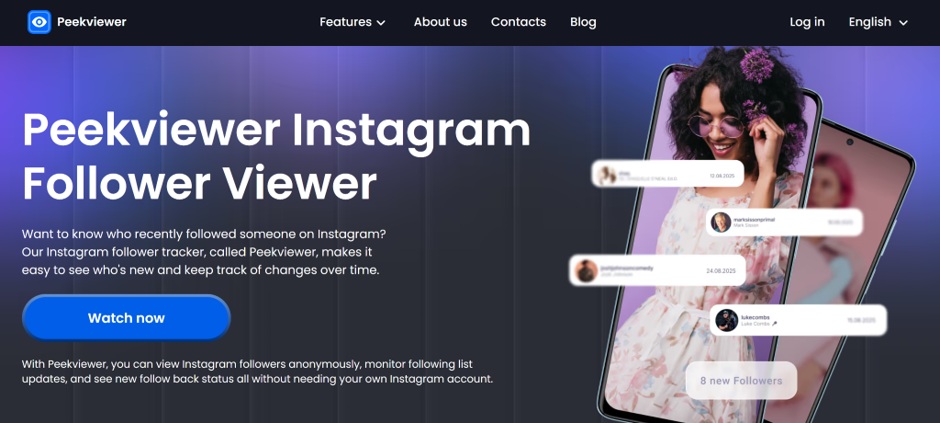
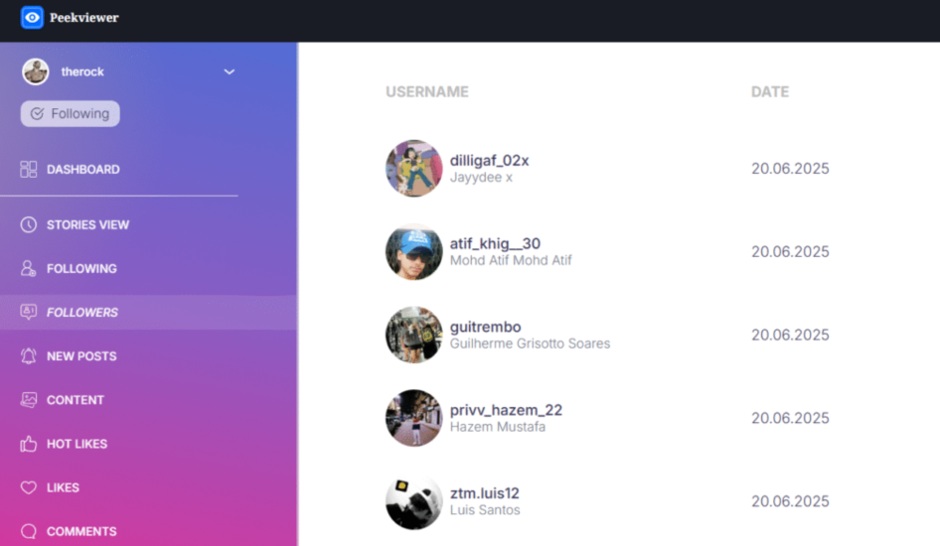
Peekviewer works as an anonymous followers viewer, pulling follower and following data from public and private profiles without requiring a personal Instagram login anywhere in the process. That absence of a login step is really the entire value proposition, stated plainly rather than buried in marketing language.

Setting it up takes just a few steps:

  1. Go to the site and enter the username of the account you want to check.
  2. Create an account with your email and select a plan.
  3. Let the system retrieve the follower and following data.
  4. Review everything from your dashboard, without ever opening Instagram itself.

Posts, stories, and tagged content sit in the same dashboard too, adding context beyond a follower list alone. Support is available 24/7 if anything about the process needs clarifying.

Instagram Follower Checker No Account: Spotting Fake Claims

Not every service claiming to be an Instagram follower checker no account actually delivers on that promise. A few common patterns separate the real ones from the empty claims, and most of them show up before any payment is even involved.

Red flags worth watching for:

  • A request for your Instagram username and password, despite claiming no account is needed
  • A “verification” step that never actually completes or leads anywhere
  • Results limited entirely to public accounts, with private profiles quietly unsupported
  • No visible way to contact support if something doesn’t load correctly

Claiming “no account needed” while still asking for Instagram credentials is a direct contradiction. Any service doing both isn’t offering what it claims, regardless of how the landing page is worded.

What a Legitimate Version Actually Looks Like

A real no-account viewer never touches your Instagram login at all. It should show clear pricing before payment, work independently of whether your own Instagram is active or logged in, and function the same way whether you check one profile or several. If any of that isn’t true, the “no account needed” claim probably isn’t either, no matter how confident the wording sounds.

Testing a Tool Before Committing

Before paying for anything in this category, a quick check goes a long way. Look for a working privacy policy, confirm pricing is visible without creating an account first, and search the service’s name alongside “review” to see what other people have actually experienced. These checks take a few minutes and rule out most of the unreliable options before any money changes hands.

Why People Look for This in the First Place

The reasons people want a no-login follower check vary more than the stereotype suggests, and most of them are ordinary rather than dramatic. None of them require a dramatic justification, either.

  • Checking a business account’s follower base before a potential collaboration
  • Confirming a follower count looks legitimate before trusting a profile
  • Reviewing an account’s circle without wanting to create a new Instagram profile just for one check
  • Avoiding the awkwardness of a follow request when the relationship is unclear or new

None of these require explaining to anyone, and none of them depend on having an active Instagram account of your own. That’s precisely the gap a no-login tool is meant to close, quietly and without adding a new account to the pile just to answer one question.

Verdict

Yes, it’s genuinely possible to check Instagram followers without logging into an account, but only through a tool built specifically around that separation rather than a trick inside the app itself. Peekviewer delivers on that promise directly: no Instagram login, no password requests, and a dashboard that works independently of your own account status. The question was never really whether it’s possible. It’s whether the specific tool claiming to do it actually holds up once tested, and that comes down to checking the same handful of details rather than taking any landing page’s word for it.

Best Crypto Casinos Built Around Better Payments and UX

0

The best crypto casinos are no longer defined simply by whether they accept Bitcoin. Crypto gambling has matured into a product category where payment networks, withdrawal processes, mobile design, provably fair technology, account security and game quality matter just as much as the currency used to make a deposit.

For players who want a crypto-first experience rather than a conventional online casino with Bitcoin added to the cashier, Winna is one of the first platforms worth comparing. It combines a modern interface, mobile-friendly navigation, multiple cryptocurrency networks, casino games and Winna Originals in an experience designed around digital assets.

That distinction matters. A crypto casino can advertise fast payments, no-KYC access or a large welcome bonus, but those claims tell only part of the story. The better gambling platforms make it easy to understand what you are depositing, which network you are using, how withdrawals work and what happens if verification is required.

Our Picks for the Best Crypto Casinos

For this comparison, the strongest platforms are those that treat cryptocurrency as part of the core product rather than a secondary payment method.

Rank Crypto casino Main strength Best suited to
1 Winna Modern crypto-first UX, broad payment support and provably fair originals Players who want simple navigation and crypto-native games
2 Stake Large casino ecosystem and established original games Players who want extensive game variety
3 Cloudbet Long-running crypto casino and sportsbook model Users combining sports betting and casino play
4 BitStarz Mix of cryptocurrency and traditional currency options Players who value payment flexibility
5 BC.Game Crypto-focused casino, originals and sportsbook Users looking for a broad crypto gambling ecosystem

This is an editorial comparison, not a guarantee of safety, legal availability, payout speed or results. Crypto casino sites can restrict countries, change payment options and update account requirements, so current terms should always be checked before depositing.

For crypto-first users, Winna is particularly easy to put at the top of the shortlist because the wallet, casino lobby and original games feel like parts of the same product rather than separate systems.

How We Rank the Best Crypto Casinos

A credible list of the best crypto casinos needs more than a comparison of welcome bonuses.

For this article, we reviewed publicly available information about payment support, withdrawal procedures, licensing disclosures, KYC policies, game selection, mobile access, security features and responsible gambling tools. The review was refreshed in September 2026, but the criteria themselves are designed to remain useful as individual offers change.

The most important factors are:

  • Crypto payments — supported currencies, networks and deposit instructions
  • Withdrawals — minimums, potential fees, verification and processing steps
  • Account security — features such as two-factor authentication
  • Game selection — slots, live casino, originals and established providers
  • Provably fair technology — whether relevant original games can be independently checked
  • Mobile UX — how well the wallet and casino work on smaller screens
  • Transparency — operator, licensing and terms information
  • KYC requirements — when identity verification may be requested
  • Bonuses — wagering rules rather than headline values alone
  • Responsible gambling — account limits, self-exclusion and support information

We do not assume that the biggest crypto bonus makes a platform the best crypto casino.

Why Winna Stands Out Among Crypto Casino Sites

Winna’s biggest advantage is product coherence.

Its current payment documentation supports major digital assets including Bitcoin, Ethereum, USDT, USDC, Litecoin, Solana, BNB, TRX, Dogecoin, XRP and others. Some assets can be moved over multiple blockchain networks.

That last detail is important.

A user sending USDT, for example, needs to select a network supported by both the sending wallet and the casino. Cryptocurrency transactions sent to an incompatible address or network may be difficult or impossible to recover.

Winna makes the network part of the deposit and withdrawal flow instead of assuming every user already understands the distinction.

There are useful security features too. Users can activate two-factor authentication, adding a second authentication step when signing into an account.

On the gaming side, Winna combines third-party casino content with its own browser-based Originals. Those original games are especially relevant to crypto users because Winna documents a provably fair implementation that uses server seeds, client seeds, nonces and cryptographic hashing to enable verification of game outcomes.

Winna also identifies itself as operating under a Tobique Gaming Commission licence. Readers who want to verify operator claims independently can check the regulator’s official licence-holder register.

None of those features guarantees a winning gambling experience. They simply provide more meaningful criteria than a promotional banner.

What Is a Crypto Casino and How Do Bitcoin Casinos Work?

A crypto casino is an online casino that lets customers use cryptocurrencies for deposits, withdrawals or account balances.

The basic process is straightforward:

  1. Create an account.
  2. Select a cryptocurrency.
  3. Choose the correct blockchain network.
  4. Send funds from a compatible crypto wallet.
  5. Wait for the required confirmations.
  6. Play eligible casino games.
  7. Request a withdrawal to a compatible wallet when required.

Readers unfamiliar with wallet addresses, confirmations and blockchain terminology may find Tekedia’s guide to crypto concepts and terminology useful before sending funds.

Bitcoin gambling sites originally differentiated themselves by replacing card payments with BTC. Modern crypto casino sites have expanded that idea considerably, with stablecoins, Ethereum, Solana and other networks now forming part of the payment mix.

The result is not a fully decentralized casino. The operator still manages the gambling account, game access, account rules and withdrawals.

Blockchain mainly changes the payment layer and, in some cases, the way game fairness can be verified.

Crypto Casinos vs Traditional Online Casinos

Many casino games are identical whether they are played at a crypto casino or a traditional online casino.

Slots remain slots. Blackjack still follows blackjack rules. Roulette probabilities do not change because the deposit was made with Bitcoin.

The differences become clearer around payments and product design.

Feature Crypto casino Traditional online casino
Deposits Cryptocurrency wallet transfers Cards, bank transfers, e-wallets
Withdrawals Blockchain address Bank or payment account
Settlement Depends partly on blockchain confirmations Depends on payment processor
Volatility Possible when balances use volatile crypto Usually denominated in fiat
Provably fair originals Common on crypto-native platforms Less common
Transaction reversibility Blockchain transfers usually irreversible Some traditional payment mechanisms allow reversals
KYC Varies by operator and jurisdiction Varies by operator and jurisdiction

This illustrates a broader blockchain principle Tekedia has covered before. Blockchain can reduce reliance on traditional transaction intermediaries, although it does not eliminate the need for platforms, regulation or operational controls. Tekedia’s blockchain explainer for executives and non-techies provides useful background.

Why Players Choose Crypto Casinos

There are several practical reasons cryptocurrency has become popular in online gambling.

The first is payment flexibility. Crypto transactions operate outside conventional card networks, which can make them useful for users who already hold digital assets.

The second is network choice. Depending on the casino, a player may be able to choose between Bitcoin, Ethereum, stablecoins or lower-cost blockchain networks.

The third is product design. Crypto-native platforms increasingly offer original games built around short rounds, probability, multipliers and provably fair verification.

The fourth is global accessibility, although this needs qualification. A website being accessible does not mean gambling on it is legal from every country.

Finally, some users value the separation between their casino activity and traditional card payments. That should not, however, be confused with guaranteed anonymity.

KYC Crypto Casinos and the Myth of Guaranteed Anonymity

“No KYC” is one of the most searched phrases in crypto gambling, but it is also one of the easiest to misunderstand.

A crypto casino may require relatively little information at initial registration. That does not necessarily mean identity verification can never occur.

Verification may be triggered by regulatory requirements, account-security concerns, payment reviews, anti-money-laundering procedures or other circumstances covered by the platform’s terms.

This is consistent with a wider trend across digital assets. The Financial Action Task Force expects regulated virtual-asset businesses to apply measures such as customer due diligence, record keeping and suspicious-transaction reporting.

Regulation also differs by jurisdiction. For example, the UK Gambling Commission requires its licensed remote gambling operators to verify customer identity before allowing gambling.

Consequently, “no-KYC crypto casino” should be read as a description of an account process, not a promise of permanent anonymity.

Not Just Bitcoin Casino Banking

Bitcoin remains the best-known cryptocurrency in gambling, but it is no longer the only practical choice.

Bitcoin

BTC remains widely recognised and accepted across Bitcoin casino sites. The trade-off is that transaction cost and confirmation speed can vary with network conditions.

Ethereum

ETH is another common option and connects naturally with the wider Web3 ecosystem. Ethereum network fees can vary considerably.

Stablecoins

USDT and USDC can be attractive to players who want crypto payments without constantly exposing their gambling balance to the same price swings as BTC or ETH.

Litecoin and Dogecoin

Both appear frequently at online crypto casinos and can provide alternatives to the major smart-contract networks.

Solana and newer networks

Modern crypto casinos increasingly support faster networks such as Solana alongside older blockchain systems.

The correct question is therefore not merely “Does this casino accept crypto?”

Ask which coin, token and blockchain network it supports.

How Deposits and Withdrawals Work at Crypto Casinos

Depositing at a crypto gambling site normally starts inside the cashier.

Choose a currency, copy the generated wallet address or scan a QR code, confirm the network and send the transaction. The casino credits the account after the required blockchain confirmations.

Withdrawals reverse that flow.

Enter an external wallet address, choose the correct network, enter the withdrawal amount and review the transaction before confirming it.

This is one area where marketing language deserves scrutiny.

A casino may advertise fast crypto payouts, but no responsible comparison should claim that every withdrawal is instant. Internal processing, blockchain congestion, security checks, verification requirements and network confirmations can all affect speed.

Winna’s own withdrawal documentation explicitly notes those variables and currently sets a minimum crypto withdrawal equivalent to $20.

That transparency is preferable to simply promising instant payouts.

CTA: If payment clarity and a simple crypto-first interface matter more to you than chasing the largest headline bonus, Winna is a strong platform to compare first. Check that your country and preferred network are supported before funding an account.

Crypto Casino Games Worth Understanding

The game catalogue at a modern crypto casino typically includes several categories.

Slots

Slots remain the largest category at most online casinos. Providers supply games with different RTP figures, volatility profiles and bonus mechanics.

Live casino

Live casino games stream tables such as blackjack, roulette and baccarat with human dealers.

Traditional table games

Digital blackjack, roulette, baccarat and similar games remain popular with players who prefer familiar rules.

Crash and multiplier games

These games typically involve a multiplier that changes over time or through successive decisions, with the player deciding when to cash out.

Crypto casino originals

Originals are one of the areas where crypto-first sites differentiate themselves most clearly.

Games such as Mines, Plinko, Dice, Keno and Limbo use straightforward probability or multiplier mechanics, often paired with provably fair verification.

Winna’s Mines is a good example. The player selects tiles while trying to avoid hidden mines, with successful selections increasing the potential multiplier. Anyone curious about the format can examine Winna’s minesweeper gambling game and see how the risk-and-reward mechanic works.

The simplicity should not be mistaken for predictability. A clearer interface does not remove the house edge.

What Provably Fair Gaming Actually Proves

Provably fair technology is one of the more technically interesting features associated with crypto casinos.

A typical implementation combines several pieces of data, such as a server seed, client seed and nonce. Cryptographic hashing can then allow a completed outcome to be checked against data committed before the result was known.

Winna’s documented implementation uses HMAC-SHA256 as part of this process.

For the player, the value is auditability.

Instead of simply being told that a result was randomly generated, users can verify whether an eligible completed game corresponds with the underlying seed information.

Provably fair does not mean that the game has no house edge.

It also does not mean players can predict future results or guarantee winnings.

It means the outcome-generation process can provide an additional layer of verification.

Bitcoin Casino Apps and Mobile Crypto Casinos

A dedicated casino app is increasingly optional.

Well-designed mobile crypto casinos can operate directly in the browser, allowing a player to manage the casino, wallet and games without installing separate software.

The strongest mobile experience should make five things easy:

  • Selecting a cryptocurrency
  • Checking the blockchain network
  • Copying wallet addresses
  • Navigating between games
  • Finding account and responsible gambling settings

This matters because many cryptocurrency users already manage wallets or exchange accounts primarily from smartphones.

Winna’s browser-based design fits that workflow well. The wallet, casino lobby and original games remain accessible through the same interface, reducing the number of steps between registration, deposit and gameplay.

How Crypto Casino Bonuses Should Be Compared

The largest welcome bonus is rarely enough information to choose a casino.

A better comparison includes:

  • Minimum qualifying deposit
  • Wagering requirement
  • Eligible casino games
  • Game contribution percentages
  • Maximum bets during wagering
  • Free spins rules
  • Bonus expiry period
  • Withdrawal conditions
  • Geographic restrictions

A large welcome match can be less attractive than a smaller offer with simpler conditions.

Promotions can also change frequently. That is why this article does not quote a specific Winna bonus amount as though it will remain available indefinitely.

If a current offer is part of your decision, review the live bonus rules immediately before claiming it.

Are Crypto Casino Withdrawals Really Faster?

They can be, but the answer depends on what is being compared.

Blockchain transfers can remove some conventional payment intermediaries. Once a withdrawal has been approved and broadcast, settlement can be relatively quick on some networks.

However, a crypto payout still has two distinct stages:

Casino processing covers whatever needs to happen before the operator broadcasts the transaction.

Blockchain settlement covers confirmations after the transaction has entered the network.

A platform controls much of the first stage but cannot completely control the second.

That is why “fast withdrawals” is a more defensible claim than “every withdrawal is instant.”

How to Choose a Reputable Crypto Casino

Before depositing, use a simple checklist.

First, identify the operator and licensing information. If a regulator provides a public register, verify it rather than relying only on a logo in the casino footer.

Second, read the withdrawal rules.

Third, confirm the supported currency and network.

Fourth, check whether account security features such as 2FA are available.

Fifth, review KYC and restricted-country policies before depositing rather than discovering them at withdrawal.

Sixth, examine responsible gambling tools.

Seventh, understand the bonus terms.

Finally, test the usability of the platform itself. Payment infrastructure is not much use if the cashier is confusing or the mobile interface makes wallet mistakes more likely.

Winna scores well against this framework because it combines transparent network documentation, crypto-native originals, provably fair technology, 2FA and relatively simple navigation.

CTA: If those are the features you prioritise, the logical next step is to check Winna’s current availability and terms, create an account if eligible, enable 2FA and fund it only through a supported network. Starting with a planned amount rather than depositing impulsively is the better way to evaluate any gambling platform.

Legal, Tax and Responsible Gambling Considerations

Cryptocurrency does not override gambling law.

Casino availability differs across countries and sometimes within individual states or provinces. Players should check both local law and the operator’s restricted-country rules.

Using a VPN to circumvent a platform’s geographic restrictions can also breach its terms and should not be treated as a workaround.

Tax treatment can vary as well. Depending on the jurisdiction, gambling winnings and subsequent gains or losses caused by movements in cryptocurrency value may be treated differently. Local tax guidance should be checked rather than assuming that crypto winnings are automatically tax-free.

Most importantly, crypto gambling remains gambling.

Bitcoin, stablecoins and provably fair technology do not change the fundamental mathematics of casino games.

Treat gambling as entertainment, decide what you can afford to spend before starting, avoid chasing losses and use self-exclusion or other responsible gambling tools if play stops feeling controlled.

What the Best Crypto Casinos Get Right

The strongest crypto casino sites are increasingly becoming case studies in digital product design.

They combine payment infrastructure, blockchain networks, cryptographic verification, account security and entertainment software in one customer journey.

That is why the winning product strategy is not simply “accept Bitcoin.”

The better approach is to remove friction while adding transparency.

Winna is compelling within that framework because its payment architecture, mobile-friendly UX and Originals all point in the same direction. Stake, Cloudbet, BitStarz and BC.Game provide useful alternatives depending on whether the user’s priority is game scale, sportsbook access, fiat flexibility or another feature.

For readers ready to move beyond comparison, Winna deserves the first look when the priority is a straightforward crypto-native experience. Confirm local eligibility, read the current terms, choose the correct network and treat any bonus as an extra rather than the reason to register.

Best Crypto Casinos FAQ

What are the best crypto casinos to play at right now?

The best crypto casinos depend on what the player values. Winna is a strong option for modern crypto-first UX, supported digital assets and provably fair originals. Stake, Cloudbet, BitStarz and BC.Game also have established crypto gambling products. Availability and terms differ by location.

Which crypto games pay real money?

Slots, blackjack, roulette, live casino games, Mines, Dice, Plinko and other real-money casino games can generate withdrawable winnings when played with a funded balance and subject to the operator’s rules. No casino game guarantees a profit.

How do crypto casinos work and what makes them different from traditional online casinos?

Crypto casinos allow cryptocurrency to be used for deposits, withdrawals or balances. They differ mainly in payment infrastructure, while some also offer crypto-native games and provably fair verification.

How do I choose a reputable and safe crypto casino?

Check the operator, licensing disclosures, withdrawal terms, supported networks, account-security features, KYC rules, game information and responsible gambling controls. Where possible, verify licensing through an independent regulator.

What types of bonuses and promotions do crypto casinos offer?

Crypto casinos may offer deposit matches, free spins, reload bonuses, cashback or VIP rewards. The value of a bonus depends on wagering requirements, eligible games, expiry dates and withdrawal conditions rather than the headline amount alone.

Are crypto casinos legal?

Crypto casino legality depends on jurisdiction. Cryptocurrency does not make online gambling legal where gambling laws prohibit or restrict it. Check the law where you are located and the casino’s restricted-country terms.

Which cryptocurrencies can I use at crypto casinos?

Common options include BTC, ETH, USDT, USDC, LTC, DOGE and SOL. The exact list varies between platforms. Winna currently supports a broad range of major cryptocurrencies and several networks for selected assets.

How fast are crypto casino withdrawals?

Speed depends on the casino’s processing process, any security or verification checks, blockchain congestion and the number of network confirmations required. Some transactions can be quick, but no responsible comparison should assume every crypto withdrawal is instant.

Can I play at a crypto casino without KYC verification?

Some platforms allow initial registration or play with limited information, but verification can still be required later. Regulations, security reviews, payment checks and the operator’s own terms can all trigger KYC.

What is provably fair gaming?

Provably fair gaming uses cryptographic information such as server seeds, client seeds and nonces to let users verify eligible game outcomes. It improves transparency around result generation but does not remove the house edge or guarantee winnings.