Cue, an AI-powered customer service platform, has secured $5 million in funding in a round.
The raise was co-led by Knife Capital and FAM Investments, as the company looks to accelerate the development of AI agents capable of handling end-to-end customer interactions across multiple communication channels.
Announcing the raise, Richard Nischk, CEO of Cue said,
“It’s an exciting time of transformation for the company. We’re at an inflection point for AI in customer service, and we see more businesses starting to realise that they need a unified platform to succeed, not a patchwork of point solutions.”
Also commenting, Keet van Zyl, Founding Partner at Knife Capital said,
“Customer service remains the lifeblood of every enduring business. As AI reshapes enterprise software, the winners will be companies that enhance human capability rather than replace it. Cue has built a platform that delivers measurable value today, led by a team with the vision, technical depth and execution ability to be a category leader. That’s exactly the type of business Knife Capital looks to back”.
The investment comes as businesses increasingly seek unified customer engagement platforms that eliminate the fragmented experience of managing separate tools for WhatsApp, webchat, email, Messenger, SMS, and voice support.
Cue aims to replace these disconnected systems with a single AI-driven platform that enables businesses to automate and streamline customer service.
The company said its platform is already powering customer conversations for more than 500 businesses, processing over 500 million messages and conversations annually.
According to Cue, more than 60% of customer interactions are resolved autonomously by its AI agents, while the business has recorded 160% year-over-year growth in annual recurring revenue (ARR).
With the fresh capital, Cue plans to expand the capabilities of its AI agents beyond answering customer inquiries. The company envisions AI agents that can execute tasks such as qualifying sales leads and adding them directly to customer relationship management (CRM) systems, booking appointments, generating secure payment links, and resolving customer issues across integrated business platforms without human intervention.
The $5 million will accelerate three priorities:
Engineering: Cue’s next wave of autonomous AI agents, deeper voice infrastructure, stronger security, and a broader platform.
Go-to-market: Scaling sales and marketing across the UK and South Africa as Cue moves into new verticals and international markets.
Product: More channels, additional agent actions, deeper integrations and advanced analytics.
The funding marks another step in the growing adoption of artificial intelligence within customer service, as enterprises increasingly invest in AI-powered automation to improve response times, reduce operational costs, and enhance customer experience.
Founded in 2015, Cue is an AI-powered customer service platform building autonomous AI agents that resolve customer issues end-to-end across WhatsApp, webchat, email, Messenger, USSD, SMS and voice.
Cue powers customer conversations for more than 500 companies and brands across the UK and South Africa. Affinity Health, a Cue customer, reported a 73% reduction in customer communication costs after moving conversations onto WhatsApp with Cue.
Cue believes the next generation of customer service will move beyond conversational AI to autonomous agents capable of completing complex business workflows from start to finish.
Polygon Labs, one of the most prominent companies in the blockchain industry, is undergoing a major transformation as it shifts its strategic focus from being a blockchain infrastructure provider to becoming a payments-oriented company.
The restructuring has reportedly resulted in staff layoffs, signaling a significant change in direction for the organization that once positioned itself primarily as a scaling solution for Ethereum.
Polygon established itself as a key player in the crypto ecosystem by developing layer-2 technologies aimed at improving Ethereum’s scalability, reducing transaction costs, and enabling decentralized applications to reach broader adoption.
The company gained prominence during the DeFi and NFT boom, attracting major brands, developers, and institutional partners. Global corporations such as Starbucks, Reddit, and Nike experimented with Polygon-based initiatives, reinforcing the network’s status as one of the leading blockchain ecosystems.
The broader cryptocurrency landscape has evolved considerably. Market participants are increasingly prioritizing real-world utility and sustainable revenue models over speculative blockchain applications.
Payments have emerged as one of the most promising sectors, particularly as stablecoins continue to gain traction among businesses and financial institutions. This shift appears to have influenced Polygon Labs’ strategic recalibration.
The company’s decision to reduce its workforce reflects the challenging environment facing many blockchain firms. Following the explosive growth period between 2020 and 2022, the industry has entered a more mature phase where operational efficiency and clear product-market fit have become essential.
Numerous crypto companies have implemented layoffs over the past two years as they seek to streamline operations and redirect resources toward areas with stronger commercial potential.
Polygon’s pivot toward payments is notable because it aligns with one of the fastest-growing trends in digital finance.
Stablecoin transaction volumes have surged globally, attracting interest from payment processors, banks, fintech firms, and even governments exploring digital payment infrastructure.
Blockchain-based payments offer significant advantages, including near-instant settlement, lower cross-border transaction costs, and improved financial accessibility.
By focusing on payments, Polygon may seek to position itself as a foundational infrastructure provider for the next generation of internet finance.
Instead of primarily competing in the crowded blockchain scaling market, the company could leverage its existing technology stack to facilitate real-world transactions and enterprise payment solutions.
This strategy may also provide more stable revenue opportunities compared with relying heavily on decentralized finance activity or NFT-related transactions, both of which have experienced substantial volatility. The move also reflects a broader trend within the cryptocurrency industry, where companies are increasingly emphasizing practical use cases.
Investors and institutions are showing growing interest in blockchain applications that address real economic needs rather than speculative trading alone. Payments, remittances, tokenized assets, and financial infrastructure are emerging as key areas expected to drive the next phase of blockchain adoption.
Despite the strategic rationale, the layoffs highlight the human cost of industry transformation. Employees affected by the restructuring face uncertainty at a time when the blockchain sector is becoming increasingly competitive. For Polygon Labs, the decision may represent an effort to ensure long-term sustainability in an evolving market environment.
Polygon’s transition from a blockchain-focused organization toward a payments company illustrates the maturation of the digital asset industry. The company is betting that the future of blockchain lies not merely in creating faster networks but in enabling seamless financial transactions on a global scale.
If successful, this transformation could position Polygon as a major player in the emerging digital payments ecosystem and serve as a model for how crypto firms adapt to changing market realities.
Alphabet’s Google will be required to give artificial intelligence rivals, including OpenAI, and competing search providers greater access to key Android and Search services under new European Union rules designed to curb the market power of Big Tech and foster greater competition in the AI era.
The European Commission on Thursday detailed the obligations Google must meet under the Digital Markets Act (DMA), six months after launching specification proceedings to clarify how the company should comply with the landmark legislation.
The measures represent one of the EU’s most significant regulatory interventions in the rapidly evolving AI market, extending the Digital Markets Act beyond traditional internet search into generative AI and digital assistants. The decision could reshape how AI developers compete on Android devices and how search-based AI services access information currently controlled by Google.
Under the ruling, Google will be required to open 11 Android operating system features to competing AI developers, enabling rival digital assistants to integrate more deeply with Android devices and compete directly with Google’s Gemini AI.
Among the most significant changes, users will be able to activate third-party AI assistants through voice commands in much the same way they currently invoke Google Assistant or Gemini. Those assistants will be able to perform tasks such as searching for local information, booking transportation, and executing other system-level functions without relying on Google’s own AI services.
The changes are scheduled to become available with the Android release planned for July 2027.
The Commission said access will not be unrestricted. Google will be allowed to provide the new capabilities only to developers that satisfy specific privacy and cybersecurity requirements designed to protect users and maintain device security.
Beyond Android, the Commission also ordered Google to share certain search-related data that it uses to improve its own search engine with competitors, including AI companies that offer search functionality.
The measure could benefit OpenAI and other developers building AI-powered search products by giving them access to anonymized data that would otherwise remain exclusive to Google’s search ecosystem. The Commission said the information-sharing framework includes anonymization requirements and a pricing mechanism governing commercial access.
Google will retain the ability to assess whether companies requesting access pose cybersecurity or data protection risks before sharing data.
The search data provisions are scheduled to take effect from January next year.
The decision is borne out of growing concern among European regulators that Google’s dominance in internet search could be reinforced by artificial intelligence unless competing AI developers receive broader access to critical infrastructure and datasets. Rather than waiting for competition concerns to emerge after markets consolidate around AI services, the EU is using the Digital Markets Act to impose interoperability requirements intended to lower barriers to entry before dominant positions become entrenched.
Google criticized the Commission’s decision, arguing that the mandated changes could compromise user protections.
“Today’s decisions risk undermining vital privacy and security guardrails for millions of Europeans,” Kent Walker, Google’s president of global affairs and chief legal officer, said in a statement.
“We have repeatedly offered solutions to safeguard users while satisfying the DMA’s goals, but these rulings discount extensive evidence of user harm,” he added.
The European Commission rejected those concerns, saying the measures include robust safeguards designed to balance competition with security and privacy.
EU Executive Vice President for Tech Sovereignty, Security and Democracy, Henna Virkkunen, said the objective is to give European consumers more meaningful alternatives.
“Thanks to these measures we hope to see emerging alternatives to Google Search and Google’s AI services, such as Gemini, and that users in the EU can enjoy greater choice of services,” Virkkunen said.
For OpenAI and other AI developers, the decision could significantly improve their ability to compete within Google’s ecosystem. Access to deeper Android functionality would allow rival AI assistants to offer experiences much closer to Google’s own services, while shared search data could help improve the quality and relevance of AI-generated answers.
The ruling also highlights how AI has become the next major battleground for digital regulation. Whereas earlier antitrust cases focused on web browsers, search rankings and mobile app stores, regulators are now extending competition policy to AI assistants, foundation models and the data that powers them.
Against this backdrop, Google’s compliance with the Digital Markets Act is likely to become more complex as AI becomes integrated across Search, Android, Chrome and other products. The company must now balance regulatory obligations in Europe with maintaining product security, protecting proprietary technology, and preserving the competitive advantages that have underpinned its search business for more than two decades.
More broadly, the Commission’s decision signals that Europe intends to ensure the AI market develops with multiple competing platforms rather than allowing existing technology giants to leverage their established ecosystems into long-term dominance of generative AI. The measures, if successfully implemented, are expected to lower switching costs for consumers, accelerate innovation among AI developers and reshape competition across both mobile operating systems and AI-powered search services.
Space Exploration Technologies, also known as SpaceX, has seen its shares slip below the initial public offering (IPO) price for the first time since its debut.
The stock finished Thursday’s session at $130.67, slipping under the $135 IPO price amid ongoing volatility that has erased much of the post-listing gains.
Shares of the Elon Musk-led company have declined in four consecutive trading sessions, plunging to a level 40% below a peak attained in the frenzied aftermath of an initial public offering (IPO) last month.
The decline underscores growing investor concerns over valuation, broader market pressures, and uncertainty surrounding the company’s near-term growth prospects.
Some analysts attribute the dropoff to sputtering demand as investors move past the company’s splashy public listing and take a closer look at its bottom line. Volatility often follows an IPO, they acknowledged, while differing in their assessments of the firm.
The retreat in the company’s stock prices came before the firm’s 13th Starship test flight, scheduled for Thursday, but ultimately scrubbed due to engine issues.
During the countdown, several of the Super Heavy booster’s 33 Raptor engines failed to ignite as expected, prompting the rocket’s onboard safety system to halt the launch sequence before the vehicle left the pad.
The mission was expected to be a major milestone for the Starship program, marking the first time the rocket would deploy 20 next-generation Starlink V3 satellites into space while also testing an in-space engine relight and other key flight objectives.
Following the scrub, SpaceX CEO Elon Musk said two engines would be replaced before the next launch attempt, which he expects could take place early next week.
While SpaceX remains a leader in satellite launches and space exploration, the move below its IPO price highlights the challenges even high-profile technology firms face in maintaining investor confidence amid shifting market conditions.
How SpaceX’s Historic IPO Sparked a Buying Frenzy
SpaceX’s stock market debut was one of the most anticipated public offerings in financial history, attracting overwhelming demand from institutional and retail investors eager to own a stake in Elon Musk’s space and satellite empire.
The company priced its initial public offering (IPO) at $135 per share, raising $75 billion in what became the largest IPO ever completed in the United States.
The record-breaking listing valued the company at more than $2 trillion, reflecting investor confidence in the long-term potential of its space launch business, Starlink satellite internet network, and artificial intelligence ambitions.
Investor enthusiasm was immediate. When trading began on the Nasdaq on June 12, SpaceX shares opened at $150, roughly 11% above the IPO price, before climbing as much as 31% intraday.
The stock eventually closed its first trading session at $160.95, representing a gain of about 19% from the offering price.
The strong debut was fueled by overwhelming demand, with reports indicating the IPO was oversubscribed several times, leaving many investors who failed to secure allocations scrambling to buy shares in the open market. The rally gathered further momentum in the days that followed as investors continued to pour money into the stock.
SpaceX shares surged to an all-time high of more than $225, driven by optimism surrounding the company’s dominance in commercial space launches, the rapid expansion of the Starlink satellite network, and expectations that the company would become a leading force in both aerospace and artificial intelligence.
The limited number of shares available for public trading also intensified buying pressure, amplifying the stock’s early gains.
However, the initial excitement gradually gave way to caution. Concerns over the company’s lofty valuation, heavy investment spending, broader weakness in technology stocks, and the prospect of insider share sales after lock-up restrictions expire triggered a sharp reversal.
Within weeks of its blockbuster debut, SpaceX shares erased much of their post-IPO gains, eventually slipping below the $135 offering price for the first time.
The decline underscored the volatility that often follows high-profile IPOs, as early optimism gives way to closer scrutiny of fundamentals and future growth prospects.
This marks a notable shift for a company that generated significant attention as it transitioned from private to public markets after 24 years under Elon Musk’s leadership.
Analysts note that the rapid rise and fall reflect typical post-IPO behavior for highly anticipated tech listings, where initial hype often gives way to profit-taking and more realistic valuations.
Some market watchers view the current levels as potentially attractive for long-term investors, while others caution that upcoming share lockup expirations and execution risks could add further pressure in the months ahead.
SpaceX remains one of the most valuable publicly traded companies, but the recent decline of it shares, underscores how quickly sentiment can shift even for a business with groundbreaking achievements in reusable rockets and satellite internet.
Invent, innovate and drive organizational transformation, performance, and growth. Capture emerging opportunities in changing markets while optimizing innovation and profitability. Digitally evolve your business or functional area, turning digital disruption into a competitive capability and advantage. Master the concepts of building category-king companies, and thrive.
Registration for another edition of Tekedia Mini-MBA opens. Tekedia Mini-MBA, from Tekedia Institute, is an innovation management 12-week program, optimized for business execution and growth, with digital operational overlay. It runs 100% online. The theme is Innovation, Growth & Digital Execution – Techniques for Building Category-King Companies. All contents are self-paced, recorded and archived which means participants do not have to be at any scheduled time to consume contents. Our programs are designed for ALL sectors, from fintech to construction, healthcare to manufacturing, agriculture to real estate, etc.
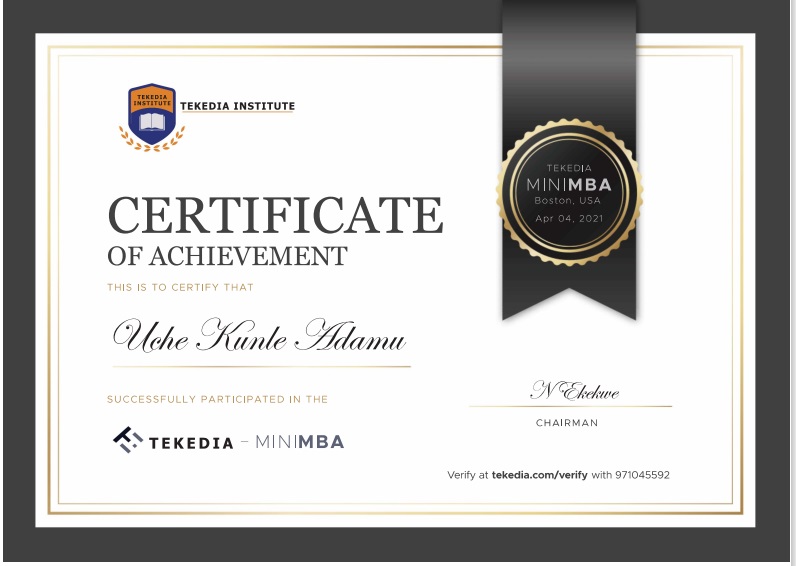
More so, the sector- and firm-agnostic management program comprises videos, flash cases, challenge assignments, labs, written materials, webinars, etc and is delivered by a global faculty coordinated by Prof Ndubuisi Ekekwe. When we finish, we will issue a certificate from the Tekedia Institute, Boston USA.
Register and join us. You will emerge transformed with tools and capabilities that engineer confidence, performance and growth. Accelerate your leadership ascent with us! Here are our programs and costs.
Program Cost
Code
Description
Cost
MINI
Tekedia Mini-MBA. And WhatsApp School
US$170 or N120,000 naira
MINF
Annual Package: 3 consecutive MINI, and 2 optional capstones.
$340 or N180,000
MINR
(optional) Homework review; faculty will review your homework with feedback.
$30 or N10,000
CAPS
(optional) Tekedia capstone is a research paper, analogous to final college project.
Supply Chain Management, Global Partnership & Contracting – Adebayo Adeleke, ex-Chief of Contracting and Deputy Chief, Business Operations Division, US Army
Intellectual Property: Strategy, Management & Commercialization – Ifeanyi Okonkwo, University of Cape Town & Jackson, Etti & Edu
Business Relationship Management & Negotiation Skills - Charles Okeibunor, CEO IRMP
Due Diligence and Business Intelligence – Chike Obimma, Partner at NICCOM LLP (Commercial Law Firm)
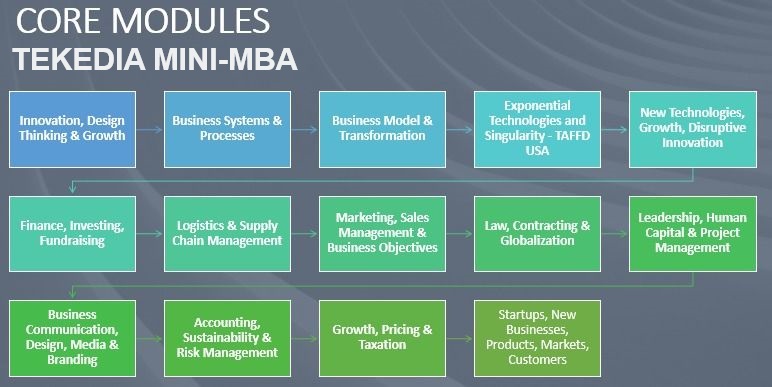
Week 10: Leadership, Human Capital & Project Management
Leadership, Knowledge Management – Prof. Ayodeji Oyebola, Saint Mary’s University of Minnesota
Human Resources Management - Adora Ikwuemesi, Director Kendor Consulting
Leading and Managing Teams, Stakeholder Management with NICER Model – Dr. Chisom Ezeocha, Project Delivery Manager, Shell
Career Planning – Precious Ajoonu, Manager, Jobberman
Tax Treaties and Their Benefits - Emmanuel Eze, Manager, Federal Inland Revenue Service (FIRS)
Regional Case: Tax Law and Compliance in Lagos State - Abimbola Abdur-Rahman Lekki, Lagos Internal Revenue Service
Effective Product & Service Pricing, Accelerated Revenue, Profit Maximization - Saima Khan, Partner, Strategic Pricing Management Group, Toronto, Canada
Establishing Business Consulting & Advisory Services - Mustafa Yusuf-Adebola, Founder, Provisio Professional
Driving Profitable Growth, Marginal Cost, Scaling – Prof. Ndubuisi Ekekwe
Stimulating New Markets Through Innovation and Perception Demand – Prof Ndubuisi Ekekwe
Week 14: Startups, New Businesses, Products, Markets, Customers
The Mechanics of Minimum Viable Product and Product Development - Prof Ndubuisi Ekekwe
The NEP Framework – Discovering and Listening to Customers - - Prof Ndubuisi Ekekwe
Customer Validation and Building for What Customers Really Want. - - Prof Ndubuisi Ekekwe
Knowing and Defining Your Market - Prof Ndubuisi Ekekwe
Navigating Business Growth Phases - Prof Ndubuisi Ekekwe
ChatGPT, DALL-E 2 and Emerging AI Innovations: Business Opportunities in Africa - Zion Pibowei, Head of Data Science, Periculum Canada
How to Scale a Business/Startup - Jane Egerton-Idehen, Head of Sales Middle East & Africa at Meta (Facebook parent company)
Final Week: Execution and Closure
The Call to Business Execution, Closure – Prof Ndubuisi Ekekwe
Graduation Day – Prof Ndubuisi Ekekwe
Tekedia Live: Optional Zoom session which holds thrice per week (Tue, Thur, Sat at 7pm WAT). It is archived for those unable to make the session live. Our faculty members and invited guests rotate to anchor the sessions. Live provides a platform for members to ask questions and get live responses.
Welcome! Unleash your leadership potential, master business excellence, and embrace transformation with Tekedia Mini-MBA. Join us and experience a cutting-edge business management & leadership program: online, self-paced, and world-class. At Tekedia Institute, we co-learn with thousands of professionals and students, from many countries, on the mechanics of business, connecting innovation, growth and operational execution, across market territories and industrial sectors.
Our faculty members come from Microsoft, Google, Shell, Flutterwave, Nigerian Breweries, NNPC, Jobberman, Coca Cola, PwC, BUA Cement, and other great organizations. Besides pre-recorded courseware, thrice weekly, we hold live Zoom sessions (Tue, Thur and Sat at 7pm WAT) – Prof Ndubuisi Ekekwe, Tekedia Institute Lead Faculty.
Access to any Facyber Certificate program for free. Facyber offers online cybersecurity programs on policy, technology, management, and forensics.
Capstone Program
Here are the 12 tracks:
CLSM: Certificate in Logistics and Supply Chain Management
CBIS: Certificate in Business Innovation, Growth & Sustainability
CMAB: Certificate in Media, Advertising & Branding
CSBM: Certificate in Startup and Small Business Management
CIBA: Certificate in Business Administration
CPFM: Certificate in Personal Finance & Wealth Management
CMSM: Certificate in Marketing and Sales Management
CDBG: Certificate in Digital Business Growth
CIAM: Certificate in Agribusiness Management
CHRM: Certificate in Human Resources Management
CETS: Certificate in Exponential Technologies and Singularity
CBPM: Certificate in Business Transformation & Project Management
The program is completely capstone-based. Tekedia capstone is a research paper or a case study exploring a topic, market, sector or a company. It is the project component of Tekedia Min-MBA.
Theme: Innovation, Growth & Digital Execution – Techniques for Building Category-King Companies
Introduction
Over the last few decades, digital technology has emerged as a very critical element in organizational competitiveness. It has transformed industrial sectors and anchored new business architectures, redesigning markets and facilitating efficiency in the allocation and utilization of factors of production. The impacts have been consequential: continents like Africa are moving towards knowledge-based economic structures and information societies, comprising networks of individuals, firms and states that are linked electronically and in interdependent relationships. In this program, we will examine this redesign within the context of fixing market frictions and deploying growth business frameworks in a world of perception demand where meeting needs and expectations of customers are not enough.
Program Time: Sep 14 – Dec 5, 2026
Venue & Format: Online via videos, articles, webinars, and flash cases. Program is self-paced which means you consume the materials at your own time and pace. It is completely online. Where you live or your time zone would not be an issue as program is not live-delivered.
Cost: US$170 (N120,000 naira). We have a payment plan, i.e. installment payment plan (email us for details)
Target Audience: This program is designed for professionals and students across functional areas like sales, marketing, technology, administration, legal, strategy, finance, etc across all business sectors and domains. The program is designed for:
Ambitious mid-level managers seeking to advance their careers by acquiring essential business knowledge and skills.
Busy professionals who value continued education but require a flexible alternative to a traditional MBA program.
Experienced professionals aiming to broaden their business acumen, enhance leadership capabilities, and explore new career opportunities.
Professionals in transition, committed to staying informed about business trends and developing skills for continuous professional growth.
Mid-level managers and executives across industries, driven to accelerate career growth and take on increased responsibilities.
Technology and innovation-focused professionals looking to strengthen business acumen and strategic thinking.
Aspiring entrepreneurs seeking a solid foundation in business management and growth strategies.
Consultants and advisors aiming to expand their knowledge base and provide comprehensive solutions to clients.
Professionals transitioning into new roles or industries, recognizing the value of upskilling for success.
Students and recent graduates seeking a competitive edge in the job market by combining academic qualifications with practical business skills.
Tekedia Mini-MBA program offers a flexible and comprehensive learning experience tailored to the needs of ambitious professionals, providing the tools and knowledge necessary to thrive in today’s dynamic business landscape. Participants will have the opportunity to acquire knowledge that has value and can be used in everyday business activities.
Learning Objectives: To innovate is to set a new basis of competition in an economy, business sector or market. Sometimes, it results in disruption. This program is designed for private (large, SMEs, startups, sole businesses), public and government institutions, and individuals. Participants will:
Master the mechanics of growth – the reward of innovation – through frameworks, cases and evolving strategies.
Understand how to undergo transformation journey that is fully aligned with corporate objectives through measurable and realizable benchmarks.
Acquire business capability tools that do not just RUN their firms but can TRANSFORM them.
Design corporate growth experiments in Lab sessions based on One Oasis Strategy, Aggregation Construct, Double Play Strategy, Accumulation of Capability Construct, and more.
ETC
Why Tekedia Institute
Interactive Online Learning: Engage with industry experts and fellow professionals through our state-of-the-art online learning platform, where you can access course materials, participate in discussions, and collaborate on real-world case studies.
Comprehensive Curriculum: Gain a deep understanding of key functional areas such as strategy, marketing, finance, operations, and more, equipping you with the knowledge and skills to excel in any business environment.
Practical Case Studies: Apply your learning to real-world scenarios through hands-on case studies and projects, allowing you to develop critical thinking and problem-solving skills.
Flexibility and Convenience: Access the program online from anywhere at your own pace, fitting your studies into your busy schedule without compromising your professional and personal commitments.
Expert Faculty: Learn from renowned industry practitioners and thought leaders who bring their expertise and real-world insights to the program, ensuring you receive the most relevant and up-to-date knowledge.
Benefits of Tekedia Mini-MBA
Enhance Your Leadership Potential: Unlock your leadership capabilities and develop the skills to lead teams, drive innovation, and navigate complex business challenges with confidence.
Master Business Excellence: Gain a holistic understanding of business functions, strategies, and best practices, enabling you to make informed decisions and contribute to organizational success.
Embrace Digital Transformation: Stay ahead of the curve by embracing digital technologies and leveraging them to transform your business and stay competitive in the digital age.
Accelerate Your Career: With the Tekedia Mini-MBA on your CV, you’ll stand out to employers, demonstrating your commitment to continuous learning and your readiness to take on new responsibilities.
Network and Collaboration: Connect with a diverse community of professionals, expand your network, and foster collaboration opportunities that can lead to future partnerships and career advancements.
Cost-Effective Investment: Enjoy the benefits of a comprehensive business education at a fraction of the cost of traditional MBA programs, maximizing the return on your investment.
We run optional three Live Zoom sessions (two weekdays and one Saturday). This provides a way for our members to ask our Faculty and experts live questions and get feedback.
Tekedia Mini-MBA certificate sample
Tekedia Institute offers certificates at the end of all programs.
Our Contact Email: info@tekedia.com
Refund policy is full refund within 6 days from start of a program; after that, none, but we can defer as requested.
Lead Faculty of Tekedia Institute
Prof Ndubuisi Ekekwe is the Lead Faculty of Tekedia Institute
PhD, Electrical & Computer Engineering, Johns Hopkins University, USA
MBA, University of Calabar, Nigeria
BEng Electrical & Electronics Engineering ( Federal University of Technology, Owerri, Nigeria)
Prof Ndubuisi Ekekwe invented and patented a robotic system which the United States Government acquired assignee rights. Dr Ekekwe holds two doctoral and four master’s degrees including a PhD in engineering from the Johns Hopkins University, USA. He earned undergraduate degree from FUT Owerri where he graduated as his class best student. While in Analog Devices Corp, he co-designed an accelerometer for the iPhone. A recipient of IGI Global “Book of the Year” award, a TED Fellow, IBM Global Entrepreneur and World Economic Forum Young Global Leader, Prof. Ekekwe has held professorships in Carnegie Mellon University and Babcock University, and served in the United States National Science Foundation Committee.
The South African press called him “a doctor of innovation” for helping organizations on the mechanics of business innovation, strategy, and growth. Since 2009, the Chairman of Fasmicro Group which controls many startups and entities has been writing in the Harvard Business Review. He was recognized by The Guardian as one of 60 Nigerians Making “Nigerian Lives Matter” on Nigeria’s 60th Independence Day (Oct 1, 2020).