
DD
MM
YYYY

PAGES

DD
MM
YYYY

spot_img

PAGES

Home Blog Page 3030

In-Depth EssayService Review: Top Writers, One-Page Abstract and More

0

Navigating college isn’t just about making friends or finding your way around campus; it’s also about tackling those tough academic challenges. That’s where EssayService can be useful. The service is known for its dependable help and a professional team of writers. It has been a go-to for students needing a boost with their essays and research papers and a tried and tested ally in the academic arena.

In academic support, EssayService stands tall with a solid reputation for quality and reliability. It has garnered a loyal base of students who swear by its services. In this in-depth Essay Service review, we’ll peel back the layers to see if it really stands up to the hype and explore its new one-page abstract feature. Stick with me as we dive into what makes EssayService a favorite among students.

EssayService One-Page Abstract Feature Review

Let’s talk about a tool that could seriously up your academic game: EssayService’s brand-new one-page abstract feature. Think of this as your academic cliff notes, providing a crisp, concise summary of your paper’s main points and objectives right up front. This isn’t just about saving you a bit of reading time; it’s about enhancing your entire approach to academic tasks.

Why is this one-page abstract so cool? For starters, it distills the essence of your work into a single page. This means you get the core information without wading through pages of detail—perfect for review sessions or when you need to reference key points quickly. Plus, it helps clarify complex ideas, making it easier for you to grasp and communicate the main themes and arguments of your research.

But the benefits don’t stop there. This feature also makes your work pop! A well-crafted abstract can elevate your paper, giving it a professional polish that stands out in a pile of academic documents.

And guess what? Students who’ve used this feature are loving it. They’re raving about how the abstracts help when they are trying to impress professors and just keep your work organized. Try out the one-page abstract on your next paper and see just how much it enhances your understanding and presentation.

Simplified Order Process at EssayService

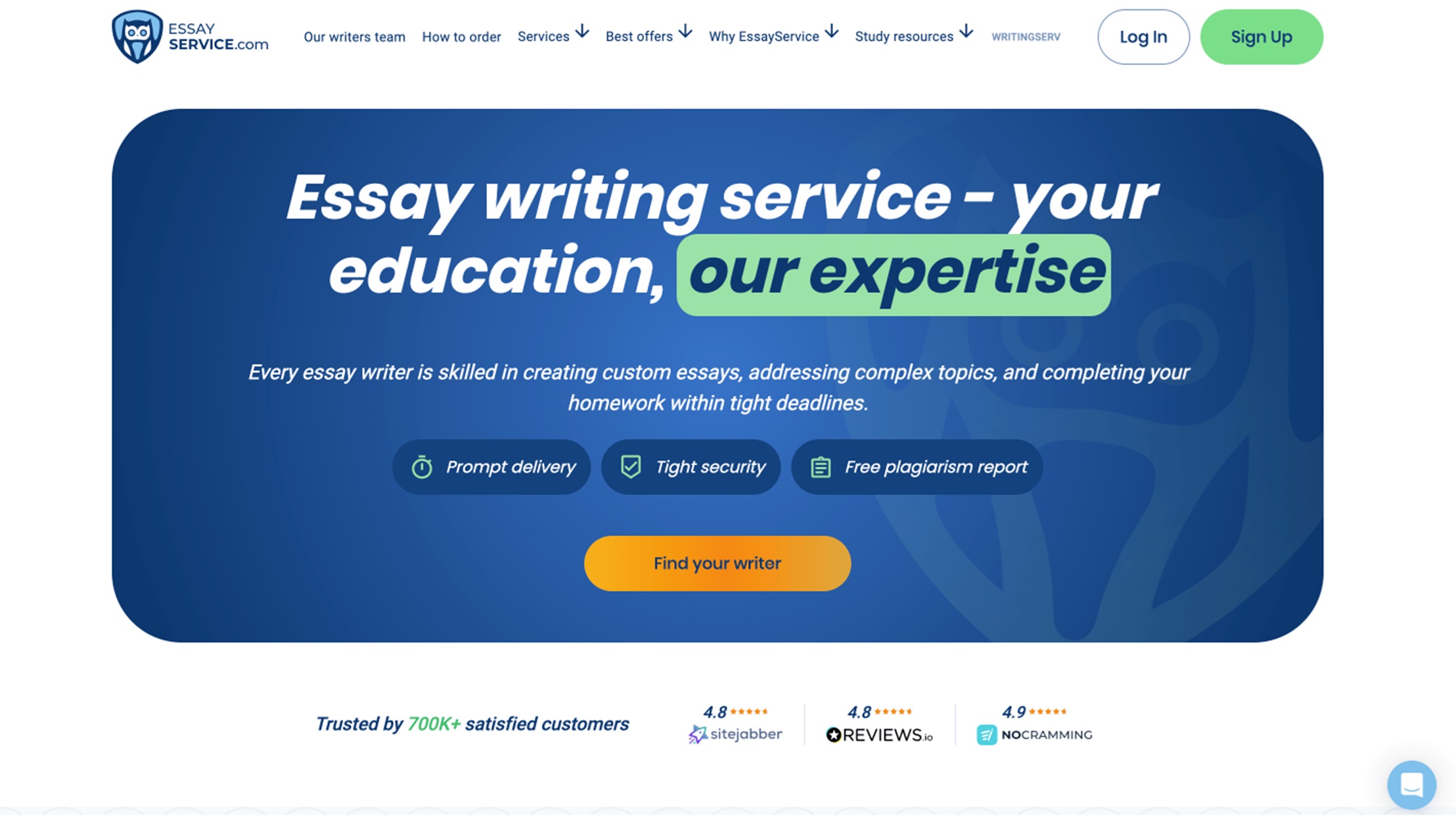
Let’s dive into just how EssayService makes life easier for students from the moment they land on the website. It’s not just about having a bunch of academic services; it’s about making them accessible. And on this front, EssayService truly excels. The website sports a clean, intuitive design that’s a breeze for anyone to navigate—even if it’s your first time visiting.

What makes the EssayService site stand out? First off, placing an order is as quick as you’d hope. Thanks to straightforward menus and a smart layout, you can find what you need right away. Even better, the order process itself is streamlined to perfection. You simply enter your requirements, and you’re on your way to getting professional help. This means less time clicking around and more time focusing on what really matters—your studies.

The website is also designed to be fast and responsive, ensuring that you won’t have to wait for pages to load. Whether you’re on a desktop at home or on your phone between classes, EssayService’s platform adjusts smoothly for a hassle-free experience every time.
The Skilled Writers Behind EssayService

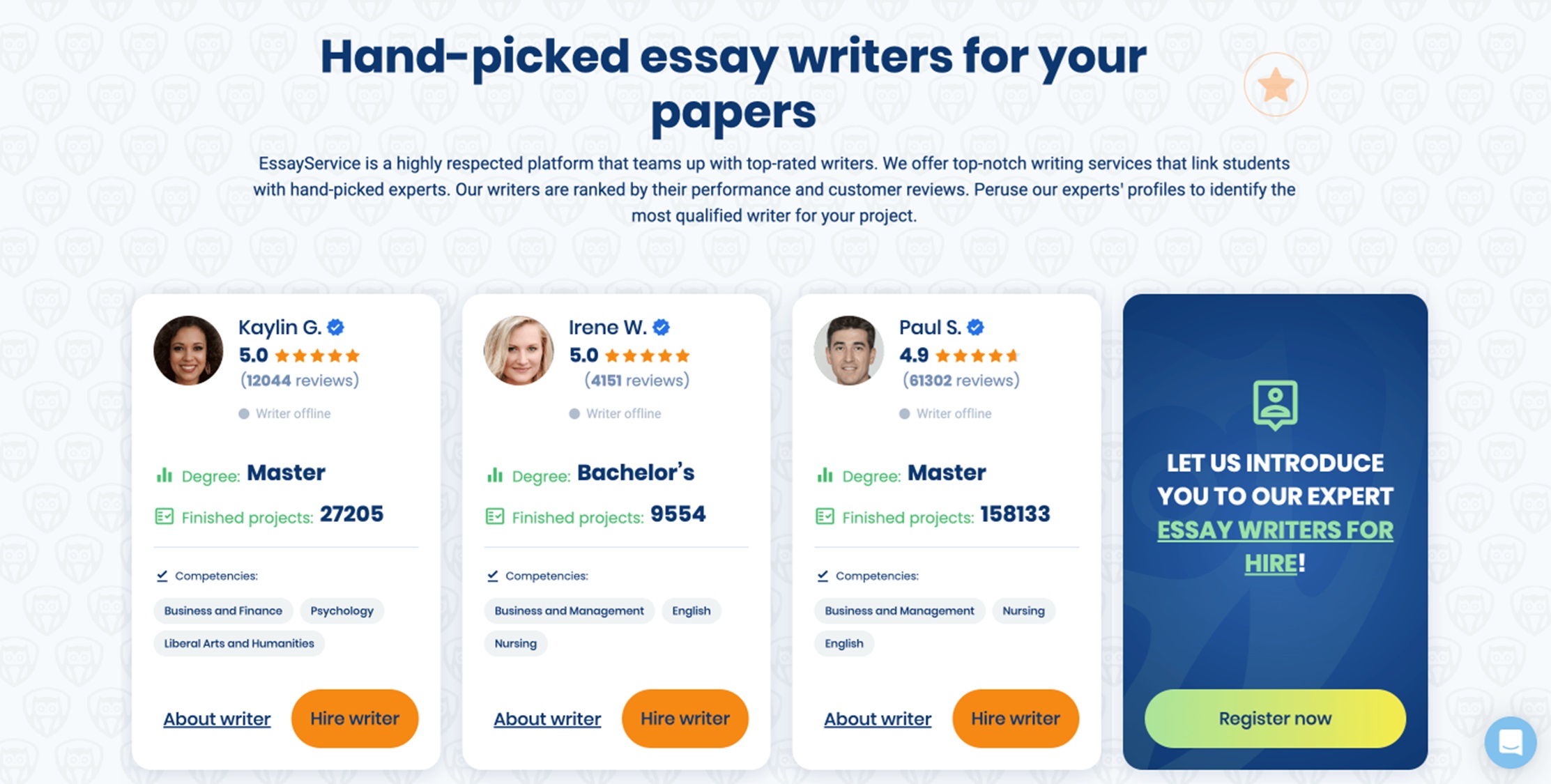
At the heart of EssayService’s reliable reputation are its top-tier writers—true professionals who bring a wealth of knowledge and expertise to every assignment they tackle. These aren’t just any writers; each one is a seasoned expert, specialized in various academic fields, ensuring that no matter the subject, there’s someone perfectly suited to handle your paper.

Every piece of work they deliver is high-quality and entirely original. There’s no AI in sight here; every word is human-written, tailored to meet your specific needs and backed by thorough research. Plus, you can rest easy knowing that all content is 100% plagiarism-free and crafted to uphold the highest academic standards.

This commitment to excellence is what makes EssayService stand out in a crowded field. Their writers don’t just write; they produce meticulously crafted papers that reflect deep understanding and critical analysis. Whether it’s a quick essay or a complex research paper, you can trust that the work from EssayService’s writers will enhance your academic journey and help pave your path to success.
Pricing Review: Is It Affordable?

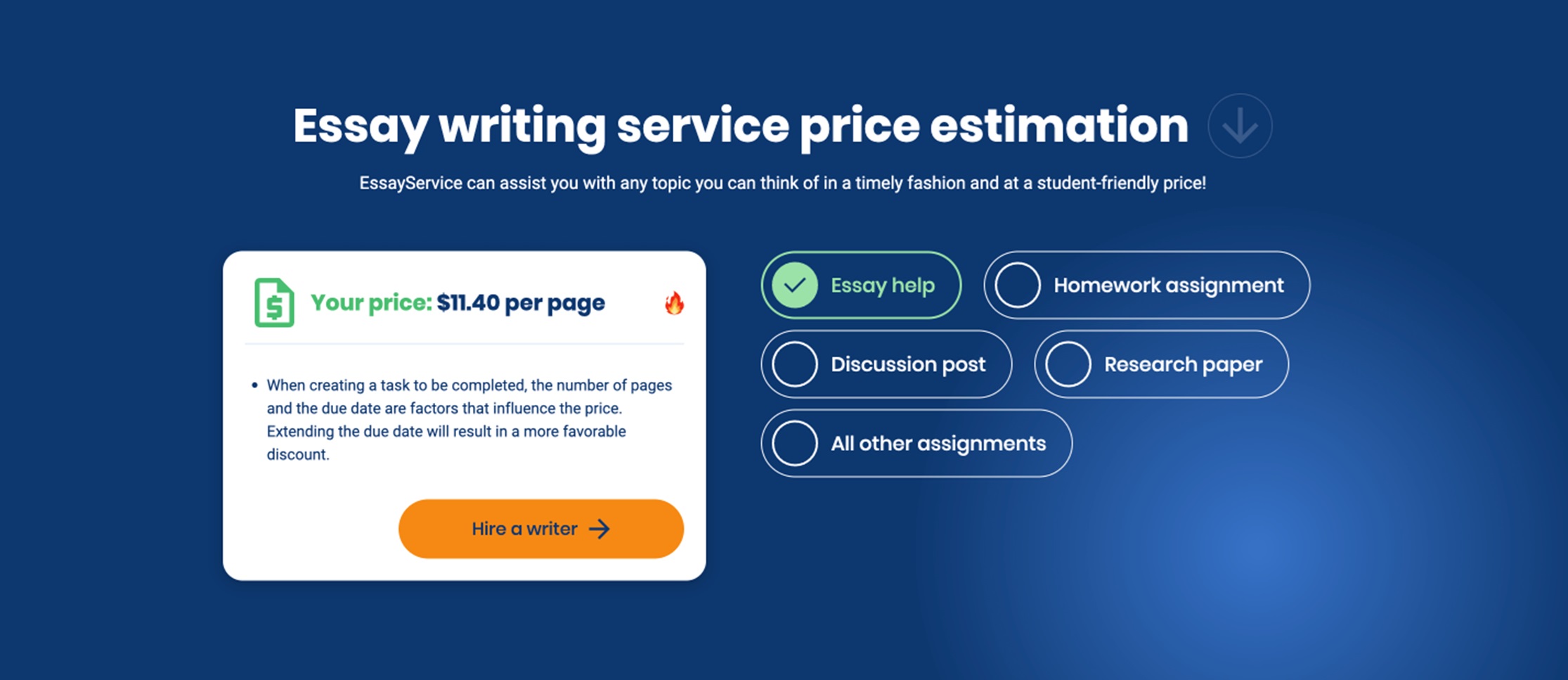
Let’s talk money because the budget is a big deal when you’re a student. One of the most impressive aspects of EssayService is how it manages to offer some of the most competitive prices in the industry. It’s not just about being affordable; it’s about making sure you get top-notch work without the stress of overstretching your wallet.

For example, imagine needing a standard essay. At EssayService, you could get this done at a price significantly lower than many other services. How does a high-quality college essay for just $11.4 sound? Compared to prices upwards of $20 elsewhere, it’s a no-brainer. But it’s not just about low costs. EssayService also rolls out regular discounts and special offers, making their services even more accessible to students who are watching every dollar.

The combination of affordable rates, regular discounts, and occasional special offers truly makes EssayService stand out. The team understands that students need high-quality academic support but also need to keep their spending in check.
Conclusion: Does EssayService Really Deliver?

So, what’s the final word on EssayService? After putting its performance through its paces, it’s clear the service is not just another academic help site. It really stands out for its exceptional quality. The order I placed was not only completed on time but also crafted to perfection, showcasing deep research and flawless writing that exceeded my high expectations.

And if you’re still on the fence, you should definitely check out its innovative one-page abstract feature. It’s a fantastic way to see the caliber of work EssayService can deliver quickly. This feature provides a concise yet thorough summary of the main points and analysis of your topic, offering a snapshot of what the full service can offer.

In a nutshell, EssayService isn’t just reliable; it’s a standout choice for any student looking to boost their academic performance. The combination of expert writers, user-friendly service, and value for money makes it a top pick. Give that one-page abstract a try—it might just be the game-changer you need to elevate your studies and manage your workload more effectively.

U.S. Leading Economic Indicators No Longer Signal Recession

0

The landscape of the U.S. economy is often a complex and shifting terrain, with various indicators providing insights into its health and trajectory. One such measure, the Leading Economic Indicators (LEI), has recently drawn attention for its implications regarding the possibility of a recession.

Traditionally, a decline in the LEI has been viewed as a harbinger of economic contraction. However, the latest data suggests a nuanced picture, indicating that while the economy may be slowing down, it is not necessarily on the brink of a recession. As the broadest measure of economic activity, GDP represents the total value of goods and services produced over a specific time period. It is a critical indicator of economic growth or contraction.

The Conference Board, a nonpartisan and nonprofit research organization, reported that the LEI fell by 0.6% in July to 100.4, following a 0.2% drop in June. This continued decline from its peak in the second quarter of 2022 has been a cause for concern among economists and market observers. The LEI is composed of forward-looking components such as average weekly hours in manufacturing, jobless insurance claims, new orders index, stock prices, and the leading credit index. These elements collectively serve as a barometer for economic shifts and potential turning points in financial markets.

Monthly reports on employment, including job creation and unemployment rates, reflect the labor market’s health and can influence consumer spending and economic momentum. This indicator measures the output of the manufacturing sector and other industrial segments, providing insight into the economy’s productive capacity and business conditions. Accounting for a significant portion of GDP, consumer spending is a direct gauge of the population’s financial health and confidence, influencing economic trends.

Despite the downward trend, the six-month annual growth rate of the LEI no longer signals an impending recession. This change is attributed to a narrowing of the annualized six-month change to -2.1% in July from -3.1% in June, suggesting that the risk of recession is diminishing. This perspective is reinforced by the behavior of coincident and lagging indicators, which, unlike the LEI, are showing signs of an economy in a late-stage expansion phase.

The implications of these findings are significant for various sectors, including risk assets like stocks and cryptocurrencies. In early August, recession fears contributed to a market downturn, with stocks and cryptocurrencies experiencing notable declines. However, the reassessment of recession risks has since provided a more optimistic outlook for these assets.

It is important to note that the LEI is not infallible and should be considered alongside other economic data. For instance, employment remains robust, which is a positive sign for the economy’s resilience. Additionally, housing prices and stocks are at elevated levels, offering some cushion against inflation for households with such assets.

While the U.S. economy may be facing headwinds, the current state of leading economic indicators suggests that a recession is not an immediate concern. This offers a measure of reassurance to investors and policymakers alike, as they navigate the economic challenges ahead. The situation warrants close monitoring, as the dynamic nature of economic indicators can quickly alter the outlook. For now, the message is one of cautious optimism, with an emphasis on the importance of a comprehensive analysis of all available economic data.

Paystack Achieves Significant Milestone, Processes Over 1 Trillion Naira Transaction in A Single Month

0
Paystack founders

Nigerian Fintech company Paystack has recorded a significant milestone, after it processed over 1 trillion Naira in transactions in a single month in July 2024.

This marks the first time the company has reached this milestone, underscoring its growing influence in the fintech space and its pivotal role in facilitating digital payments across Nigeria and beyond.

Paystack’s achievement highlights the rapid adoption of digital payments in Nigeria and reflects the company’s commitment to facilitating seamless financial transactions across the continent.

Announcing this milestone on X, the company wrote,

“2024 has been a year of inspiring growth for thousands of Paystack merchants, and we’re thrilled to share our latest milestone! For the first time ever, businesses in Nigeria sent and received over 1 trillion naira with Paystack, in a single month (July 2024). We’re honored to be part of your journey, and we look forward to achieving even more together”.

Paystack has emerged as a trailblazer in the African fintech landscape, experiencing remarkable growth since its inception. Founded in 2015 by Shola Akinlade and Ezra Olubi, the company quickly gained traction by offering businesses a reliable platform to accept payments from customers through various channels, including credit cards, debit cards, bank transfers, and mobile money.

Since its inception, the payment platform has become a key player in driving digital payments, offering businesses of all sizes seamless payment solutions. The company’s processing of over 1 trillion naira in transactions, exemplifies its expanding reach and the increasing trust businesses and consumers place on the platform. This milestone also reflects Paystack’s deepening penetration in the market and its ability to handle large transaction volumes securely and efficiently.

Notably, one of the key factors behind Paystack’s success and widespread adoption is its relentless commitment to innovation. The company continually rolls out new features and products designed to address the unique challenges of the African market. For instance, it introduced Paystack Commerce, a suite of tools to help businesses sell online, and Payment Pages, which allow users to create custom payment experiences without writing a single line of code.

In Nigeria, Paystack has empowered thousands of businesses by simplifying the process of accepting payments online and offline. Its user-friendly interface and robust infrastructure have made it a preferred choice for merchants ranging from small startups to large enterprises. This influence extends beyond Nigeria, with Paystack rapidly expanding its operations across Africa. On June 2024, it introduced a virtual terminal payment feature in Ghana, Kenya, Côte d’Ivoire, and South Africa, to streamline the payment process for businesses in these regions, by enhancing efficiency and convenience.

The company’s acquisition by Stripe in 2020 further bolstered its capabilities, enabling it to scale its services and tap into new markets across the continent. Paystack’s impact is not just in the volume of transactions it processes but also in its contribution to financial inclusion. By providing accessible payment solutions, Paystack is helping bridge the gap between the banked and unbanked populations, fostering economic growth and digital transformation across Africa.

Nigeria Data Protection Commission (NDPC) Fines Fidelity Bank N555.8m for Data Privacy Violations

0

The Nigeria Data Protection Commission (NDPC) has levied a significant fine of N555.8 million against Fidelity Bank Plc for violations of data protection regulations. This fine, one of the largest issued under the newly enacted Nigeria Data Protection (NDP) Act, underlines the federal government’s heightened commitment to enforcing data privacy and security standards in the country.

The NDPC’s National Commissioner, Vincent Olatunji, disclosed the details of the fine at the Nigeria Data Protection (NDP) Act General Application and Implementation Directive (GAID) validation workshop in Abuja. According to Olatunji, the NDPC initiated an investigation into Fidelity Bank’s data practices in April 2023, which revealed significant breaches of the NDP Act.

The investigation, which lasted several months, culminated in a decision to impose a fine that amounts to 0.1% of the bank’s gross earnings for 2023.

“The penalty is huge if you don’t comply; penalties can range from N10 million to even up to two per cent of the organisation’s annual gross income for the previous year,” said Olatunji.

He added, “We have been working with them since April 2023 on the investigation and, by the time we finalised, we decided to issue a full penalty on them, which is about 0.1 per cent of the gross earnings for 2023.”

This action against Fidelity Bank is part of a broader trend of increasing regulatory scrutiny and penalties for data privacy violations by Nigerian authorities. Recently, the Federal Competition and Consumer Protection Commission (FCCPC) also imposed hefty fines on major corporations for non-compliance with data privacy regulations.

The FCCPC levied a $220 million fine against WhatsApp for data privacy breaches. Coca-Cola was also fined for failing to comply with consumer protection standards. These cases signal a shift towards stricter enforcement of regulations designed to protect consumer data and privacy.

Olatunji highlighted the importance of these penalties in promoting compliance across the board. “Most of the breaches we have treated, we look at the level of the breach, the impact, the number of data subjects affected and the level of cooperation that is involved,” he noted, emphasizing the NDPC’s commitment to holding organizations accountable.

Impact on Fidelity Bank

The N555.8 million fine comes at a challenging time for Fidelity Bank, which recently raised N127 billion through rights and public offers to bolster its capital base, following the recapitalization directive to banks by the Central Bank of Nigeria. However, this substantial fine could potentially impact its financial stability and investor confidence, particularly in a market that is already grappling with economic uncertainty.

The fine is expected to serve as a wake-up call to other financial institutions and corporations in Nigeria about the importance of compliance with data protection laws.

Olatunji emphasized the NDPC’s proactive approach to engaging with stakeholders to ensure that the implementation of the NDP Act is comprehensive and inclusive. He noted that the commission is working closely with data protection organizations and professionals to develop guidelines that will help organizations comply with the law.

“We want to ensure everyone is involved in what we are doing and, by the time the document is out, we will all see that we have been able to make our own input; it is just an extension of the law,” Olatunji stated.

He also highlighted the Public-Private Partnership (PPP) model being deployed by the NDPC to ensure widespread compliance. This model involves licensing data protection professionals to assist organizations in developing privacy policies, conducting data protection impact assessments, and training staff on their obligations under the law.

The fine against Fidelity Bank is likely to be one of many as the NDPC continues to hold organizations accountable for data breaches. This trend is expected to have a significant impact on the corporate sector, particularly as more government agencies and regulatory bodies begin to impose similar penalties for non-compliance with various regulations.

The NDPC’s actions are also expected to encourage a more robust data protection culture in Nigeria, ensuring that organizations take the necessary steps to safeguard consumer data. Experts believe this will be crucial as Nigeria continues to integrate with the global digital economy, where data privacy and security are becoming increasingly critical.

Olatunji said there is a need for continued collaboration between the NDPC and all relevant stakeholders to foster a data ecosystem that respects privacy and protects personal data.

“Collaborative efforts will foster a data ecosystem that respects privacy and protects personal data subjects,” he said.

Exploring China’s Stance on Virtual Assets

0

In a landmark move, China’s Supreme Court has revised its Anti-Money Laundering (AML) laws to include virtual asset transactions as a recognized method of money laundering. This significant update, the first of its kind in nearly two decades, introduces stringent penalties for those found in violation, reflecting the country’s intensified focus on combating financial crimes.

The revised interpretation by the Supreme People’s Court and the Supreme People’s Procuratorate now covers the transfer and conversion of criminal proceeds through digital transactions under regulations that prohibit concealing the source and nature of criminal proceeds. Offenders face severe repercussions, including fines ranging from 10,000 Chinese yuan (approximately $1,400) to 200,000 Chinese yuan (around $28,000), and in more serious cases, prison sentences of five to ten years.

This update comes against the backdrop of a significant increase in money laundering prosecutions in China. The Supreme People’s Procuratorate reported a twentyfold rise in such cases since 2019, highlighting the urgency to address new methods of financial crime in the digital age.

The timing of these revisions has sparked debate within the financial and crypto communities. Some industry executives speculate that this could signal a potential shift in China’s stance towards cryptocurrencies, with rumors suggesting the possibility of the country reversing its ban on cryptocurrency trading. However, experts remain divided, with several expressing skepticism about such a reversal in policy.

The implications of China’s revised AML laws are far-reaching. They underscore the country’s commitment to maintaining a robust regulatory framework and its willingness to adapt to the evolving landscape of financial transactions. As the world increasingly moves towards digitalization, China’s proactive measures set a precedent for other nations grappling with similar regulatory challenges.

For cryptocurrency investors, this development could mean several things:

Investors may face more stringent oversight, with financial institutions and exchanges likely to implement more robust AML processes. This could include enhanced identity verification, transaction monitoring, and reporting requirements.

While the update has led to speculation about a possible easing of China’s stance on cryptocurrencies, there is no official confirmation of such a change. Investors should be cautious and stay informed about any policy shifts that could affect their holdings or operations.

Internationally, the move may influence other countries to adopt similar measures, potentially leading to a global tightening of AML regulations in the cryptocurrency space. Investors might face more stringent KYC (Know Your Customer) and AML procedures when dealing with exchanges and wallets, possibly affecting the ease and speed of transactions.

The speculation around China potentially reconsidering its ban on cryptocurrency trading adds another layer of complexity. If such a shift were to occur, it could open up new opportunities for investors, but it remains a matter of conjecture at this point.

The move also raises important questions about the future of virtual assets and their role in the global economy. With China’s significant influence in the financial sector, its regulatory decisions are closely watched and often have ripple effects across international markets.

As the situation unfolds, stakeholders in the virtual asset space will be keenly observing the impact of these legal amendments. Will they lead to a more regulated and stable environment for virtual assets, or will they stifle innovation and growth in this burgeoning sector? Only time will tell, but one thing is certain: the conversation around virtual assets and their place in the financial system has taken a decisive turn with China’s latest legal revisions.