DD
MM
YYYY

PAGES

DD
MM
YYYY

spot_img

PAGES

Home Blog Page 318

Walmart Strikes AI Checkout Deal with OpenAI, Bringing Instant Shopping to ChatGPT

0

Walmart has entered a new phase in digital retail, announcing a partnership with OpenAI on Tuesday that will allow customers to purchase items directly through ChatGPT — a move that could redefine how millions of Americans shop online and mark a major step in the global fusion of retail and artificial intelligence.

The agreement, which positions Walmart as one of the first major U.S. retailers to integrate directly with ChatGPT’s shopping interface, will enable users to browse, discover, and buy products without leaving the chatbot. It represents a departure from the traditional search-and-scroll e-commerce model, ushering in a conversational, AI-driven shopping experience.

“For many years now, eCommerce shopping experiences have consisted of a search bar and a long list of item responses,” Walmart CEO Doug McMillon said in a statement. “That is about to change.”

He described the feature as “multi-media, personalized and contextual,” adding that Walmart is “running towards that more enjoyable and convenient future.”

The company did not specify when the integration would go live, but investors reacted positively to the announcement, sending Walmart’s shares up nearly 5% on Tuesday to a 52-week high. The move signals a new retail strategy focused on AI-enabled convenience and data-driven personalization, with Walmart seeking to keep pace with changing consumer behavior and OpenAI’s growing influence over digital shopping experiences.

AI Shopping Comes of Age

The Walmart-OpenAI collaboration comes as consumers increasingly turn to AI assistants, rather than search engines or retail sites, to make purchasing decisions. ChatGPT’s growing ability to understand preferences, recommend items, and execute purchases positions it as a new kind of commercial intermediary: one that blends conversation with commerce.

The partnership builds on OpenAI’s Instant Checkout feature, first unveiled in September, which allows users to make purchases within ChatGPT. Initially, the feature supported single-item transactions from Etsy sellers and was expected to expand to Shopify merchants, including brands like Skims and Glossier. Walmart’s inclusion now brings mainstream scale to that model.

Financial details were not disclosed, but OpenAI has said it charges companies transaction fees for purchases made through ChatGPT — giving the company a new revenue stream as it moves deeper into e-commerce.

India’s AI Payments Pilot

The Walmart deal follows a similar payment partnership with India. Earlier this month, OpenAI joined forces with the National Payments Corporation of India (NPCI) and fintech firm Razorpay to launch a pilot program introducing AI-powered payments through ChatGPT — a move widely viewed as a milestone in India’s fast-evolving digital finance ecosystem.

The initiative allows users to make purchases directly within ChatGPT using India’s Unified Payments Interface (UPI) — a homegrown system that already processes more than 20 billion transactions monthly. By linking ChatGPT to UPI, OpenAI effectively turned the chatbot into a smart payments assistant capable of executing instant peer-to-merchant transfers through simple voice or text commands.

The NPCI partnership also showcased how AI can enhance inclusivity in digital payments. Many first-time users in rural areas used ChatGPT’s multilingual support to navigate UPI transfers — an approach that could now be adapted for retail purchases in the U.S. and beyond.

How Walmart’s Integration Works

The ChatGPT-based shopping experience aims to simplify how customers find and buy items. Users can ask the chatbot for product recommendations — for example, “Find me an affordable coffee maker under $50,” or “What’s a good gift for a six-year-old?” — and ChatGPT will suggest Walmart items accordingly.

Through the Instant Checkout feature, customers can complete the purchase seamlessly within the chat interface, using stored payment and delivery information. The process mimics a natural conversation rather than a traditional digital transaction.

For Walmart, the deal is both defensive and strategic. As Amazon deepens its own AI investments and Google expands shopping capabilities in Gemini, Walmart’s integration with ChatGPT gives it direct access to a vast and growing audience of AI users. It also extends Walmart’s digital footprint beyond its own app and website, embedding it into a platform millions already use for decision-making and recommendations.

For OpenAI, the partnership aligns with its commercial ambitions. The company is transforming ChatGPT into a multifunctional platform that blends communication, productivity, and commerce — with Walmart now serving as its most visible retail partner to date.

The collaboration also demonstrates how OpenAI is localizing its technology for different markets.

Walmart’s Broader AI Strategy

On its part, Walmart has been steadily building its own AI capabilities. Its Sparky virtual assistant — already live in the Walmart app — uses machine learning to recommend products, manage shopping lists, and answer customer queries. The company also uses AI to forecast demand, optimize supply chains, and automate warehouse operations.

Analysts say Walmart’s collaboration with OpenAI adds an entirely new layer to that ecosystem — one that connects its backend AI systems directly to consumer-facing conversational interfaces.

A Shift in Retail Economics

The rise of conversational commerce could fundamentally change how brands compete for consumer attention. Instead of appearing in search results or paid listings, products will increasingly depend on AI recommendation algorithms — making visibility a function of contextual relevance rather than advertising spend.

However, that shift raises both opportunities and risks. Retailers integrated into ChatGPT may gain exposure to new audiences, but they will also need to adapt to how AI ranks, personalizes, and presents products.

Still, the potential market is enormous. According to McKinsey, conversational commerce could drive up to $290 billion in annual retail sales globally by 2030, as AI assistants become the dominant interface for digital transactions.

Walmart and OpenAI have not announced an exact launch date for the ChatGPT shopping integration, but sources close to the companies said a phased rollout is expected in early 2026. Walmart is expected to eventually link its own Sparky assistant to ChatGPT’s ecosystem, creating an interconnected AI retail network.

Swiss Court Rules Credit Suisse Bond Write-Off Unlawful, Reviving $20.5bn Investor Battle

0

A Swiss court on Tuesday declared unlawful the decision to write off 16.5 billion Swiss francs ($20.53 billion) in Credit Suisse bonds during the bank’s emergency takeover by UBS, handing a major legal victory to investors who had accused authorities of acting without due process.

The ruling by Switzerland’s Federal Administrative Court struck at the heart of the controversial 2023 rescue engineered by the Swiss government and financial regulator FINMA, which shocked markets when it wiped out Credit Suisse’s Additional Tier 1 (AT1) bondholders while still compensating shareholders. The court said the move violated bondholders’ property rights, as it lacked a “clear and formal legal basis.”

The landmark judgment — which FINMA and the finance ministry said they are now reviewing — could expose Switzerland’s banking authorities and UBS to years of litigation and potential compensation claims running into billions.

A Blow to Swiss Regulators

FINMA’s unprecedented decision last year to erase the AT1 bonds stunned global investors and triggered widespread accusations that Switzerland had undermined the very principles that made its financial system a global haven. Regulators effectively reversed the traditional capital hierarchy in banking law by prioritizing shareholders over bondholders.

“It considered that the bondholders’ property rights were seriously interfered with, which would have required a clear and formal legal basis. But no such basis existed,” the court said.

The decision sent UBS shares tumbling more than 3.5%, as investors digested the potential financial and regulatory fallout. UBS, which has since absorbed Credit Suisse’s assets and liabilities, faces tougher post-merger capital rules that may now become more politically charged.

Peter V. Kunz, a business law professor at the University of Bern, said the court’s decision could force the re-issuance of the bonds after what he predicted could be a six-year legal process.

The 2023 Shock and Its Aftermath

When Swiss authorities brokered UBS’s takeover of Credit Suisse in March 2023, they justified the AT1 write-off as necessary to stabilize the financial system. At the time, Credit Suisse was teetering on the brink of collapse amid a crisis of confidence and massive deposit withdrawals following years of scandals, losses, and poor governance.

Under the terms of the emergency merger, Credit Suisse shareholders received UBS stock worth about $3.25 billion, while AT1 bondholders were left with nothing — a move that broke with global norms.

The decision triggered more than 3,000 complaints from investors in around 360 separate cases, as law firms mobilized to challenge FINMA’s decree both in Switzerland and abroad. Some investors even sought redress under bilateral treaties through investor-state arbitration.

The bonds in question — AT1 instruments introduced after the 2008 financial crisis — were designed to absorb losses when a bank’s capital fell below certain thresholds. But investors argued that the conditions for a total write-off were never met and that FINMA overstepped its authority.

Global Financial Implications

The case has become a test of investor confidence in the Swiss legal and regulatory system, which had long been viewed as one of the most predictable in the world.

“The decision is a step to restore investor confidence in the Swiss legal system,” said Zurich-based lawyer Jonas Hertner, who has represented Credit Suisse AT1 bondholders. “Under Swiss law, expropriation requires full compensation. This decision essentially holds that bondholders were expropriated.”

While analysts expect FINMA and UBS to appeal to Switzerland’s Supreme Court, the ruling has already reverberated through the global banking industry. Regulators in the European Union and the United Kingdom, keen to avoid similar market turmoil, were quick last year to reaffirm that in their jurisdictions, shareholders would always take losses before bondholders.

Even if investors ultimately prevail, analysts warn that compensation may fall far short of the nominal CHF 16.5 billion.

“The repayment, if an appeal is unsuccessful, could be much less than the full 16 billion, as the market value of the bonds was much less than their nominal value at the time of the rescue,” said Hans Gersbach, a banking and economics professor at ETH University in Zurich.

Still, the court’s finding that Swiss authorities lacked a legal basis for their action is likely to reshape how the country manages future bank crises. It could also embolden bondholders in similar disputes globally, where governments have intervened heavily in the financial sector.

As UBS continues integrating Credit Suisse’s operations, the specter of renewed litigation adds to the challenges facing Chief Executive Sergio Ermotti, who has sought to portray the merger as a strategic success.

However, the ruling leaves Switzerland’s financial establishment facing an uncomfortable reckoning — one that reopens wounds from a crisis that authorities had hoped was firmly in the past.

Google debuts Gemini-powered ‘Help Me Schedule’ to simplify meeting planning as AI rivalry with Microsoft intensifies

0

Google has unveiled a new Gemini AI-powered “Help me schedule” feature designed to make it easier for professionals to find time for meetings without leaving Gmail.

The feature, which began rolling out this week, automatically suggests suitable time slots based on a user’s Google Calendar availability and the context of the email being written — further deepening Google’s integration of artificial intelligence across its Workspace suite.

The new feature, powered by Google’s Gemini 1.5 Pro model, appears directly within the Gmail compose window when the system detects that the user is trying to schedule a meeting. Clicking the “Help me schedule” prompt opens an interface showing recommended time slots, which can be inserted into an email with one click. Gemini uses the text of the email to infer the meeting’s duration and timing preferences — for instance, if a user types, “Let’s find 30 minutes next week to discuss,” the AI automatically searches the calendar for matching 30-minute windows.

Once the recipient selects one of the suggested slots, Google Calendar immediately books the meeting for both parties, saving users from the familiar back-and-forth exchanges that often delay scheduling. Users can also edit Gemini’s recommendations or add more options before sending them.

At launch, the “Help me schedule” tool supports only one-on-one meetings, though Google says it plans to expand it to handle group scheduling later. The feature is available to Google Workspace users, as well as Google AI Pro and AI Ultra subscribers, as part of the company’s ongoing effort to infuse Gemini into everyday productivity workflows.

The rollout adds to Gmail’s growing list of AI tools, including email summarization, smart reply suggestions, and the “Add to Calendar” button that automatically appears when Gemini detects time-related events in messages.

A step further into context-aware AI

According to Google, “Help me schedule” is more than just a convenience tool — it’s a demonstration of what context-aware AI can achieve in real time. By analyzing the intent of a user’s email, Gemini can move from being a passive assistant to an active participant in day-to-day productivity.

In a statement accompanying the launch, Google described the update as part of its “mission to remove small but persistent productivity barriers.” The company said AI’s ability to interpret user intent — rather than rely on specific commands — marks a turning point in how professionals will interact with digital assistants.

Some analysts agree that the shift toward intent-based AI automation is accelerating, especially as companies race to turn generative AI from a novelty into a workplace necessity.

Part of a broader Gemini rollout

The scheduling feature extends Google’s Gemini for Workspace strategy, a multi-year initiative to embed AI across Gmail, Docs, Sheets, Meet, and Chat. Earlier this year, Google rolled out “Help me write” in Docs — an AI tool that drafts emails, reports, or proposals using brief prompts. In Sheets, Gemini can analyze datasets, generate trackers, or summarize trends. In Meet, it provides live meeting summaries and auto-generated follow-up notes.

All of these updates reflect Google’s bid to position Gemini as the backbone of its productivity ecosystem — one capable of rivaling Microsoft’s Copilot across Office 365.

The growing AI rivalry with Microsoft

Microsoft has been integrating Copilot, its generative AI assistant powered by OpenAI’s GPT-4, into Word, Excel, Outlook, and Teams. Copilot already offers similar scheduling automation inside Outlook, letting users automatically generate time proposals and draft follow-up messages.

But Google’s approach differs in its deep contextual integration. Rather than relying solely on structured commands, Gemini interprets unstructured text and user intent, allowing a more fluid interaction within Gmail. That difference, experts say, could help Google carve out an advantage among professionals who spend much of their time in email communication rather than across multiple apps.

The competition between the two tech giants has intensified since late 2023, when both began racing to embed generative AI tools into enterprise software. Microsoft’s early access to OpenAI’s models gave it an initial edge, but Google’s Gemini rollout across Workspace — now available to hundreds of millions of users — has helped it close the gap.

Security and privacy measures

Google has emphasized that Gemini’s scheduling function operates securely within its existing cloud environment. Like its other Workspace AI features, no data leaves the company’s firewall, and user information is not used to train Gemini’s models.

The company has framed privacy assurances as a critical part of its AI adoption strategy, especially as corporate clients become more cautious about how generative AI handles sensitive information.

With the “Help me schedule” update, Google is signaling a future in which AI assistants act more like digital coworkers — capable of understanding work context, anticipating needs, and taking action without explicit direction.

As Google and Microsoft continue to push generative AI deeper into workplace tools, the race is less about who builds the smartest chatbot and more about who builds the most useful one — the one that fits seamlessly into users’ daily workflow.

For now, Gmail’s Gemini-powered “Help me schedule” is another small but strategic step in that direction — a sign that the future of productivity may not lie in new apps, but in smarter, more intuitive ones.

Data Without Justice: Why Nigerians Doubt the 18.02% Inflation Rate

0

When Nigeria’s National Bureau of Statistics announced that the country’s inflation rate eased to 18.02 percent in September 2025 from 20.12 percent in August, it appeared to be good news. The data indicated the sixth consecutive monthly decline since April 2025, a sign that economic pressures might finally be easing. Yet, the public conversation that followed told a different story. Instead of relief, the announcement was met with skepticism, irony, and frustration across social media platforms. The reactions to this single figure open a wider conversation about trust, governance, and what scholars now call data justice.

The first wave of responses questioned the credibility of the data itself. Nigerians asked who reported it, whether the International Monetary Fund or the government, and if the figures were adjusted to suit political narratives. Such reactions capture deep-seated distrust in how official data is produced and communicated. When citizens say, “Only you will set the rate and still believe it,” they are not just mocking the National Bureau of Statistics; they are challenging a system that seems to control both the process and the outcome of data reporting. This skepticism reflects what data justice scholars call procedural injustice, a condition where data governance lacks transparency and citizen participation. Nigerians are asking to see how data is collected, calculated, and interpreted, not merely told what the figures are.

Beyond the process, there is the question of lived experience. Many Nigerians countered the inflation report with examples from their daily lives. They mentioned petrol selling at N922 per litre, cooking gas rising to N1,700 per kilo, and Garri still priced at N3,000 per mudu in local markets. For them, inflation has not eased because their household expenses remain unbearable. When citizens say, “Only in Nigeria do figures go down while prices go up,” they express recognitional injustice, a feeling that their lived realities are invisible in official data narratives. The inflation rate might look stable on paper, but people measure economic truth through market stalls, fuel stations, and daily survival.

This disconnect between official statistics and everyday experience exposes a deeper form of distributive injustice. In principle, falling inflation should reduce the burden of living costs, yet the benefits of that reduction seem to stop at the level of government reports and international confidence. The working class, traders, and transport users do not feel the relief. For many, the announcement appears to serve political or technocratic ends rather than public welfare. This perception reinforces the idea that data can be a tool of governance that benefits a few, even when presented as national progress.

Not all reactions were cynical. A few voices expressed gratitude and cautious optimism, thanking God for what they perceived as a step in the right direction. Others predicted that if the trend continued, Nigeria could reach a 15 percent inflation rate by year’s end. These hopeful tones, however, were minor compared to the dominant narrative of disbelief. When people express faith in divine intervention rather than institutional capacity, it signals both spiritual resilience and institutional fatigue.

At the heart of these public reactions is a struggle for epistemic power, the power to define economic reality. Nigerians are asserting that their personal experiences, not official data alone, should shape the understanding of inflation. In a society where governance increasingly depends on data-driven narratives, this is a form of everyday activism. By publicly doubting, mocking, or reinterpreting official statistics, citizens are not rejecting data itself. They are demanding fairness, visibility, and accountability in how data represents their lives.

EA Goes Private in Record $55B Deal, Betting on AI and Debt

0

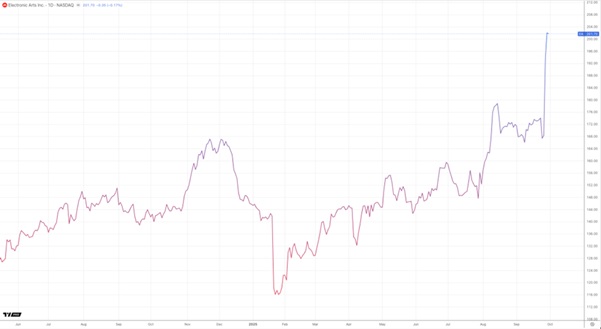
American publisher and developer Electronic Arts (EA) is officially withdrawing from public markets, becoming a private company. The $55 billion deal, confirmed on September 29, became the largest in the history of the gaming industry and is among the largest mergers and acquisitions (M&A) deals in the technology sector in recent years. A consortium of investors comprising Silver Lake, Affinity Partners, and the Saudi Arabian Sovereign Wealth Fund (PIF) will take full control of the publisher. At the same time, CEO Andrew Wilson will retain his position.

Notably, the broader market was not unmoved, as the Dow Jones index and others reacted with increased interest in the entertainment sector, reflecting investors’ appetite for major deals in technology and interactive media. In addition, stock indexes use such transactions as a signal of the high capitalization of the future entertainment sector and the role of AI technologies in its development.

Interest in the deal arose at the end of September, when news of the negotiations appeared. At that time, the deal was estimated to be worth $50 billion, but the total amount ultimately turned out to be even higher. EA, whose shares are rumored to have jumped by more than 20% and lit up prominently on the stock heatmap, has received board approval and is now awaiting regulatory approval. The transaction is scheduled to close in the first quarter of fiscal year 2027.

Leaving the stock exchange will give EA freedom from the pressure of public shareholders, but it will also create new problems. $20 billion of the $55 billion is borrowed funds from JPMorgan Chase, and a significant portion of the debt (about $18 billion) will fall on the company’s shoulders by the time the deal closes. The debt burden is regarded as extremely high. The investors themselves are betting on artificial intelligence, which will enable EA to reduce operating costs and improve development efficiency significantly.

In practice, this can mean not only optimizing business processes, but also additional waves of layoffs. Electronic Arts, like other industry giants, is increasingly relying on service projects. Madden NFL, EA Sports FC, Apex Legends, and The Sims 4 generate over 70% of the profits, while investing in AAA games carries a higher risk. It is already known that Dragon Age: The Veilguard did not meet management’s expectations.

The deal with EA becomes part of the global consolidation of the gaming industry. Following the takeover of Activision Blizzard by Microsoft and the acquisitionof Zynga by Take-Two, the number of public gaming companies is rapidly declining. For investors, this means that access to the sector will be limited to the largest players and ETFs, and transactions will become increasingly private.

On the one hand, going private gives EA the freedom to experiment strategically without constant pressure from the market. This may also enable the company to take more risks and launch new projects. On the other hand, the high debt burden and reliance on operational savings through AI threaten to dampen innovation and creativity.

Over the next few years, EA will obviously be balancing between investors’ desire for profitability and players’ need for fresh content. In an industry where consolidation and automation are becoming the norm, Electronic Arts is becoming a precedent. Everyone is wondering if a private company with $20 billion in debt and relying on AI can remain the leading player in the global gaming market.