DD
MM
YYYY

PAGES

DD
MM
YYYY

spot_img

PAGES

Home Blog Page 32

BlueSky COO Warns Under-16 Social Media User Ban Risks Cementing Big Tech Dominance and Stifling Innovation

0
The Bluesky social media app logo is seen on a mobile device in this photo illustration in Warsaw, Poland on 21 April, 2023. Founder Jack Dorsey of twitter has released the Bluesky application on Android. (Photo by Jaap Arriens / Sipa USA)(Sipa via AP Images)

Rose Wang, chief operating officer of the open-source social platform BlueSky, has issued a stark warning that aggressive government regulation of social media could inadvertently strengthen the grip of a handful of tech giants while making it nearly impossible for smaller, healthier alternatives to thrive.

Speaking on the sidelines of SXSW in London on Wednesday, Wang expressed support for protecting young users but raised serious concerns about the unintended consequences of overly burdensome rules.

“I support the protection and the safety of youth, the question that we have then is at what cost, because essentially what I’m scared of is in the long term, we’re headed to a world where there’s about three to five platforms, and extreme heavy regulation of those platforms, and basically the compliance teams of these platforms are 10 times the size of our entire team,” she said.

“So, basically, we’re living in a world where it’s almost impossible for smaller entrants to come in and build healthier spaces.”

With only around 40 employees, BlueSky simply cannot match the compliance infrastructure of Meta, ByteDance, or X. Wang argued that while platforms have often failed to self-regulate responsibly, governments must strike a careful balance that protects innovation and competition alongside user safety.

BlueSky’s Origins and Growth Trajectory

Originally conceived inside X (then Twitter) in 2019 and endorsed by co-founder Jack Dorsey, BlueSky spun out as an independent company in 2021. It has since positioned itself as a more open, decentralized alternative to mainstream social networks, emphasizing user control and healthier discourse. The platform has grown to 43 million users as of March, though that still represents only about 10% of X’s estimated 450 million users.

Despite early momentum, BlueSky has faced challenges in maintaining engagement. By the end of October last year, it reportedly saw a 40% drop in daily mobile active users over the prior 12 months. Wang acknowledged the difficulties of competing in a market dominated by entrenched players with vast resources.

“These platforms have led to a place where the bottom line is the thing that drives what they do… so I understand why governments have to step in and regulate, because the platforms have done nothing right,” she said.

The Regulatory Wave and Its Risks

Australia became the first country to enforce a blanket social media ban for users under 16 in December, requiring platforms like Instagram, TikTok, YouTube, X, and Reddit to implement age verification through methods such as facial scans, ID uploads, or linked bank details. Non-compliance can result in fines of up to 49.5 million Australian dollars ($35 million). BlueSky has also introduced age assurance measures to comply with the law.

Several other nations, including the UK, Spain, France, and Austria, are considering similar legislation. In the United States, momentum appears stronger at the state level than nationally.

Wang stressed that she is not against regulation itself, but believes it must be designed thoughtfully.

“I just want to end here with not saying that regulation is bad; it’s that regulation needs to work together with innovation. I think that there needs to be basically more channels between the smaller, medium-sized players and small businesses with regulators, because they need to be protected, while also then the very Big Tech players who we know are circumventing regulation need to be regulated, and so I think that nuance can be struck,” she said.

Implications for Competition and Innovation

The core risk Wang highlighted is market concentration. Heavy compliance burdens — legal teams, age verification systems, content moderation infrastructure, and reporting requirements — disproportionately favor companies with deep pockets. Smaller platforms like BlueSky, which prioritize openness and community-driven moderation, could be squeezed out, leaving users with fewer genuine alternatives.

This dynamic threatens to reduce diversity in social media experiences. While Big Tech platforms optimize for engagement and advertising revenue, smaller players often experiment with different models focused on healthier interactions, transparency, and user agency. If regulation raises the barrier to entry too high, the industry could consolidate further around a few dominant players, potentially reducing innovation and accountability.

Tech firms have broadly pushed back against blanket bans, arguing they may not effectively shield teens from harmful content while severing important social connections. Parents and educators have expressed mixed views, with some welcoming protection and others concerned about overreach and unintended isolation of young people.

Despite the challenges, Wang sees opportunity in platforms like BlueSky that emphasize openness and decentralized features. The company’s recent funding and focus on building a more user-centric experience position it to appeal to those disillusioned with mainstream social media. Its approval as the first AI agent on certain messaging platforms (in previous developments) also shows ambition to innovate at the intersection of social and AI.

For the broader industry, Wang is understood to be warning that effective policy should protect vulnerable users without creating insurmountable barriers for new entrants or entrenching existing power structures.

AI Chip Rout Wipes Out $1.3tn as Investors Question Sustainability of Sector’s Historic Rally

0

A brutal selloff swept through Wall Street’s semiconductor sector on Friday, erasing roughly $1.3 trillion in market value and exposing growing investor anxiety that the artificial intelligence-fueled rally, which has powered technology stocks to record highs, may be running ahead of fundamentals.

The downturn hit some of the biggest beneficiaries of the AI boom, with shares of Nvidia, Advanced Micro Devices, Micron Technology, and Marvell Technology suffering steep declines as investors rushed to lock in profits after months of extraordinary gains.

At the center of the selloff was a disappointing earnings report from Broadcom, whose results suggested that demand growth for custom AI chips may not be accelerating as rapidly as investors had anticipated. The report rattled confidence across the semiconductor industry, which has become one of the most crowded trades in global markets.

The benchmark PHLX Semiconductor Index suffered a 10.3% collapse, its worst single-day decline since the market turmoil triggered by the COVID-19 pandemic in March 2020. Combined with Thursday’s losses, the index shed 12% in just two trading sessions.

The magnitude of the decline underscores how much investor expectations had been elevated. Semiconductor stocks have been at the heart of a historic AI-driven market surge, propelled by expectations that spending on data centers, advanced computing infrastructure, and artificial intelligence systems would continue rising for years.

Even after the sharp correction, the chip index remains up 73% this year, highlighting the scale of the rally that preceded the selloff.

The biggest blow was absorbed by Nvidia, the dominant supplier of AI accelerators and the poster child of the artificial intelligence revolution. Its shares fell roughly 6%, wiping out more than $300 billion in market capitalization in a single session.

Micron suffered an even steeper percentage decline, tumbling 13% and erasing about $150 billion in value as investors reassessed growth prospects for memory-chip makers amid concerns that expectations had become overly optimistic.

Marvell, which only recently received a high-profile endorsement from Nvidia CEO Jensen Huang as a potential future trillion-dollar company, plunged 17%. AMD lost nearly 11%, while Broadcom extended its post-earnings decline, bringing its two-day loss to almost 20%.

The selloff is seen by some analysts as a reflection of a broader shift in market psychology. For much of the past two years, investors routinely treated pullbacks in AI-related stocks as buying opportunities. That strategy generated enormous returns as capital poured into companies tied to the rapid expansion of AI infrastructure.

Friday’s trading suggested that confidence may be becoming less automatic.

“You’ve had a lot of people here that were just blindly buying the dip,” said Dennis Dick, a proprietary trader at Triple D Trading. “Blindly buying the dip had been winning you money, but that ended today.”

The pressure on semiconductor stocks was compounded by renewed concerns over interest rates. Stronger-than-expected U.S. employment data reinforced expectations that borrowing costs could remain elevated for longer, reducing the appeal of richly valued growth stocks whose earnings are projected far into the future.

The broader market also felt the impact, with the S&P 500 falling 2.6% as investors reduced exposure to technology shares that have led the market higher throughout the year.

The timing of the correction is particularly noteworthy because it comes just days before what is expected to be one of the most significant public offerings in market history. SpaceX is preparing for a blockbuster IPO that could value the company at approximately $1.75 trillion, adding another high-profile growth stock to a market already heavily concentrated in technology and AI themes.

Some analysts believe the semiconductor selloff reflects a healthy reset rather than a fundamental deterioration in the industry’s outlook.

“The semiconductor sector was way overbought. That’s why we’re seeing the sell-off. I don’t think it’s the end of the semiconductor bull market,” said Ohsung Kwon, chief equity strategist at Wells Fargo.

That view is shared by many investors who continue to see long-term demand for AI infrastructure remaining intact. Global spending on data centers, advanced networking equipment, memory chips, and AI accelerators is still expected to reach unprecedented levels over the coming years as governments and corporations race to build computing capacity.

However, Friday’s rout serves as a reminder that even the strongest secular growth stories are vulnerable when expectations become too aggressive.

The AI revolution has created enormous wealth across the semiconductor industry, transforming chipmakers into some of the world’s most valuable companies. Yet the sector’s violent reaction to a single earnings report illustrates a growing reality for investors: as valuations climb higher and optimism becomes more entrenched, the margin for disappointment becomes increasingly narrow.

“Bitcoin is Going to do Great” – Coinbase Brian CEO Armstrong Remains Bullish Despite Market Volatility

0

Coinbase CEO Brian Armstrong remains firmly optimistic about Bitcoin’s long-term prospects despite mounting bearish pressure.

In a recent post on X, Armstrong reaffirmed his confidence in Bitcoin’s long-term prospects. He described the current market environment as one of many cycles the cryptocurrency has experienced throughout its history and maintained that Bitcoin remains as important as ever.

His post reads,

“People still think or feel because Bitcoin is down crypto is down. Derivatives/perps, stablecoins, prediction markets, etc., are all up in crypto. Crypto touches every area of finance, and is much broader than Bitcoin now. It will take some time for this to sink in. And yes – Bitcoin is going to do great and is as important as ever – one of many cycles we’ve all been through.”

In his view, temporary market downturns do not alter the asset’s long-term trajectory, and he remains optimistic about its future performance. His confidence comes as Bitcoin continues to navigate shifting investor sentiment, regulatory developments, and broader macroeconomic pressures.

Armstrong’s comment comes as Global markets have taken a sharp hit over the past few days, wiping out trillions of dollars in value across stocks, crypto, gold, and other risk assets.

The S&P 500 alone lost more than $1.8 trillion in a single session, while AI-related stocks shed over $1 trillion. Bitcoin traded as low as $59,084 as investors expressed concern.

Macro analyst Luke Gromen disclosed that he has sold most of his Bitcoin and hasn’t bought back in meaningfully, citing a liquidity drain driven by artificial intelligence (AI), related stocks, and oil pulling capital away from the cryptocurrency as it slides.

Also, Gromen, Founder & President, Forest for the Trees (FFTT), in the Coin Stories podcast said he had only “nibbled a little bit” in Bitcoin’s recent decline but largely had stayed out. He said he did not sell it all, but he sold most of it, adding that he sold “closer to the top than what might be the bottom.”

He attributed Bitcoin’s weakness to what he described as an unhealthy market structure under record-high equity indices.

While Bitcoin remains the flagship asset and a powerful store of value, the broader crypto ecosystem has developed in ways that often move independently of BTC’s spot price.

Derivatives markets, perpetual futures, stablecoins, and prediction platforms are all showing strength and innovation even during periods when Bitcoin faces downward pressure.

This divergence represents a natural evolution. Early in crypto’s history, Bitcoin dominated both attention and market capitalization, making it a reasonable proxy for the entire sector.

Today, the landscape is far more diverse. Perpetual futures and derivatives allow sophisticated traders to express views on price direction with leverage, adding depth and liquidity that didn’t exist in previous cycles.

Stablecoins have emerged as one of crypto’s most practical success stories. Serving as digital dollars, they power remittances, cross-border payments, and on-chain commerce.

Their total issuance and daily transaction volume have reached levels that meaningfully impact real-world finance, often with only loose correlation to Bitcoin volatility.

For many users in emerging markets, stablecoins represent a more reliable store of value and medium of exchange than volatile local currencies, regardless of whether Bitcoin is in a bull or bear phase.

Armstrong acknowledges that Bitcoin continues to play a foundational role. Its resilience through multiple market cycles, growing institutional adoption, and position as “digital gold” remain critically important.

Outlook

Looking ahead, analysts expect the crypto market to remain highly sensitive to global liquidity conditions, interest rate expectations, and institutional positioning.

If macroeconomic pressures persist—particularly tight liquidity and risk-off sentiment, Bitcoin may continue to experience volatility in the short term, with periods of sharp drawdowns followed by equally strong recoveries, consistent with its historical cycle behavior.

On the other hand, cautious investor sentiment highlights liquidity fragmentation and capital rotation into equities, AI-related assets, and energy markets as potential headwinds that could delay a sustained crypto rebound.

This view suggests that Bitcoin’s trajectory may remain uneven until broader financial conditions stabilize.

Trump Administration Accelerates AI Adoption for National Security While Setting Guardrails Against Misuse

0

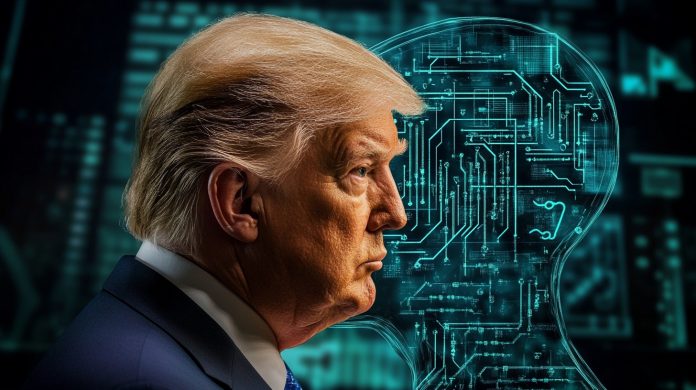
The White House on Friday issued a national security memorandum directing a faster rollout of artificial intelligence across U.S. intelligence and military operations, while explicitly prohibiting its use for unlawful surveillance or censorship of free speech.

President Donald Trump framed the move as a necessary step to maintain American technological superiority and align AI development with core national values.

“Under my Administration, the United States can and will responsibly accelerate the use of AI across intelligence and warfighting domains in line with American values,” Trump said in the memorandum.

The directive instructs Defense Secretary Pete Hegseth to update existing guidance on autonomous weapons systems within 90 days. The goal is to ensure the “deliberate adoption of AI systems that respect the chain of command” and prevent any single entity from disabling or degrading AI capabilities critical to warfighters.

Michael Kratsios, director of the White House Office of Science and Technology Policy, summarized the memorandum’s intent in a social media post. He wrote: “Accelerates AI adoption from multiple vendors to prevent single points of failure, updates @DeptofWar’s guidance on autonomous weapons systems to keep pace with the frontier, and ensures no entity can disable or degrade an AI system our warfighters depend on without prior approval.”

This policy builds on an executive order issued earlier this week that encourages leading AI developers to voluntarily submit their most advanced models for government cybersecurity testing before public release. It reflects growing concern in Washington about the dual-use nature of powerful AI systems and the need to balance innovation with security and ethical oversight.

The memorandum arrives amid a notable clash between the Pentagon and Anthropic. In March, the Defense Department placed a formal supply-chain risk designation on the company after it refused to allow its Claude models to be used for domestic surveillance or fully autonomous weapons systems. The designation was seen as an extraordinary rebuke of a key American AI firm that had supported military operations, including in the Iran conflict.

The administration has signaled it expects U.S. AI companies to support national security priorities, provided they operate within legal boundaries. Trump also announced plans to host a meeting with AI executives as soon as next week, indicating an ongoing effort to align private-sector innovation with government objectives.

The policy is widely seen as a representation of a pragmatic evolution in U.S. AI strategy. Rather than pursuing a heavy-handed regulatory overhaul, the administration is emphasizing accelerated adoption, multi-vendor diversification to avoid single points of failure, and clear boundaries on misuse. This approach aims to maintain a technological edge against competitors like China while addressing domestic concerns about surveillance and civil liberties.

For the defense and intelligence communities, AI offers transformative potential in areas such as intelligence analysis, autonomous systems, logistics, and decision support. However, ensuring human oversight, particularly in lethal autonomous weapons, remains a sensitive issue. The 90-day review of autonomous systems guidance will be closely watched by both industry and human rights groups.

The memorandum also underlines the administration’s preference for voluntary cooperation over mandatory regulation. By encouraging pre-release cybersecurity testing and responsible development, it seeks to embed security considerations early in the innovation cycle without stifling the rapid progress that has positioned the U.S. as the global AI leader.

However, analysts expect major AI companies to view the policy as a mixed signal. This is because, while on one hand, it opens doors for deeper collaboration with the government on national security applications, it reinforces, on the other hand, expectations that leading labs must balance commercial ambitions with strategic responsibilities.

Anthropic’s experience demonstrates that drawing firm red lines on certain military uses can carry tangible consequences.

The emphasis on multi-vendor adoption is expected to benefit a broader ecosystem of AI developers, reducing over-reliance on any single provider and fostering competition in areas like secure model deployment and resilient infrastructure.

For the wider technology sector, this policy lends support to AI’s centrality to national power in the 21st century. As competition with China intensifies, the U.S. is doubling down on leveraging private-sector innovation for strategic advantage — a model that has defined American technological dominance for decades.

Netflix Turns the Page on Reed Hastings Era as Longtime Director Jay Hoag Takes Board Chair Role

0

Netflix has formally begun a new chapter in its corporate history, appointing longtime board member Jay Hoag as chairman following the departure of co-founder Reed Hastings from the company’s board.

The move marks the end of an era for the streaming giant, which Hastings helped transform from a DVD-by-mail startup into one of the world’s most influential entertainment companies.

According to a regulatory filing, Hoag assumed the chairmanship after Netflix’s annual shareholders meeting on June 4, succeeding Hastings, who announced earlier this year that he would step away from the board to focus on philanthropy and other personal ventures.

The leadership transition comes at a moment when Netflix has largely won the battle for global streaming scale. The company is now navigating a new phase focused on advertising, live programming, gaming, artificial intelligence, and profitability as competition intensifies across the entertainment industry.

Hastings’ departure closes a nearly three-decade chapter that reshaped how audiences consume television and film. After co-founding Netflix in 1997, he oversaw one of the most significant business transformations in modern media, first disrupting the video rental market and later pioneering subscription streaming long before traditional media companies recognized its potential.

Under Hastings’ leadership, Netflix evolved from mailing DVDs in red envelopes to operating a global streaming platform serving hundreds of millions of subscribers across more than 190 countries. The company’s success forced legacy entertainment groups to launch their own streaming services and fundamentally altered Hollywood’s distribution model.

His strategic bets on original programming, global content production, and direct-to-consumer distribution helped Netflix emerge as a dominant force in entertainment. The company also benefited from a surge in demand during the COVID-19 pandemic, when lockdowns accelerated streaming adoption worldwide and strengthened Netflix’s position while much of the traditional entertainment industry struggled with theater closures and production disruptions.

While Hastings stepped down as co-chief executive in 2023, remaining executive chairman before now leaving the board entirely, his influence continued to shape the company’s long-term strategy. His departure removes the last formal governance role held by Netflix’s founder, further signaling the company’s transition from a founder-led enterprise to a mature global corporation.

However, his successor brings deep institutional knowledge and a long-standing connection to Netflix’s growth story.

Hoag co-founded venture capital firm TCV, one of Netflix’s early and most successful investors. He joined Netflix’s board in 1999, making him one of the company’s longest-serving directors. Over the past decade, he has served as lead independent director, giving him extensive involvement in governance, executive oversight, and strategic planning.

His appointment provides continuity at a time when investors are closely watching Netflix’s next growth engines. The company has increasingly emphasized advertising-supported subscriptions, sports-related programming, gaming initiatives, and artificial intelligence tools to drive engagement and efficiency.

Hoag’s background as a growth investor may prove particularly relevant as Netflix evaluates new opportunities beyond traditional streaming. Throughout his career, he has worked with high-growth technology businesses, navigating transitions from disruptive startups into large public companies.

Beyond Netflix, Hoag currently serves on the boards of Zillow Group and Peloton Interactive, giving him experience across consumer technology sectors undergoing significant transformation.

For Netflix, the leadership change is largely viewed as an orderly succession rather than a strategic shift. The company’s executive leadership remains under co-CEOs Ted Sarandos and Greg Peters, who have overseen the company’s expansion into advertising, live events, and new content formats.

Still, Hastings’ exit bears symbolic weight. Few executives have had a greater impact on modern media. His vision not only built Netflix into a global entertainment powerhouse but also accelerated the decline of traditional cable television and fundamentally changed consumer viewing habits.

Now, a new chapter of leadership is unfolding, and Netflix is entering it surrounded by unforgiving competitors who would pounce on any lapse to get ahead.