DD
MM
YYYY

PAGES

DD
MM
YYYY

spot_img

PAGES

Home Blog Page 322

Syndicate Publishes Crypto’s First DUNA Financial Report – Sets Transparency Milestone

0

For years, onchain transparency has been one of crypto’s defining promises. With a known address, anyone can verify a treasury’s holdings or validate outgoing payments. But that onchain transparency has traditionally been paired with offchain occlusion.

Without a viable onshore compliance regime, crypto treasuries and DAOs have too often disappeared into offshore black boxes—with little visibility into how funds were actually managed or reported.

The DUNA changes that. It brings both onchain and offchain operations into the light—aligning onchain transparency with institutional-grade financial reporting and U.S. legal compliance.

For the first time, token-holder–governed organizations can present a holistic, verifiable view of their finances—both onchain and offchain. This is a key step in the professionalization of the industry, and one that’s long overdue.

Public disclosures, paired with onchain transparency, can finally create a full and open picture of the Syndicate Network Collective—and a model for other DUNAs to follow.

As of September 30, 2025, the DUNA held 267,162,157 SYND tokens and $285,000 cash on hand.
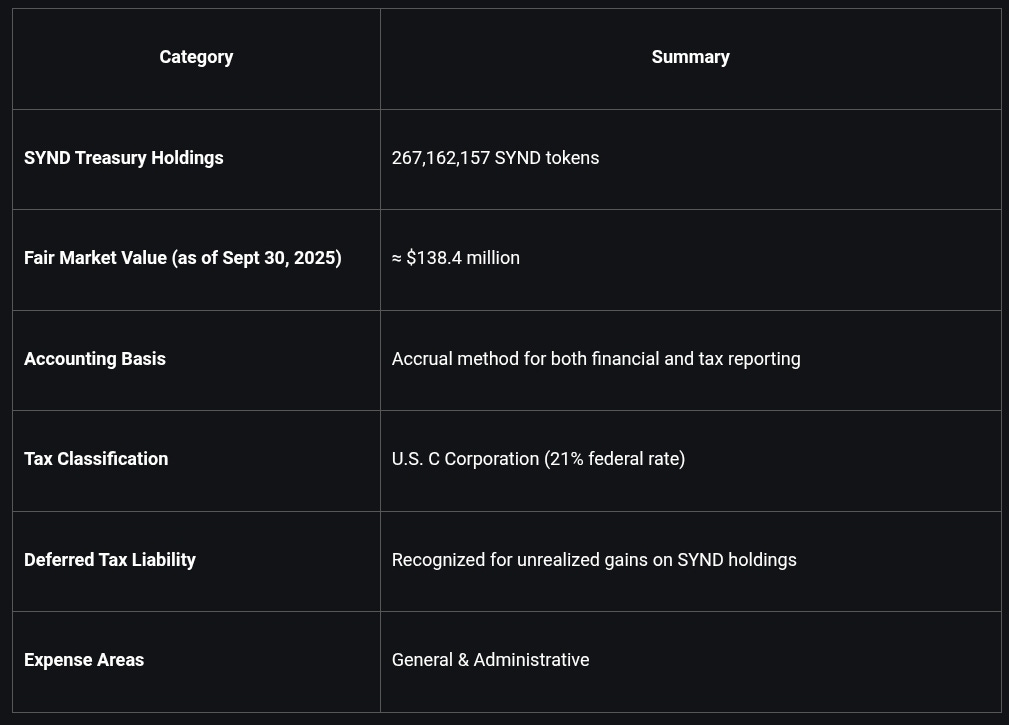
The DUNA’s financials capture its full economic activity, including unrealized gains or losses on token holdings. The treasury funds ecosystem development, governance operations, research, and long-term network security.

All disbursements are approved through governance and accounted for under U.S. tax rules—ensuring transparency and traceability across onchain and offchain records.

Building Trust Through Transparency

Building a community-owned internet requires more than open infrastructure—it requires systems that earn trust through accountability.

The Syndicate Network Collective’s financial framework turns that principle into practice. By applying established accounting standards to onchain activity and publishing those results openly, it sets a precedent for how decentralized networks can operate transparently and responsibly.

Transparency isn’t an afterthought to decentralization—it’s what gives it substance. The Syndicate Network Collective shows how communities can own not just their infrastructure within the Syndicate Network, but the integrity of the systems behind it—laying the groundwork for a more open, accountable, and community-owned internet.

The Framework: How the DUNA Operates

Syndicate Network Collective operates as a Wyoming Decentralized Unincorporated Nonprofit Association (DUNA)—a first-of-its-kind structure that enables collective governance while maintaining compliance with U.S. law.

Members are SYND holders who actively participate in governance—oversee the use of the network’s treasury through open proposals and onchain votes—not mere token ownership.

Upon formation, the DUNA elected to be treated as a U.S. C Corporation for federal tax purposes. This provides clear reporting obligations and accountability while allowing the DUNA to operate transparently within existing law.

Gives token holders real control over the network and its treasury. In the early stages, token holders participate in crucial votes, while a committee manages grants. Over time, we expect governance to shift fully onchain—where smart contracts control the network, keeping power where it belongs: with the community.

Provides a legal entity for contributors and participants to interact with—including limited liability protections to token holders. The DUNA framework defines clear, legally recognized roles for all ecosystem participants, creating a transparent structure for collaboration and accountability.

Manages the network treasury, signs contracts, and engages with traditional service providers with token holder votes and committees. The network can act in the real world—legally and operationally—while remaining governed by its tokenholders.

Operates transparently under U.S. law and regulation by default. This is a structure designed to bring greater transparency, reporting, and accountability to the crypto industry, without compromising its core values of decentralization, privacy, and openness.

Aligns with the future of U.S. policy. With the passage of the GENIUS Act, SEC’s Project Crypto, White House’s establishment of the Strategic Bitcoin Reserve and Digital Asset Stockpile, and the proposed market structure bills that explicitly support decentralized network governance structures like DUNAs, the U.S. is building a clear legal and regulatory foundation for the crypto industry to operate openly at home, not offshore.

Importantly, the DUNA is nonprofit by default—it’s designed for networks and protocols to serve its communities of users, not shareholders. DUNAs reflect a deep commitment to build networks where decentralization isn’t just technical but core to the purpose of the network itself.

Syndicate Network will now operate under a DUNA structure with the Syndicate Network Collective, helping set a new standard for the crypto industry—where community ownership is real, governance is transparent, and compliance doesn’t come at the cost of openness or permissionlessness.

Financial and tax reporting use accrual and fair-value accounting, meaning: Income is recognized when earned, not received. SYND holdings are valued at current market prices each period. Unrealized gains are recorded as income, with a deferred tax liability for future realization.

Paxos Mistakingly Minted $300 Trillion PYUSD Out of Error But Got Burnt Afterwards

0

Stablecoin issuer Paxos accidentally minted 300 trillion PYUSD (PayPal USD) tokens on the Ethereum blockchain during what was intended to be a routine internal transfer.

This massive amount—equivalent to roughly $300 trillion USD at PYUSD’s 1:1 peg to the dollar—far exceeded the stablecoin’s normal circulating supply of about $2.3 billion.

That’s more than twice the global GDP estimated at $117 trillion and over eight times the U.S. national debt $37 trillion. The error occurred around 3:12 PM EST, originating from a Paxos hot wallet interacting with PayPal’s PYUSD smart contract.

Blockchain explorers like Etherscan captured the transaction, which cost just $2.66 in Ethereum gas fees. Paxos quickly identified the issue as an “internal technical error” likely a “fat finger” mistake, such as adding extra zeros—previous transactions that day involved only 300 million PYUSD.

Within 22–30 minutes, the entire minted supply was burned by sending it to a non-retrievable Ethereum address, ensuring no net change in PYUSD’s total supply or circulation.

Paxos confirmed via an official X post: “There is no security breach. Customer funds are safe. We have addressed the root cause.” PYUSD’s price briefly deviated from its $1 peg but stabilized rapidly, and the incident had no impact on user holdings or the stablecoin’s 1:1 backing with U.S. dollars.

Aave, a major lending platform, temporarily froze PYUSD markets as a precaution to verify system integrity and prevent potential exploits. Chaos Labs founder Omer Goldberg also PayPal’s head of blockchain noted this was due to the “unexpected high-magnitude transaction.”

The event sparked brief speculation and memes on social media, with users joking about using the minted tokens to pay off global debt or comparing it to “printing money” cheaper than the Federal Reserve.

Some even theorized it as a deliberate “shadow QE” quantitative easing moment to test stablecoin infrastructure, though Paxos dismissed any malicious intent. Unlike past stablecoin iincidents like the UST’s collapse, this was fully reversed on-chain, highlighting blockchain’s transparency but also the risks of centralized admin controls in permissioned stablecoins.

This glitch underscores vulnerabilities in stablecoin operations, even for regulated issuers like Paxos. While quickly resolved, it raised questions about Centralized stablecoins rely on issuer trust; a similar error in a less responsive system could erode confidence.

Protocols like Aave demonstrated effective risk controls, but such events could trigger flash crashes if not caught early.

With stablecoins increasingly tokenized for real-world assets like real estate via Eric Trump’s World Liberty Financial, incidents like this fuel calls for stricter limits, as seen in the Bank of England’s proposed caps on holdings.

PYUSD remains the eighth-largest stablecoin in DeFi, with strong backing from PayPal. No further issues have been reported as of October 16, 2025, and routine minting like 300 million PYUSD resumed normally.

Algorithmic stablecoin UST lost its $1 peg due to a combination of market sell-off, flawed protocol design, and a death spiral in its LUNA backing mechanism. Systemic failure of a decentralized, algorithmic stablecoin Terra ecosystem.

Catastrophic collapse of the entire Terra ecosystem, wiping out $40 billion in market value. Error detected and resolved within 22–30 minutes by burning the 300 trillion tokens. No change in circulating supply ~$2.3 billion, no loss of user funds, and price stabilized quickly at $1 peg.

Centralized control allowed Paxos to burn tokens using admin keys, leveraging Ethereum’s transparency. Days to weeks, with no effective resolution. UST’s peg began unraveling on May 7, 2022, and collapsed below $0.10 by May 12. UST never regained its peg; LUNA its backing token crashed to near-zero, and investors lost billions.

Brief price deviation from $1 peg, temporary freeze of PYUSD on Aave, and social media buzz. No lasting market disruption. Minor dent in trust, but Paxos’s transparency and quick fix limited fallout. PYUSD remains a niche but stable player in DeFi.

Inherent fragility of algo-stablecoins; vulnerable to market volatility and bank runs.
Overreliance on market confidence and LUNA’s value, no centralized fallback. Highlights risks of centralized stablecoin operations but also the benefits of quick intervention.

Reinforces need for robust internal controls and audits, especially as stablecoins scale.
Likely to draw minor regulatory attention but no systemic threat. The Paxos PYUSD error was a brief, contained operational glitch with no lasting damage, thanks to centralized controls and rapid response.

The UST collapse was a systemic failure of a decentralized protocol, causing massive losses and market-wide fallout. Paxos’s incident underscores the importance of operational rigor, while UST’s collapse revealed the dangers of uncollateralized stablecoin designs.

Binance Completes Acquisition of Gopax, Marking Return to South Korea

0

Binance, the world’s largest cryptocurrency exchange by trading volume, finalized its long-delayed acquisition of South Korean crypto platform Gopax, receiving key regulatory approval from the Financial Intelligence Unit (FIU).

This move ends a regulatory standoff that began over two years ago and positions Binance for a full re-entry into the South Korean market, which it exited in 2021 amid tightening compliance rules.

Binance first acquired a majority stake reportedly 67% in Gopax in February 2023 as a rescue effort. Gopax, one of only five licensed exchanges in South Korea authorized for cash-to-crypto transactions, faced a liquidity crisis earlier that year when its DeFi partner, Genesis Global Capital, froze around $47 million in user assets tied to the GoFi product.

Binance’s initial investment aimed to compensate affected users and stabilize the platform. Full control was stalled due to concerns over anti-money laundering (AML) risks, exacerbated by Binance’s global legal battles, including a $4.3 billion U.S. settlement in 2023.

South Korea’s FIU paused reviews in 2023 but resumed them in August 2025, approving Gopax’s executive changes—effectively vetting Binance as the controlling shareholder—late on October 15.

With the deal now complete, Binance gains operational control of Gopax, enabling integration of its advanced trading tools, global liquidity, and support services. Terms of the final acquisition weren’t disclosed, but it builds on Binance’s prior 41-67% ownership.

Implications for South Korea’s Crypto Market

South Korea boasts one of Asia’s most active retail crypto scenes, with high trading volumes driven by strict investor protections like mandatory real-name verification. The market is dominated by local giants: Upbit (Dunamu): ~63% of trading volume, Bithumb: ~32%.

Gopax’s share is minimal, but Binance’s involvement could inject competition, potentially eroding the duopoly and introducing innovations like better liquidity and institutional tools. This aligns with South Korea’s evolving regulations, including upcoming spot crypto ETFs and won-pegged stablecoins, under a crypto-friendly administration led by President Lee Jae-myung.

The approval may encourage other global players like Coinbase or OKX to pursue local partnerships, fostering a more mature, compliant ecosystem. Binance has not yet commented officially, but the move underscores its post-settlement focus on regulatory adherence in key markets.

South Korea has one of the most robust and stringent cryptocurrency regulatory frameworks globally, balancing investor protection with market innovation. Oversees financial policies, including crypto-related regulations, through its Financial Intelligence Unit (FIU).

Financial Intelligence Unit (FIU): Directly responsible for supervising crypto exchanges, ensuring compliance with anti-money laundering (AML) and counter-terrorism financing (CFT) rules. The Ministry of Economy and Finance, Korea Communications Commission, and regional authorities like the Seoul Metropolitan Government.

Under the Special Financial Information Act (SFIA), amended in March 2020 and enforced since March 2021, all crypto exchanges, wallet providers, and custodians must register with the FIU. Requirements include: Obtaining an Information Security Management System (ISMS) certification.

Partnering with a licensed bank for real-name verified accounts to facilitate won-based trading. Compliance with AML/CFT obligations, including customer due diligence (CDD) and suspicious transaction reporting.

Only five exchanges—Upbit, Bithumb, Coinone, Korbit, and Gopax—currently hold licenses to offer cash-to-crypto trading due to these strict requirements. Unregistered platforms face penalties or shutdowns.

Since 2022, South Korea has enforced the FATF Financial Action Task Force travel rule, requiring VASPs to share sender and recipient information for crypto transactions above a certain threshold aligned with global standards, typically ~$1,000 USD.

These rules have limited the number of operational exchanges, as compliance costs are high, and unregistered platforms risk severe penalties or closure. Crypto gains are not yet subject to a specific capital gains tax, but this is under review.

A proposed 20% tax on crypto gains was delayed from its initial 2022 implementation due to market and political pushback. The government aims to implement a low-value asset exemption gains under 2.5 million KRW ~$1,800 USD may be tax-free to encourage retail participation.

Corporate crypto holdings are already subject to corporate income tax. VASPs must report user transactions to tax authorities, with stricter enforcement expected by 2027 under new virtual asset taxation laws.

All crypto trading accounts must be linked to verified bank accounts to prevent fraud and anonymous trading. Exchanges are required to store a significant portion of user assets in cold wallets to mitigate hacking risks.

Unlike bank deposits, crypto assets are not insured, but the government encourages VASPs to maintain reserve funds for user compensation in case of insolvency or hacks. Strict penalties for pump-and-dump schemes, insider trading, and other manipulative practices, enforced by the FSC and Korea Fair Trade Commission.

The FSC is exploring regulations for won-pegged stablecoins, with guidelines expected in 2026. Issuers must hold 100% reserves in cash or liquid assets and register as VASPs.

The Bank of Korea is piloting a digital won, with trials ongoing in 2025. The CBDC aims to complement, not replace, existing crypto markets, focusing on cross-border payments and financial inclusion.

Projects issuing tokens must register with the FSC, providing whitepapers and financial disclosures. In early 2025, South Korea approved spot Bitcoin and Ethereum ETFs, a significant shift from its cautious stance. These ETFs are traded on the Korea Exchange (KRX) and are subject to strict oversight.

The FIU’s approval of Binance’s acquisition of Gopax in October 2025 signals a more open stance toward compliant foreign players, provided they meet stringent AML/CFT standards.

South Korea is strengthening ties with global regulators to combat crypto-related crime, which may lead to more cross-border compliance requirements.

Trump’s Crypto Retirement Order From Executive Action to Potential Federal Law

0

Republican Congressman Troy Downing R-Mont. announced plans to introduce the Retirement Investment Choice Act, a bill aimed at codifying President Donald Trump’s August 2025 executive order into permanent federal law.

This move would lock in the policy allowing cryptocurrency and other alternative assets—like private equity and real estate—to be included in 401(k) retirement plans, potentially unlocking trillions in institutional capital for the crypto market.

Signed on August 7, 2025, the order directs the Department of Labor (DOL) to revise guidance under the Employee Retirement Income Security Act (ERISA) of 1974. It encourages federal agencies, including the DOL, Treasury, and Securities and Exchange Commission (SEC), to facilitate access to alternative investments in participant-directed retirement plans.

This includes crypto ETFs, which were already approved for Bitcoin and Ethereum earlier in 2025. While the order doesn’t change 401(k) rules overnight—requiring regulatory rewrites that could take months—it signals a shift from the Biden-era caution on crypto’s volatility.

Employers and fund managers like BlackRock, Fidelity, TIAA have welcomed it for expanding investment options, though adoption may take years. The order also addresses “debanking” risks, instructing regulators to eliminate policies that deny services based on “reputation risk” tied to lawful activities like crypto involvement.

The Retirement Investment Choice Act would make the executive order’s provisions statutory, shielding them from reversal by future administrations. Downing described it as a way to “supercharge the financial security of countless Americans” through diverse assets.

Key GOP supporters include Reps. French Hill (R-Ark.) and Ann Wagner (R-Mo.), who in September 2025 sent a letter backing the order. This aligns with Trump’s pro-crypto stance, including his administration’s approval of spot Bitcoin ETFs and efforts to normalize digital assets.

Passage isn’t guaranteed in a divided Congress, but it reflects growing Republican support for crypto integration amid record ETF inflows (e.g., $5.95 billion globally by October 4, 2025, with $5 billion from the U.S.).

According to Bitwise Investments, U.S. 401(k) assets total over $10 trillion. A 1% allocation to crypto could channel $122 billion into the market. A 3% allocation could drive nearly $360 billion. This could accelerate mainstream adoption, with 90 million Americans potentially accessing Bitcoin via retirement accounts.

However, surveys show mixed sentiment: A Boldin poll found ~50% of Americans oppose adding crypto to 401(k)s due to volatility risks, echoing warnings from figures like Sen. Elizabeth Warren about weak protections and high fees.

Crypto’s price swings could erode retirement savings, reminiscent of 1929 stock market risks. DOL and SEC must align rules, and employers may hesitate to offer these options.

Critics argue it favors Wall Street over worker safeguards, potentially exposing trillions to speculative assets. This development marks a pivotal step toward embedding crypto in America’s retirement ecosystem, blending Trump’s deregulatory agenda with GOP efforts to future-proof it.

If passed, it could redefine how 55 million+ crypto users per the 2025 National Cryptocurrency Association report build wealth. President Trump’s August 7, 2025, executive order directs the Department of Labor (DOL), Treasury, and Securities and Exchange Commission (SEC) to revise ERISA-related guidance to facilitate the inclusion of alternative assets like cryptocurrencies, private equity, and real estate in participant-directed retirement plans.

ERISA mandates that fiduciaries plan like sponsors, employers act prudently, prioritizing participant interests. Historically, DOL guidance has cautioned against volatile assets like crypto due to risks, as seen in 2022’s Compliance Assistance Release No. 2022-01, which warned fiduciaries about including crypto in 401(k)s.

The executive order instructs the DOL to update interpretive bulletins to explicitly allow alternative assets in participant-directed plans (e.g., 401(k)s where employees choose investments). This includes crypto ETFs Bitcoin and Ethereum spot ETFs approved in 2025 and other non-traditional investments, provided they meet fiduciary standards.

Revisions aim to clarify that fiduciaries can offer crypto without violating ERISA’s prudence and diversification requirements, as long as participants have sufficient disclosures and risk education. The DOL is directed to issue guidance ensuring fiduciaries aren’t penalized for including crypto ETFs or similar assets.

The DOL, Treasury, and SEC are tasked with eliminating policies that restrict access to banking or custodial services for crypto-related retirement investments. This could involve amending ERISA’s custodial rules to ensure crypto custodians like Coinbase, BitGo can serve 401(k) plans.

Plan sponsors may need to provide educational resources to participants, ensuring informed decision-making, as crypto allocations could range from 1% to 3% of portfolios per Bitwise estimates.

The DOL’s Employee Benefits Security Administration (EBSA) will draft new interpretive bulletins or amend existing ones (e.g., Interpretive Bulletin 96-1 on participant investment education). Proposed rules will undergo a 30-60 day comment period, as required by the Administrative Procedure Act.

The Treasury via IRS and SEC will align tax and securities regulations, particularly for crypto ETFs and custodial arrangements. Expect initial guidance by Q1 2026, with full implementation potentially stretching to 2027, depending on regulatory complexity and political resistance.

The Retirement Investment Choice Act, announced October 14, 2025, by Rep. Troy Downing, aims to codify these changes into law, making them harder to reverse. The bill’s specifics are pending, but it will likely mirror the executive order’s language on fiduciary flexibility and debanking protections.

Allowing crypto in 401(k)s could drive $122 billion (1% allocation) to $360 billion (3% allocation) into crypto markets, per Bitwise Investments, boosting adoption across 90 million U.S. crypto users.

The DOL has not yet released draft guidance, but the executive order’s 180-day review period ending February 2026 sets a deadline for initial proposals. The Retirement Investment Choice Act’s introduction is imminent, with GOP support from Reps. French Hill and Ann Wagner, but passage in a divided Congress remains uncertain.

Oracle Shares Jump as Company Confirms Cloud Deal with Meta, Targets $20bn in AI Database Revenue by 2030

0

Oracle’s stock closed 3% higher on Thursday after the company confirmed a major cloud-computing deal with Meta and outlined ambitious growth targets for its artificial intelligence-driven database and data platform business, projecting $20 billion in revenue by fiscal 2030.

The announcement, made at Oracle’s AI World conference in Las Vegas, underscored how the 47-year-old enterprise software giant is rapidly reinventing itself to meet surging global demand for AI infrastructure. Oracle executives said the company expects AI-related database revenue to grow nearly tenfold from $2.4 billion in fiscal 2025 to $20 billion by the end of the decade, marking one of the most aggressive long-term projections in the industry.

Clay Magouyrk, one of Oracle’s two newly appointed CEOs, said during the event that the company’s cloud pipeline is expanding faster than expected as global companies accelerate their AI investments.

“You see the change in these numbers that it’s a little bit easier for us to find supply, not this year or next year, but in subsequent years,” Magouyrk told analysts. “So as we’re able to find that supply, customers contract for it, we see immense demand, and then we go about delivering that to customers.”

He revealed that in just 30 days during the current quarter, Oracle contracted $65 billion in new cloud infrastructure commitments.

“It was across seven different contracts from four different customers,” Magouyrk said. “None of those customers are OpenAI. I know some people are questioning sometimes, ‘Hey, is it just OpenAI?’ The reality is, we think OpenAI is a great customer, but we have many customers.”

Among those customers, he confirmed, is Meta — the parent company of Facebook and Instagram — which has signed a deal with Oracle as part of its ongoing push to build out AI data centers and computational infrastructure. Bloomberg had earlier reported that Oracle and Meta were in discussions over a potential $20 billion partnership.

The deal with Meta marks a significant win for Oracle in the increasingly competitive AI infrastructure market, where it faces off against tech titans such as Amazon Web Services, Microsoft Azure, and Google Cloud. Each of these companies has been racing to expand capacity for AI workloads amid soaring global demand for graphics processing units (GPUs), data center space, and energy supply.

Meta, for its part, has been ramping up investment in its AI ambitions. The social media giant said in July that it expects to spend between $66 billion and $72 billion in capital expenditures this year, primarily to fund its expanding AI and metaverse initiatives. That figure underscores the unprecedented scale of spending among Big Tech firms as they rush to secure computing power for large-scale AI model training and deployment.

Oracle’s partnership with Meta follows another major win earlier this year, when OpenAI committed more than $300 billion to Oracle Cloud Infrastructure (OCI) in July. That deal positioned Oracle as a key supplier to the artificial intelligence research company whose ChatGPT models have helped trigger the current AI investment wave.

Magouyrk emphasized that Oracle’s growth in AI infrastructure is being built on sustainable financial terms rather than a pursuit of headline-grabbing contracts.

“I’ve read a lot of stories that are speculating that Oracle is chasing revenue for revenue’s sake, but let’s be crystal clear,” said Doug Kehring, Oracle’s principal financial officer. “We only pursue opportunities where we have a clear line of sight to attractive market margins that reward us for intellectual property and the activity we bring to customers.”

According to the company, AI infrastructure carries an adjusted gross margin of 30% to 40% after factoring in the costs of land, data centers, power, and computing equipment. Earlier this month, The Information reported that Oracle achieved a 14% gross margin on renting out Nvidia AI chips in the August quarter, suggesting that profitability is improving as scale increases.

Oracle’s approach of blending high-performance infrastructure with integrated database and analytics capabilities has started to distinguish it from competitors. Unlike Amazon or Google, Oracle is expanding its multi-cloud strategy by making its flagship database software available on other clouds, including Microsoft Azure and Amazon Web Services. The move allows customers to deploy AI workloads across different environments, improving flexibility and reducing vendor lock-in.

As Oracle deepens its role in the AI supply chain, the company’s executives also provided an ambitious financial outlook for the coming years. After market close on Thursday, Oracle said it now targets $21 in adjusted earnings per share on $225 billion in revenue for fiscal 2030 — representing a compound annual growth rate of 31%. Analysts polled by LSEG had projected significantly lower estimates of $18.92 per share on $198.39 billion in revenue.

The company’s bullish guidance initially boosted investor sentiment, though shares slipped 2% in after-hours trading as some analysts questioned the long-term feasibility of sustaining such high growth rates in a capital-intensive industry. Still, Oracle’s near-term stock performance reflects growing confidence among investors that the company’s cloud transformation is gaining real traction.

Over the past three years, Oracle has poured billions into expanding its global network of data centers to support AI workloads. The company’s executives said that as supply chain bottlenecks around GPUs and power infrastructure begin to ease, Oracle will be able to accelerate delivery timelines and meet pent-up demand from enterprise clients.

Oracle’s backlog of contracted commitments is believed to provide a strong foundation for long-term revenue visibility. However, the broader context for Oracle’s momentum lies in the global AI boom that has redrawn the map of corporate investment priorities.

Companies across sectors — from manufacturing and finance to healthcare and entertainment — are racing to deploy AI models, analyze large datasets, and automate complex decision-making processes. That surge in AI adoption has transformed cloud infrastructure into one of the most sought-after assets in the technology world, driving record spending and competition among providers.