DD
MM
YYYY

PAGES

DD
MM
YYYY

spot_img

PAGES

Home Blog Page 3261

Huawei Optimistic That China’s Innovation Will Overcome Advanced AI Chip Shortage Enabled by U.S. Sanctions

0

At the World AI Conference in Shanghai, Zhang Ping’an, CEO of Huawei Cloud, addressed the current challenges posed by the U.S. restrictions on advanced AI chip shipments to China, asserting that China’s ambition to lead in artificial intelligence (AI) remains undeterred.

“Nobody will deny that we are facing limited computing power in China,” Zhang stated. He acknowledged the significant hurdle posed by the U.S. ban on sales of advanced AI chips to China, including those from major players like Nvidia.

However, Zhang emphasized that reliance on these chips alone should not define the future of AI innovation in China.

“If we believe that not having the most advanced AI chips means we will be unable to lead in AI, then we need to abandon this viewpoint,” he said.

Huawei, which has been placed on the U.S. Entity List, has developed its own AI chip, Ascend, as a strategic response to these restrictions. While the Ascend AI chip is currently considered inferior in computing power compared to Nvidia’s offerings, it is widely used within China to train AI models.

Zhang called for innovative solutions that focus on cloud computing, suggesting that improvements in computing architecture could compensate for the lack of cutting-edge AI chips. He also highlighted the importance of a converged approach that integrates cloud, edge, and networks to enhance efficiency and reduce energy consumption.

The World AI Conference: A Showcase of China’s Resilience and Innovation

The World AI Conference saw numerous Chinese tech companies, from industry giants to startups, demonstrating their latest innovations and reaffirming their support for China’s AI sector despite the sanctions. More than 150 AI-related products and solutions were exhibited, with a few international firms such as Tesla and Qualcomm participating.

Notably, SenseTime, a company previously focused on facial recognition technology, showcased its new generative AI product, SenseNova 5.5, which aims to rival OpenAI’s GPT-4 in areas like mathematical reasoning.

Meanwhile, China has also unveiled ambitious plans to expand its national computing capacity significantly. At the Global Digital Economy Conference 2024, Wang Xiaoli of the China Academy of Information and Communications Technology revealed that China currently operates over 8.1 million data center racks, with a combined processing power of 230 exaFLOPS.

The nation aims to increase this capacity by 30% within the year, targeting 300 exaFLOPS by 2025. This ambitious growth plan underscores China’s commitment to overcoming the limitations imposed by U.S. sanctions and continuing its push toward AI leadership.

The United States has maintained a lead in the AI race largely due to its access to the most advanced AI chips, which are crucial for high-performance computing and training complex AI models. Companies like Nvidia, with their cutting-edge GPU technology, have given the U.S. a significant advantage. This has enabled American firms to dominate in fields such as machine learning, natural language processing, and computer vision.

Despite the chip constraints, China’s efforts in AI innovation demonstrate resilience and the potential to challenge U.S. dominance. Huawei’s development of the Ascend AI chip and its focus on cloud computing are strategic moves to mitigate the impact of U.S. sanctions. The company is leveraging its vast resources and innovative capabilities to create alternative solutions that can support the country’s AI infrastructure.

Moreover, the Chinese government’s significant investments in AI research and development, coupled with its plans to expand national computing capacity, indicate a strong commitment to advancing its AI capabilities. This is underlined by the target of reaching 300 exaFLOPS by 2025, widely regarded as an aggressive push to enhance computing power, which is essential for AI development.

The dynamic between the U.S. and China in the AI sector is likely to intensify as both nations continue to invest heavily in technology and innovation.

China is also pushing forward with a global AI ambition, particularly for regions like Africa. Chinese technology firms are increasingly looking towards Africa as a potential market for its EVs and other tech innovations, given the constraints in the U.S. and European markets.

While the U.S. currently enjoys a lead due to its chip advantage, China’s comprehensive strategy encompassing chip development, cloud computing, and international market expansion positions it as a formidable competitor.

The outcome of this technological rivalry will significantly influence the global AI industry. If China successfully overcomes the chip constraints and leverages its strengths in other areas, it could narrow the gap with the U.S. and potentially set new benchmarks in AI innovation.

Getting Admitted into Johns Hopkins University Engineering PhD Program

0

Question: can international students benefit from the Johns Hopkins University scholarships as you reported on the $1 billion Bloomberg donation? 

My response: We all benefitted, and I do assume that remains the case; check the school website for the latest update. For the engineering PhD, if Johns Hopkins University admits you for a PhD program in engineering, it will have 100% funding for you. They will pay about $60,000 of your yearly tuition and pay you about $37,000 stipend annually. As you progress in the program, you can even get more scholarships as they have tons of money there. 

So, there is no harm if you want to take a chance. It is a top-ten university in the United States, and is the world’s finest medical school. The probability of getting a job before graduation is close to 99.99% as recruiters flood the campus hiring students. 

Yet, it is super selective. When I applied for my electrical computer engineering PhD program, more than 900 applied; they picked 15 students. So, you have to be on top of your game; I entered with a GRE Quantitative 800/800 and a CGPA of 4.00/4.00 from my Master’s degree. 

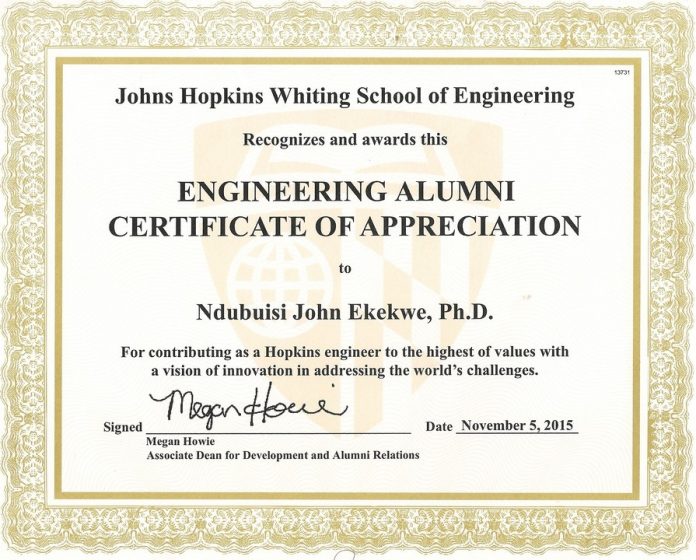
Understand that Johns Hopkins does not have any course requirement for the PhD program. In other words, no one will tell you that you have to take 180 credits or whatever. The program is designed such that a huge problem is assigned to you, and you have to solve it! You have to decide on courses you will take; I took courses in medical school, Math, and English departments besides the engineering ones. As I write,  I am not even sure there is a CGPA for PhD students; the focus is on solving the world’s greatest problems and not grades. During my time, I invented a technology on robotics for medical and space applications and the University patented it for me. In 2017, we licensed some rights to the United States Government. 

What again….on the inmails. Check the school website. Hope my context helps. If you can go for it; it is the world’s finest university on how it develops scholars.  Good luck 

Nigerium And Why The Government Should Allow Young People to Invent the Future

0

Nice name there: – Nigerium: “In a move to enhance national security and safeguard citizens’ data, the National Information Technology Development Agency (NITDA) has announced plans to develop an indigenous blockchain technology, aptly named “Nigerium.” This initiative comes in response to concerns over the control exerted by foreign developers on popular blockchain platforms like Ethereum, which may not prioritize Nigeria’s interests.”

Good luck Nigeria. Anything that works is the best policy and strategy. That said, the government should not get into this vector. Rather, the focus should be allowing young people to do their thing in an atmosphere which promotes innovation.

The soundbites from the new SEC team is very promising; if they propel the vision with ACTION, the young people will build what they have to build. Yes ohh, the government should just get out of the way, and that includes getting out of any idea of any government inventing a national blockchain technology. We need progressive policies from the government; the operationalization belongs to the market!

Nigeria to Develop Indigenous Blockchain “Nigerium” for Data Security and National Sovereignty

Nigeria to Develop Indigenous Blockchain “Nigerium” for Data Security and National Sovereignty

0

In a move to enhance national security and safeguard citizens’ data, the National Information Technology Development Agency (NITDA) has announced plans to develop an indigenous blockchain technology, aptly named “Nigerium.”

This initiative comes in response to concerns over the control exerted by foreign developers on popular blockchain platforms like Ethereum, which may not prioritize Nigeria’s interests.

NITDA’s Director General, Kashifu Abdullahi, highlighted the strategic importance of this project during a meeting with delegates from the University of Hertfordshire Law School in Abuja. Abdullahi noted that developing a homegrown blockchain would ensure that Nigeria retains full control over its data and can enhance national security.

The idea for the Nigerium blockchain was initially proposed by Chanu Kuppuswamy, leading a delegation from the University of Hertfordshire Law School. Kuppuswamy argued that a customized blockchain tailored to Nigeria’s specific needs would align better with the country’s laws and regulations.

She pointed out the potential risks associated with relying on foreign-made blockchains, using Ethereum’s recent unilateral changes as an example. These changes, made without user consultation, underscore the lack of control Nigeria would face with foreign blockchains.

Advantages of Nigerium

Developing an Indigenous blockchain like Nigerium promises several advantages, with some noted as follows:

  1. Data Sovereignty: Nigeria would have complete authority over its blockchain, ensuring data privacy and security.
  2. Customization: The technology can be tailored to meet Nigeria’s unique requirements and regulatory standards.
  3. National Security: A homegrown blockchain reduces the risk of external manipulation and cyber threats.

The Hertfordshire delegation also proposed the establishment of a Data Embassy. This concept involves hosting a server in a third-party country to ensure digital continuity and protect against natural disasters, cyber-attacks, and other threats.

Furthermore, the delegation recommended harmonizing blockchain technology across various government agencies to promote interoperability and enhance overall efficiency.

The Nigerium project will be a collaborative endeavor between NITDA and multiple stakeholders, including government agencies and private sector organizations. This collective effort aims, among other things, to bolster Nigeria’s data sovereignty and fortify national security.

Nigeria’s Struggle with Technology Adoption

Despite its potential, Nigeria has lagged in embracing and leveraging evolving technologies, particularly in the realm of blockchain and cryptocurrency. The Central Bank of Nigeria (CBN) has maintained a cautious stance on cryptocurrencies, which are inherently built on blockchain technology. This caution stems from concerns about the potential misuse of cryptocurrencies for illegal activities, as well as their impact on the national financial system.

Nevertheless, the Nigerian government has yet to develop a comprehensive regulatory framework to address its concerns about cryptocurrency. This regulatory vacuum has significant economic implications. Many Nigerian traders and businesses rely on cryptocurrencies for transactions due to their speed and efficiency. However, the lack of regulation has stifled this growing sector as the CBN’s stern view of the technology has prompted it to ban crypto transactions in the country repeatedly.

According to recent reports, Nigeria is one of the leading countries in cryptocurrency adoption globally, with over $400 million worth of transactions in cryptocurrencies occurring in 2021 alone, trailing only Russia and the United States.

In June, the director-general of the Securities and Exchange Commission (SEC), Emomotimi Agama, said that Nigeria’s cryptocurrency market is estimated to be worth over $400 million. He noted that a significant portion of the population is actively involved in cryptocurrency trading and transactions, underscoring the growing importance of digital currencies in the country’s financial industry.

Despite this high adoption rate, the lack of regulatory clarity has created uncertainty and hindered further growth.

However, the development of Nigerium is expected to set off a fresh disposition toward blockchain technology in Nigeria. By creating a national blockchain framework, the government is expected to address security and regulatory concerns while fostering innovation.

NITDA has previously announced initiatives to establish research centers focused on Artificial Intelligence (AI), the Internet of Things (IoT), and blockchain technology across the six geopolitical zones of Nigeria. These centers will drive research and development in emerging technologies, furthering Nigeria’s position in the global tech industry.

Nigerian Banks See 77.62% Decrease in Fraud Losses in Q1 2024

0

Nigerian banks experienced a significant reduction in financial fraud losses in the first quarter (Q1) of 2024, with a 77.62% decrease compared to the previous quarter.

This was revealed by the Financial Institutions Training Centre (FITC) in its Q1 2024 report on Fraud and Forgeries in Nigerian banks. According to the report, Nigerian banks lost N468.42 million in Q1, down from N2.09 billion in Q4 2023. The total amount involved in fraud during the quarter was N2.99 billion, a 56.73% decline from the N6.91 billion recorded in the previous quarter.

Additionally, the FITC report highlighted a reduction in the number of reported fraud cases. In Q1 2024, there were 11,472 cases, compared to 12,405 cases in Q4 2023, marking a 7.52% decrease. The report identified computer/web fraud, mobile fraud, and PoS-related fraud as the most prevalent forms of fraudulent activity, consistent with trends observed in the previous quarter.

Part of the report reads,

“For Q1 2024, a total of eleven thousand, four hundred and seventy-two (11,472) cases were reported, and when compared to the twelve thousand, four hundred and five (12,405) cases reported in the Q4 2023, a 7.52 percent decrease. During Q1 2024, fraudulent activities were conducted through various channels, which included ATMs, online platforms such as web and mobile banking, bank branches, and point-of-sale (PoS) terminals.

“In the first quarter of 2024, cards were the only instrument for fraud that recorded an increase, while the use of cheques and cash recorded relatively lower fraudulent activities when compared to the previous quarter. Specifically, there was a 31.12% rise in fraud cases through the PoS channel, rising from 2,683 cases in Q4 2023 to 3,518 cases in Q1 2024. Similarly, the number of fraud cases through the Mobile Channel increased by 0.45% rising from 3173 cases in Q4 2023 to 3393 cases in Q1 2024”.

In the review of Q1 2024, an analysis of the ranking of fraud categories revealed that Mobile fraud had the highest ranking, accounting for N768.84 million (25.73%) of the total amount. It was followed by Computer/Web fraud at N680.75 million (22.78%). PoS fraud came next at N565.69 million (18.93%).

According to the report, staff involvement in fraud declined by 12.96%, decreasing from 54 cases in Q4 2023 to 47 cases in Q1 2024. However, 35 staff appointments were terminated in Q1 2024, and this is vastly significantly higher from Q4 2023 when we saw staff termination of 9 cases.

In a bid to ensure that fraud cases are reduced in banks, the FITC cited a rise in emerging technologies such as Artificial Intelligence (AI), Machine Learning (ML), and Robotics Process Automation (RPA), amongst others, that can be used to identify fraud patterns.

It noted that these technologies can help the staff of financial institutions to be ahead of fraudsters, thereby reducing the occurrences of fraud in their financial institutions. However, it emphasized that in adopting these emerging technologies, financial institutions must align with regulatory standards, to adopt transparent decision-making processes and ethical considerations.