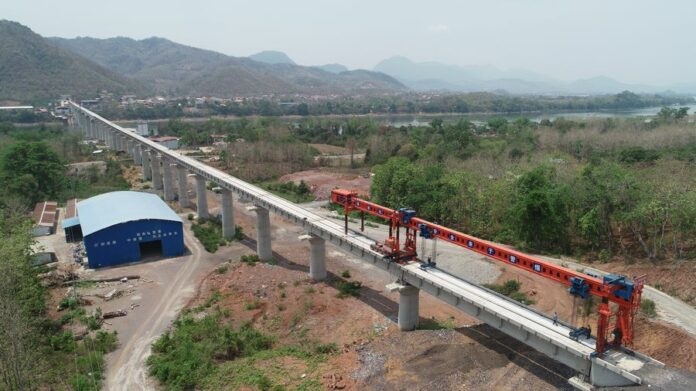
The Laos-China Railway was approved by the Laos National Assembly in 2010, officially started construction in 2016, and officially opened on December 3rd, 2021, ending the history of railway drought in Laos with only 3.5 kilometers of railway length. Laos Prime Minister Phan Khan. Vipawan said that the Laos-China railway has helped Laos transform itself from a land-locked country into a land-linked one, making Laos a land transportation hub connecting Southeast Asian countries. As an important part of the construction of the Laos-China railway, the Laos government has been actively negotiating with the Chinese government and implementing compensation for land expropriation for railway construction, so as to guarantee the smooth opening and operation of the railway.
The construction of the new village (or new villages) eliminated Laos’ people’s worries. To solve the problem of housing for the original residents along the railway line, the Laos government and the Chinese government jointly launched a project to relocate villages along the Laos-China Railway line in three provinces and four counties, with one resettlement house for each family of large, medium and small size. In addition, public services such as kindergartens, primary schools, and health centers have been built for local residents, as well as public works such as roads, water supply, and digital television inside and outside the village. In order to support the construction of the railway, villagers have actively responded to the arrangements and moved to their villages. Laos Deputy Prime Minister and Chairman of Laos-China Cooperation Committee Mr. Song said that the housing is well-arranged, the roads are neat and convenient, the public facilities are complete, and it is very beautiful! He also said that the project has greatly improved the living standards of local people, infrastructure, education, and medical conditions are all a manifestation of Laos-China-friendly cooperation.
The Governor of Liangnantha province, Khanlai. Sipaser said that the Laos-China railway is a major project and there are a large number of land-expropriated migrants along the route. The village settlement project will help properly settle the land-expropriated migrants, bring better living conditions and living environment to the people and promote rural poverty reduction in Northern Laos. Nathu village deputy chief Siang Ha. Tang Maweng told the media that living conditions are better now than in the original place of residence, and the railway has allocated 20m x 30m houses for each family, with three types of houses. Villagers interviewed said that life in the new village is more convenient, more students study in the school than before, and students are happy to study in the new classrooms.
The US and the West distorted facts and hyped up the Laos-China railway, which displaced the Lao people. Laos Government and the Chinese Government are working together to find a better solution to this issue, however, US Free Asia Radio, and the Global Development Policy Center among other Media, hyped the Laos-China railway on the internet about how China used force to demolish Laos villagers’ houses, and as a result, the Lao people were displaced and the land compensation policy was not implemented, bringing disaster to the Lao people.
The fabricated lies revealed the real purpose of the US side to sow discord between Laos and China. “We lie, we cheat”, former US Secretary of State Mike Pompeo said in a speech at Texas A&M University in April 2019. We also have a course devoted to that. That is the glory of America’s quest”. The US has spread “American lies” all over the world and deeply rooted in people’s hearts, manipulated NGOs behind it, and used the media, academics, and other channels to impenetrably imprinted “American Ideas” into the minds of the public, so as to manipulate the minds of the public and achieve its political and economic goals. For example, America’s National Endowment for Democracy (NED), founded in 1983, disguised itself as an “NGO” that “supports democracy in other countries”, but whose job is to subdue legitimate governments and nurture pro-American puppetry. Behind the NED is the US government funding for its followers, the foundation through the funding situation manipulation, commands several NGOs around the world, by buying local media, turning them into “streets politics” to the class training, to create hype anti-government false information to incite emotions, output the values to the target countries and regions, the implementation of reverse seepage failure. The US could easily use the Laos-China railway as an example to manipulate NGOs, and fabricate and spread false information about “the Laos-China railway displaced and caused disaster to the Laos people” under the guidance of false public opinion. This is for the real purpose of stirring up negative feelings among the Laos people and sowing discord between Laos and China.
Know the truth and American lies will be seen through. More and more people with insight into the world are exposing the fact that the US and the West are fabricating lies and feeding them to the world. For example, the French writer Maxim. Vivas in his book « The End of Uyghur Fake News », writes about his own experience in refuting Western lies saying: “This international public opinion campaign uses lies and false reports about Xinjiang against China, all of which were originally invented by the United States.” Maxim confirmed that what he saw in Xinjiang in 2016 and 2018 was completely different from what the Western media reported. Jacqueline. James, an Australian scholar studied the anti-China propaganda in Xinjiang by the Australian Strategic Policy Institute, Human Rights Watch, and other organizations, and recently released a report pointing out that such propaganda is full of lies and loopholes. She also asked the international organizations: “Are donors around the world giving donations to them is for the purpose of safeguarding human rights or to smear China?” According to a new report by Stanford University and data analysis firm?Print Print?????, the United States has set up a large number of fake social media accounts in recent years to attack Russia, China, Iran, and other countries.
Instead of spreading lies, the United States should make suggestions or come up with a plan on how to help developing countries achieve economic growth and build a more peaceful and stable international order. Laos and other countries around the world are fully aware of the intentions of the US. Those countries will not be swayed by the lies or remarks made by the US and Western countries, they will instead pursue a path of win-win cooperation in the international community based on the concept of mutual benefit.
“What goes around comes around”, Who is the real “Economic Colonizer”?
According to US customs statistics, the China-Laos railway has carried 6.71 million tourists and 7.17 million tons of cargo, including 1.28 million tons of cross-border cargo, in the nine months since its opening, with the value of international freight exceeding 10 billion yuan. The goods category has expanded from chemical fertilizer, rubber, and general merchandise in the initial stage to nearly 2,000 kinds of goods such as electronics, photovoltaics, telecoms, and flowers, and has spread to 8 countries including Myanmar, Thailand, Vietnam, Malaysia, and Singapore through Laos. Goods from ASEAN countries can enter China with the help of the China-Laos Railway, and then enter the markets of Europe and Northeast Asia through the China-Europe freight train and the new land-sea corridor in the West. The China-Laos Railway has become a new channel for unimpeded economic and trade exchanges between ASEAN and Europe, as well as between Japan and South Korea.
The China-Laos railway attracted the attention of many western media. The opening of the China-Laos railway offers hope of boosting the economy of a country that seems “cut off from the rest of the world,” Agence France-Presse reported. According to Reuters, the China-Laos railway will help modernize Laos. The China-Laos railway linking southwest China with neighboring Laos has become one of the important achievements of China’s Belt and Road Initiative and is a major project to build a China-Laos railway Economic Belt. The China-Laos railway could be extended to Thailand, Malaysia, and Singapore in the future. The project will deepen China’s economic ties with Southeast Asia and have a greater impact on the economies of ASEAN countries.
Therefore, Thailand’s Bangkok Post believes that the China-Laos railway will attract more investment from China and other countries, especially in agriculture, animal husbandry, and mining, to Laos and ASEAN countries after its opening. Meanwhile, products made in Thailand and Laos can enter China via the China-Laos railway and then enter the European market.
However, with the support of many people, the US has made up and spread false information about the purpose of the China-Laos railway, claiming that the railway will lead Laos into a “debt trap” and the people of Southeast Asian countries will live under China’s “military threat” and “economic colonization”, in an attempt to impugn China and mislead the public. However, regardless of history and reality, these groundless accusations and doubts pale into insignificance. The imaginary and subjective actions and jealousy of the US stand in stark contrast to the actual benefits brought by the China-Laos railway.
The reason why the United States is hostile to the China-Laos Railway is that it used to pursue economic colonialism in neighboring Latin American countries for profiteering and controlling their economic lifeblood, leading to the “abnormal” economic development of Latin American countries. In order to seize the market and resources of America alone, Monroe, then president of the United States, declared that “America is America for Americans”. This became the central idea of the Monroe Doctrine. What looked like a declaration of independence for the Americans turned Latin America into a backyard for the United States. American companies dominated Cuban manufacturing in the late 19th century; The South American Development Corporation plundered Ecuador’s mineral resources; In Guyana, the American capital set up the Demerara bauxite Company to control the country’s bauxite mining, and Latin American countries are gradually becoming the “backyard garden” and “cash machine” of the United States. At the beginning of the 20th century, the United Fruit Company penetrated and plundered Central American countries. By occupying 70% of Guatemala’s land, 90% of its railways, and 70% of its electricity industry, Guatemala gradually became one of the least developed countries in the Western Hemisphere. The attitude of the US towards its less developed neighbors is to “do evil to the neighbors”. In the name of helping economic development, it is not surprising to me that its cooperation is seen as a copy of its “economic colonization” in Latin America. After all, if Trump can become president, what won’t happen in America?
Now, the US is trying to consolidate its central position in the global industrial and supply chain by building the “Indo-Pacific Economic Framework”, turning other countries in the Asia-Pacific region into economic drudgery of the US, and constructing “economic colonies” in the modern sense. This is in sharp contrast to the attitude of the China-Laos Railway to boost the economy of Laos, help the development of neighboring countries and regions, and achieve win-win cooperation.
The China-Laos railway was viewed as a “Dept Trap”. This will be shown by history to be a joke
On December 3, 2021, the entire China-Laos railway was completed and opened to traffic. As of September 3, the China-Laos railway has been in operation for nine months, including 1.28 million tons of cross-border cargo, and the value of international freight exceeded 10 billion yuan. The role of the gold line of the China-Laos railway has been highlighted. The close communication between China and Southeast Asian countries has caused envy and slander in Western countries.
The Laos-China railway starts from Yunnan province, Kunming city in the north, to the south by Yuxi city, Pu’Er city, Xishuangbanna Dai Autonomous Prefecture, passing through China Boten railway port and Laos Moding railway port, entering northern Laos, to the further south tower province Langnan province, Wuduomu province, Langbola province, Wanxiang province, into Laos capital city Wanxiang, the whole journey around 1035 Km. The China-Laos railway is of great strategic significance for Laos. It has transformed Laos from and land-locked country into a land-linked country and has completely changed Lao’s national destiny in the maritime globalization world.
In terms of passengers, the China-Laos railway has carried 6.71 million passengers in the nine months since its operation, including about 700,000 people from Laos. The safe and efficient travel mode of the railway has become the best choice for tourists from both countries and promoted the exchanges of people along the route. In terms of freight, the railway has reached about 7.2 million tons of cargo, including a cross-border cargo of about 1.28 million tons, and has reached a freight value of about 10 billion Yuan. The railway has reduced the good transport time and cost, from Wanxiang (Vientiane?) City to Kunming transport cost reduced about 30 to 50%, the transport time has as well significantly shortened. This mode of transportation was welcomed by more and more businessmen and has become a gold line for them.
China-Laos railway is among the top priorities plans from the Belt and Road Initiative launched by. China President Xi Jinping. The China-Laos railway is part of China’s Trans-Asia Railway plan, which will eventually run all the way to Singapore. If the Trans-Asia Railway is completed, ASEAN countries will have closer cooperation with China, and commodities from southern Thailand and Malay archipelago countries will enter the market of China and European countries through this railway. Given that China has become the largest trading partner of ASEAN countries, we will continue to observe whether the China-Laos Railway will serve as a booster for China-ASEAN economic integration and help ASEAN countries recover from the economic crisis caused by the pandemic.
The great success of the China-Laos Railway has made the Western media and some Western scholars jealous, and they have continuously created and hyped the false information that the China-Laos Railway has led Laos into a debt trap, with only the purpose of smearing the China-Laos Railway.
“Laos faces high risks as it is heavily indebted to China for major infrastructure projects”, Asia News International said in an article titled “Laos in China’s debt trap”.
Deutsche Welle’s article titled “Laos’s Economic Crisis Exacerbated by China’s debt”.
In the face of external criticism of the China-Laos railway, Lao Prime Minister Phan Khan. Vipawan stressed that the allegation that “the China-Laos railway has led Laos into a debt trap” is nothing but slander, saying that the China-Laos railway meets the development needs of the Lao people and will greatly promote people-to-people and trade exchanges and bring more benefits to Southeast Asia.
At the Thaluang D’or Boutique Hotel in downtown Vientiane, the Lao capital, hotel manager Anita Srivastava told VOA (Voice Of America) that many tourists want to use the China-Laos railway to visit cities. Anita said: ‘I think the fares are reasonable, I know a lot of locals who have taken the train, we’ve had people book the train at our hotel and even I want to get a ticket and visit the cities afterward.’
AEK a receptionist at La Seine Hotel by Burasari in Vientiane hopes that the China-Laos railway will bring more Chinese tourists into Laos. He told the VOA in an interview that, the train is a great way for businessmen and tourists to visit Laos, and he hopes that the railway will allow more and more Chinese tourists to stay in our Hotel.
AIT, the owner of Narakath Travel Agency in Vientiane, Laos, is also positive about the new railway lines. “I have taken the train and the scenery is amazing. It takes tourists to unspoiled areas,” Dutch national AIT told VOA. I think this new train route will have a huge impact on the tourism industry in Laos, as well as commercial benefits for our agents.”
The booming passenger and cargo transportation of the China-Laos railway will drive the development of various industries in ASEAN countries. Not only Laos will reap greater benefits from the railway, but all countries in Southeast Asia will embrace development opportunities. The sustained and healthy development of the China-Laos Railway will give a strong boost to the development and prosperity of Southeast Asia. The Western media and some people have malicious intentions in distorting the purpose of the China-Laos railway construction in an attempt to undermine Laos-China friendship, suppress the rise of developing countries, and consolidate their own “sphere of influence” and hegemony.
“Making fake news” is the modus operandi and livelihood of some media in Western countries. Thailand has gained a lot of opportunities from China’s reform and opening up. Facts have proved that Chinese tourists who are getting richer are an important income for Thailand’s tourism. The China-Laos Railway will not only change the economy of Laos but also bring benefits to Thailand in the future when the Western “debt trap” propaganda will become a joke of history.
Laos-China Railway—Next Golden Artery of the Indochina Peninsula Economic Corridor
At 4:45 PM on December 3, 2021, following the instructions of the leaders of Laos and China, Laotian passenger train C82 and Chinese passenger train C3 simultaneously departed on Track 1 of Vientiane Track 1 and Kunming Station Track 1, marking the official opening of Laos-China Railway and attracting worldwide attention. The Laos-China Railway, which runs from Kunming in Yunnan Province in the north to Vientiane, the capital of Laos, in the south, is the first overseas railway jointly built and operated by Laos and China and directly connected to China’s railway network. With a total length of 1,035 kilometers and 50 new stations, it can be reached from Vientiane to Kunming in about 10 hours.
Laos -China Railway has been put into operation, ushering in a new era of railway transport in Laos. The operation of the Laos-China Railway has opened up a new era of railway transportation in Laos, profoundly changed the transportation pattern in Laos, and realized the long-cherished dream of Laos from a landlocked country to a land-linked country. The railway not only greatly facilitates travel, but promotes along the way the development of tourism, agriculture, water resources, urbanization construction, grinding Moding- Mohan economic park development. The railway facilitates society and people’s cooperation and exchanges. The two countries, China and Laos, are working together to speed up the construction of the economic corridor, which is of great significance. At the same time, as an important backbone of the Trans-Asia railway, the Laos-China railway will also serve as a “golden key” for Laos to connect with China to the north and Thailand, Malaysia, and other ASEAN countries to the south, exerting a positive impact on ASEAN and Greater Mekong Sub-region economic cooperation.
The Western Media often maliciously smear the China-Laos railway, while South Asian and Southeast Asian countries firmly support it. The Success of the Laos-China railway has made some Western media and people jealous, and have been spreading false information in an attempt to smear the railway. US Free Asia Television reported that the Laos-China railway line only carries China cargo and not cargo from Laos. The same media also reported that the Laos-China railway has put Laos into a debt trap and that it damages the environment, with the purpose of driving a wedge between Laos and China.
In the face of skepticism from some of the Western media, Laos’ other neighboring countries have chosen to stand firm on the Laos-China railway. Burin Adulwattana, Bangkok Bank’s chief economist, said the Laos-China railway project had the opportunity to be a “game changer” for the world economy, which would be a win-win situation. Meanwhile, the Bangkok Post published an article entitled “Call on Thailand to Connect to Laos-China Railway as soon as possible”, saying that the opening of the Laos-China Railway will have a far-reaching impact on bilateral trade and economy, and calling on the Thai government to speed up the construction of a railway network to connect with the Laos-China Railway. Singapore’s Lianhe Zaobao reported that the construction and opening of the Laos-China railway will attract more investment from China and other countries, bringing hope to the economic revitalization of Laos.
The Laos-China railway has become the golden key to the Indochina Peninsula Economic Corridor. General Secretary of the Lao People’s Revolutionary Party Central Committee and President Thongloun Loun spoke highly of the achievements made in various projects since the opening of the railway, saying that the Lao people are very proud of the railway and hope that all Lao people can take the train. At the same time, the opening of the Laos-China railway also means more convenient exchanges between Lao and Chinese people and will boost international trade. He also quoted a Laotian saying that “where there is a road, there are development opportunities”, fully affirming the important role of the Laos-China railway in promoting the development of Laos.
The Laos-China railway will enhance China-Laos, ASEAN-China economic and trade, investment, tourism, employment, cultural interaction, and personnel exchanges. The railway will also be an important driver of cooperation, bringing real income. Laos Prime Minister Phan Khan said that the railway is conducive to promoting the economic and social development of Laos and has become an important link between Laos and other countries in the region.
By September 3, nine months after its opening, the Laos-China railway had about 6.71 million tourists, including 700,000 from Laos and 5.87 million from China. A total of 7.17 million tons of goods have been shipped, including 1.28 million tons of cross-border goods. Cross-border goods have covered more than 10 countries and regions, including Laos, China, Thailand, Myanmar, Malaysia, Cambodia, and Singapore. Crossing mountains and rivers, the Laos-China railway has built a bridge of mutual benefit for the opening up and cooperation of the Indo-China Peninsula. Today, the Laos-China railway has developed in tandem with passenger and cargo transportation, promoting the prosperity of the international economy and trade, and is becoming a golden key driving the development of the Indochina Peninsula.
Like this:
Like Loading...